Powering Progress · Lesson 16 · 8 min read
Leave the Operation Stronger: Restore Safeguards, Close Risks and Hand Over the Real Condition
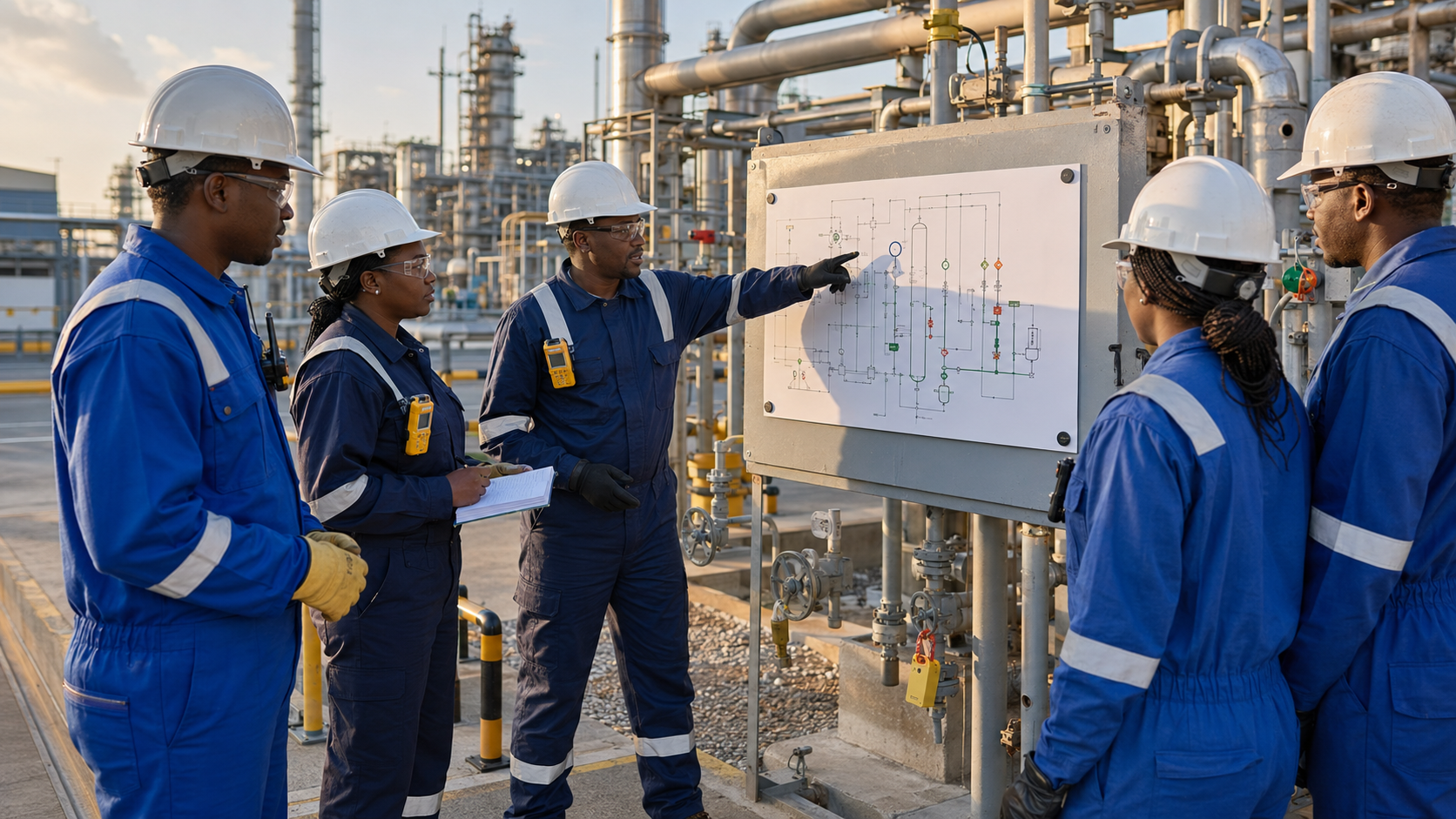
Work is complete only when safeguards are restored, residual risks are visible and the receiving team understands the condition it inherits.
Completion should improve the operating condition
Maintenance, projects, testing and abnormal operations can temporarily remove guards, bypass trips, disturb containment, change line-ups or create additional monitoring. The immediate task may finish while these temporary conditions remain. Progress is not complete until the plant is returned to an understood and authorised state.
Leaving the operation stronger means more than returning production. It means confirming that safeguards, documentation, housekeeping, environmental controls and ownership are at least as clear and effective as they were before the work—and improved where the job revealed weakness.
Restore deliberately, not by assumption
Use an approved reinstatement sequence. Confirm equipment identity, mechanical completion, removal of tools and temporary materials, correct valve and electrical line-up, guards, drains, alarms, trips, fire protection and other affected barriers. Perform required leak, function and proof tests before declaring availability.
Temporary changes need explicit closure. Check bypass, override, inhibition, jumper, scaffold, temporary hose and software registers. If something cannot be restored, assess and authorise the residual condition, establish restrictions and give it a named restoration owner.
Hand over risk, reasoning and next triggers
A handover should state what work was done, what changed, what remains incomplete and how the equipment behaved on return. Include abnormal readings, temporary controls, monitoring requirements and the condition that will require escalation or shutdown.
The receiving team should verify understanding through questions and read-back where appropriate. Documents support the conversation but do not replace it. A list of closed permits cannot explain every residual risk or why a particular restriction remains.
Use closeout to create future resilience
Capture defects, access issues, procedure gaps and successful improvements discovered during the job. Assign them through the appropriate process and confirm they do not disappear when the temporary work team demobilises.
- Verify every affected safeguard and temporary arrangement.
- Authorise and own any residual risk that cannot be removed.
- Transfer the condition, consequence and next decision trigger.
- Convert job learning into permanent operational improvement.
Team discussion
For the most recent completed job, what evidence shows that all safeguards were restored and the receiving shift understood every remaining risk?
Editorial note: This independent Worksite Safety Hub article provides general learning and does not replace site reinstatement, permit or handover requirements.
Daily HSSE updates
Subscribe for practical HSSE updates.
Subscribe for the daily message, selected HSSE news and occasional new-resource alerts from Worksite Safety Hub.