
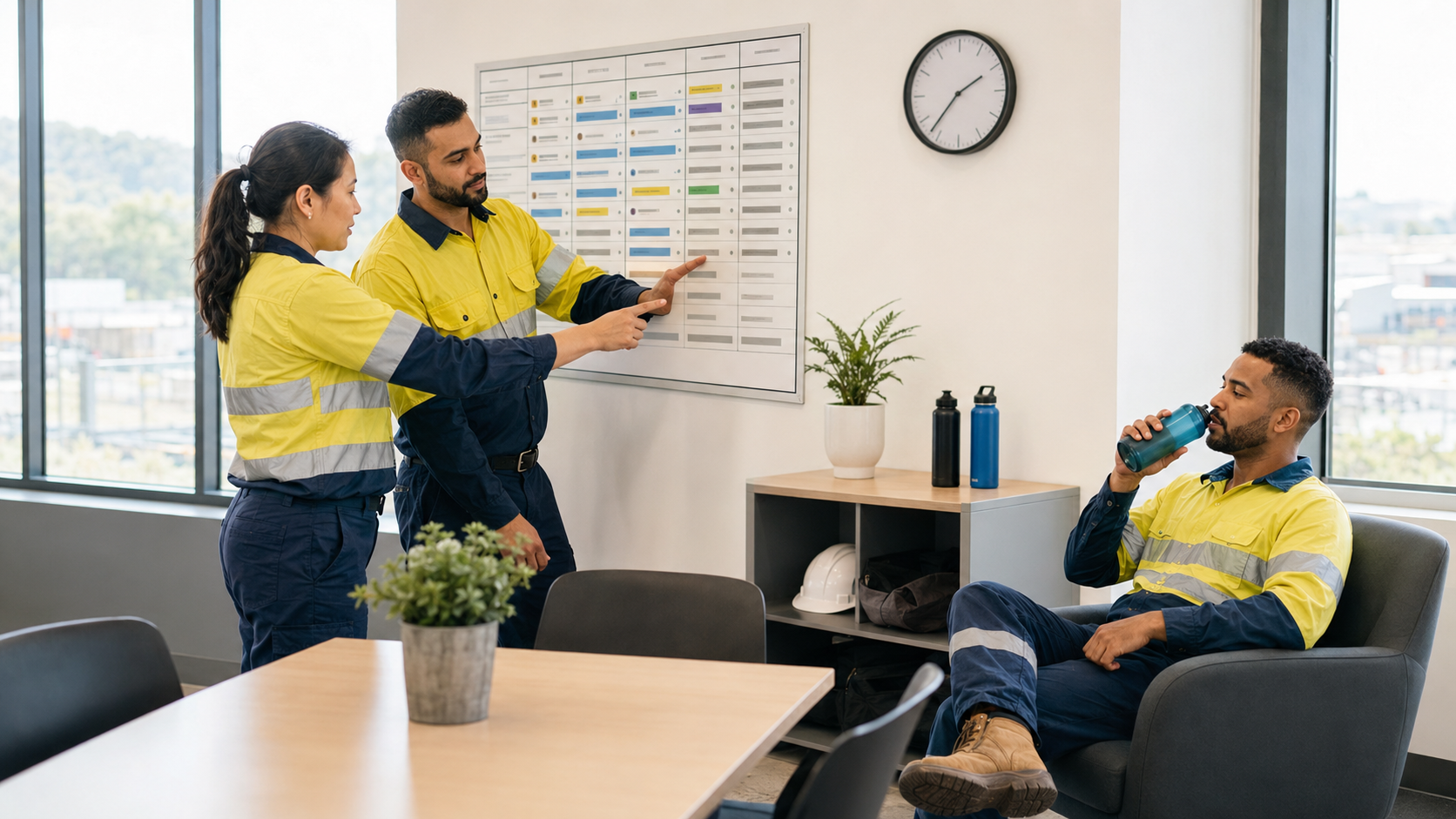
Fatigue changes how work is performed
Fatigue is more than feeling sleepy. It can slow reactions, narrow attention, weaken short-term memory and make a familiar shortcut feel reasonable. In a control room, vehicle, workshop or permit office, those effects may appear as a missed trend, an incomplete handover, a repeated instruction or a decision made without checking the changing conditions.
The risk is often hardest to see in experienced teams. Familiarity can help people compensate for a while, but it can also hide deteriorating performance behind routine language and confidence. A worker may still look composed, complete basic tasks and underestimate how much alertness has fallen. That is why fatigue should be managed as an operational hazard rather than left to individual willpower.
Work design creates or reduces fatigue risk
Sleep away from work matters, but the organisation also shapes exposure through shift timing, duration, rotation, overtime, workload, travel and recovery opportunities. Consecutive night shifts, short changeovers, long commutes and unplanned extensions can combine even when each item appears acceptable by itself. Demanding weather, heat, vibration, noise and monotonous monitoring can add to the burden.
Build fatigue review into planning rather than waiting for someone to struggle. Examine the complete sequence from travel to pre-shift preparation, work, handover and the journey home. Look for cumulative hours and circadian lows, not only one long shift. A schedule that meets a numerical limit can still be poorly arranged for the actual task and workforce.
Critical tasks need stronger barriers
Not every hour carries the same consequence. Startup, shutdown, simultaneous operations, emergency response, isolation changes, lifting, driving and troubleshooting can demand sustained attention and rapid judgement. Identify these periods during planning and avoid placing the most complex or irreversible decisions at predictable low-alertness points where reasonably practicable.
When fatigue exposure cannot be eliminated, strengthen verification. Use structured handovers, independent checks for high-consequence actions, clear operating limits and deliberate pauses before unfamiliar or changing work. These controls support alert people too; under fatigue they become especially important because memory and self-checking are less reliable.
Make reporting safe and useful
A reporting process fails if speaking up is treated as poor attitude or lack of toughness. Workers need a practical way to declare that they may not be fit for a task without being pushed to diagnose themselves or disclose private medical information to the whole team. Supervisors should know what immediate options are available and when occupational-health support is needed.
Respond to the risk, not the reputation of the person. A temporary reassignment, additional competent support, controlled rest, transport arrangement or relief may be appropriate depending on the site procedure and circumstances. If fatigue is persistent, unusual or associated with illness, medication or a sleep disorder, assessment belongs with a qualified health professional.
Do not confuse stimulation with recovery
Caffeine, bright light, conversation and movement may briefly improve alertness, but they do not replace sleep. Their effects vary, can wear off at the wrong time and may interfere with later recovery. Opening a window or turning up music is not a dependable control for a fatigued driver or an operator making a critical decision.
Use temporary alertness measures only within the approved fatigue plan, never as permission to extend unsafe work. If a person is struggling to stay awake, making repeated errors or losing situational awareness, stop the exposure and arrange safe relief. The journey after the shift must be considered too; reaching the gate does not end the risk.
Supervisors should look for system signals
Patterns reveal more than isolated mistakes. Review overtime, call-outs, shift swaps, travel delays, workload peaks, repeated rework, near misses and reports of poor recovery. Compare these signals with when demanding tasks occur. Protect confidentiality, but do not allow the absence of medical details to prevent correction of an obviously fatigue-promoting schedule.
After an event, ask how hours, timing, workload and recovery affected performance without assuming fatigue was either the sole cause or irrelevant. This produces better learning than labelling a worker careless. Corrective action may need changes to staffing, planning, accommodation, transport, supervision or task design—not another reminder to ‘stay alert.’
A practical fatigue-risk check for today
Choose one safety-critical task planned during a night shift, extended shift or early-morning period. Review the people, schedule, workload, travel and recovery conditions together, then confirm what will happen if alertness falls. The plan should protect the individual and operation without relying on embarrassment, caffeine or heroic effort.
- Identify the highest-consequence decisions and their planned timing.
- Check recent hours, overtime, call-outs, travel and recovery opportunity.
- Confirm competent relief, independent verification and stop-work arrangements.
- Make the confidential reporting and occupational-health route easy to find.
- Plan a safe journey or accommodation option after the shift.
Fatigue is controlled best when work is designed for human limits, high-consequence actions have dependable checks and people can report reduced alertness before it becomes an incident.
Visitor comments
0 recent commentsNo comments yet. Be the first to share a constructive safety reflection.