HSSE TIPS · Product Reviews · Mobile Oral Healthcare
Mercedes-Benz Sprinter Mobile Dental Clinic Review: Equipment, Specifications & Buying Guide
Affiliate Disclosure: Worksite Safety Hub may earn a commission if you make a qualifying purchase through links in this article. This does not change the price you pay.
Introduction — Bringing Professional Dental Care Beyond Traditional Clinics
A dental outreach programme needs more than a vehicle that can reach the community. The working space must accommodate the patient and dental team, while air, water, suction and electrical systems support the selected equipment. Instrument processing, accessibility and servicing determine whether a promising mobile layout fits the service being planned.
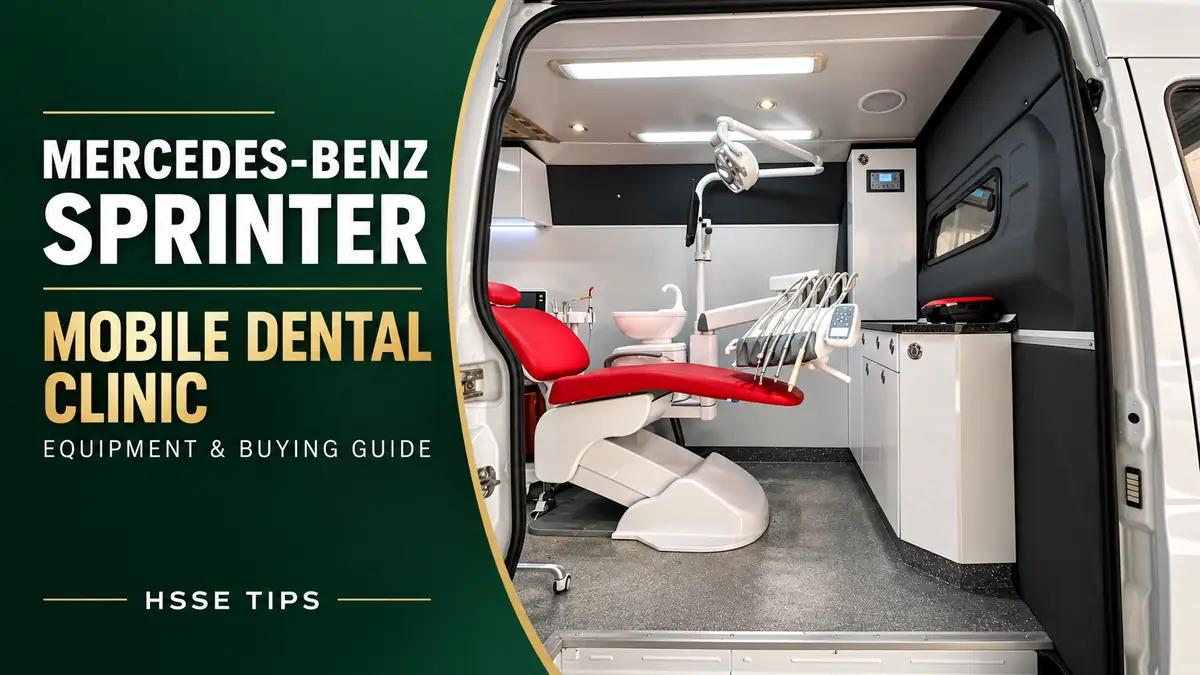
The advertised Mercedes-Benz Sprinter Mobile Dental Clinic makes its purpose clear in the original photographs: a red reclining dental chair, articulated delivery unit, operating light and compact cabinetry occupy a converted van. Further images reveal a sink, compressor and stored generator. This review examines that photographed configuration, distinguishing it from the larger dental-container designs also described in the seller’s material. It is a documentary buying assessment, not a clinical inspection or road test.
EXPLORE THE MERCEDES-BENZ MOBILE DENTAL CLINIC
Mercedes-Benz Sprinter Mobile Dental Clinic Overview
Autoline VN35862 advertises a new Mercedes-Benz Sprinter Dental Clinic. AmbulanceMed identifies itself as the producer in the description, and its branding appears inside the photographed conversion. The gallery and attached ten-page catalogue show the same red-chair van interior, with treatment space near the cab and worktops extending towards the rear doors.
The marketplace classifies the product under ambulances, but the evidence supports a mobile dental facility. A stretcher transport configuration, emergency warning package or combined patient-transport role has not been established. Buyers should specify dental-service approval separately from any ambulance registration they may require.

Understanding the Mercedes-Benz Sprinter Platform
The Sprinter designation identifies the advertised vehicle family, without proving a 315, 316, 319, 419 or another derivative. Neither a readable VIN nor a manufacturer build sheet was available. The conversion photographs show a panel-van interior rather than a separate rectangular medical container.
Mercedes-Benz’s official Body and Equipment Guidelines explain the technical limitations relevant to equipment installation. For this purchase, the converter should identify the applicable chassis series, market and guideline edition, then document the chair anchorage, added electrical systems and weight distribution. Do not substitute specifications from another Sprinter ambulance simply because its body looks similar.
Engine, Transmission and Drivetrain
The listing records a four-cylinder diesel, 2,143 cm³ displacement, 195 HP / 143 kW and Euro 6. These are seller-entered specifications, not a verified engine identity. They need reconciliation with the offered chassis records before a buyer selects maintenance parts or evaluates destination emissions compliance.
Six gears are listed, while AmbulanceMed’s related van-type page describes a manual configuration. The unit-specific gearbox type, engine code, torque and driven-wheel arrangement remain unconfirmed. Obtain the build sheet and transmission identification. No fuel economy, range or performance figure is adopted here without a documented basis for the completed vehicle.
Chassis, Dimensions and Gross Vehicle Weight
The seller’s dimensional and weight entries need a completed-vehicle measurement sheet. In particular, the recorded 1.4 m overall width and 2 m height should not be treated as validated external clearance dimensions. The technical description also discusses a heavier chassis-based design, so its capacity assumptions cannot automatically define this van.
Wheelbase, axle limits and remaining payload must come from chassis plates and weighing records. Include the chair, cabinets, generator, compressor, fluids, instruments and travelling staff in the loading assessment. The dental chair and wheeled stools are treatment furniture; approved travel seating and restraints require separate documentation.
Dental Clinic Conversion and Exterior Design
The sliding-door photograph shows a white van body, a substantial entry threshold and a dark partition behind the driving cab. Internally, white cabinets, dark worktops, overhead lockers and a grey speckled floor form the clinical workspace. No full front, rear exterior or driver-cabin view was available for independent configuration checks.
AmbulanceMed’s general container literature describes particular construction layers and an X-ray section. Those statements should not replace a materials schedule for this photographed van. Request the actual flooring, wall finishes, insulation and mounting details, together with cleaning-product compatibility and access for utility maintenance.
Dental Treatment Area and Interior Layout
The chair occupies the forward treatment area, beside the open side entrance. A monitor and operating light are positioned above it. Worktops run along the rear portion of the vehicle, with a sink on one side and cabinets and equipment on both sides. Rear doors remain visible at the end of the aisle.
This arrangement is worth assessing through a working demonstration. Have the intended dentist and assistant check access to the patient, chair movement, instrument reach and circulation around seated staff. Confirm that cabinet doors, service panels and emergency exits remain accessible in the operating configuration. No measured internal clearance or wheelchair access route was verified.

Dental Chair, Delivery Unit and Instruments
A red-upholstered chair, headrest, armrests, white base, multi-hose delivery unit, cuspidor and articulated dental light are clearly photographed. A red wheeled stool and Philips-branded display are also visible. The display’s presence does not establish dental imaging capability, and the chair’s exact manufacturer, model and rated patient load are not readable.
The attached van catalogue describes adjustable chair functions and several instrument modules. Treat these as configuration information pending a model-specific equipment schedule. Ask which handpieces, scaler, curing light and accessories are actually supplied, with serial numbers, instructions and service support. No verified intraoral camera or radiographic device inventory was found.

DISCOVER THE DENTAL EQUIPMENT & FACILITIES
Compressor, Suction and Dental Utility Systems
An open cabinet photograph shows a compressor assembly with receiver, pressure gauges, regulator/filter components and connected tubing. Its nameplate is not sufficiently clear to establish reliable performance data. Do not infer oil-free air quality, dryer specification, air delivery or suitability for the intended handpieces from appearance alone.
The delivery unit includes fluid-handling fittings, but the suction pump’s model and capacity are not established. Request a utility diagram covering air treatment, moisture management, suction, waste collection and chair connections. Acceptance should include the equipment supplier’s operating checks under the agreed workload, plus accessible servicing and replacement filters.

Sterilization and Infection Prevention Facilities
The sink, worktops and storage provide infrastructure for a clinical workflow, but do not prove a validated instrument-processing arrangement. Although the wider dental-container description mentions an autoclave, no clearly identified autoclave was verified in this van’s gallery or catalogue. Specify whether instruments will be processed onboard or through an authorized support facility.
CDC dental guidance emphasizes trained personnel, manufacturer reprocessing instructions and a defined sequence for reusable instruments. Procurement should therefore cover the full cleaning-to-storage workflow, suitable equipment, monitoring and records. A sterilizer purchase alone would not establish the complete process. Keep clean supplies and contaminated instruments appropriately separated in the agreed layout.
Electrical Power and Backup Systems
A portable generator marked DTS Power appears beneath a worktop. The attached catalogue describes a 3 kVA generator as part of its van configuration, but the photographed generator’s rating, frequency and output are not independently established. A stored generator is not proof of a commissioned onboard power system.
Require the electrical designer’s approved operating location, exhaust and ventilation arrangements, protection scheme and load schedule. Confirm supply voltage from equipment nameplates rather than relying on the catalogue’s ambiguous “220w” wording. Identify external supply connections, earthing and changeover provisions, together with any separately quoted inverter or batteries. Backup runtime is unverified.
Water Supply, Sanitation and Waste Management
The photographs show a stainless-steel sink and tap; the van catalogue describes hot and cold water with a pressure-pump arrangement. Freshwater and wastewater tank sizes, fill points, drainage and dental-chair water connections still require a unit-specific plumbing diagram. A toilet has not been verified.
CDC guidance makes clear that an independent water bottle alone does not establish acceptable dental water quality. Obtain the dental unit manufacturer’s treatment, monitoring and maintenance instructions. Include storage between deployments, replenishment and approved wastewater and clinical-waste disposal in the service plan. No tank capacity or number of patients per fill can be calculated from the available evidence.

Heating, Ventilation and Air Conditioning
A ceiling-mounted air-distribution unit, overhead lighting and under-locker illumination appear in the gallery. The configuration literature describes ventilation, but heating and cooling output, fresh-air provision and performance in the intended climate have not been demonstrated.
Ask the converter to identify each installed unit and its maintenance access. The operating plan should address patient and staff comfort, equipment heat and utility demand. No specialized filtration, negative pressure or infection-control air-performance certification is established for this conversion.
Transportation and Deployment Requirements
This is a self-propelled dental van, not a removable 20-foot module on the evidence reviewed. Before routing it to outreach sites, obtain actual external dimensions, turning and parking requirements, axle weights and ground-clearance information. Confirm a suitable parking surface, safe patient approach, agreed power arrangements and waste servicing.
The doorway threshold is visible, but an approved ramp, lift and handrails are not. Establish accessibility with the supplier before accepting a community-service deployment plan. Define a departure checklist covering secured chair assemblies, locked drawers, restrained portable equipment and travel seating. No installation duration or daily treatment throughput has been verified.

Mobile Dental Healthcare Applications
The chair-based layout is a candidate for professionally operated oral-health outreach, including community, rural, school or workplace programmes where the selected equipment and approvals support the service. The purchaser should define the examination and treatment scope before choosing instruments, staffing, referral arrangements and support facilities.
Humanitarian or private mobile operators should also establish replenishment, equipment servicing and continuity of patient records between visits. This review does not establish authorization for radiography, advanced surgery or specialized procedures. For a different clinical mission, our Isuzu mobile maternity clinic guide illustrates why equipment selection must follow the intended healthcare service.
Mobile Dental Clinic vs Conventional Dental Practice
A mobile clinic carries its workspace between sites; a conventional practice receives patients at a fixed facility. The mobile operator must plan vehicle access, secure travel, utility availability and equipment recovery alongside clinical operations. A fixed practice generally resolves those infrastructure questions at one location, while serving its own defined catchment.
Neither arrangement establishes better treatment quality by itself. Compare actual chair access, instrument processing, accessibility, staffing and maintenance support. For broader facility comparisons, see our DAF mobile medical clinic review; its box-body specifications do not apply to this Sprinter.
Safety, Hygiene and Regulatory Considerations
Acceptance should involve qualified dental personnel, the converter and appropriate technical inspectors. Confirm clinical licensing, equipment documentation, chair anchorage, fire protection and electrical safety. Establish sharps and clinical-waste arrangements, cleaning schedules and maintenance responsibilities. Radiography, if ordered separately, requires the relevant equipment documentation and destination-specific radiation approvals.
Vehicle import, emissions and registration checks remain separate from permission to operate a dental service. The word “ambulance” in a marketplace category does not settle either question. Our Mercedes-Benz intensive care ambulance review concerns a different configuration and clinical role.
Technical Specifications
The tables summarize the photographed van and identified source claims. They are not a manufacturer-approved build sheet.
| Item | Evidence and scope |
|---|---|
| Advertised platform | Mercedes-Benz Sprinter Dental Clinic; precise derivative and VIN unverified |
| Advertiser powertrain entries | Diesel; 2,143 cm³; four cylinders; 195 HP / 143 kW; Euro 6 |
| Transmission | Six gears in listing; related van literature describes manual. Unit-specific confirmation required. |
| Chassis acceptance data | Drivetrain, wheelbase, axle limits, completed weight and approved travel seating require records |
| Item | Evidence and scope |
|---|---|
| Conversion identity | AmbulanceMed branding and attached van catalogue |
| Photographed layout | One dental chair, delivery unit, light, stool, monitor, opposing worktops and cabinetry |
| Patient access | Sliding-door entrance and threshold visible; ramp/lift and clearances unverified |
| Radiography | Separate panoramic room described for a larger configuration; not verified in photographed van |
| Item | Evidence and scope |
|---|---|
| Air and water hardware | Compressor, receiver, gauges, sink and tap photographed; ratings and capacities unverified |
| Power | Portable generator photographed; catalogue describes 3 kVA configuration, actual rating to confirm |
| Sterilization | No model-specific autoclave verified for the pictured van |
| Climate and lighting | Ceiling air-distribution fitting, overhead and cabinet lighting visible; performance unverified |
VIEW CURRENT PRICE & AVAILABILITY
Current Seller Offer — Verified 25 October 2026
Source checked on this date; no physical inspection or clinical commissioning is implied. Request a quotation tied to the actual chassis and selected dental package.
- Product: Mercedes-Benz Sprinter Mobile Dental Clinic / Ambulance; Autoline VN35862
- Seller / Conversion: AMBULANCEMED LTD.ŞTİ / AmbulanceMed
- Product Location: Ankara, Türkiye — listing location field; exact physical dispatch site not independently confirmed
- Asking Price: On request
- Production / Condition: June 2026 / new — advertiser entries; chassis and conversion dates to confirm
- Mileage / First Registration: Not established
- Engine / Transmission: Seller entries summarized above; VIN-linked specification required
- Gross Vehicle Weight: 6,900 kg listed, alongside 2,400 kg net and 4,500 kg load capacity. Completed-vehicle and axle records required; usable payload not verified.
- Dental Equipment: Photographed chair and utility package; brands, models and contractual inclusions to confirm
- Sterilization / Power: Autoclave unverified; generator visible, technical installation and rating to confirm
- Availability: Listing accessible; exact stock allocation and build lead time unconfirmed
- Delivery / Export: Unit-specific destinations, shipping arrangements and export terms not verified
Delivery destinations, shipping arrangements, and applicable transport terms were not specified in the information reviewed. Prospective buyers should confirm these details directly with the seller.
What Buyers Should Confirm Before Purchasing
Ask for a VIN-linked chassis specification, current exterior photographs and an itemized conversion drawing. Reconcile the weight and dimensional entries with plates, measured clearances and the finished vehicle’s weighing certificate. Obtain equipment model numbers and manuals before planning servicing or consumables.
The signed inventory should separate fixed installations, included loose equipment, photographed demonstration items, priced options and buyer-supplied items. Make acceptance depend on chair operation, air and suction checks, electrical and plumbing tests, waterline instructions and the agreed instrument-processing provision. Specify warranty territory, training, spares, transport insurance, collection point, Incoterms and destination approvals.
Frequently Asked Questions
Is this a dental clinic or an emergency ambulance?
The photographs support a mobile dental clinic. A stretcher transport configuration and emergency ambulance capability have not been established.
Which Sprinter model is advertised?
The listing names Sprinter Dental Clinic. It does not establish a precise derivative, engine code or chassis specification without VIN-linked records.
Is the dental chair included?
It is clearly photographed and described in the van catalogue. Confirm the supplied model, accessories and inclusion in the signed quotation.
Does the van include panoramic dental X-ray?
Not verified. The wider description concerns a larger two-section design; the reviewed van images do not establish a separate panoramic room.
Is an autoclave supplied?
No identified autoclave was verified for this photographed van. Agree the instrument-processing system and any separately supplied sterilizer before purchase.
Does it have a compressor and generator?
Both are visible. Air performance, generator rating and the approved operating installation require technical documentation and commissioning.
What is the price and product location?
The listing shows price on request and Ankara, Türkiye. Confirm the actual dispatch location and complete equipment quotation with the seller.
Can wheelchair users enter?
The gallery shows a side-door threshold, without a verified accessible ramp or lift. Request an accessibility demonstration and measured entry route.
Is there an advertiser video?
No unit-specific video was verified in the listing and catalogue reviewed. Request a current walkthrough rather than treating unrelated footage as evidence.
Final Verdict
This Sprinter dental-clinic offer is most compelling in its original interior views: the red chair, delivery system, lighting, cabinetry and utility hardware present a recognizable mobile dental workspace. The attached van catalogue helps explain its intended configuration without proving every component of the eventual sale.
A qualified buyer can use those references to define a precise outreach specification. Match the chassis records, equipment inventory and commissioning evidence to the service required, then request the corresponding commercial offer. The larger container and panoramic-room descriptions should remain separate unless expressly ordered and documented.
Planning a wider oral-healthcare project? Read our mobile dental bus vs mobile dental van comparison for a configuration-based buying guide.
Join the Conversation
Which matters most to your mobile dental programme: patient accessibility, reliable utilities, instrument processing or service support? Add your experience in the discussion below. Every Task. Every Person. Home Safe.
Sources and Editorial Method
Original advertisement and twelve-photo gallery: Autoline VN35862, checked 25 October 2026. The attached ten-page Mercedes Dental Clinic catalogue was inspected. Technical context: AmbulanceMed van-type dental clinic, separate container-type dental configuration, and Mercedes-Benz Body and Equipment Guidelines. Infection-prevention context: CDC guidance on instrument reprocessing and dental unit water quality. No device-specific operating manuals, final build certificate or unit video were verified. Commercial enquiries use the tracked buttons above.
Your experience matters
Share your thoughts on this page
Have a question, a useful experience or a suggestion? Add your input below.
Comments are public. Keep them respectful and relevant. Do not share contact details, confidential information or emergency reports.
Comments on this page
Loading comments…