HSSE TIPS · Product Reviews · Mobile Healthcare Facilities
IVECO Daily Mobile Clinic Ambulance Review: Medical Equipment, Specs & Buying Guide
Affiliate Disclosure: Worksite Safety Hub may earn a commission if you make a qualifying purchase through links in this article. This does not change the price you pay.
Introduction — Bringing Healthcare Services Closer to Communities
Taking healthcare beyond a permanent building requires more than a vehicle and an examination couch. Staff need a practical workspace, patients need privacy and accessible entry, and equipment needs dependable utilities wherever the clinic stops.
The advertised IVECO Daily Mobile Clinic Ambulance offers an interesting starting point: photographs show a box-shaped medical body, fitted cabinetry, handwashing sink, teal examination furniture and rear access stairs. A linked technical brief adds a maternity and treatment-room design to the enquiry.
The strongest evidence concerns the clinical module. The exact Daily chassis and sale inventory still require documentation. This review explains what the photographs and documents establish, how the facility could fit an outreach programme, and the purchasing checks that matter before a contract.
EXPLORE THE IVECO DAILY MOBILE CLINIC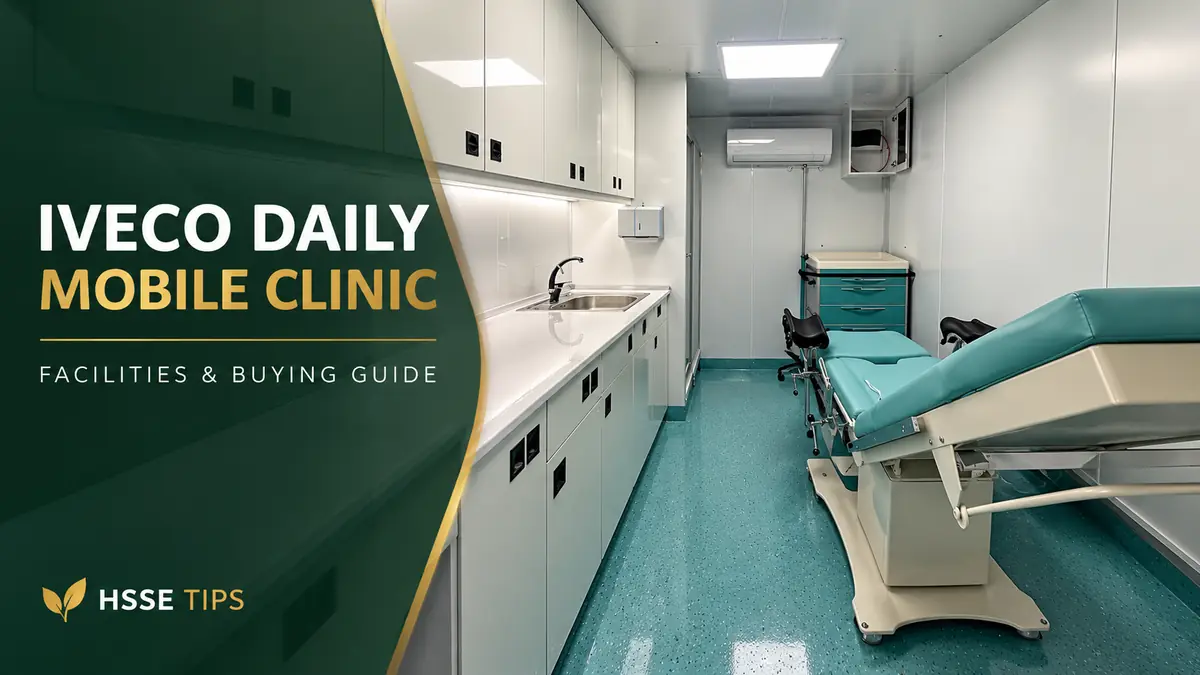
IVECO Daily Mobile Clinic Ambulance Overview
The offer is advertised as “Daily Mobile Clinics” within a marketplace ambulance category. Its visual and documentary evidence is more specific: a transportable medical module with an examination and treatment orientation. Marketplace classification alone does not establish emergency patient-transport approval.
Read the material at three levels: structured vehicle fields supplied by the seller; features visible in photographs; and proposed provisions in the attached container brief. None substitutes for a serial-numbered specification and signed equipment schedule. This distinction makes comparison with competing clinic offers much more useful.

Understanding the IVECO Daily Platform
IVECO’s official Daily chassis-cab material describes a commercial platform built around a steel C-section frame. For bodybuilders, the relevant engineering task is integrating the medical body, mounting structure and services with a correctly specified chassis.
The advertisement does not identify a complete Daily variant or provide a VIN. Its exterior photographs also do not resolve that identification. Buyers should obtain the vehicle build sheet, chassis plate and current photographs showing the entire cab and body together. Generic Daily range capacities, suspension options and driver-assistance features cannot be assigned to this offer.
Engine, Transmission and Drivetrain
The seller’s structured fields state a 2,287 cm³ four-cylinder diesel rated at 115 kW, displayed alongside 156 HP. Six gears are listed, but the transmission’s operating type is not specified. Engine code, torque, emissions classification and driven axle arrangement remain unconfirmed.
These entries provide questions for the technical enquiry rather than a complete powertrain identification. Ask for manufacturer records tied to the actual chassis, including the gearbox designation and maintenance requirements. No verified consumption or range assessment is possible from the available evidence, and no four-wheel-drive capability is established.
Chassis, Dimensions and Gross Vehicle Weight
A dimensioned general-arrangement drawing is essential here. The listing provides both overall and body dimensions without establishing their measurement scope. They should not be used to book a transport route, design a parking bay or infer standing height until the supplier separates complete-vehicle, external-module and usable-interior measurements.
Gross vehicle weight, axle ratings and completed operating weight are also missing. The procurement calculation must account for the conversion, fluids, fuel, staff, supplies and every fitted device. A generic transport-capacity statement elsewhere in the sales copy does not establish usable payload for this vehicle.
Medical Body and Exterior Design
The original exterior photographs show a rectangular medical body mounted on a truck, while other views show modules during handling and workshop preparation. They are useful construction context, but do not demonstrate that every photograph represents one currently available vehicle.
The attached “Mobile Health Container 20Ft” document describes a truck-carried module. Its language is prospective, so treat it as a design brief whose applicability must be confirmed. Obtain the bodybuilder’s mounting drawing, corrosion protection specification and transport restraints. Removability, lifting equipment and container-handling compatibility need their own drawings and ratings.
Mobile Clinic Interior and Patient Examination Facilities
The interior is the offer’s most informative feature. Original photographs show cabinets and worktops along the left side, a sink, an examination chair, additional patient furniture, ceiling lights and a wall-mounted air-conditioning unit. This gives a concrete basis for discussing staff movement, cleaning access and consultation privacy.
The linked brief proposes two rooms, combining waiting with recovery or treatment and placing examination space separately. That proposal should be reconciled with an as-built floor plan. Establish clear door widths, working clearances, privacy arrangements and the number of people permitted in each space. A furniture count is not a verified patient-throughput figure.

Medical Equipment and Storage
Fitted cabinetry provides visible storage infrastructure. The examination furniture and sink are also identifiable by function, although manufacturers, load ratings and clinical commissioning records are absent.
Separate the purchase schedule into four categories: installed features shown, equipment contractually included, loose items photographed, and options. The second category is not established merely by appearance. Bags, supplies and portable instruments need individual confirmation.
The brief proposes ultrasound, sterilization and aspiration equipment, plus a medicine refrigerator. These are documentary proposals, not verified installed devices with identified models. Ask which items are included, their electrical requirements, service support and acceptance tests. No monitor, defibrillator, ventilator, oxygen system or diagnostic test menu is confirmed for the sale.

Electrical Power and Backup Systems
The attached brief specifies 220 V distribution, protective devices and a 6 kVA diesel generator. Separate generic sales text mentions 5 kW. These are different ratings and do not define one supplied generator. Request the actual make, model, continuous output, frequency and connection diagram.
Build a load schedule that includes cooling, lighting, refrigeration and devices operating simultaneously. Commissioning should demonstrate earthing, protective-device operation and safe changeover between supplies. Confirm whether batteries or an inverter exist, what they support and how long essential loads remain supplied. An external socket alone does not establish backup autonomy.
Water Supply, Sanitation and Waste Management
A sink is visible, while the brief proposes water treatment and sanitary facilities. Tank sizes, pump arrangements, wastewater handling and the exact supplied plumbing are not established. A photograph of a basin cannot show the quality of the incoming water or the disposal route.
Define refill and drainage arrangements for each deployment site. The operating plan should cover hand hygiene, cleaning water, approved waste storage and collection, with maintenance access to pumps and pipework. Confirm any toilet or shower on the final floor plan rather than assuming it from generic product text.
Heating, Ventilation and Air Conditioning
A split air-conditioner is visible in the examination room. The design brief also describes heating, ventilation and filtration provisions. Neither the photograph nor the proposal verifies installed performance under a particular climate, occupancy or clinical workload.
Ask for a ventilation drawing, equipment list and commissioning results. Do not interpret the design’s filtration terminology as HEPA certification, negative-pressure isolation or approval for airborne-infection procedures. Temperature-sensitive medicines need their own validated storage arrangements and monitoring; room cooling does not replace refrigerator qualification.
Transportation and Deployment Requirements
Plan the clinic as a facility that travels and then operates at an agreed site. Confirm whether it remains on its chassis during service, how it is levelled, and what staff must do before moving. The offer does not establish a complete demounting or crane-handling system.
Rear stairs with handrails are photographed. Assess the landing, ground conditions and access route, including a solution for people unable to use stairs. No wheelchair lift or ramp is verified. The transport survey should check clearances, turning space, surface loading, overhead obstacles and emergency access.
Before departure, secure furniture, loose equipment, drawers and fluid connections according to the bodybuilder’s instructions. At the destination, use a documented arrival inspection, utility connection and functional-check sequence. These tasks belong in the handover training and operating manual.

Healthcare and Medical Outreach Applications
The examination-oriented layout supports a procurement enquiry for outreach consultation and treatment space. Rural health programmes, hospital outreach teams and remote industrial operators can assess it against a defined service brief, staffing model and referral network.
The maternity markings and attached brief give this offer a distinctive focus, but they do not establish authorized delivery-room operation or clinical readiness. Any maternity service requires the appropriate equipment, personnel, governance and referral arrangements. Humanitarian use likewise depends on local needs, sustainable supplies and access to onward care.
WHO’s Mobile Clinics Toolkit emphasizes feasibility, service planning and quality monitoring. Applied here, that means defining the intended programme before selecting options, then assessing whether the completed facility can deliver that programme consistently.
Mobile Clinic vs Ambulance: Understanding Their Different Functions
A mobile clinic provides a workspace for care at a deployment site. An ambulance used for patient transport needs a suitable transport layout, approved seating and restraints, secure stretcher installation and the relevant vehicle and service authorization.
This advertisement does not establish those transport provisions. An examination chair is not evidence of a certified transport stretcher. Emergency lights, siren and communications are also unverified. Buyers seeking an ambulance should request a separate transport specification and approval evidence rather than relying on the marketplace category.
Safety, Hygiene and Regulatory Considerations
Acceptance should cover both the road vehicle and the clinical installation. Verify vehicle weights and axle loads in the agreed operating condition, medical-body mounting, equipment securing, electrical protection, fire precautions and safe access. Identify which inspections and approvals apply in the destination jurisdiction.
The clinical operator needs qualified personnel, cleaning procedures, sharps and waste arrangements, equipment maintenance and an incident-response plan. Confirm compatible cleaning agents for interior surfaces and document responsibility for water quality and temperature monitoring.
Ask for traceable certificates and test reports that identify the actual equipment or completed installation. No ambulance-standard compliance, laboratory accreditation, medical-grade ventilation certification or WHO product approval was established in the material reviewed.
Technical Specifications
The tables separate seller entries, direct visual observations and proposed design provisions. They do not constitute an independently inspected build specification.
| Item | Evidence and scope |
|---|---|
| Advertised identity | IVECO Daily Mobile Clinics; exact chassis variant and VIN not supplied |
| Seller-stated engine | 2,287 cm³, inline four-cylinder diesel; 115 kW / displayed 156 HP |
| Gearbox entry | Six gears; operating type unconfirmed |
| Fuel tank entry | 70 litres; seller-stated |
| Braking entries | Disc brakes and ABS; seller-stated |
| Item | Evidence and scope |
|---|---|
| Exterior photographs | Rectangular truck-mounted medical body; maternity-clinic markings |
| Interior photographs | Cabinets, worktops, sink, examination furniture and ceiling lights |
| Entry photograph | Rear stairs with handrails |
| Attached design brief | 20ft truck-carried healthcare container; proposed examination and waiting/treatment arrangement |
| Seller dimension entries | Overall 6.3 × 2.35 × 2.5 m; body 5.897 × 2.348 × 2.39 m. Measurement scope unresolved; not verified vehicle envelope |
| Item | Evidence and scope |
|---|---|
| Photographed HVAC | Wall-mounted split air-conditioning unit; model and performance unidentified |
| Brief: power | 220 V distribution and 6 kVA diesel generator proposed; applicability and supplied equipment require confirmation |
| Brief: equipment | Ultrasound, sterilizer, aspiration equipment and medicine refrigerator proposed; inclusion and models unconfirmed |
| Brief: sanitation | Water treatment, toilet and shower described as design provisions; as-built installation unconfirmed |
| Contract inventory | No serial-numbered medical-device schedule verified |
Current Seller Offer — Verified 25 October 2026
Product: IVECO Daily Mobile Clinics / Ambulance, advertised by AMBULANCEMED LTD.ŞTİ, reference TL35861.
Product Location: Türkiye, country-level listing field only. The vehicle’s physical dispatch city and site are not specified; the supplier’s office is not used as its location.
Asking price: €99,000. VAT treatment, equipment scope and transport basis require confirmation. Manufacture entry: June 2026. Condition: New, seller-stated. First registration and mileage are not specified.
Engine: Seller lists 2,287 cm³ diesel, 115 kW. Transmission: Six gears listed; type unconfirmed. Drivetrain, gross vehicle weight and payload: Not verified.
Medical conversion and equipment: Supplier photographs and a container design brief are provided; the exact body manufacturer, included inventory and power installation need a signed specification. A two-year warranty is advertised, with coverage and conditions to be established.
Availability: Publicly advertised when checked. Ready stock, quantity, production status and dispatch date were not independently confirmed.
Delivery destinations, shipping arrangements, and applicable transport terms were not specified in the information reviewed. Prospective buyers should confirm these details directly with the seller.
Export documentation, customs responsibilities, Incoterms and commissioning services are not established. Keep these commercial terms separate from the technical acceptance schedule.
What Buyers Should Confirm Before Purchasing
Start with a written mission brief: who will use the facility, which services it will provide, where it will park and how patients will reach it. Set acceptance criteria before comparing quotations.
- Identify the asset: VIN, build sheet, current complete-vehicle photographs, body serial number and ownership documentation.
- Fix the configuration: Dimensioned floor plan, mounting drawings, weights, access provision and exact patient capacity.
- Define the inventory: Device models, quantities, inclusion, consumables, maintenance support and training.
- Prove the utilities: Load schedule, generator data, water and drainage arrangements, HVAC and electrical test records.
- Agree delivery and acceptance: Freight scope, permits, insurance, warranty, site commissioning and remedy for deficiencies.
Request a live walkthrough that follows the proposed patient route and shows equipment labels. It is a useful complement to an independent inspection. No advertiser video of this exact supplied configuration was verified in the material reviewed.
Frequently Asked Questions
Is this definitely a patient-transport ambulance?
No. The photographed clinic layout does not verify an approved transport configuration. Obtain a separate transport specification if that is your intended use.
Which IVECO Daily model is supplied?
The title names Daily Mobile Clinics, but the complete variant and VIN are not provided. Confirm the chassis against manufacturer records.
Is the examination equipment included?
Furniture is visible, while other devices are proposed in the attached brief. Require a signed inventory identifying every included item.
Does the unit include a generator?
The brief and generic sales text describe different generator ratings. Inclusion and the actual generator specification require confirmation.
Can the clinic provide maternity care?
Its photographs and brief have a maternity orientation. Clinical service readiness and authorization must be established for the completed installation and operator.
Is wheelchair access confirmed?
No. Rear stairs are photographed; a suitable alternative access arrangement must be agreed where required.
Does it have laboratory or isolation capability?
No diagnostic laboratory inventory, biological containment or isolation certification was verified. Those services need separately documented infrastructure and approval.
Can the medical body be removed from the truck?
A truck-carried container is described, but a rated demounting and lifting system is not established. Ask for the handling design and procedure.
Is international delivery included in the price?
No verified transport scope or destinations were provided. Confirm freight, export terms, destination requirements and commissioning in the quotation.
Final Verdict
This IVECO Daily mobile-clinic offer is most useful as an enquiry into a furnished examination and treatment module. Its original photographs provide a clear view of cabinetry, handwashing facilities, examination furniture and access stairs; the linked brief adds a defined clinical design direction.
A sound purchase depends on reconciling that evidence with the exact chassis, completed layout, device inventory and utility tests. With those documents agreed, institutional buyers can judge the facility against their outreach programme and obtain a quotation with a meaningful acceptance standard.
CONTACT THE SELLERJoin the Conversation
Which requirement would shape your mobile clinic purchase: patient access, room layout, power reliability, clinical equipment or deployment support? Share your procurement experience or question in the comments.
Research and Editorial Basis
Autoline TL35861 was reached through the supplied affiliate redirect and checked on 25 October 2026. Original advertiser photographs are reproduced with source attribution and watermarks retained; no blanket reuse licence is asserted. The attached Mobile Health Container 20Ft technical brief is treated as a design proposal. General engineering context: IVECO Daily chassis-cab documentation. Operational context: WHO Health Cluster Mobile Clinics Toolkit. This is a desk-based review; no road test, VIN inspection, utility commissioning or clinical assessment was performed.
HSSE TIPS — Worksite Safety Hub
Every Task. Every Person. Home Safe.
Your experience matters
Share your thoughts on this page
Have a question, a useful experience or a suggestion? Add your input below.
Comments are public. Keep them respectful and relevant. Do not share contact details, confidential information or emergency reports.
Comments on this page
Loading comments…