Process Safety · Lesson 53 · 9 min read
Prove Zero Pressure Before Opening a Pig Trap Closure
A quick-opening closure gives fast access to a pig launcher or receiver, but it also places people beside a large pressure boundary. If gas or liquid remains trapped, starting to release the closure can convert stored pressure into violent door movement, flying components and a hydrocarbon release. The safe condition is not “the gauge looks low.” It is a proved, stable, zero-energy condition across the complete trap volume.
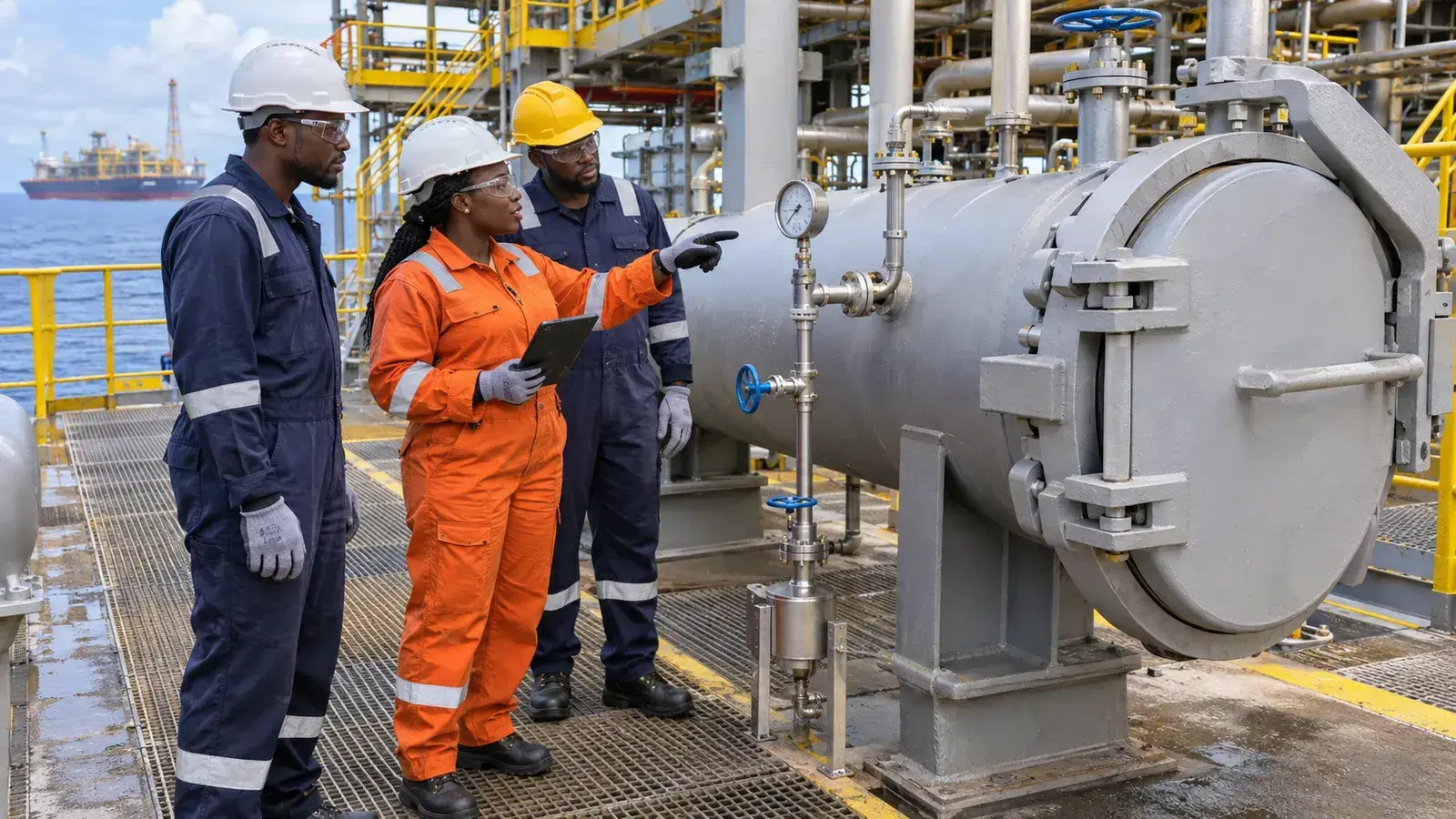
The hazard mechanism: stored pressure can hide
A pig trap may retain pressure after the main-line valves are closed. Gas can remain compressed behind the pig, liquid can be trapped in a low point, and pressure can be reintroduced through a leaking or incorrectly lined-up valve. Debris or pieces of a damaged pig can block a vent or drain. A pressure indicator connected to the same blocked pocket may then fall to zero while another section remains pressurised.
UK HSE guidance on safe isolation says a pig trap should indicate internal pressure, preferably at two points, with the indicators visible to the person operating the closure. It also calls for safe venting and draining of both sides of the pig and warns that debris can block drain points and create false indications of complete depressurisation. These are functional requirements: the arrangement must reveal the condition that matters at the closure.
Official incident evidence
BSEE Safety Alert 173 records a fatal offshore pig-launcher event. Two operators attempted to blow down a gas pipeline through the launcher lid. The launcher had neither a pressure gauge nor a relief valve, and the closed valve arrangement made its pressure impossible to determine. As the lid was opened, trapped gas released and tore the lid from its hinges, fatally injuring both operators. The alert recommends pressure indication and relief on pig launchers and receivers.
HSE enforcement information from 2024 also shows why task design matters. During inspection of offshore oil-line pig-launching arrangements, HSE identified human and organisational weaknesses involving valve access and labelling, omitted line-up checks, technician competence, door-seal checks and pressure build-up tests. Hardware, procedures, competence and verification must work as one barrier system.
Operational analysis: prove the whole volume
A safe opening sequence starts with a current flow-path understanding. The team identifies every connection that can supply pressure, every place pressure or liquid can remain, and the intended vent and drain destinations. The trap is isolated using the installation's approved standard, then vented and drained without placing anyone in front of the closure.
The proof must be independent of a single indication. Operators verify that the correct vent and drain paths are open, that flow has ceased for an understood reason, that pressure indicators respond as expected, and that the condition remains stable. If a vent or drain does not behave as predicted, the task stops. No one defeats a closure interlock, loosens fasteners or uses the door as a test of whether pressure remains.

Hypothetical FPSO example: receiving a cleaning pig
Hypothetical example—not a documented incident: An FPSO receives a cleaning pig from a subsea flowline. After the pig signaller operates, the field team isolates the receiver and begins depressurisation. One local gauge falls to zero, but the expected liquid drainage is very small and the high-point vent produces only a short release.
The operator does not begin opening the closure. The team stops, confirms the valve line-up with the control room, and treats the unexpected behaviour as evidence that the pressure state is uncertain. A competent person directs checks from safe positions and discovers debris restricting one drain. After the approved recovery method clears the restriction, both sides of the pig are drained and vented, independent indicators remain at zero, and the responsible authority releases the hold point. This example does not prescribe a universal valve line-up, venting time or opening method.
Critical controls
Effective isolation: isolate every credible pressure source, including bypasses, kicker lines, equalising lines and utility connections. Prove the boundary in accordance with the approved isolation standard.
Independent pressure evidence: use suitable indicators positioned to reveal the trap's internal condition. Confirm instrument health and do not rely on one gauge, one sound or elapsed time.
Functional vents and drains: establish discharge to an approved safe system, verify that both sides of a pig can be depressurised and drained, and have a defined response for blockage or abnormal flow.
Closure safeguard and exclusion: maintain closure interlocks and mechanical locks, keep people out of the line of fire, and prohibit using the closure to test for pressure.
Leadership actions
Leaders should classify pig-trap operation as safety-critical work and verify that the field layout supports reliable human performance. Gauges, valves, vents and drains must be accessible and identifiable; procedures must match the installed arrangement; and operators must be competent in normal and abnormal conditions. Repeatedly awkward venting, unreliable gauges or improvised workarounds are defects to correct, not local habits to tolerate.
Supervisors should protect the hold point before closure opening. A schedule, vessel movement or production target must not turn uncertain pressure into an assumption. Learning from difficult pig receipts should update task risk assessment, maintenance, inspection and operating procedures.
Three practical actions
- Walk the trap: identify every pressure source, trapped pocket, indicator, vent and drain before the next pigging task.
- Challenge the proof: ask how the team would recognise a blocked vent or drain and what independent evidence confirms zero pressure.
- Protect the hold point: define who authorises closure access, what evidence is recorded and which abnormal signs require stopping.
Takeaway and team discussion
Key takeaway: a pig-trap closure is safe to open only after the complete trapped volume is isolated, vented, drained and independently proved at zero pressure.
Discussion question: if our local gauge showed zero but a vent or drain behaved unexpectedly, what would prevent the team from treating the closure as the next test?
Continue in the Process Safety hub, and connect this lesson with verified isolation, drain-valve containment and flow-path verification.
Verified primary references
- UK HSE: The safe isolation of plant and equipment (HSG253), pig-trap guidance.
- U.S. BSEE/MMS Safety Alert 173: Pig Launcher Explosion Results in Two Fatalities.
- UK HSE: 2024 enforcement notice concerning offshore pig-launcher operations.
- UK HSE: Safety of pressure systems—Approved Code of Practice and guidance.
Video check: no directly relevant official technical or incident video on pig-trap closure opening was identified, so no unrelated video is embedded.
Published and sources checked 4 November 2026. Educational discussion only: apply the installation's approved safety case, pigging procedure, isolation standard, line-of-fire controls and equipment-specific closure instructions.
Your experience matters
Share your thoughts on this page
Have a question, a useful experience or a suggestion? Add your input below.
Comments are public. Keep them respectful and relevant. Do not share contact details, confidential information or emergency reports.
Comments on this page
Loading comments…