Security · Maritime Operations · 12 min read
Black Sea Ship Attacks: Rescue Limits and Merchant-Vessel Readiness
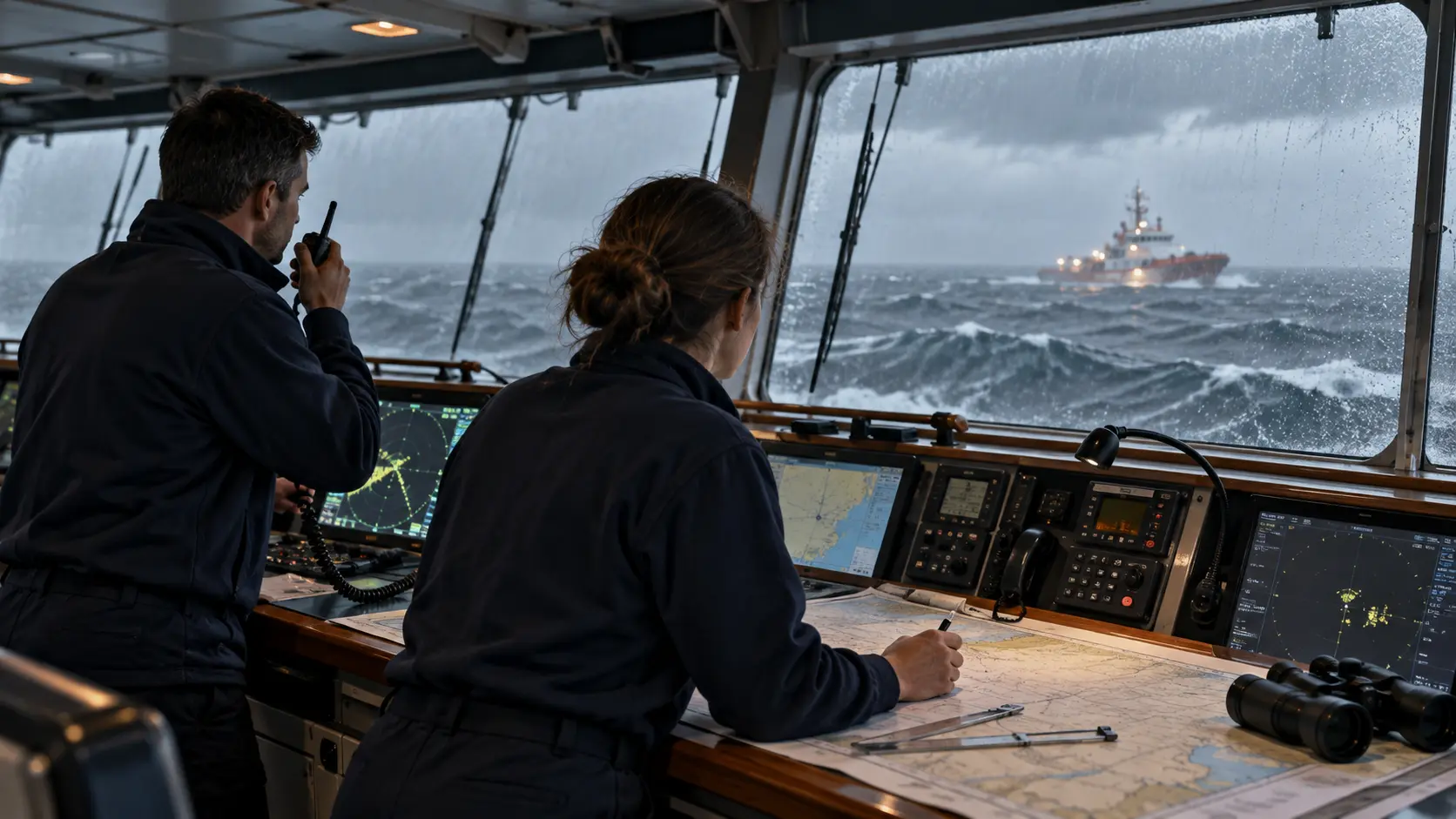
The latest attacks off Bulgaria show that maritime security cannot be managed as a stand-alone security issue. A drone strike can immediately create fire, flooding, loss of propulsion, medical, abandonment, search-and-rescue and pollution emergencies—often at night and with little warning.
14 October update: search officially ended
Bulgaria’s Ministry of Transport and Communications announced the official end of the HS Dignity search-and-rescue operation at 15:00 local time on 14 October 2026. Its notice was published the same day.
The operation resumed at 10:30. Search activity stopped at 14:30 after weather deteriorated sharply: north-northeasterly wind gusts reached 72 km/h, rain reduced visibility and the notice reported sea state 5. That figure is not a stated five-metre wave height.
The notice does not provide a final casualty total. Ending a search does not, by itself, establish the fate of every missing person. Read the official search-end notice ↗
Confirmed vessel and rescue information
The ministry’s technical notice, published on 13 October, identifies Malta-flagged CHELSEA-3, with 15 crew, as attacked at 01:15 about 17 nautical miles east of Byala. All 15 were rescued.
Guinea-Bissau-flagged HS Dignity, with 16 crew, was struck at 01:20 and sank about 17 nautical miles east of Shabla. Both vessels were travelling without cargo. The notice identifies Azov Concord and SCANDI ASSERTER as ships assisting five survivors from HS Dignity—not as the sunken ship.
These later technical details replace earlier preliminary timing, location and search reporting in this article. They are not a final investigation into responsibility, damage mechanisms or casualties. Read the ministry’s vessel information ↗
Practical lesson: rescue availability is a changing control
A plan that assumes nearby ships or helicopters can always recover people is incomplete. Weather, darkness, access, communications and responder exposure can constrain rescue. The lesson is to strengthen survival readiness before entering a higher-risk area, not to predict how any individual in this incident would have survived.
- Verify life-saving appliances, immersion protection and emergency communications against the vessel’s approved arrangements.
- Rehearse personnel accounting, casualty transfer and the master’s decision process for shelter, muster and abandonment.
- Keep forecast changes and rescue limitations in voyage and emergency reviews; do not turn general forecasts into unsupported rescue-time guarantees.
- Coordinate assistance through the relevant rescue authority. Assess weather, approach hazards and rescuer safety before manoeuvring or launching recovery equipment.
- Keep family liaison and public updates factual. Clearly label information that has not been confirmed by the competent authority.
The origin of the drones and any pollution outcome are not established by the two ministry notices. Do not infer that an empty cargo hold means there is no bunker-fuel or other pollution risk.
Why this changes the maritime risk picture
The 13 October events followed attacks on merchant shipping in the same wider Black Sea area during the previous week. That pattern increases the practical risk for vessels approaching ports, waiting offshore, transiting regional routes or supporting rescue operations.
For operators, the scenario is no longer only “security incident.” A strike above the waterline can injure people, ignite accommodation or cargo areas and damage navigation or communications. A strike near the waterline can cause progressive flooding, list, power loss or rapid abandonment. Rescue vessels and nearby ships may then enter an uncertain hazard area while trying to save lives.
Eight immediate controls for ship and shore teams
- Refresh the voyage threat assessment. Use current coastal-state, flag-state, company-security and navigational information. Review routing, speed, waiting areas, port approach timing and credible diversion options before entering the affected region.
- Connect security watchkeeping with safe navigation. Increase visual, radar and communications vigilance without overloading the bridge team. Define who monitors, who navigates, who reports and who can call for additional support.
- Reduce avoidable personnel exposure. Limit non-essential open-deck work in higher-risk periods, identify protected internal locations and ensure crews understand the difference between shelter, muster and abandon-ship instructions.
- Rehearse fire, flooding and loss-of-power actions together. Verify remote stops, watertight integrity, emergency power, fixed and portable firefighting systems, damage-control equipment and the ability to isolate affected ventilation, fuel and electrical systems.
- Prepare for rapid medical response and abandonment. Confirm first-aid capability, casualty movement, life-saving appliances, immersion protection, emergency lighting and accurate personnel accountability. Everyone must know the trigger for abandoning versus remaining in a safer protected space.
- Protect pollution barriers. Review cargo and bunker shutdowns, tank soundings, scupper control, spill equipment and prompt reporting. A security strike can become an environmental emergency before the full damage is visible.
- Keep reporting routes simple. Ensure bridge teams have current MRCC, coastal-state, flag-state, company and security-reporting contacts. Preserve VDR, radar, AIS, CCTV and communications evidence when safe to do so.
- Manage fatigue and distress. Additional lookouts and security watches can quickly erode performance. Use relief plans, protected rest, clear handovers and post-incident psychological support.
Do not improvise counter-drone measures
Commercial crews should not attempt unauthorised jamming, interception or weapons use. Such actions can create navigation, aviation, communications and legal hazards and may expose people on deck. Protective actions must stay within flag-state, coastal-state and company instructions.
The operational focus is early detection, exposure reduction, protected response, damage control, rescue readiness and reliable reporting.
A practical bridge-to-shore readiness check
- What is the latest verified threat information for the planned route and waiting area?
- Which spaces offer the best practical protection without compromising escape?
- Can the bridge call the relevant rescue and security authorities without searching for numbers?
- Can the crew isolate fire, flooding, fuel and electrical hazards after a strike?
- Who accounts for every person, including contractors and supernumeraries?
- What damage would require an immediate pollution notification?
- How will the master preserve evidence without delaying life-saving action?
- What relief is available if heightened watches continue for several days?
Official incident briefing
The Bulgarian Council of Ministers published this official briefing on the emergency Security Council meeting. The video is in Bulgarian and documents the authorities’ initial response; it is not a training video, and later official updates should take precedence as the investigation develops.
Watch the official Bulgarian government briefing on YouTube ↗
Authoritative sources and update history
- Bulgarian Ministry of Transport and Communications — Official end of the HS Dignity searchPublished 14 October 2026; search ended 15:00 local
- Bulgarian Ministry of Transport and Communications — Affected and assisting vesselsPublished 13 October 2026; technical vessel and survivor information
- Bulgarian Council of Ministers — Initial emergency Security Council briefing13 October 2026; initial information, superseded where later technical details differ
- IMO — Statement on attacks against civilian merchant vesselsSupporting international maritime-safety context
This article was first published on 13 October and materially updated on 14 October. The initial official video is retained for context; it does not announce the search’s end.
Your experience matters
Share your thoughts on this page
Have a question, a useful experience or a suggestion? Add your input below.
Comments are public. Keep them respectful and relevant. Do not share contact details, confidential information or emergency reports.
Comments on this page
Loading comments…