Maritime Safety · Investigation analysis · 7 min read
Argos Georgia Foundering: How an Open Hatch and Delayed Response Cost 13 Lives
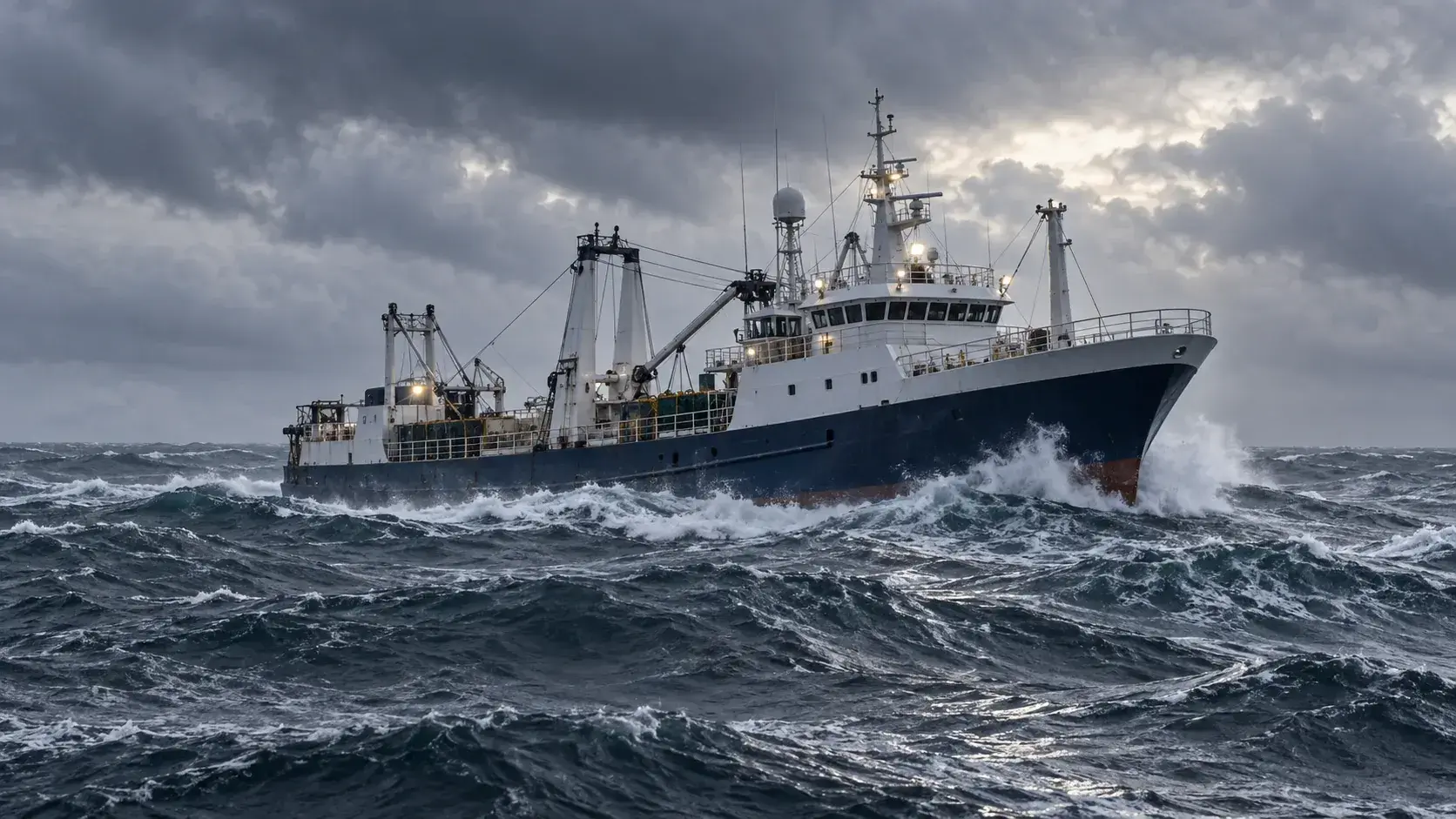
A fishing vessel’s line-hauling hatch opened unexpectedly in heavy seas. The resulting flooding spread through open internal doors; the crew could not close the hatch. The UK Marine Accident Investigation Branch (MAIB) identified technical, operational and emergency-response failures in a casualty that killed 13 people.
What happened
On 22 July 2024, the St Helena-registered longline fishing vessel Argos Georgia was travelling from Port Stanley in the Falkland Islands toward fishing grounds near South Georgia. At about 1300 local report time, approximately 190 nautical miles east of Port Stanley, its previously closed starboard line-hauling hatch opened without a command. Seawater entered the line-hauler room and spread through the vessel. The vessel developed an increasing starboard list, lost propulsion at about 1551, and sank at about 1900.
There were 27 people aboard: 25 crew and two observers. Fourteen survived. Nine people were recovered deceased and four remained missing, presumed dead. The report records winds of roughly 40 to 75 knots, waves of 7 to 10 metres and sea temperature of 3.5°C. These conditions made evacuation and survival exceptionally difficult.
The barrier failures behind the flooding
MAIB found that the hatch’s manual securing bolts had likely not been applied before the vessel sailed. The investigation also identified a design weakness in the hatch drive mechanism; the crew could not close the hatch after it opened, probably because the mechanism failed. This is an investigation finding with stated uncertainty, not proof of a single operator action as the sole cause.
Flooding was no longer confined to the line-hauler room. A hinged weathertight door was open and hooked back. Sliding electro-hydraulic doors could not be closed, probably after their controls were deluged and short-circuited. Floodwater then prevented access to the manual emergency control. The combined loss of closure, compartmentation, power and access allowed progressive flooding and loss of stability.
The safety lesson extends beyond the fishing sector: a shell opening is part of the vessel’s boundary against the sea. Its securing method, status indication, operating system, backup controls and adjacent internal doors must function as a connected protection system under realistic failure conditions.
Emergency decisions affected survival time
The investigation describes an unstructured onboard response and delays in declaring distress and abandoning the vessel. A crew member first raised the alarm through a colleague on another fishing vessel, who relayed it to Falkland Islands authorities. As the list increased, the crew mustered and donned immersion suits. They began entering two liferafts at about 1600; one raft was damaged during abandonment. Poor evacuation control, severe weather and liferaft damage increased exposure to cold water.
By about 1130 on 23 July, responding vessels had recovered the 14 survivors and nine deceased crew members. The report notes that the nine recovered deceased people wore immersion suits, and eight were found face down and had drowned. An immersion suit improves survival prospects but cannot replace timely distress alerting, controlled abandonment and a usable survival craft.
Actions for vessel operators and offshore teams
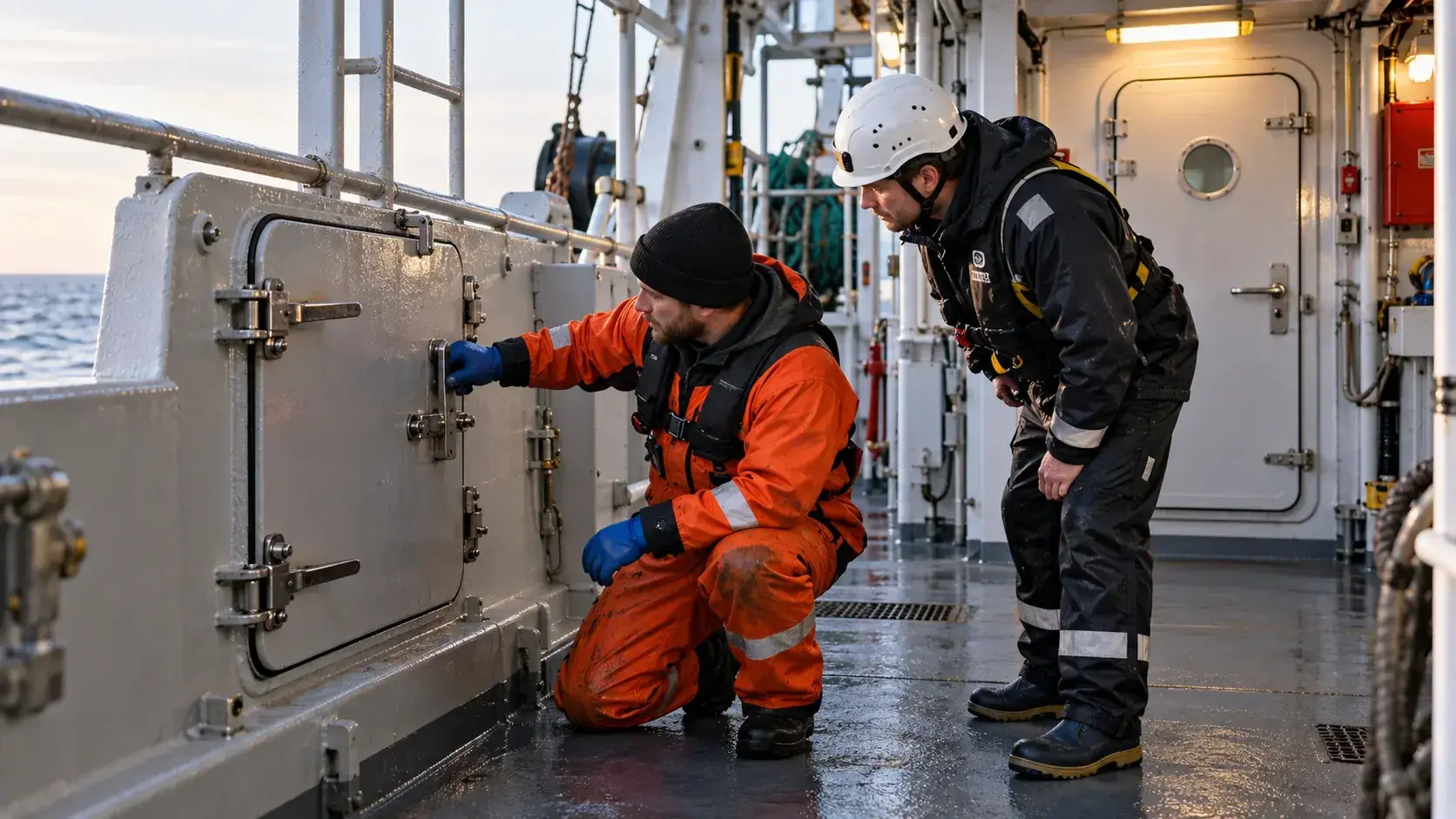
- Prove closure before passage. Verify each safety-critical shell opening is fully closed and secured; bridge indication and checklists should reflect the actual securing state, not merely the motor position.
- Test the failure case. Assess whether doors remain secured if a drive component fails, and whether local, remote and manual closure remain available after flooding, loss of power or a severe list.
- Preserve compartment boundaries. Keep required weathertight doors closed at sea and verify that alarms, electrical controls and manual overrides remain usable under credible flooding conditions.
- Drill the decisions. Exercise escalating flooding, deteriorating stability, distress transmission, abandonment authority, damaged survival craft and remote shoreside support together.
- Check survival readiness. Match immersion suits, liferafts and launching arrangements to crew numbers, sea conditions and the vessel’s operating area.
These are practical review questions drawn from the report’s failure sequence. They do not replace a vessel-specific risk assessment, flag-state requirements or the vessel’s approved procedures.
MAIB recommendations and status
MAIB recommended that the UK Maritime and Coastguard Agency amend the applicable code for fishing vessels of 24 metres registered length and over so shell-door arrangements include, at minimum, automatic locking capable of securing doors in the closed position. This is a recommendation in the report, not a statement that the code has already changed.
It also recommended that vessel manager Argos Froyanes Limited implement a documented safety-management system across its fishing vessels, and that Falkland Islands authorities improve search-and-rescue communications so distressed vessels can establish direct, reliable contact in their area of responsibility.
The question to take to the next safety meeting
Which opening or internal door on our vessel depends on one manual action, vulnerable control system or inaccessible backup—and how would the team know and respond if it failed in heavy weather?
Primary sources
MAIB investigation page, published 25 September 2026 ↗
MAIB Report 19/2026, full investigation and annexes (PDF) ↗
Source attribution: UK Marine Accident Investigation Branch, Report on the investigation of the foundering of the longline fishing vessel Argos Georgia (2026). This article paraphrases the findings and distinguishes reported conclusions from operational lessons.
Your experience matters
Share your thoughts on this page
Have a question, a useful experience or a suggestion? Add your input below.
Comments are public. Keep them respectful and relevant. Do not share contact details, confidential information or emergency reports.
Comments on this page
Loading comments…