Safety · Product Reviews · 11 min read
SNAKOL SK-505A/B Review: 2-in-1 Insulation Tester and True-RMS Multimeter

A safety-led review of the SNAKOL SK-505A and SK-505B megohmmeters, comparing test voltages, resistance ranges, PI/DAR functions, multimeter features and the critical checks required before professional use.
Affiliate disclosure and review basis
This article contains an affiliate link. Worksite Safety Hub may earn a commission if you make a qualifying purchase through it, at no additional cost to you. This is an independent, specification-led review based on the supplied marketplace images and listing information; we have not personally field-tested, calibrated or independently certified the exact instrument.
The listing presents at least two variants with materially different limits. Confirm the model printed on the instrument, the selected checkout option, the supplied manual, test-lead ratings, accessories and documentary evidence before purchase. Marketplace specifications can change and should be treated as advertised claims until verified for the exact unit delivered.
Quick verdict
The SK-505 concept is attractive: it combines an insulation-resistance tester with a general-purpose True-RMS digital multimeter in one portable, rubberized instrument. PI/DAR calculations, timed tests, a guard terminal, a large display and a carry kit could make it a convenient troubleshooting tool for competent electricians and maintenance technicians working on motors, cables, HVAC equipment and de-energized installations.
Our verdict is conditional. The feature set is strong for the price, but a high-voltage tester is only as trustworthy as its input protection, output control, documentation, calibration and accessories. The SK-505A is the more conservative choice when tests up to 1,000 V satisfy the approved procedure. The SK-505B's 2,500 V insulation range is a specialist capability—not an automatic upgrade—and should be selected only where the equipment manufacturer or engineering procedure calls for that voltage.
What the 2-in-1 design actually combines
In insulation mode, the instrument applies a selected DC test voltage and measures the very small current flowing through or over the insulation to calculate resistance. This is fundamentally different from the low-voltage resistance function of an ordinary multimeter. The test can expose deterioration, moisture, contamination and damaged insulation, but the result still requires context: equipment type, temperature, test duration, previous readings and the manufacturer's limits all matter.
The multimeter side is advertised for AC/DC voltage, ordinary resistance, capacitance, frequency, diode checks and continuity. Auto-ranging, data hold, a backlight and automatic power-off improve convenience. Combining the functions can reduce the number of instruments carried, but it does not turn one mode into proof that another mode is safe or suitable.
SK-505A versus SK-505B
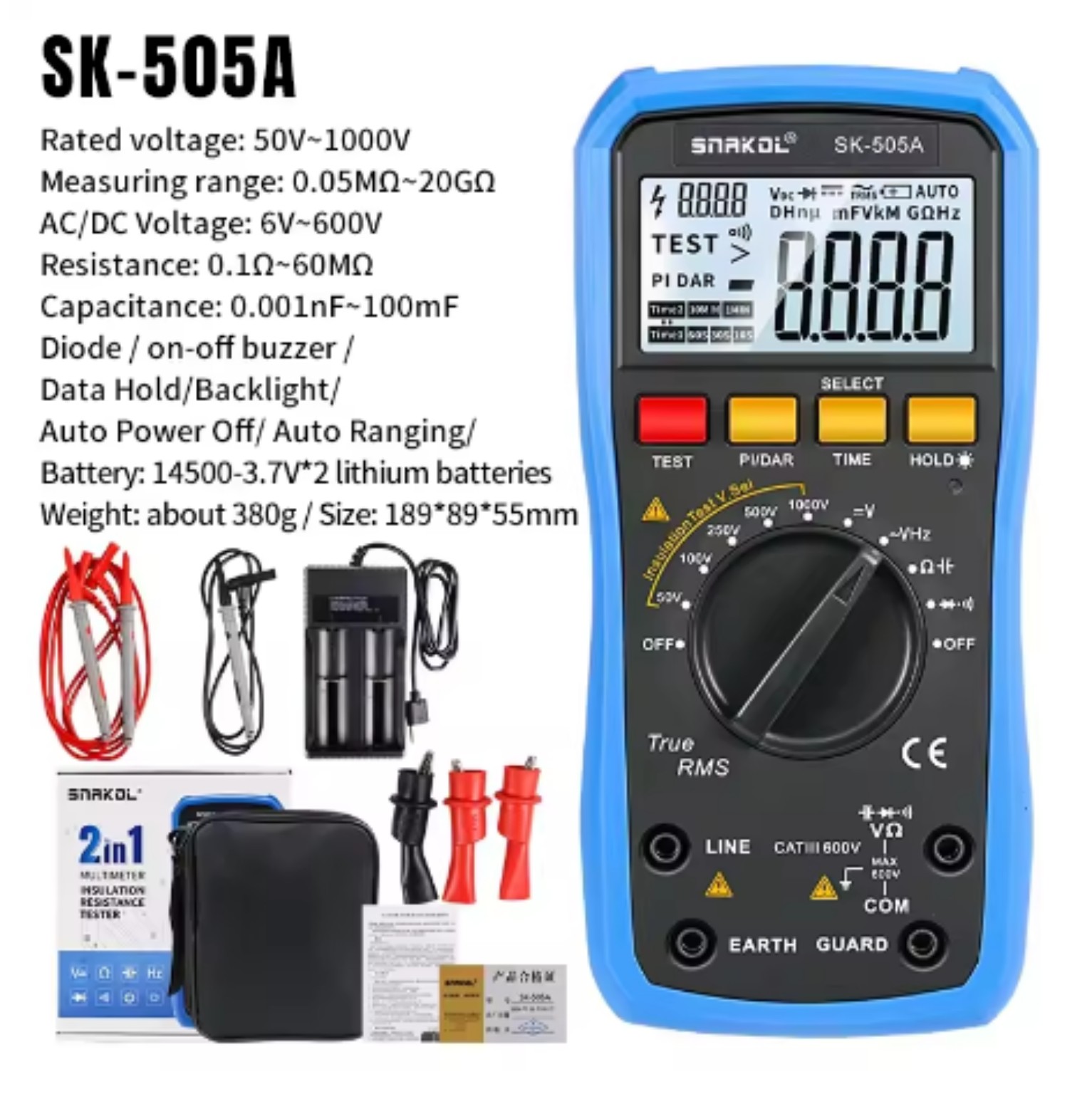
The SK-505A is advertised with selectable insulation-test voltages of 50, 100, 250, 500 and 1,000 V, a 0.05 MΩ to 20 GΩ insulation-resistance range, and AC/DC voltage measurement from 6 to 600 V. Its front marking shows CAT III 600 V. This variant is the logical starting point for buyers whose approved work stays within those test voltages and input limits.
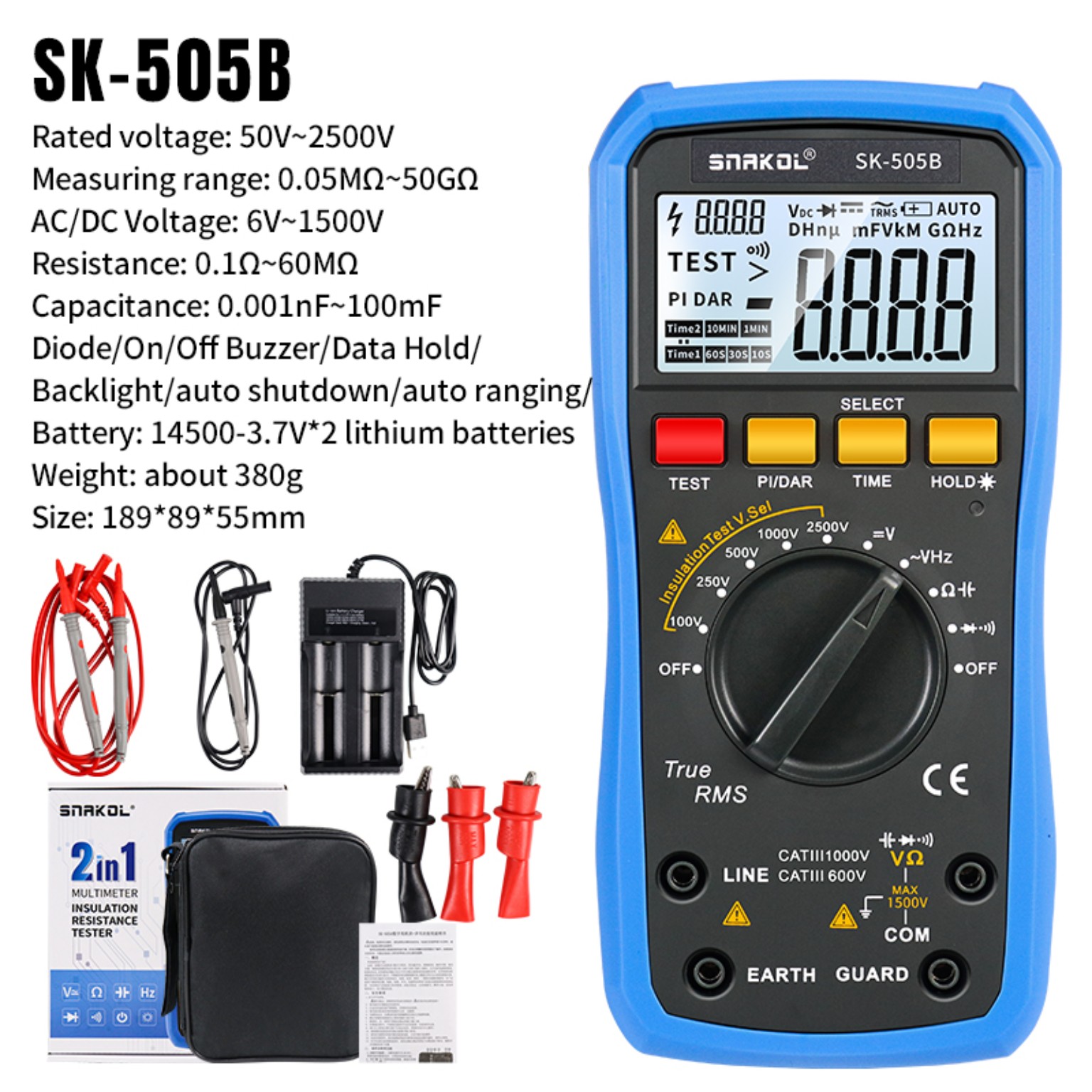
The SK-505B is advertised with 100, 250, 500, 1,000 and 2,500 V insulation tests, a 0.05 MΩ to 50 GΩ insulation-resistance range, and AC/DC voltage measurement from 6 to 1,500 V. Those expanded figures demand more scrutiny, not less. Ask for a model-specific manual, independently verifiable safety certification, input-protection details and the ratings of every supplied lead and clip. Never infer a safe measurement category from a maximum voltage number alone.
- SK-505A: advertised 50–1,000 V insulation-test selection and up to 20 GΩ.
- SK-505B: advertised 100–2,500 V insulation-test selection and up to 50 GΩ.
- Both: advertised 0.1 Ω–60 MΩ resistance and 0.001 nF–100 mF capacitance.
- Both: PI/DAR, timed testing, continuity, diode, data hold, backlight and auto-ranging.
- Select by the approved test procedure—not by choosing the largest number.
A safe insulation-test sequence
An insulation tester deliberately generates potentially hazardous DC voltage. Testing therefore begins with planning and isolation—not with turning the selector. Only trained, authorized people should perform the work under the site's electrical-safety procedure and the equipment manufacturer's instructions.
De-energize and isolate every source, apply lockout/tagout, prove the circuit dead with an approved method, and discharge stored energy. Disconnect or protect electronics, surge-protection devices, drives, control boards and other components that could be damaged. Connect the leads with the test function inactive, establish an exclusion area, announce the test, keep hands clear, then apply only the specified voltage. When finished, allow the instrument's discharge cycle to complete and verify zero before touching or reconnecting the circuit.
- Identify the equipment, test points, expected value and permitted test voltage.
- Isolate all sources and secure the isolation against reconnection.
- Prove dead using an approved tester and proving method.
- Discharge capacitors and isolate sensitive electronics.
- Use undamaged, correctly rated leads with guarded finger barriers.
- Keep people clear while voltage is applied.
- Discharge after the test and verify zero before handling conductors.
PI, DAR, timed tests and the guard terminal
Polarization Index (PI) and Dielectric Absorption Ratio (DAR) compare insulation-resistance readings taken at different times. They can make trending easier on suitable motors, cables and windings, but they are not universal pass/fail buttons. The asset manufacturer's guidance, temperature correction, previous results and the organization's maintenance standard should control interpretation.
The dedicated guard connection can help divert surface leakage away from the measurement when the approved test method requires it. That can improve the usefulness of measurements on contaminated or high-resistance insulation, but an incorrectly connected guard can also produce misleading results. Users should follow the exact connection diagram for the asset and instrument rather than improvising from the terminal labels.
Multimeter performance and everyday use
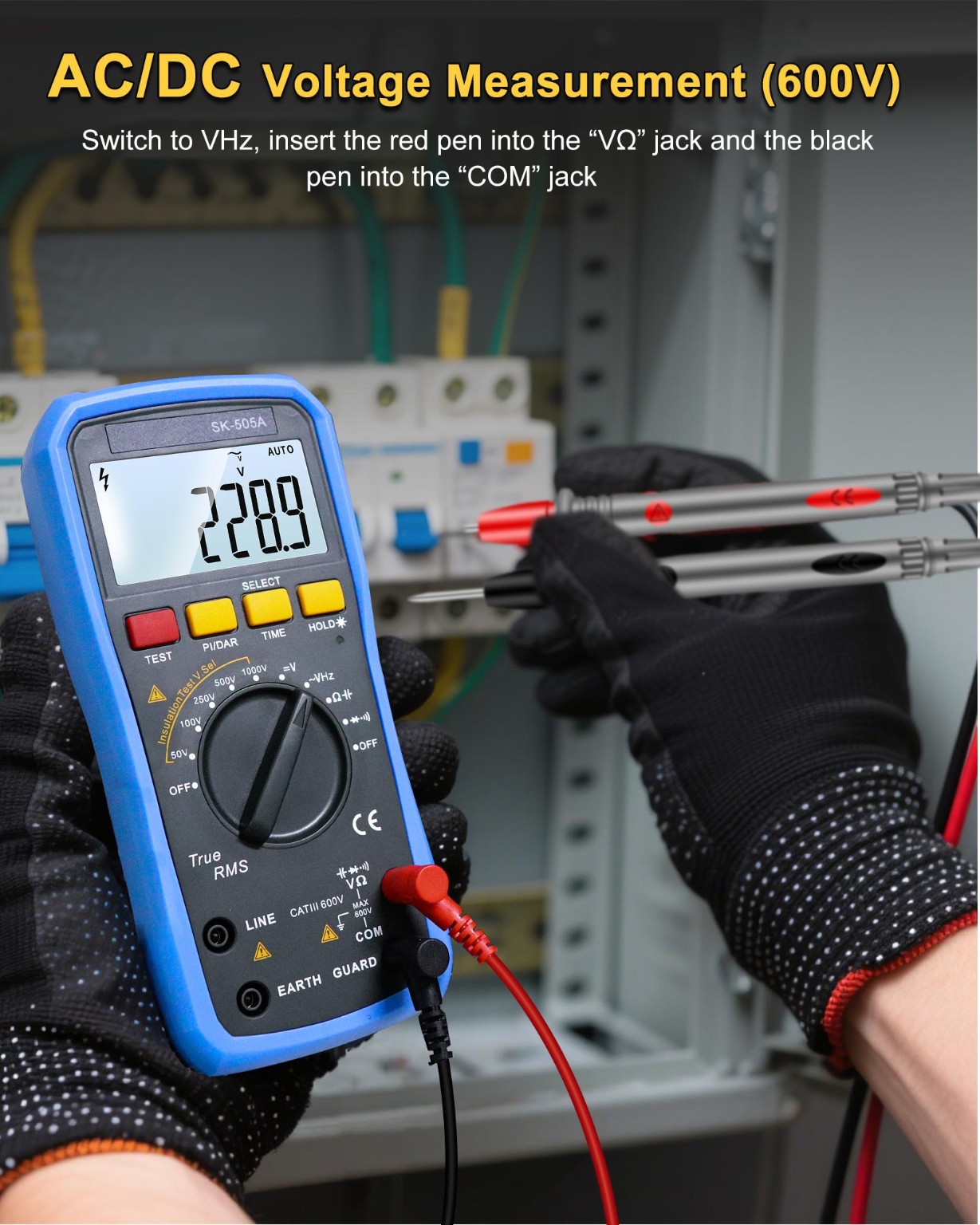
For routine fault-finding, the advertised True-RMS voltage function, resistance, frequency, capacitance, diode and continuity modes cover many common checks. A large display, backlight, auto-ranging and hold function are useful in plant rooms and panels, while the fold-out stand can improve visibility on a bench.
However, the voltage function does not automatically make this the correct instrument for proving dead, high-energy switchboards or every live measurement. Use only instruments and leads whose independently verified category, voltage rating and condition match the installation. Inspect the leads before use, keep fingers behind barriers, select the correct sockets and function, and follow the site's energized-work restrictions.
CAT ratings and input protection: the decisive buyer check
Measurement category is about the transient energy an instrument can withstand at a specified point in an electrical system; it is not simply the largest steady-state voltage shown on the display. Markings on the face, a CE logo or a marketplace description do not by themselves demonstrate the internal fusing, clearances, creepage distances and protective components required for high-energy work.
The SK-505A images show CAT III 600 V. The SK-505B images advertise a 1,500 V maximum input and display category markings that need careful model-specific confirmation. Before professional use, obtain traceable documentation for the exact meter and leads, confirm the recognized test standard and certificate issuer, and check whether the claimed rating applies to every input configuration. If that evidence is unavailable, restrict the instrument to an appropriately assessed environment or choose equipment from a supplier with verifiable certification and support.
Build, battery and supplied accessories
The meter is approximately 189 × 89 × 55 mm and the listing states a weight of about 380 g. The blue outer shell appears to provide grip and impact protection, and the rear stand supports bench viewing. Power is advertised as two rechargeable 14500 3.7 V lithium cells with a separate charger.
Images show a carry case, test leads, high-voltage clips or probes, charger and paperwork, but package contents can vary. Confirm whether batteries are included, whether the charger is compatible with local mains supply, and whether spare rated leads are obtainable. Charge batteries only in a safe location using the supplied or manufacturer-approved charger, and remove damaged, swollen or overheating cells from service.
Best-fit users and applications
This instrument may suit qualified electricians, motor-repair technicians, HVAC service teams and industrial maintenance personnel who need insulation trending plus ordinary multimeter functions in a portable kit. Likely applications include appropriately isolated motors, cables, heating elements and selected low-voltage equipment where the manufacturer specifies an insulation test.
It is a poor fit for casual users, anyone without high-voltage test training, or work where independently documented category protection and calibration are mandatory but cannot be verified. It should not be used in explosive atmospheres unless the exact model has the required approval, and it does not replace a personal voltage detector, dedicated proving unit, power-quality analyzer, earth tester or calibrated laboratory instrument where those are specified.
What to confirm before ordering
Choose the variant from the actual job requirement. Compare the product selected at checkout with the model label and range table, then ask the seller for the current English manual, declaration or certificate, applicable test standard, calibration information, lead ratings, warranty and exact package contents. Also check buyer photographs for recurring issues with the rotary switch, sockets, display, charger and lead quality.
- Exact model: SK-505A or SK-505B.
- Required insulation-test voltages and maximum resistance range.
- Verified input voltage and measurement-category rating.
- Documented safety standard, certificate and manufacturer identity.
- Accuracy, test current, short-circuit current and automatic discharge behaviour.
- Lead, clip and probe ratings for the intended test voltage.
- Battery, charger plug, case and manual included in the selected package.
- Calibration, warranty, returns, import costs and replacement support.
Final assessment
The SNAKOL SK-505A/B offers an unusually broad feature set in one compact package. PI/DAR, timed insulation tests, a guard terminal and useful multimeter modes could make it an efficient maintenance companion. For general work that legitimately requires up to 1,000 V insulation tests, the SK-505A is the more measured choice. The SK-505B makes sense only for competent specialists with a defined 2,500 V requirement and convincing model-specific documentation.
Do not let the attractive specification list outrun the evidence. Verify protection ratings and accessories, use a controlled isolation-and-discharge procedure, and compare results against asset-specific limits. If certification, calibration or support cannot be established, the safer purchase is a traceable instrument from an authorized electrical-test supplier.
Confirm the exact model, specification, certification evidence, shipping terms and current price before ordering.
Sources
- AliExpress — SNAKOL SK-505A/B 2-in-1 insulation tester listingPublished Product listing; accessed 19 September 2026
- HSE — Electrical safety at workPublished Current guidance; accessed 19 September 2026
- OSHA — Electrical SafetyPublished Current safety resources; accessed 19 September 2026
Daily HSSE updates
Subscribe for practical HSSE updates.
Subscribe for the daily message, selected HSSE news and occasional new-resource alerts from Worksite Safety Hub.