Safety · Product Reviews · 11 min read
MESTEK CGD02A Combustible Gas Detector Review: Capable Leak Finder or False Confidence?

A safety-first review of the MESTEK CGD02A handheld combustible-gas leak detector, including its %LEL and ppm display, flexible probe, advertised specifications, safe-use workflow and critical limitations.
Affiliate disclosure and review basis
This independent review contains an affiliate link. Worksite Safety Hub may earn a commission if you make a qualifying purchase through it, at no additional cost to you. Our assessment is based on the supplied listing images and seller specifications; we have not independently calibrated, bump-tested or field-tested the exact instrument.
This article covers the black MESTEK CGD02A handheld combustible-gas leak detector with a flexible gooseneck probe. It is not the earlier four-gas personal monitor, remote laser methane detector or portable air-quality monitor reviewed on this site. Those instruments use different sensing arrangements and serve different safety functions.
Quick verdict
The CGD02A has the right physical format for tracing a suspected fuel-gas leak around accessible joints, valves, hoses and appliance connections: a hand-sized body, bright colour screen, audible and visual warning, selectable ppm/%LEL presentation and a long probe that reaches behind equipment. The seller advertises a fast response, automatic startup zeroing and a wide methane-referenced range.
Its attractive display should not be mistaken for a certified safety case. The listing material does not establish gas selectivity, calibration traceability, hazardous-area approval or suitability for confined-space entry. Our verdict is cautiously positive as a preliminary leak-localisation tool in a controlled, non-classified setting, but negative as a personal life-safety monitor or the sole basis for declaring an atmosphere safe.
What the CGD02A is—and is not
This is a broad-response combustible-gas detector. It may respond to natural gas, LPG and other flammable vapours, but it does not identify which substance is present. A response calibrated or scaled to methane can differ substantially for propane, butane, alcohol vapour and other compounds because sensor sensitivity is gas-dependent.
It does not measure oxygen, carbon monoxide or hydrogen sulphide, and it is not a substitute for a fixed domestic gas alarm, a certified personal multi-gas detector or a complete atmospheric-testing programme. A normal reading cannot prove that every hazard is absent.
- Useful role: locating or comparing suspected leak points under a controlled procedure.
- Not gas identification: a numerical response does not name the gas.
- Not personal protection: it does not continuously cover the normal four-gas set.
- Not confined-space clearance: it cannot establish a safe entry atmosphere.
- Not automatically Ex-rated: verify exact hazardous-location approval before any classified-area use.
Advertised specifications, with caveats
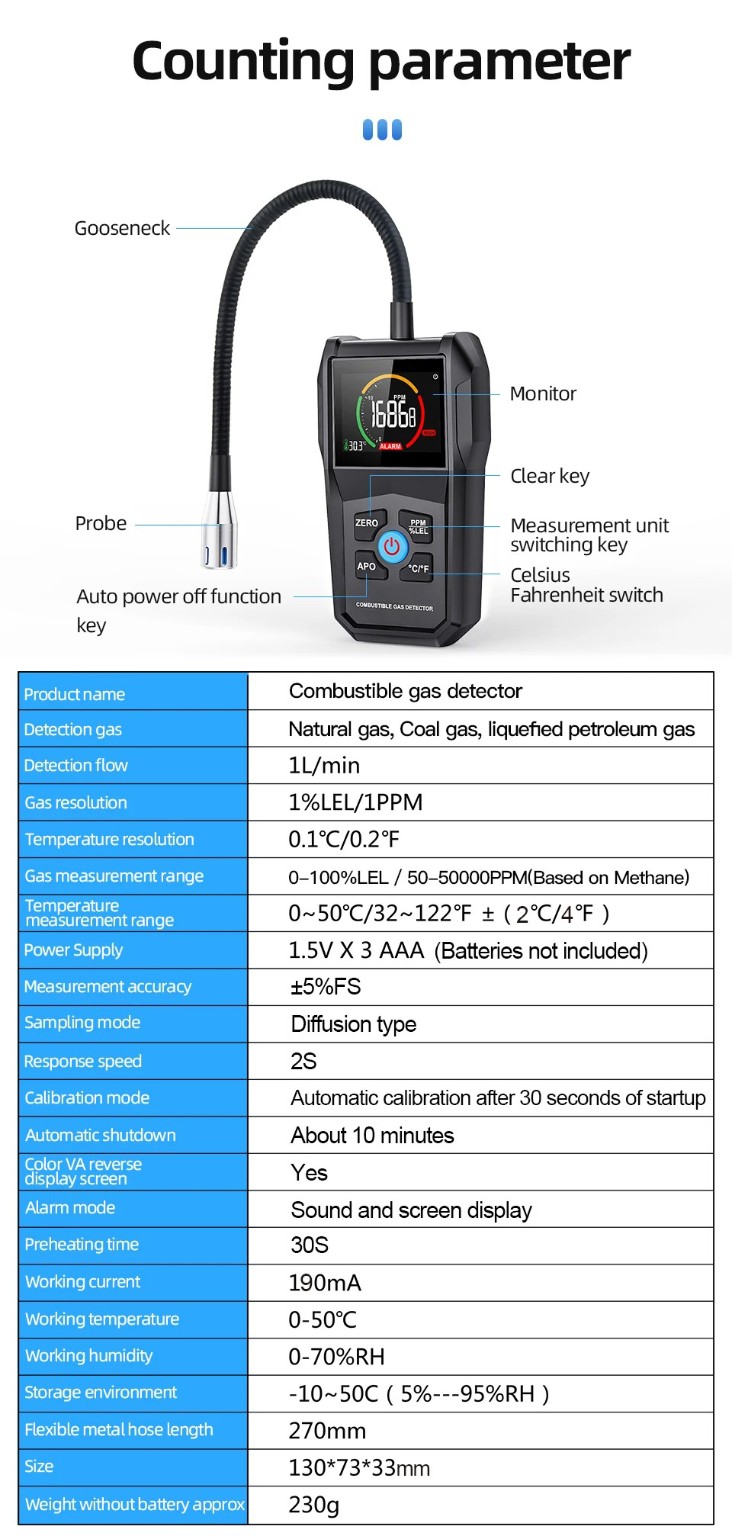
The listing advertises 0–100% LEL and 50–50,000 ppm ranges based on methane, 1% LEL/1 ppm resolution, ±5% full-scale accuracy and a two-second response. It also lists a 30-second warm-up, automatic calibration after startup, sound plus screen alarms, a 0–50°C working range and 0–70% RH working humidity.
The claimed 1 L/min detection flow sits awkwardly beside the listing's description of diffusion sampling; a passive diffusion instrument does not normally have a pump flow in the same sense as an aspirated detector. Ask the seller to explain the sampling method, response-time test, accuracy conditions and calibration gas. Do not build a safety procedure around a translated specification image alone.
- Gas range: advertised 0–100% LEL or 50–50,000 ppm, methane-referenced.
- Resolution: advertised 1% LEL or 1 ppm.
- Accuracy: advertised ±5% of full scale.
- Response: advertised 2 seconds; test conditions are not shown.
- Warm-up/zero: approximately 30 seconds at startup.
- Probe: seller lists 270 mm; another graphic states approximately 280 mm.
- Body: advertised 130 × 73 × 33 mm and about 230 g without batteries.
Reading ppm and %LEL correctly
Parts per million and percent of the lower explosive limit describe different scales. One percent by volume equals 10,000 ppm, but %LEL is a fraction of the concentration at which a particular gas can ignite in air. Because each gas has its own LEL and the instrument is advertised as methane-referenced, a displayed ppm value should not be treated as a laboratory concentration for an unknown gas.
Cross-sensitivity can be helpful when searching for a leak, yet it also creates ambiguity. Use the reading to follow a rising or falling trend toward a suspected source under an approved method. Do not use it to identify a chemical, assess toxic exposure or convert between gases without the manufacturer's response factors and technical guidance.
Flexible probe and leak-search technique
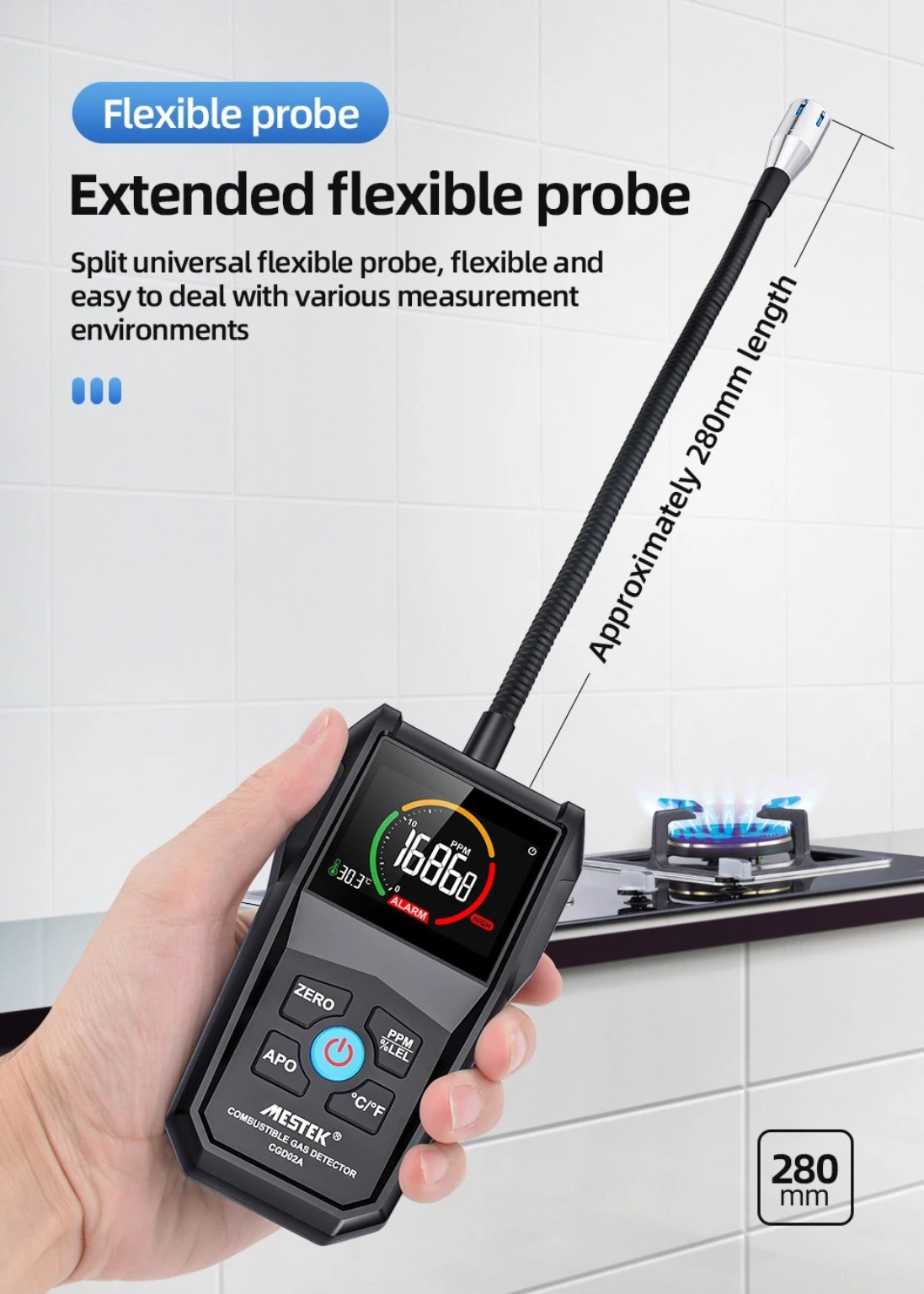
The roughly 27–28 cm gooseneck helps place the sensor close to fittings without pushing the operator's hand behind hot or awkward equipment. It can be shaped to scan valve stems, regulators, threaded joints and the underside of appliance connections while keeping the display visible.
Start in known clean air, allow the full warm-up and verify the detector's response with the manufacturer's approved test gas. Approach from clean air, scan slowly, pause near each potential leak point and repeat from more than one direction. Air movement can dilute or displace a plume, so one quick pass is not conclusive. Never deliberately release fuel gas to test it, and never use a flame to find a leak.
Display, alarms and controls
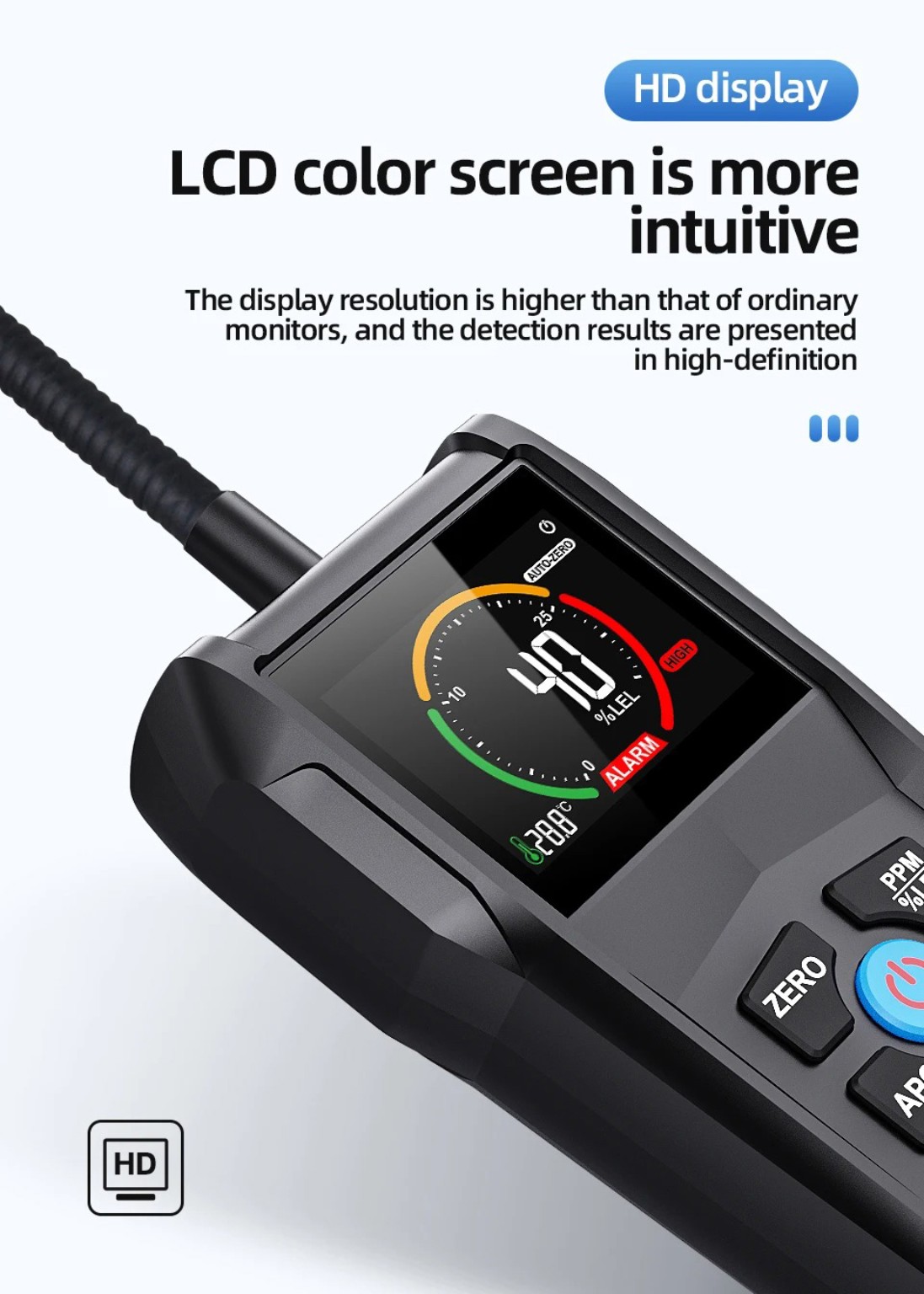
The colour LCD uses a green, amber and red arc around a large numerical reading, with temperature and alarm status shown below. Dedicated keys provide zeroing, ppm/%LEL selection, auto-power-off control and °C/°F switching. This is more readable than a simple bar graph and should help operators see a trend while moving the probe.
A bright display can still show a wrong value if the sensor is poisoned, depleted, contaminated or zeroed in gas. Confirm the audible alarm, visual indication and numerical response before use. Keep alarm settings under procedural control, and treat an alarm as a reason to withdraw and follow the emergency or leak-response plan—not as permission to continue searching for a higher number.
The automatic-zero trap
The seller states that the unit automatically calibrates or zeros after about 30 seconds of startup. That is convenient only when startup occurs in genuinely clean air. If the detector is switched on beside an active leak, it may treat the contaminated background as zero and suppress the subsequent indication.
Power up outdoors or in another confirmed clean-air location allowed by the manual, wait for stabilization, then perform the required functional check. If readings drift or the zero is uncertain, leave the area and repeat the procedure. Automatic zeroing is not a substitute for calibration with a known, traceable gas standard.
Bump checks, calibration and sensor life
A bump or function check exposes the detector to a known combustible-gas challenge to confirm that the sensor and alarms respond. Calibration goes further by adjusting the indication against a known concentration. Both depend on the exact sensor, gas, adapter, regulator flow and procedure specified by the manufacturer.
Before purchase, obtain the English manual and ask for the calibration method, recommended gas and concentration, interval, pass criteria, sensor replacement life and service route. Also ask what the instrument does after a failed check. If a reliable bump and calibration system is unavailable, restrict the device to non-safety-critical experimentation rather than workplace decisions.
Power, package contents and ownership cost
The CGD02A uses three 1.5 V AAA batteries and is advertised to shut down after about ten minutes of inactivity. Replace batteries in a safe location, observe polarity and inspect the compartment for damage or contamination. Confirm whether auto-off can be disabled for longer surveys and how low battery affects the alarm and measurement.
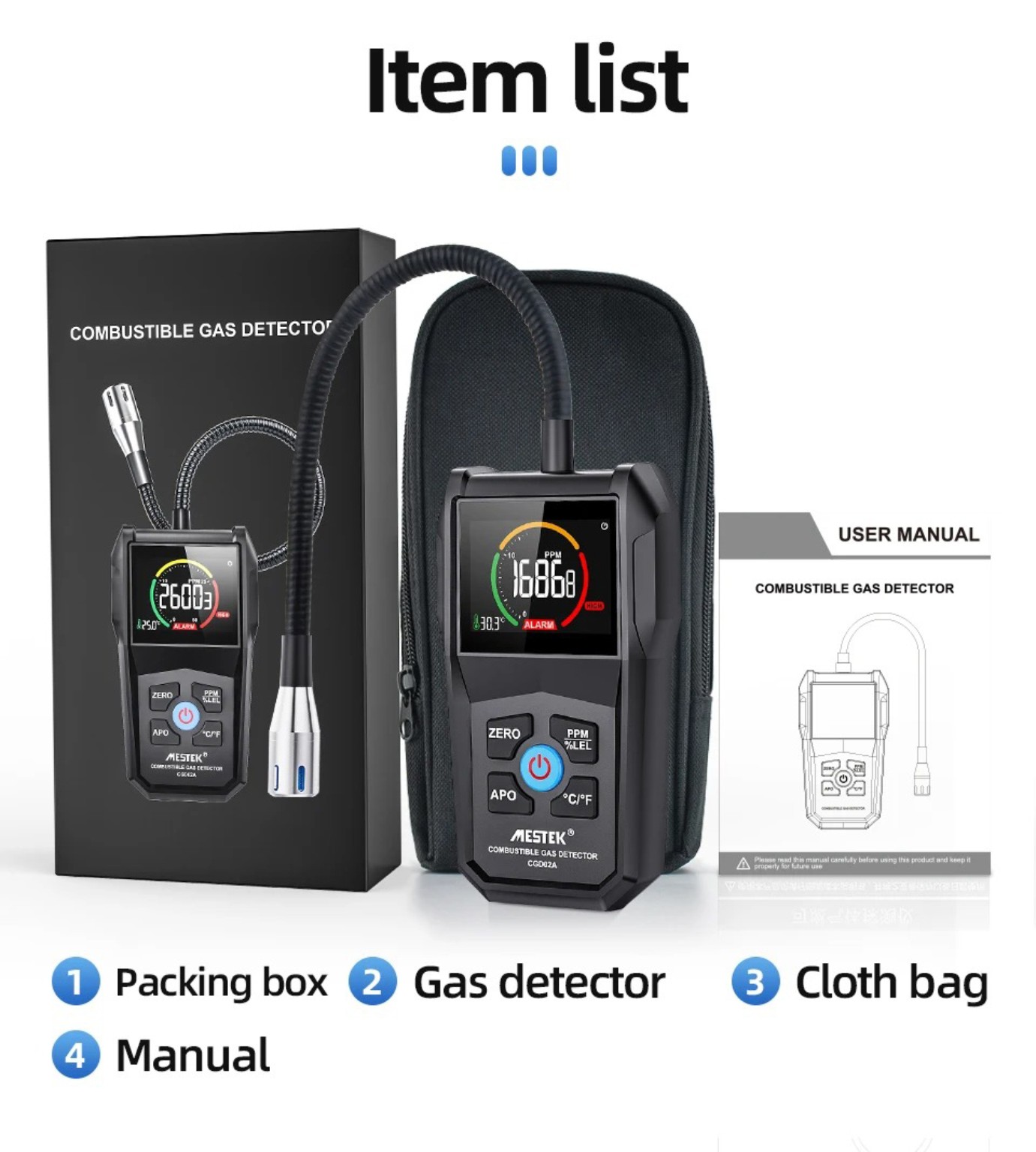
The pictured package contains the detector, retail box, zippered cloth case and manual; batteries and calibration equipment are not shown as included. Budget for quality batteries, approved test gas, a compatible regulator and any service or sensor replacement—not just the purchase price.
Critical safety limitations
Do not carry this detector into a potentially explosive or classified atmosphere unless the exact CGD02A model has an independently verifiable hazardous-location approval that matches the site's gas group, temperature class and zone or division. The supplied images do not establish intrinsic safety. Battery changes, switching and ordinary electronics can introduce ignition risks.
Do not use it for confined-space entry, hot-work clearance, respiratory protection decisions or emergency re-entry. OSHA's confined-space framework requires evaluation of atmospheric hazards, proper testing equipment and a complete control system; this single combustible-gas channel cannot measure oxygen or toxic gases. If gas is suspected indoors, avoid switches and ignition sources, move people to safety, follow the utility or emergency-service instructions and do not remain solely to obtain a reading.
- No demonstrated intrinsic-safety or hazardous-area approval in the supplied listing material.
- No oxygen or toxic-gas channels.
- No gas-species identification.
- No evidence here of data logging, calibration history or failed-test lockout.
- No substitute for fixed alarms, competent leak repair or emergency procedures.
Who should consider it?
The CGD02A may suit a knowledgeable homeowner, appliance technician or maintenance worker who wants a portable indicator for preliminary checks on accessible natural-gas or LPG connections in a non-classified environment, provided local rules allow the task and the instrument is correctly checked.
Choose professional approved equipment instead when results affect entry, evacuation, hot work, statutory inspection, hazardous-area work or worker exposure. A pumped multi-gas instrument, gas-specific detector, ultrasonic leak detector or approved test method may be more appropriate depending on the hazard assessment and objective.
Buyer checklist
Confirm the exact model and documentation before ordering; marketplace photographs may be reused across variants. Save the selected-option page and compare the delivered label, manual and controls with it.
- Exact MESTEK CGD02A model and included accessories.
- Sensor technology, target gases, cross-sensitivity and expected sensor life.
- Methane calibration point, accuracy conditions and response-time definition.
- Approved bump-check and calibration equipment plus written procedure.
- Alarm setpoints, auto-zero behaviour and ability to disable auto-off.
- Verifiable Ex approval if the intended location requires it.
- Warranty, replacement sensor, calibration service and return route.
Final assessment
The MESTEK CGD02A is a visually clear, conveniently shaped combustible-gas leak finder. Its flexible probe, colour display, selectable units and replaceable AAA batteries make it more practical than a minimal beeping wand for tracing trends around accessible fittings.
The instrument's real value depends on disciplined use and documentation, not its screen graphics. Treat the wide gas list and performance figures as seller claims until verified, zero it only in known clean air, prove response before use and keep it out of classified areas without the correct approval. Under those limits it may be a useful first-look tool; outside them it risks creating precisely the false confidence that good gas detection is meant to prevent.
Confirm the exact model, specification, certification evidence, shipping terms and current price before ordering.
Sources
- AliExpress — MESTEK CGD02A combustible gas detector listingPublished Product listing; accessed 20 September 2026
- OSHA — Permit-Required Confined Spaces, 29 CFR 1910.146Published Current standard; accessed 20 September 2026
- OSHA — Procedures for Atmospheric Testing, Appendix B to 1910.146Published Current guidance; accessed 20 September 2026
Daily HSSE updates
Subscribe for practical HSSE updates.
Subscribe for the daily message, selected HSSE news and occasional new-resource alerts from Worksite Safety Hub.