Safety · 10 min read
Seconds to Escape: What the MV June Aster Ferry Fire Teaches About Emergency Readiness
Updated 13 September 2026
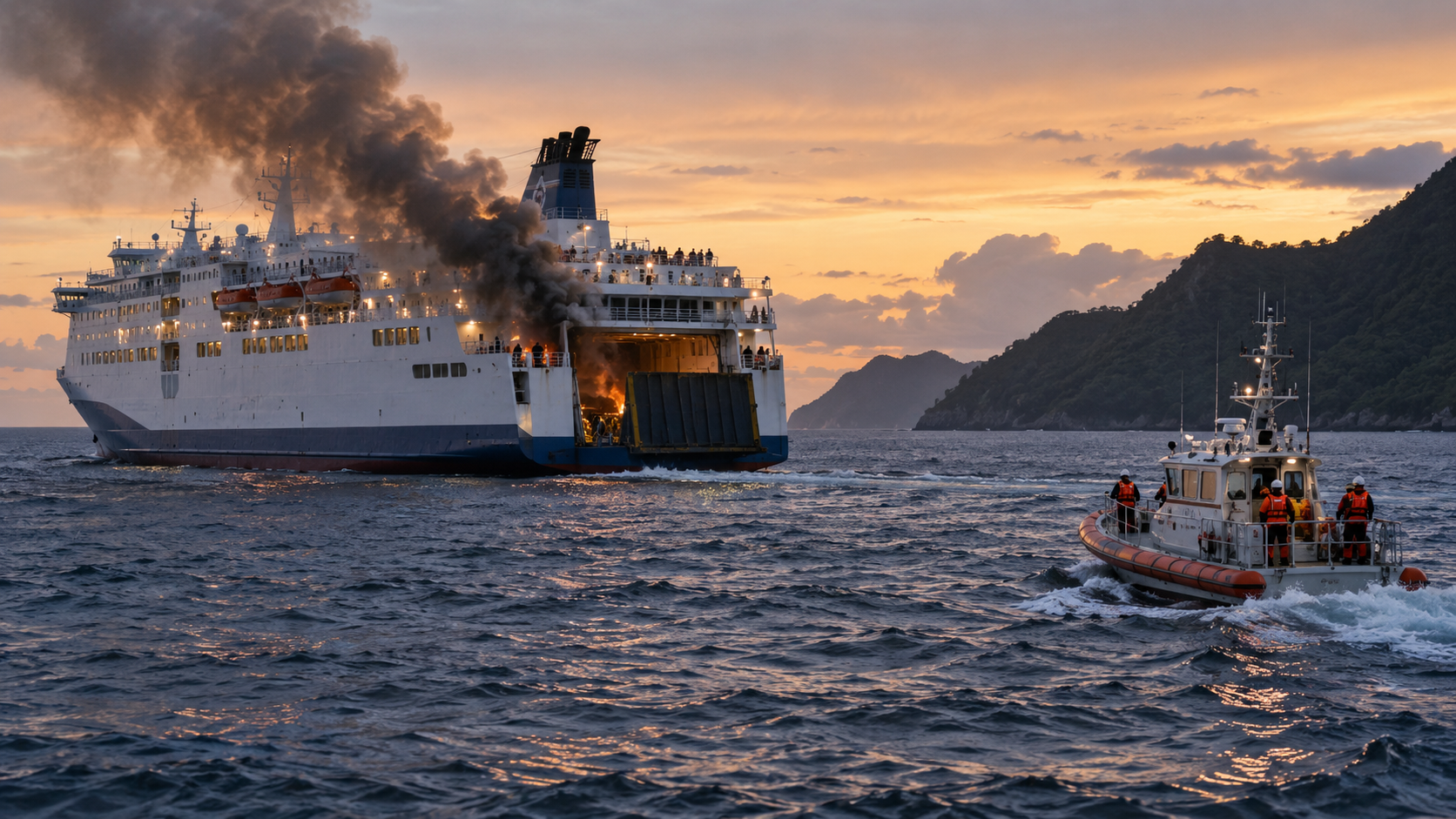
The latest reported toll is 76 deaths, with 13 people unaccounted for. The tragedy reinforces the need for survivable escape routes, reliable personnel accounting and sustained recovery planning.
Latest update · 13 September: 76 deaths, 13 unaccounted for
Authorities reported recovering 41 additional remains on 12 September, bringing the reported death toll to 76, with 13 people unaccounted for. These figures supersede the earlier toll of 35 and remain subject to official reconciliation.
Reuters reported on 13 September that identification could take weeks or months and flooded sections remained unsearched. Investigators had not established the fire's origin or cause. Neither casualty totals nor the presence of any vehicle establish which safety barriers failed.
Beyond evacuation: accounting, recovery and family support
The following are practical planning questions prompted by the incident, rather than findings about this vessel. Emergency arrangements should continue through recovery and identification, with defined responsibilities, sustained resources and respectful communication with affected families.
Maintain a controlled personnel register that distinguishes rescued people, those unaccounted for and officially confirmed fatalities. Record the source, time and verifier for each change. Reconcile boarding changes and reports from hospitals or independent arrivals through the responsible authorities; never calculate a missing-person total from incompatible snapshots.
Appoint a trained family-liaison lead and provide a dependable contact channel. Share verified information privately, explain uncertainty and arrange welfare support. Leave casualty identification and notification to authorised teams; protect personal information and avoid circulating unverified names or images.
Recovery entry requires repeated assessment of structural stability, flooding, heat and atmospheric hazards by competent responders. Define authorisation, monitoring, communications, rescue backup and withdrawal criteria. Preserve evidence under investigation-team direction, while maintaining responder safety as the immediate priority.
- Exercise an emergency that lasts several days, including shift handovers and responder fatigue.
- Test reconciliation when manifest changes and hospital information arrive at different times.
- Assign responsibility for family communication, welfare support and confidential records.
- Reassess each recovery entry as water levels, structure and atmospheric conditions change.
- Keep a decision log and protect evidence without obstructing urgent lifesaving work.
Historical update · 11–12 September: initial rise to 35
On 11 September, responders gained access to the fire-damaged ferry after heat and smoke had prevented entry for more than a day. Philippine authorities reported that 30 additional bodies had been recovered, raising the confirmed death toll from five to at least 35. On 12 September, the recovered bodies were brought ashore for identification, while retrieval and accounting continued. This earlier account is retained as historical context; the 13 September update above supersedes its casualty figures.
Authorities had also verified that two people named on the original manifest did not board. Forty-three people had been reported rescued. These are evolving operational figures, not final investigation findings. Survivor accounts cited by the Maritime Industry Authority described two explosions, but investigators have not determined the origin or cause of the fire. No vehicle or cargo item should be presented as the cause on the basis of its presence aboard.
The new toll makes the survivability question urgent: when smoke blocks an escape path and heat prevents rescuers from entering, people may have no second chance. That is an inference for emergency-planning review, not a finding about where individual passengers were located or how the vessel's systems performed.
- Challenge whether smoke can disable the primary and alternative escape routes at the same time.
- Test emergency lighting, low-level guidance and access to lifejackets under realistic obscured-visibility conditions.
- Reconcile manifests promptly after cancellations and boarding changes; account for people who reach shore independently.
- Set responder entry, backup and withdrawal criteria before teams face pressure to enter a hot, unstable space.
- Include people who need assistance in evacuation drills, without assuming everyone can self-evacuate at the same speed.
What is confirmed—and what remains unknown
At approximately 6:45 p.m. on 9 September 2026, fire engulfed the passenger-and-cargo ferry MV June Aster as it approached Coron in Palawan, Philippines. The original manifest listed 117 passengers and 17 crew members; authorities subsequently found that two listed people had not boarded. On 10 September, the initial reported toll was five dead, 43 rescued and 86 unaccounted for. That was an early snapshot, superseded by the dated update above.
Search operations, identification, survivor interviews and reconciliation of the manifest were continuing. Conflicting early totals are common during a mass-rescue operation, so casualty and missing-person numbers should be updated only from authoritative releases.
A survivor reportedly described a loud explosion followed by smoke and rapidly spreading fire, possibly from the cargo area. The vessel carried general goods, motorcycles, a forklift, a pickup truck and an electric vehicle. Investigators have not established where or why the fire began. The presence of a particular vehicle or cargo item is not evidence that it caused the event.
Why this incident matters beyond passenger shipping
A fire in an enclosed vehicle or cargo space can develop faster than people can interpret incomplete information, raise an alarm, reach the location and apply effective suppression. Smoke can make familiar escape routes unusable, disable equipment, obscure signs and separate families or workgroups. Heat can weaken structure, threaten fuel and pressurised systems and make entry unsafe for rescuers.
This escalation pattern is relevant to roll-on/roll-off vessels, offshore accommodation units, warehouses, parking structures, tunnels, battery-storage rooms, logistics hubs and any worksite where mixed cargo and people share limited escape routes. The durable lesson is not to guess the ignition source. It is to test whether the system can detect, contain, communicate and evacuate quickly enough when the initiating event is still uncertain.
Inspection compliance is a starting point, not a fire scenario
Authorities reported that the ferry had passed safety inspections and was operating below its stated passenger capacity. Those facts matter, but they do not demonstrate how every barrier performed during the emergency. A certificate records compliance at a point in time; it cannot replace effective cargo control, maintained equipment, alert watchkeepers, practised crews and passengers who can reach lifesaving appliances under smoke-filled conditions.
HSSE assurance should therefore connect documentary compliance with field performance. Inspectors and operators should ask whether detection reaches concealed spaces, whether fire doors and dampers close as designed, whether hydrants and fixed systems can operate throughout the event, and whether escape routes remain usable after the first route is lost.
Treat cargo acceptance as a safety-critical barrier
Mixed passenger-and-cargo operations depend on accurate declarations. Undeclared fuel, damaged batteries, incompatible chemicals, leaking cylinders or poorly secured vehicles can change both the likelihood of fire and the correct response. Acceptance controls should identify what is being carried, its condition, where it will be stowed and which emergency information the crew requires.
Electric vehicles and other battery-powered equipment require competent, risk-based controls, but they should not be blamed merely because they were present. The practical response is to review applicable maritime requirements, manufacturer guidance, charging restrictions, damaged-battery criteria, segregation, thermal monitoring and firefighting capability for the actual cargo profile.
- Verify declarations rather than relying only on a shipper's description.
- Reject leaking, damaged, overheating or improperly packaged items.
- Control ignition sources and unauthorised charging in cargo spaces.
- Secure vehicles and machinery against movement and accidental activation.
- Give watchkeepers immediate access to cargo locations and hazard information.
Detection must create usable decision time
An alarm is valuable only if it is early, credible and linked to action. Smoke, heat, flame or gas detection should suit the geometry and ventilation of the protected space. Testing must demonstrate that a developing fire will be detected under realistic airflow and loading arrangements—not simply that the panel receives a signal from a test device.
The response sequence should define who verifies an alarm, who stops ventilation or fuel systems, who releases fixed suppression, who broadcasts emergency instructions and what conditions trigger immediate abandonment. Requiring visual confirmation before acting can consume the margin that early detection was designed to provide.
Design for escape when the normal route disappears
Emergency plans often assume orderly movement along the primary route. A real fire may fill that route with toxic smoke within minutes. Alternative escape paths, emergency lighting, low-level markings, fire doors and clear access to lifejackets must remain available after normal lighting and communications are lost.
Passenger information should be understandable without specialist maritime knowledge and usable across relevant languages and accessibility needs. Crew must be positioned to direct people, prevent dangerous counterflow and stop re-entry for belongings. Children, older passengers, people with disabilities and anyone unfamiliar with the vessel may need direct assistance rather than a general announcement.
- Walk every escape route under simulated loss of lighting and reduced visibility.
- Check that cargo, vehicles and temporary items cannot obstruct exits.
- Ensure lifejackets remain reachable if cabins or usual muster routes are inaccessible.
- Provide redundant alarms and public-address capability backed by portable methods.
- Practise accounting when passengers enter the water or reach shore independently.
Drills should recreate pressure, not choreography
A familiar daytime drill with announced start conditions can create confidence without testing the hardest decisions. Scenarios should include a night alarm, rapid smoke spread, an unavailable stairway, a missing person, damaged communications, an unresponsive passenger and a developing list. The objective is not theatrical realism; it is to reveal where information, authority, equipment or coordination breaks down.
Drills should also test closed-loop communication. Critical instructions need acknowledgement and completion reports. If a team cannot confirm that ventilation stopped, a boundary cooled or a compartment cleared, the command team must treat the action as incomplete.
Protect rescuers from becoming additional casualties
The Philippine Coast Guard reported that heat, smoke and explosion risk prevented immediate entry to the damaged vessel. That is an important operational lesson. Urgency does not remove the need for structural assessment, atmosphere monitoring, suitable respiratory protection, backup teams, communications and a controlled entry plan.
Incident commanders must balance survivability information against the hazards to responders. A burning or listing vessel can change orientation, lose watertight integrity or expose teams to stored energy and hazardous cargo. Re-entry limits, withdrawal triggers and accountability should be agreed before teams commit.
Emergency response is a network
The response involved coastguard, military and civilian vessels, local fishermen and private operators. In remote or island settings, nearby crews may reach survivors before specialised resources. Plans should identify those capabilities in advance, establish compatible communications and clarify how volunteers are directed without exposing them to uncontrolled hazards.
Shore reception is part of the same emergency. Survivors may be dispersed across boats and landing points, making medical triage, identity confirmation and family information difficult. A robust plan connects search and rescue with hospitals, local authorities, welfare support, environmental response and an auditable process for reconciling the manifest.
Questions HSSE leaders should ask now
Use this incident as a prompt to test one location where fire, mixed cargo and limited escape time could combine. Keep the review focused on barrier performance rather than unverified explanations of the June Aster fire.
- How do we identify undeclared, damaged or incompatible cargo before loading or storage?
- What is the longest credible time from ignition to detection, alarm and first control action?
- Which escape route is most vulnerable to early smoke, and what is the tested alternative?
- Can people reach lifesaving equipment when cabins, normal stairs or lighting are unavailable?
- Who has authority to release fixed suppression or order evacuation without delay?
- Do drills test nighttime conditions, incomplete information and communications failure?
- What conditions make rescue entry unacceptable, and who can order withdrawal?
- Can we reconcile every employee, contractor, passenger or visitor during a dispersed evacuation?
Learn without outrunning the investigation
Major incidents create pressure to identify a single failed item quickly. That pressure can turn preliminary testimony into a conclusion and distract from the system of barriers that should prevent escalation. Organisations can act now by verifying their own cargo controls, detection, escape arrangements and emergency coordination without claiming to know what caused this tragedy.
When the Philippine authorities release verified findings, HSSE teams should compare them with the assumptions used in their review and update controls accordingly. Responsible learning is both urgent and disciplined: strengthen obvious vulnerabilities immediately, preserve uncertainty where evidence is incomplete and revise the lesson when facts change.
Sources
- Ferry victims may take months to identify — ReutersPublished 13 September 2026
- Death toll rises to 76 — ReutersPublished 12 September 2026
- Official incident updates — Philippine Coast GuardPublished 9–12 September 2026
- Philippine ferry fire death toll jumps to 35 — ReutersPublished 11 September 2026
- Bodies from charred Philippine ferry arrive at port — Associated PressPublished 12 September 2026
- Philippines deploys vessels as rescuers seek access to burned ferry — ReutersPublished 10 September 2026
- A fire that burned overnight on a passenger ferry leaves at least 5 dead — Associated PressPublished 10 September 2026
Daily HSSE updates
Subscribe for practical HSSE updates.
Subscribe for the daily message, selected HSSE news and occasional new-resource alerts from Worksite Safety Hub.