Safety · HSSE Watch
Rigging Competency: Prepare for Canada’s National Standard
Published
WorkSafeBC announcement: 28 October 2026 · Worksite Safety Hub article: 29 October 2026
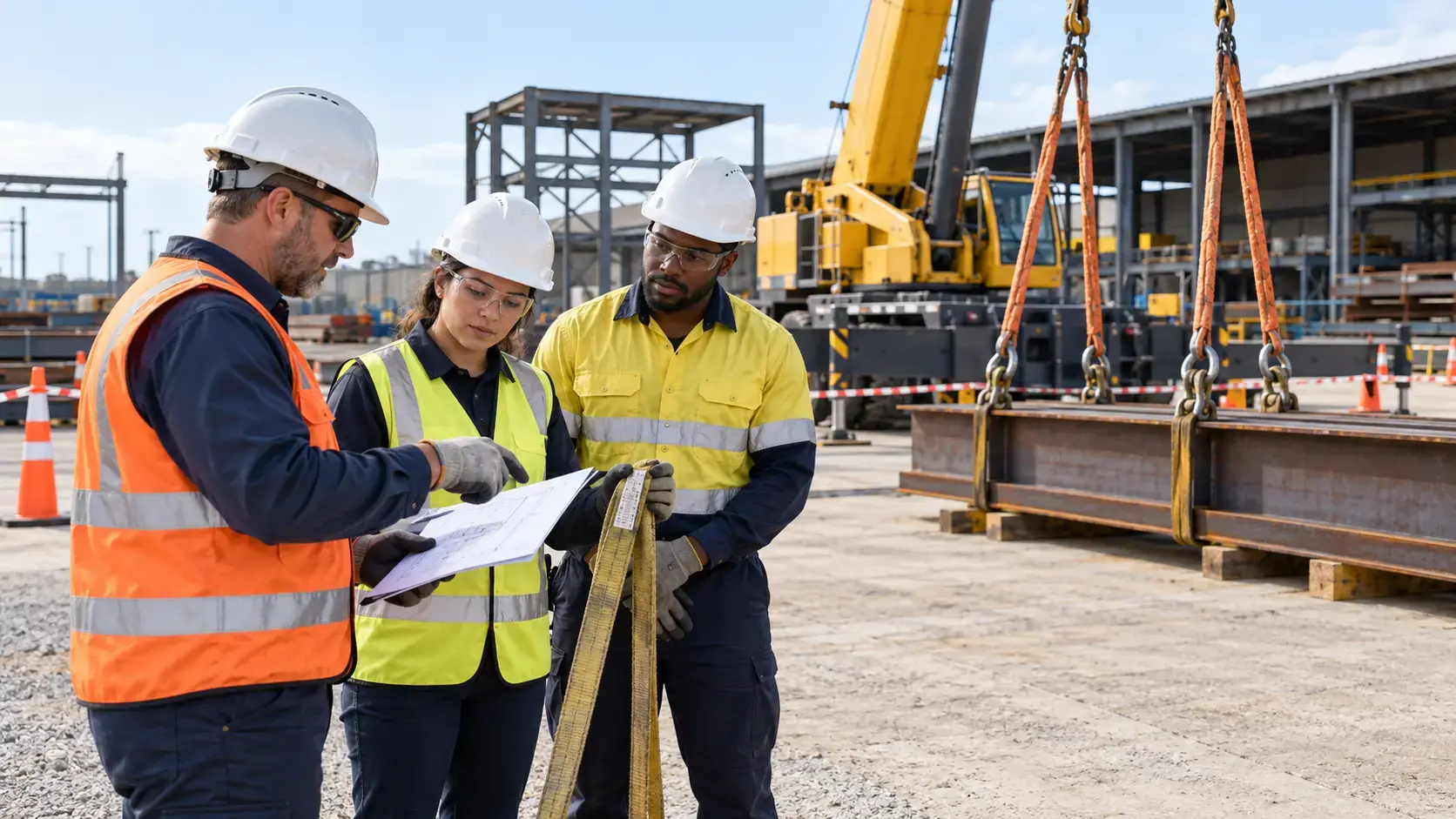
A training card can show that a course was completed. It does not, by itself, prove that a person can select, inspect, configure and control rigging safely for the load, equipment and work environment in front of them. A new Canadian standards project makes that distinction explicit and gives lifting teams a useful reason to strengthen competency assurance now.
What changed on 28 October 2026
WorkSafeBC announced ↗ that CSA Group and WorkSafeBC have agreed to accelerate development of a national standard for rigging and hoisting competencies in Canada. The proposed standard is intended to define a nationally recognized baseline of knowledge, skills and abilities for construction, manufacturing, transportation, energy and marine operations.
WorkSafeBC says the proposed standard is expected to scale competency requirements to task complexity, support valid and practical competency assessment and certification, clarify employers’ responsibility to assess competency in the specific work environment, and require competence to remain current as practices, equipment and hazards change.
Development is beginning in autumn 2026. Consultation is expected in spring 2027 and implementation in late 2027. WorkSafeBC is also conducting a comprehensive review of Part 15 of British Columbia’s Occupational Health and Safety Regulation, with anticipated revisions to training, assessment and qualification requirements.
Why the development matters
Regulatory requirements for rigging already exist across Canada, but WorkSafeBC says competency expectations vary. That variation can create weak points when workers, contractors and equipment move between provinces, employers or industries. A common benchmark can improve consistency, but a national certificate will still need to be translated into the actual task and worksite.
The most important practical message is already visible in the proposal: competence should be demonstrated, proportional to complexity, site-specific and current. Those principles apply whether the lift uses a small shop hoist, a mobile crane, a vessel crane, a gantry system or equipment being used temporarily for lifting.
1. Build a task-based competency matrix
List the rigging activities people are authorized to perform rather than relying on a single label such as “rigger.” Distinguish routine load attachment, sling and hardware inspection, signalling, blind lifts, multiple-crane work, engineered lifting points, personnel lifting, offshore or marine lifts, unusual load geometry and critical lifts.
For each activity, define the knowledge, practical skill, supervision and decision authority required. Include the limits of authorization. A person competent to attach a known load under direct supervision may not be competent to select the entire rigging arrangement for a complex lift.
2. Assess performance under representative conditions
Use practical assessment that reflects the equipment, load information, communication method, weather or environmental conditions and space constraints found at work. Ask the candidate to explain decisions, identify defects, calculate or verify load effects where required, select compatible components and respond to a changed condition.
Written questions can test knowledge, but they cannot show whether a person notices a damaged sling, reads an identification tag correctly, recognizes side loading, establishes a safe landing arrangement or gives an unambiguous stop signal. Keep people clear of exposure while assessment scenarios are conducted.
3. Verify assessors and evidence
Define who is competent to assess each level of work and how impartiality is protected. The assessor should understand the applicable regulation, equipment, rigging methods and work environment. A supervisor signing a familiar worker’s form without observing the task is not reliable verification.
Records should identify the person assessed, date, task scope, equipment or rigging categories, assessment method, assessor, result, restrictions and required reassessment. Avoid generic records that cannot show what the person was actually assessed to do.
4. Keep competence current
Set reassessment triggers based on risk, not only a calendar. Triggers may include a long gap in practice, change of role, new lifting equipment, different rigging technology, a revised standard, an incident or near miss, repeated defects, changed load types, or evidence that procedures are not being followed.
Refresher training is useful when it addresses an identified gap. It should not become an automatic substitute for observing whether the worker can still perform the task and make sound decisions.
5. Control contractor and cross-border interfaces
Before work starts, compare contractor credentials and assessment evidence with the site’s task categories. Confirm signals, radio language, lift-plan roles, inspection standards, stop-work authority and who accepts the rigging arrangement. Resolve differences before the load is connected.
Where certificates come from different jurisdictions or training providers, do not guess equivalence. Use a competent review and, when necessary, a site-specific practical verification. Procurement and scheduling pressure should not decide whether competence is accepted.
6. Connect competence to lift planning and supervision
A competent rigger still needs accurate load information, suitable equipment, controlled ground or deck conditions, a defined travel and landing path, exclusion zones and effective supervision. Competence assurance is one barrier in the lifting system, not permission to compensate for a weak plan.
Supervision should match complexity and the team’s demonstrated capability. Make the stop signal universal and ensure any person can call it when the load, equipment, communication or environment differs from the plan.
7. Prepare for the consultation
Canadian employers, workers, unions, training providers and technical specialists should preserve evidence from assessments, incidents, observations and difficult lifts so consultation feedback is specific. Test whether proposed categories and assessment methods will work for small employers, remote sites, marine operations, maintenance shutdowns and complex industrial projects.
Track the official CSA Group and WorkSafeBC process rather than relying on social-media summaries. Review internal programmes when draft requirements become available, but do not claim compliance with a standard that has not yet been finalized.
Leadership and toolbox questions
- What exact rigging tasks is each person authorized to perform?
- When was competence last observed under representative conditions?
- Who is qualified and sufficiently independent to assess the task?
- Which changes trigger reassessment before the next lift?
- How do we verify contractor credentials against our actual lift?
- Can every team member stop the lift without hesitation?
- What evidence would show that competency remains current?
Authoritative video availability
No directly relevant WorkSafeBC or CSA Group video explaining the 28 October standards project was verified at publication. General lifting videos were not embedded because they do not explain the proposed standard or consultation timetable.
Sources and dates
- WorkSafeBC — CSA Group to develop national standard for rigging and hoisting competencies ↗Official news release published 28 October 2026. Primary source for the proposed scope, development process and timetable.
- WorkSafeBC — Rigging resources ↗Official current guidance page. States that rigging must be performed by qualified workers or under their direct supervision.
- WorkSafeBC — OHS Regulation Part 15: Rigging ↗Current British Columbia regulatory text. The proposed national standard is not a replacement for duties already in force.
- WorkSafeBC — Guidelines Part 14: crane and hoist competency ↗Supporting official guidance on demonstrating and documenting competency for equipment and responsibilities. It is not the proposed rigger standard.
Sources checked 29 October 2026. Source statements and original practical applications are distinguished above. Always consult current official advice and applicable local requirements.
Share the lesson
Open the separate 9:16 Pinterest poster
Illustrative prevention visual, not an actual project, incident or technical operating procedure. HSSE TIPS branding appears only in the designed poster footer.
Your experience matters
Share your thoughts on this page
Have a question, a useful experience or a suggestion? Add your input below.
Comments are public. Keep them respectful and relevant. Do not share contact details, confidential information or emergency reports.
Comments on this page
Loading comments…