Safety · HSSE Watch
Non-Routine Lifting: Plan the Load Before It Moves
Published
Incident: 24 March 2025 · Sentencing: 23 October 2026 · HSE publication and Worksite Safety Hub article: 26 October 2026
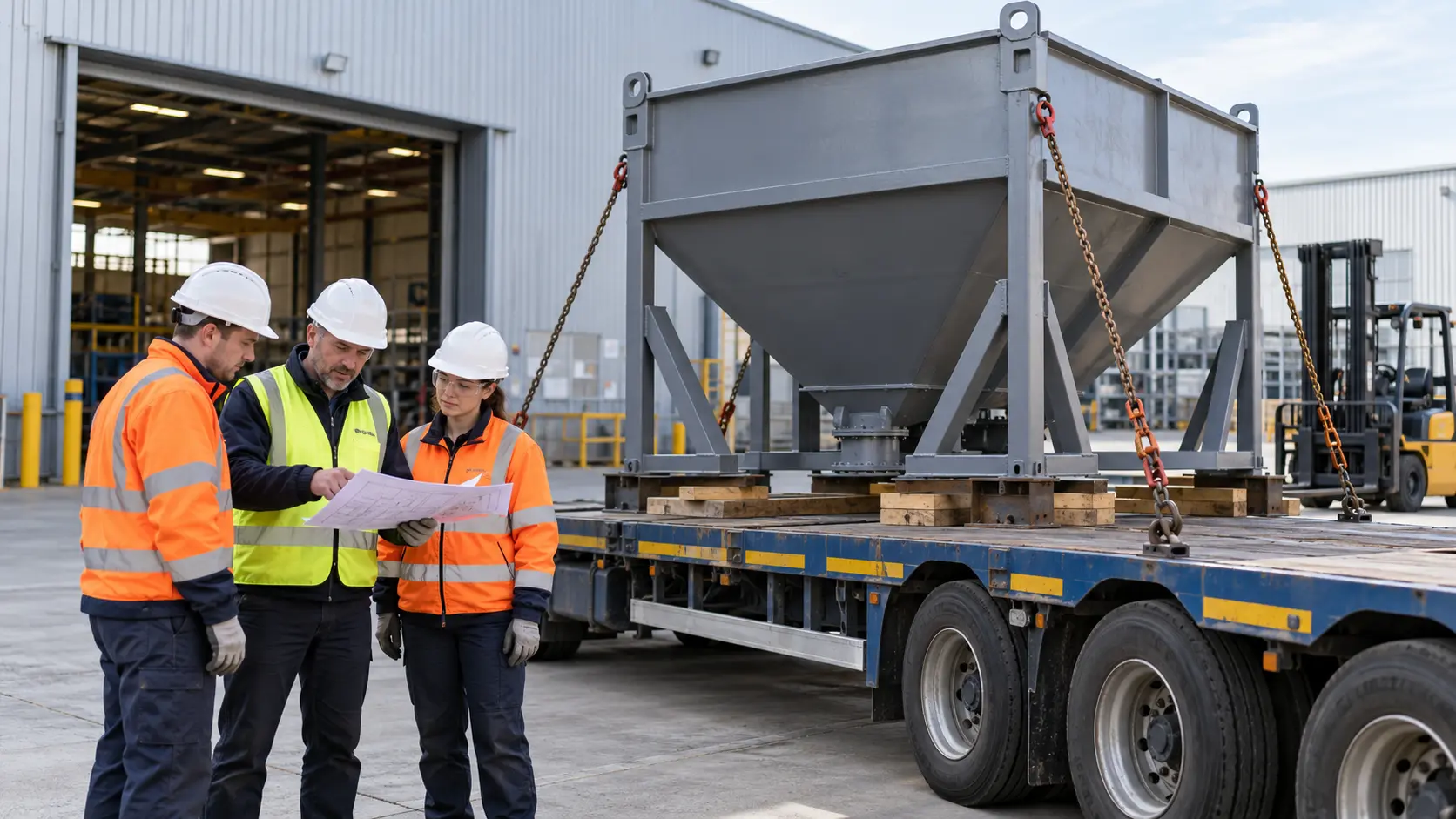
A lift that happens rarely can be more dangerous than one performed every day. A UK prosecution involving a one-tonne metal hopper shows why an unfamiliar load must not be moved until its weight, centre of gravity, lifting points, equipment, sequence and exclusion zone have been properly planned.
What happened
According to the Health and Safety Executive’s official enforcement release ↗, workers at E H Hassell & Sons Limited were unloading steel components for a large filtration system from a lorry trailer on 24 March 2025. The task was not routine for the site and there was no established unloading system.
The workers attempted to move a one-tonne metal hopper using a forklift with its forks beneath the unsecured load. The hopper slid from the forks and struck 63-year-old Gary Taylor, who was standing alongside it. HSE reports that he sustained fractures to his skull, neck and spine, two broken ribs and a severe forehead laceration. He spent three weeks in hospital, was unable to work for seven months and continues to experience significant consequences.
HSE found that the lifting operation had not been properly planned by a competent person. The load’s weight, size, centre of gravity and lifting points had not been adequately assessed, and there was no safe system of work.
The company pleaded guilty to breaching Regulation 8(1) of the Lifting Operations and Lifting Equipment Regulations 1998. Birmingham Magistrates’ Court fined it £300,000 and ordered it to pay £5,690 in costs on 23 October 2026. HSE published the case on 26 October 2026.
Why the lesson travels beyond one factory
The same risk pattern appears wherever teams receive, unload, position or install an unfamiliar heavy item: a fabrication shop, construction site, warehouse, mine, utility, offshore base or maintenance shutdown. The equipment may be familiar, but the load and sequence are not.
A forklift’s rated capacity alone does not prove that it is suitable for a particular lift. Capacity changes with load centre, attachment, mast height and operating conditions. An awkward object can also slide, roll or rotate before the equipment becomes overloaded. The whole system—not only the machine—must be assessed.
1. Recognise the non-routine lift early
Flag loads that are unusual in weight, shape, packaging, centre of gravity, lifting points, fragility or delivery method before the vehicle arrives. Do the same when the normal crane, attachment, unloading bay or experienced team will not be available.
Purchase orders and delivery plans should require the supplier to provide the information needed for safe unloading. “We will work it out when it arrives” is a warning that the task has not been planned.
2. Verify the load data
Confirm the actual weight, dimensions, centre of gravity, engineered lifting points and structural condition. Use drawings, markings and supplier information that can be traced to the item. If essential information is missing or inconsistent, treat that uncertainty as a stop condition.
Do not assume that a symmetrical-looking object has a central centre of gravity. Internal components, openings and asymmetric fabrication can make the load behave differently from its appearance.
3. Select a method for the task—not simply the equipment at hand
Choose equipment and accessories only after understanding the load and the complete movement. Confirm capacity at the intended load centre and configuration, compatibility of attachments, restraint against sliding or rotation, required clearances and a controlled way to land the load.
Where forks are proposed, verify that the load is designed to be supported that way and can be positively secured. Improvised contact beneath an unsecured object should trigger a competent reassessment.
4. Plan the full sequence
Cover vehicle positioning, restraint removal, attachment, test lift, travel or slewing, final placement and de-rigging. Check ground and floor capacity, overhead hazards, gradients, weather, visibility, lighting and interactions with other work.
The HSE lifting-operation guidance ↗ says lifting operations must be properly planned by a competent person, appropriately supervised and carried out safely. The level of detail should be proportionate to the risk, with written planning for complex lifts.
5. Prevent sliding, rolling and rotation
Identify every direction in which the load could move unexpectedly. Use engineered lifting points, suitable accessories, positive restraint and stable support arrangements. Confirm that packaging, pallets, temporary frames or trailer restraints will not be mistaken for lifting points.
A trial lift should be small and controlled. Check balance, attachment security, equipment response and clearances before continuing. If the load shifts or behaves differently from the plan, lower it to a safe position and re-plan.
6. Keep people out of the line of fire
Define an exclusion zone that covers the load’s possible fall, slide, swing and overturn paths—not merely the space directly beneath it. No one should stand alongside an unsecured load or between it and a fixed object.
Use planned tag lines or remote controls only where they reduce risk and cannot pull a worker into danger. A person must never be used as the control that compensates for an unstable load.
7. Assign competence and supervision
Name the person responsible for planning and the person supervising the operation. Competence should match the complexity of the task and include the ability to challenge uncertain load data, unsuitable equipment and changing site conditions.
Everyone involved should understand the plan, communication method, exclusion zone and stop signal. One person should coordinate the movement, with clear authority to stop it.
8. Use a pre-lift hold point
Before releasing transport restraints or raising the load, verify the load data, equipment configuration, lifting accessories, route, landing area, ground conditions, communications and emergency arrangements. Confirm that barriers are in place and unnecessary people are clear.
State the conditions that require a stop: missing information, damaged lifting points, equipment different from the plan, poor visibility, people entering the zone, unexpected movement or a change in the load’s condition.
Leadership and toolbox questions
- What evidence confirms the load’s weight and centre of gravity?
- Where are the manufacturer-approved lifting or support points?
- Why is this equipment and attachment suitable for the complete movement?
- Who planned the lift, and who will supervise it?
- Where could the load slide, rotate, fall or trap a person?
- What is the exclusion zone, and how will it be maintained?
- What observation will stop the job and require a new plan?
- How will the load be landed and de-rigged without anyone entering danger?
What remains specific to the case
The official release establishes the prosecution findings described above. It does not provide every detail of the equipment configuration, individual decisions or internal conversations. Those gaps should not be filled with speculation. The broad prevention lesson is the absence of competent planning and a safe system for a non-routine lift.
Video availability
No directly relevant authoritative, embeddable video for this occurrence was verified at publication. No unrelated forklift or lifting footage has been added.
Sources and dates
- UK Health and Safety Executive — manufacturing company fined after worker was seriously injured ↗Official enforcement release published 26 October 2026. Primary source for the incident, injuries, investigation findings, plea, fine and costs.
- UK Health and Safety Executive — planning and organising lifting operations ↗Official guidance on competent planning, written plans for complex lifts, foreseeable risks, load security, supervision and keeping people away from loads.
Sources checked 26 October 2026. Source statements and original practical applications are distinguished above. Always consult current official advice and applicable local requirements.
Share the lesson
Open the separate 9:16 Pinterest poster
Illustrative visual, not an actual incident or a technical procedure. HSSE TIPS branding appears only in the designed poster footer.
Your experience matters
Share your thoughts on this page
Have a question, a useful experience or a suggestion? Add your input below.
Comments are public. Keep them respectful and relevant. Do not share contact details, confidential information or emergency reports.
Comments on this page
Loading comments…