Safety · HSSE Watch
Temporary Warehouse Routes: Control the Change Before Vehicles Move
Published
Incident: 14 November 2024 · Sentencing: 20 October 2026 · HSE publication: 23 October 2026 · Article published 24 October 2026
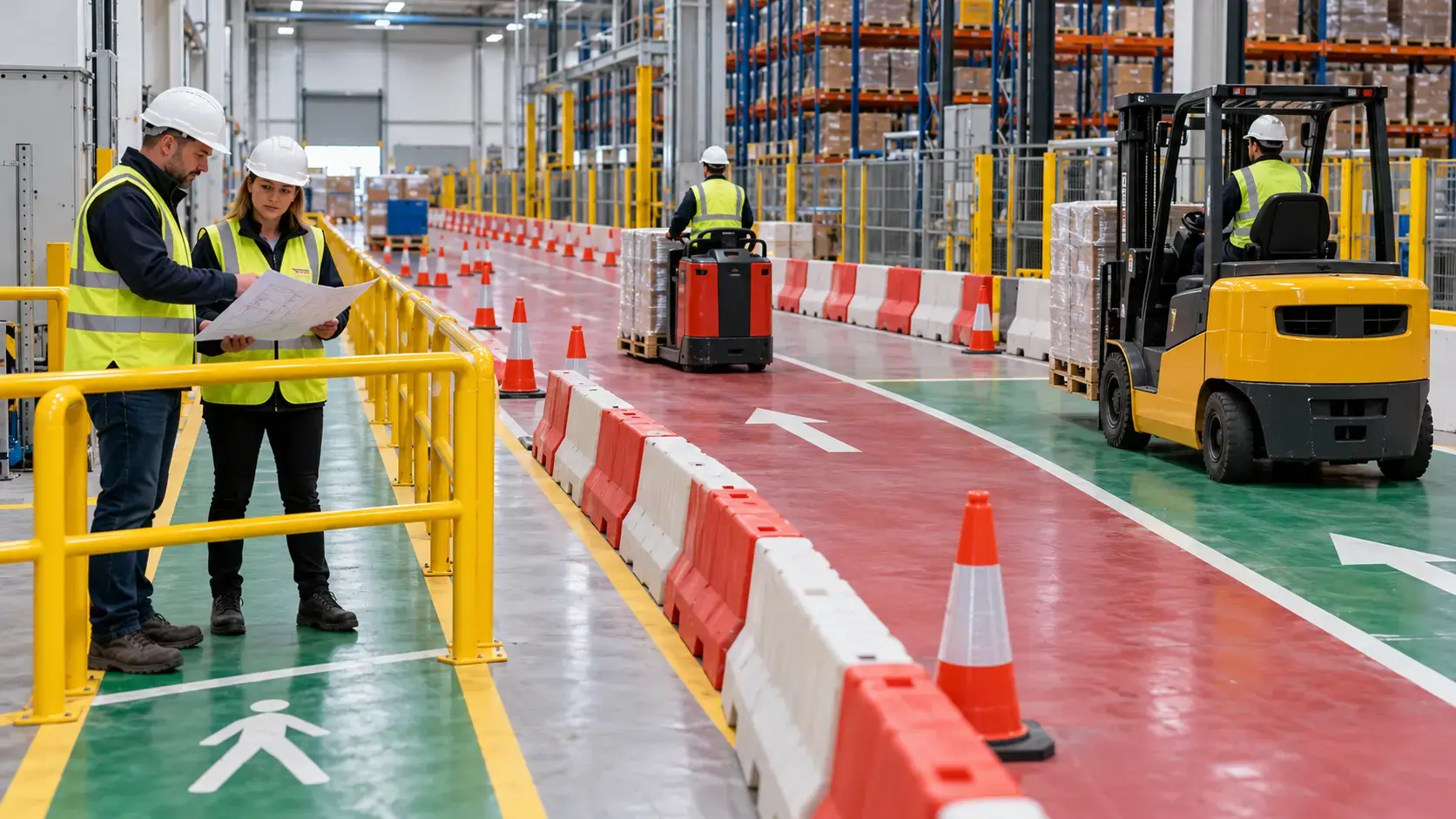
Temporary routes are still traffic systems. HSE's prosecution of a bed-springs company shows how an installation project can change normal vehicle movements, create a new conflict point and expose workers when the wider workplace-transport risk is not assessed before the change goes live.
What happened and what the court heard
HSE reported ↗ that on 14 November 2024, a 20-year-old worker riding a pallet truck collided with a forklift during the installation of automated machinery. The worker sustained multiple fractures to his foot and longer-term nerve damage.
According to HSE, temporary changes to vehicle routes meant pallet trucks and forklifts used the same routes in a busy loading area. Visibility was limited and vehicle movements had increased. HSE found that the changes had not been properly risk assessed: the company concentrated on the installation work but failed to consider its wider effect on workplace transport.
The company pleaded guilty and was fined £80,000 with £3,374 costs at sentencing on 20 October 2026. These are confirmed HSE investigation and court-outcome facts. This article does not add a cause beyond the regulator's published findings.
Why this is a management-of-change lesson
A temporary route can alter who meets whom, where they meet, the available sight distance, traffic density, turning space and pedestrian escape options. Cones or a marked line may show the intended route, but they do not by themselves eliminate a vehicle conflict.
Treat material traffic changes as controlled operational changes. Define the change, assess interfaces, select controls, communicate them, verify the route in use and set clear conditions for stopping or restoring the original layout.
1. Approve the route before barriers move
Name the person who owns the temporary traffic plan and the person authorised to release it. Record why the change is needed, the exact area and duration, affected vehicle and pedestrian groups, contractor interfaces and the route-restoration plan.
Do not let installation pressure turn a planned change into an informal detour. If the assessed layout cannot be implemented, pause and reassess before traffic uses a different arrangement.
2. Map every movement and conflict point
Follow HSE's workplace-transport guidance ↗: map vehicle and pedestrian movements, deliveries, reversing, crossings, loading, parking and shift changes. Include maintenance, cleaning, emergency access and unusual loads—not only the project's main vehicles.
Check whether previously separate vehicle types now share a route, whether movements have increased, and whether racking, stored goods, machinery, screens or temporary works restrict sight lines.
3. Build separation into the layout
Use physical segregation, separate doors or time windows, one-way travel, protected crossings and controlled access where practicable. Set speed and priority rules that fit the available visibility and stopping distance. Avoid relying on drivers making eye contact at a blind corner.
Where separation is temporarily impossible, reduce simultaneous movements and introduce a competent traffic controller or other engineered and administrative controls justified by the assessment. High-visibility clothing is a supporting measure, not a substitute for a safe layout.
4. Test the route under representative conditions
Before release, walk and drive the proposed route at representative traffic levels. Check mirrors, lighting, audible and visual warnings, turning clearance, surface condition, doorways and sight distance from each relevant vehicle position. Include the least-visible vehicle and the busiest credible period.
Observe the first movements. Stop the change if vehicles encroach on protected space, workers improvise a shortcut, queues block sight lines or the planned controls cannot be maintained.
5. Control handovers, contractors and restoration
Brief drivers, pedestrians, contractors, supervisors and security before the route changes. Use a simple marked plan at entrances and handover points, and remove superseded signs. Confirm language and literacy needs and check understanding through observation.
Review the change after each layout or production alteration, incident, near miss or visibility complaint. When the project ends, inspect and formally release the restored route rather than assuming normal arrangements have returned.
Leadership and toolbox questions
- What changed in our traffic system—not only in the project area?
- Which vehicle or pedestrian groups now share space that was previously separated?
- Can each driver see and stop before every conflict point?
- What hard separation prevents a mistake becoming a collision?
- Who authorises the temporary route, observes first use and can stop it?
- How will the next shift and every contractor know the current layout?
- What triggers reassessment or restoration?
Authoritative video
HSE — CCTV footage captures moment warehouse worker injured in forklift collision. HSE embedded this footage with its official press release. It depicts a real collision and injury and should be used carefully for learning, not replayed for shock value. Watch the official HSE-linked video directly ↗.
Sources and dates
- Health and Safety Executive — Bed springs company fined after worker injured in warehouse collision ↗Published 23 October 2026. Primary source for the incident, investigation findings, court outcome and HSE inspector statement.
- Health and Safety Executive — Workplace transport risk assessment ↗Official guidance on mapping vehicle and pedestrian movements, route separation, crossings, lighting and driver competence.
- Health and Safety Executive — Workplace transport hub ↗Official workplace transport guidance and topic index for employers.
- Health and Safety Executive — CCTV footage of the warehouse collision ↗Direct video linked and embedded by HSE with its official press release. The footage depicts a real collision and injury.
Sources checked 24 October 2026. Source statements and original practical applications are distinguished above. Always consult current official advice and applicable local requirements.
Share the lesson
Open the separate 9:16 Pinterest poster
Illustrative visual, not an actual incident or a technical procedure. HSSE TIPS branding appears only in the designed poster footer.
Your experience matters
Share your thoughts on this page
Have a question, a useful experience or a suggestion? Add your input below.
Comments are public. Keep them respectful and relevant. Do not share contact details, confidential information or emergency reports.
Comments on this page
Loading comments…