Safety · Product Reviews · 11 min read
Remote Laser Methane Detector Review: Is 30-Metre Non-Contact Leak Screening Worth It?
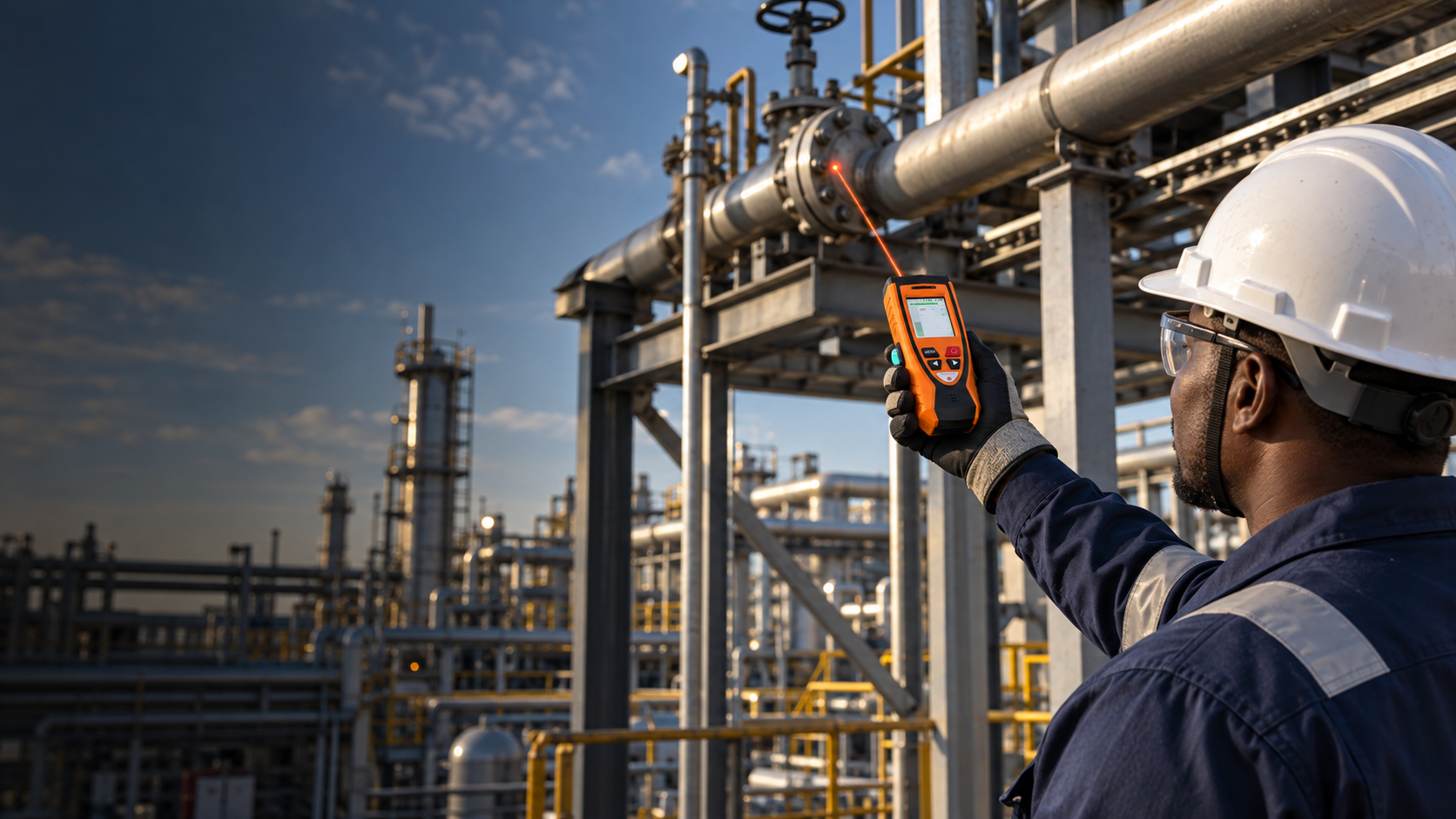
A safety-led review of the orange handheld remote laser methane detector advertised for non-contact CH₄ screening up to 30 metres, with practical guidance on ppm·m readings, field use, limitations and buyer checks.
Affiliate disclosure and review basis
This article contains an affiliate link. Worksite Safety Hub may earn a commission if you make a qualifying purchase through it, at no additional cost to you. This independent review is based on the supplied product images and marketplace information; we have not personally field-tested or calibrated the exact instrument.
The listing presents an orange-and-black handheld optical methane detector with a colour display. Marketplace options, firmware, certificates and accessories can change. Treat the range, response, storage, battery and protection figures discussed below as advertised claims until the seller provides model-specific documentation for the exact unit selected.
Quick verdict
This detector addresses a valuable problem: screening elevated, fenced-off or otherwise difficult-to-reach methane leak points without placing the operator directly beside the suspected source. Its compact enclosure, colour display, visual and audible alarms, rechargeable battery and automatic record storage make the concept attractive for rapid route-based surveys.
The strongest limitation is also fundamental to how the instrument works. It reports methane integrated along the laser path, commonly expressed as ppm·m, rather than a conventional local ppm reading at the leak point. It should therefore be used as a screening and localisation aid within a competent leak-detection programme—not as a personal gas monitor, four-gas detector, oxygen monitor or standalone proof that an area is safe.
How remote laser methane detection works
The instrument directs a wavelength of laser light toward a suitable background beyond the suspected plume. Some light is reflected back to the receiver. Methane molecules in the beam path absorb a characteristic portion of that light, and the detector processes the returned signal to estimate the path-integrated methane concentration.
This arrangement allows non-contact screening where direct access is difficult. It also means the result depends on the complete optical path: the plume must intersect the beam, the target must return enough light, and rain, fog, steam, dust, strong reflections, distance, movement and background material may affect performance. The laser should be swept methodically across likely leak paths rather than aimed once and treated as conclusive.
- Methane-specific optical screening rather than a general hydrocarbon response.
- Line-of-sight operation requires a usable reflective background.
- The beam must pass through the methane plume to register it.
- Wind can move or dilute the plume away from the expected position.
The advertised 30-metre range in practice
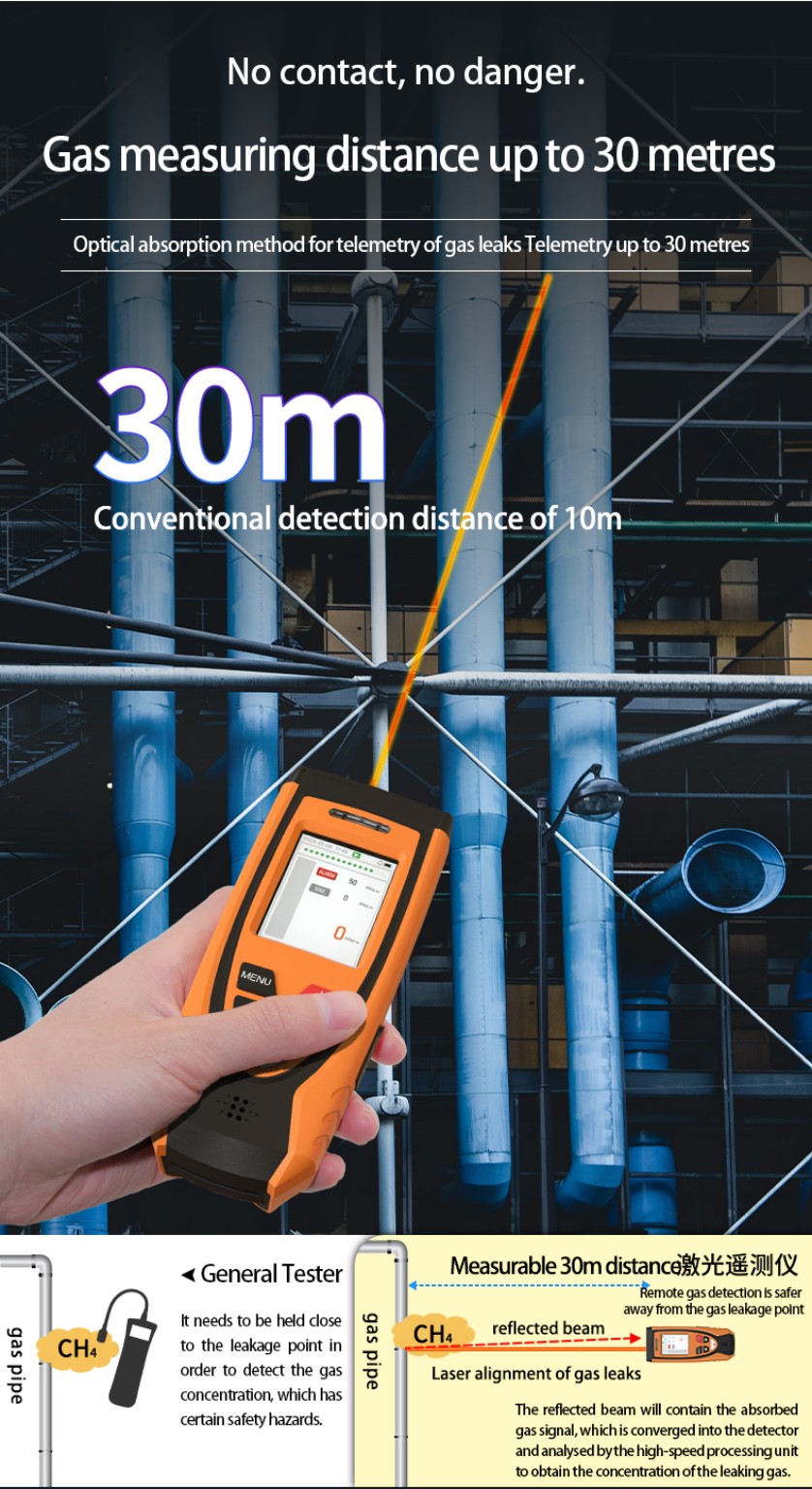
The listing advertises gas measurement at distances up to 30 metres. That could be useful for elevated flanges, valve stations, overhead pipe racks, roof-level equipment and locations where approaching the suspected leak would add unnecessary exposure.
Maximum range is not guaranteed working range. Reflectivity, beam angle, plume size, ambient conditions, hand stability and the optical cleanliness of the detector all matter. Buyers should request the minimum detectable path concentration, working-distance conditions, accuracy or uncertainty statement, response time, warm-up requirement and any recommended reflective targets. Field procedures should define when a distant indication requires closer confirmation with an approved instrument or method.
Understanding ppm·m—not ordinary ppm
A display value in ppm·m represents concentration multiplied by the length of methane encountered by the beam. For example, a short dense plume and a longer dilute plume can produce a similar integrated result. The instrument does not automatically reveal the plume thickness, the local concentration at one point or the leak’s mass flow rate.
This distinction matters when setting alarms and interpreting trends. Do not compare a ppm·m value directly with a personal occupational exposure limit stated in ppm, and do not use it to authorise entry into a confined space. A competent procedure should explain the units, scanning pattern, background check, alarm response and follow-up verification method.
Display, alarms and data logging
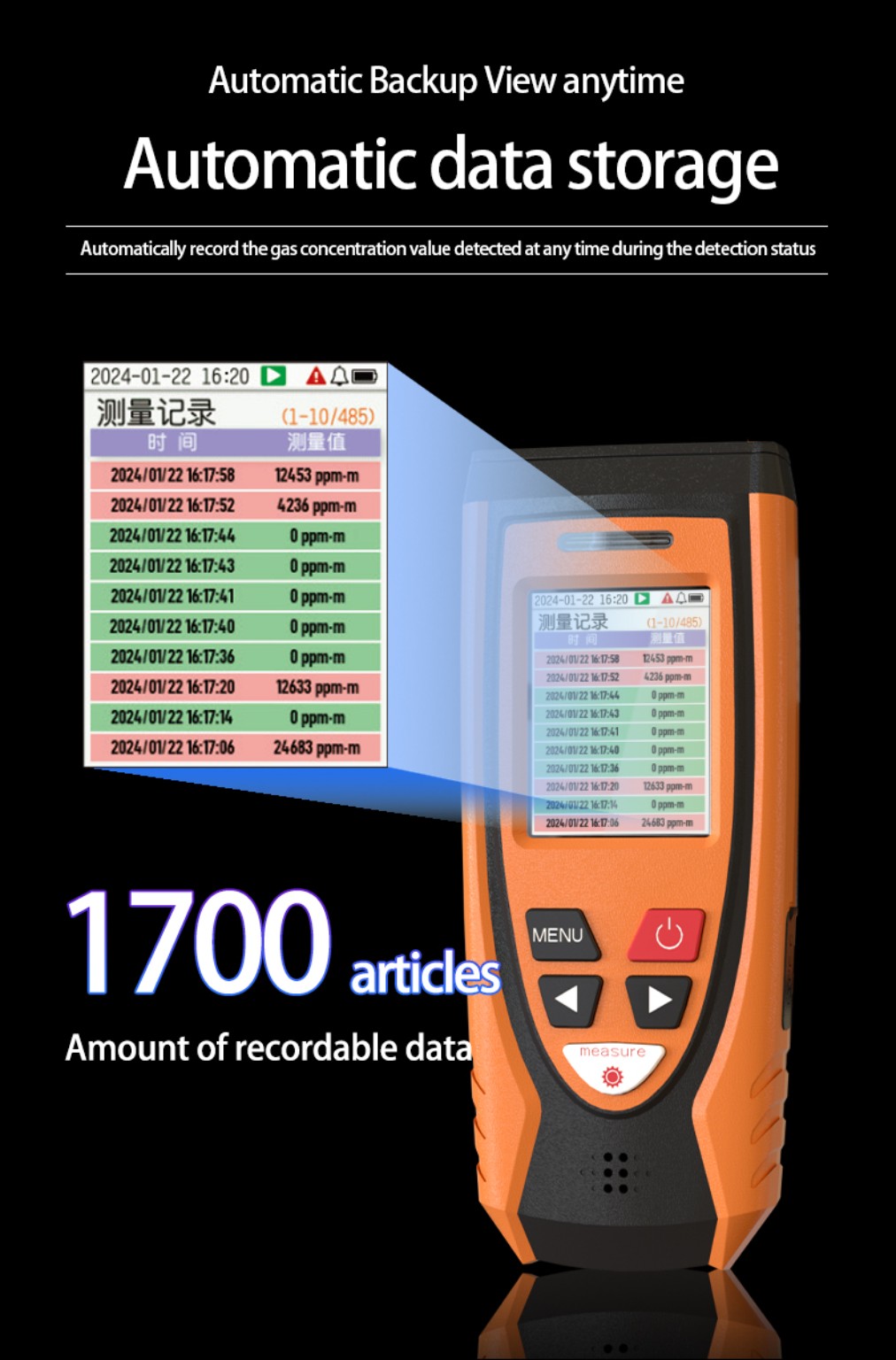
The colour interface is shown with a live concentration value, maximum value, alarm threshold and a trend view. A trend can help an operator distinguish a repeatable plume intersection from an isolated unstable reading. The product images also advertise automatic storage of up to 1,700 records, although the translated graphic incorrectly calls them ‘articles’. Confirm whether records include date, time, value, alarm status and a user-entered location, and whether they can be exported in a usable format.
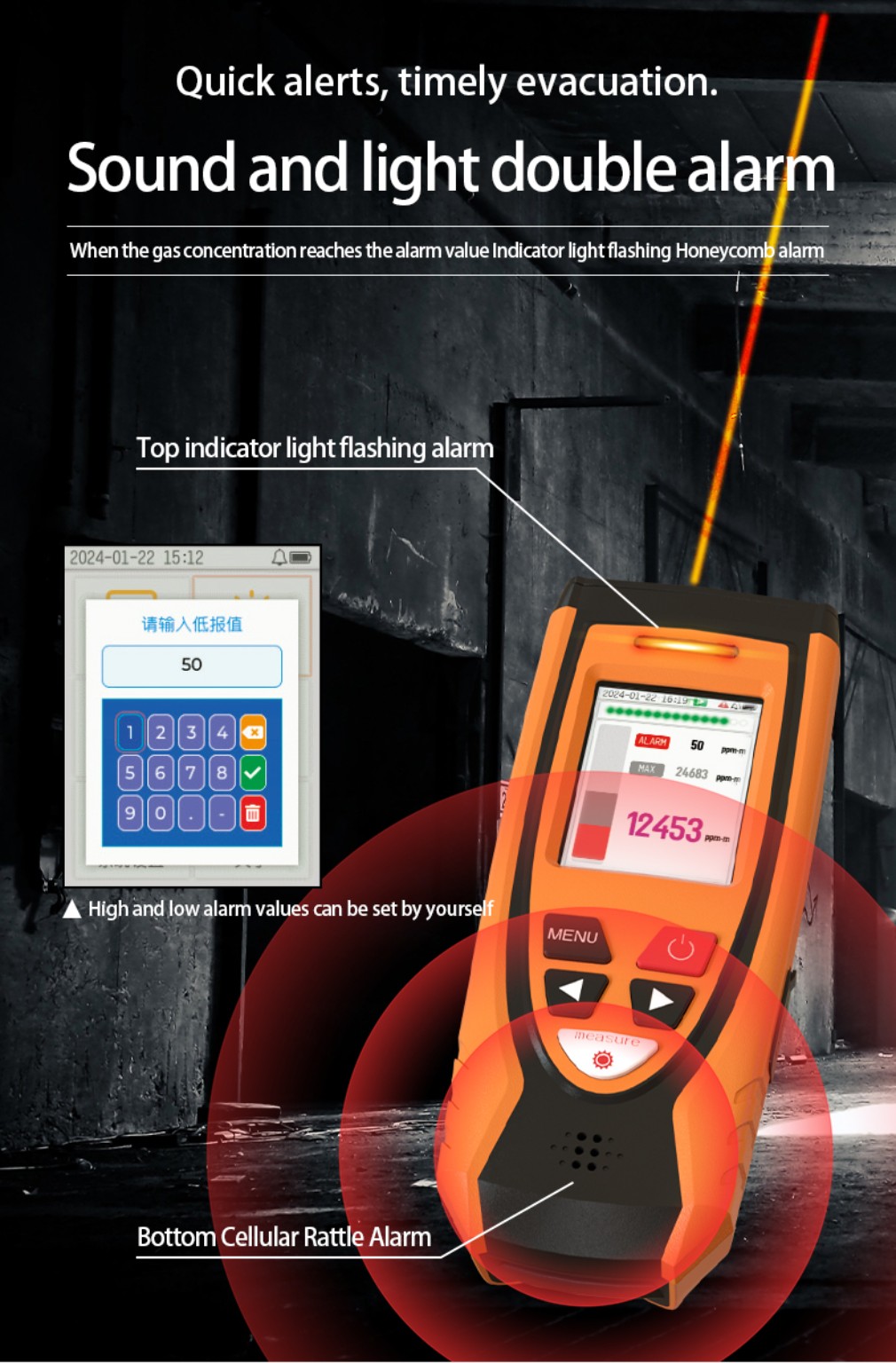
Sound and light alarms are advertised, with adjustable high and low thresholds. Those settings should be controlled by the employer’s monitoring plan and protected from casual changes. An alarm is a trigger to follow the field response procedure—it is not a diagnosis of leak rate, severity or safe approach distance.
Battery, enclosure and field handling
The supplied images show USB Type-C charging, a claimed 2,000 mAh rechargeable battery and an advertised standby time of at least 10 hours. Confirm operating runtime with the laser active, charging time, low-battery behaviour and whether the battery is replaceable. Charging should take place only where the manufacturer and site rules permit it, especially around classified locations.
The two-colour overmoulded housing is promoted as dust resistant, splash resistant and rugged. Those descriptions are useful marketing shorthand but are not substitutes for an independently documented ingress-protection rating or drop-test standard. The optical window must remain clean and unscratched, and the instrument should be stored in a protective case with its lens cover fitted.
Where it could add the most value
After verification, training and acceptance testing, the detector may support rapid methane screening at natural-gas facilities, compressor areas, biogas plants, tank farms, utilities and oil-and-gas installations. It is particularly attractive when a technician can inspect a component from a safer platform or ground-level position instead of climbing solely to perform an initial check.
A sensible workflow is to review the equipment and wind direction, establish a safe viewing position, scan slowly across likely release points and downwind plume paths, repeat the scan from another angle where practical, mark repeatable indications, then confirm and manage the finding under the site’s leak-detection-and-repair process.
- Elevated valves, flanges and pipe-rack connections.
- Fenced or restricted areas with a clear optical path.
- Rapid route screening before targeted investigation.
- Post-repair checks when the approved procedure accepts the method.
- Trend and record collection for maintenance follow-up.
What this instrument cannot replace
This is not a breathing-zone personal monitor and the supplied material does not show oxygen, hydrogen sulphide, carbon monoxide or combustible-gas %LEL channels. It cannot establish that a confined space is safe, detect every fuel gas, measure oxygen deficiency, or warn a worker about all atmospheric hazards around them.
A remote methane indication also does not automatically quantify emissions or prove the exact leaking component. Regulatory surveys, repair verification or emissions reporting may require approved methods, calibrated equipment, documented quality controls and trained personnel. Use the detector to improve where you look—not to bypass the rest of the monitoring programme.
Laser and hazardous-area checks are essential
Before workplace use, obtain the exact laser class, wavelength, output and eye-safety instructions. Never aim the beam at people, vehicle operators, aircraft, unapproved reflective surfaces or anything outside the defined survey target. Training should cover safe aiming, protective covers, damaged optics and local laser-control requirements.
For oil, gas or other potentially explosive atmospheres, verify the exact hazardous-area or intrinsic-safety approval against the issuing body’s database. A generic CE mark, manufacturer claim or certificate for a similar product is not enough. The approval must match the model, battery, charging restriction, gas group, temperature class and zone or division required by the site.
Buyer’s verification checklist
Ask for model-specific evidence before ordering and compare it with your organisation’s technical specification. If the seller cannot answer the critical safety and performance questions clearly, treat that as a purchasing decision—not a paperwork inconvenience.
- Exact model number, methane measurement principle and displayed unit.
- Laser class, wavelength, output and eye-safety documentation.
- Working distance, minimum detectable ppm·m, range, accuracy and response time.
- Required reflective background and stated weather or environmental limits.
- Independently verifiable hazardous-area approval where required.
- Calibration, zero-check, self-test and functional-check procedure.
- Alarm-setting control, record capacity and data-export method.
- Battery runtime, Type-C charging restrictions and replacement route.
- Verified ingress/drop ratings, warranty, repair and local support.
Final assessment
The handheld remote laser methane detector offers a compelling capability: fast, non-contact screening of methane at points that may be awkward or hazardous to approach. The advertised 30 m reach, colour trend display, alarms, data storage and rechargeable format could make survey rounds more efficient when the instrument is used by trained personnel under a clear method.
Our recommendation is conditional. Buy only after the exact model’s laser safety, methane performance, calibration process and hazardous-area approval have been verified. Used correctly, it can be a valuable first-look tool for finding where further action is needed. Used as a substitute for personal monitoring, gas testing or formal leak quantification, it could create false confidence.
Confirm the exact model, specification, certification evidence, shipping terms and current price before ordering.
Sources
- AliExpress — Handheld remote laser methane detector product listingPublished Product listing; accessed 19 September 2026
- OGCI — Methane HubPublished Current methane measurement and mitigation resources; accessed 19 September 2026
- IEA — Global Methane TrackerPublished Current methane data resource; accessed 19 September 2026
Daily HSSE updates
Subscribe for practical HSSE updates.
Subscribe for the daily message, selected HSSE news and occasional new-resource alerts from Worksite Safety Hub.