Safety · Product Reviews · 10 min read
PTH-10E 4-in-1 Air Monitor Review: Useful for Camping and RVs?

A safety-first review of the portable PTH-10E CO, CO₂, temperature and humidity monitor—covering its ranges, adjustable alerts, model differences and why it must not replace a certified carbon-monoxide alarm.
Affiliate disclosure and critical safety note
This article contains an affiliate link. Worksite Safety Hub may earn a commission if you make a qualifying purchase through it, at no additional cost to you. Our assessment is based on the supplied product images and marketplace claims; we have not independently tested or calibrated the exact monitor.
The listing itself states that this is a portable air-monitoring device and “not a certified household safety alarm.” Treat the PTH-10E as supplementary information only. It must not replace a certified carbon-monoxide alarm installed and maintained according to the alarm manufacturer, RV or boat manufacturer, local law and relevant safety requirements.
Quick verdict
The PTH-10E combines four useful readings—carbon monoxide, carbon dioxide, temperature and relative humidity—in a small rechargeable unit with a bright display, colour status ring, audible alert, lanyard and carabiner. It could help campers and RV users notice changing air quality, compare ventilation conditions and record general comfort trends without carrying several separate meters.
The safety limitation is decisive. The advertised default CO alarm of 150 ppm is not a substitute for the response profile of a certified life-safety alarm, and the seller provides no visible approval standard in the supplied material. Our verdict: useful as a secondary awareness monitor if its readings are checked against a trusted instrument, but unsuitable as the only warning against deadly carbon monoxide.
What the PTH-10E measures
The seller advertises a CO range of 0–1,000 ppm, a CO₂ range of 400–5,000 ppm, temperature from −10°C to 50°C and relative humidity from 0% to 95%. The listing gives approximate accuracy claims of ±10% for CO, ±(50 ppm + 5%) for CO₂, ±1.5°C for temperature and ±5% RH for humidity.
Those figures need context. Ask what sensor technologies are used, how long they take to stabilize, expected sensor life, warm-up time, drift, cross-sensitivities, response time and calibration method. For CO₂ in particular, confirm whether the exact PTH-10E uses a true NDIR sensor rather than an estimated “eCO₂” value derived from another gas sensor.
- CO: advertised 0–1,000 ppm.
- CO₂: advertised 400–5,000 ppm.
- Temperature: advertised −10°C to 50°C.
- Humidity: advertised 0–95% RH.
- Colour ring and audible alert.
- User-adjustable alarm values.
- Rechargeable 1,000 mAh battery and USB Type-C charging.
PTH-10C, PTH-10D and PTH-10E compared
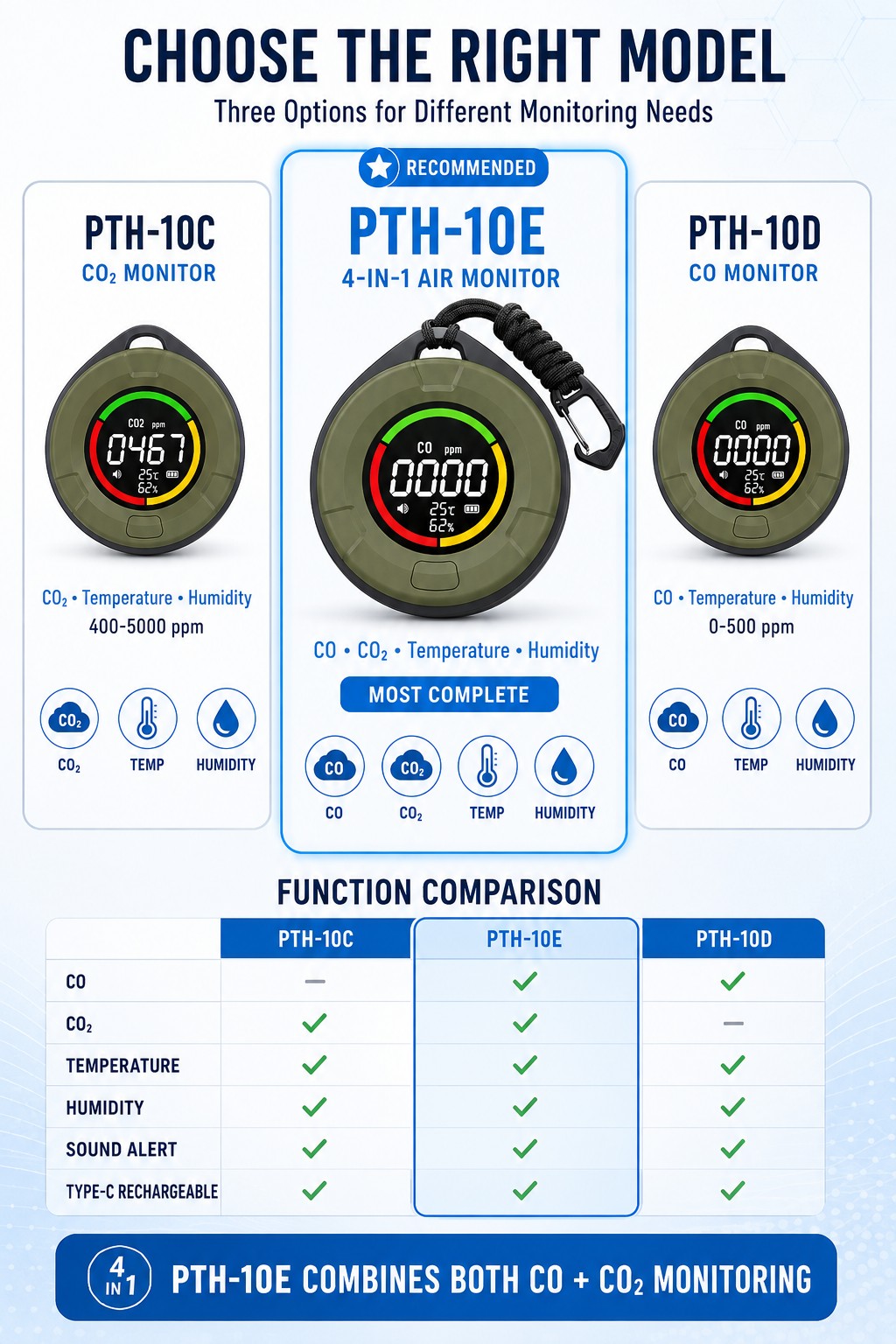
The product family contains three look-alike models. The PTH-10C is shown as a CO₂, temperature and humidity monitor. The PTH-10D is shown as a CO, temperature and humidity monitor. The PTH-10E combines CO, CO₂, temperature and humidity and is the only four-in-one option in the comparison.
This distinction is easy to miss when thumbnails and enclosures look almost identical. Check the option name at checkout, then verify the model marking and startup display when the unit arrives. A CO₂-only model cannot detect carbon monoxide, and a CO-only model cannot tell you whether exhaled-air accumulation suggests inadequate ventilation.
CO and CO₂ are different hazards
Carbon monoxide is a colourless, odourless toxic gas created by incomplete combustion. Sources around camping and RV use can include generators, vehicle exhausts, charcoal, faulty heaters, cookers and engines. Symptoms such as headache, dizziness, weakness, nausea, confusion or chest pain require immediate fresh air and emergency help; do not wait for a portable monitor to confirm exposure.
Carbon dioxide is produced by breathing and combustion. Rising indoor CO₂ often indicates insufficient ventilation and can contribute to stuffiness, headache and impaired concentration, but it is not a direct measure of oxygen and it does not prove that other pollutants are absent. A normal CO₂ reading cannot demonstrate that an RV, tent or workplace is safe.
Alarm display and adjustable thresholds
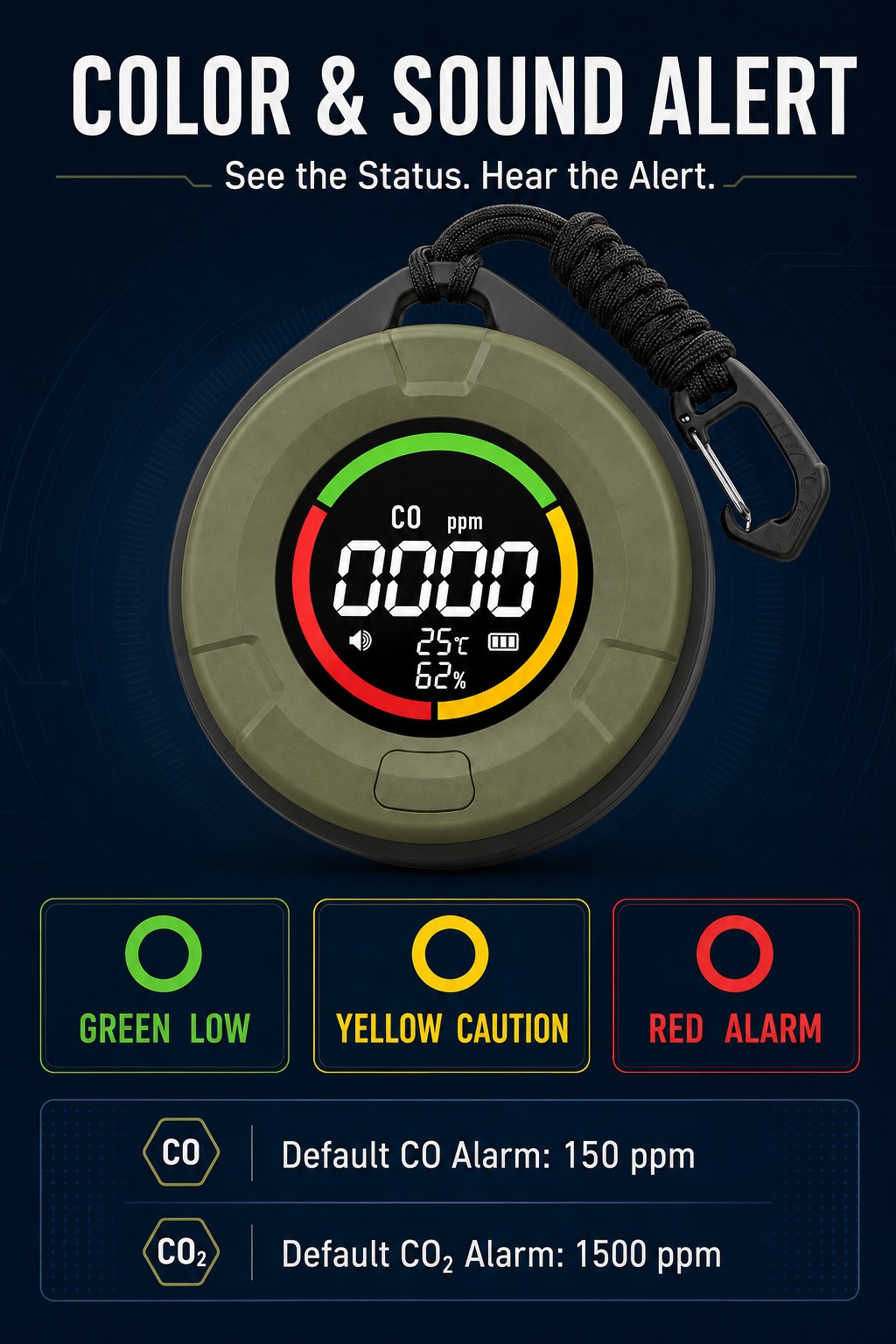
The screen uses a green, yellow and red ring to make status changes visible at a glance, and an audible alarm is advertised. The supplied graphic shows default alarm settings of 150 ppm for CO and 1,500 ppm for CO₂, with one-button adjustment.
A user-adjustable threshold can be helpful for ventilation awareness but also creates risk: an accidental high setting may suppress an important warning, while an overly low setting may cause nuisance alarms and alarm fatigue. Record the approved settings, prevent casual changes and function-check the unit before each trip. Never use the adjustable PTH-10E threshold to override the behavior of a certified fixed CO alarm.
Safe camping and RV use
Keep combustion outside sleeping and enclosed living areas. Never use charcoal, a barbecue, a fuel-burning camping stove, generator or vehicle engine inside a tent, awning, RV or other enclosed space. Position generators outdoors and well away from doors, windows and vents, following the manufacturer’s separation and exhaust-direction instructions.
Install certified CO alarms in the locations required for the RV or accommodation and test them regularly. Use the PTH-10E only as an additional portable check. If either device alarms, or anyone develops possible CO symptoms, move everyone to fresh air immediately, contact emergency services and do not re-enter until the source has been identified and the area declared safe.
Portability, battery and package contents
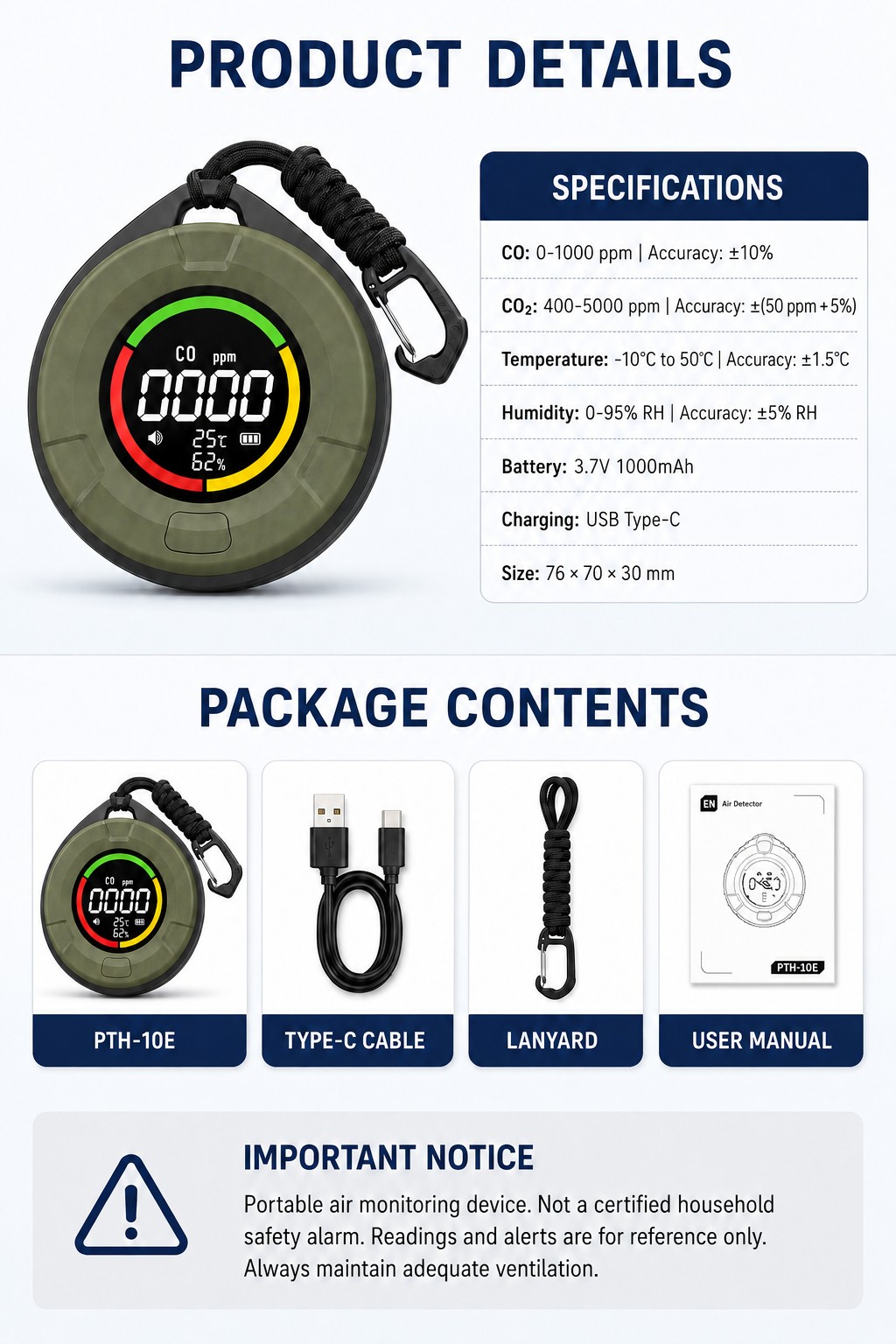
The monitor is advertised at approximately 76 × 70 × 30 mm with a 3.7 V, 1,000 mAh rechargeable battery. A coiled tether, carabiner and lanyard support carrying or hanging, while USB Type-C charging is convenient for travel. The seller pictures the monitor, cable, lanyard and manual as package contents.
Runtime and charging time are not established by the supplied images. Battery level can affect availability when a warning is needed, so recharge before travel and keep a certified fixed alarm operating independently. Do not charge beside fuel vapour or in another potentially explosive atmosphere unless the equipment is specifically approved for that location.
Placement and interpretation
Portable readings depend heavily on placement. Avoid positioning the monitor directly beside a person's breath, cooking steam, an open window or a ventilation outlet unless that is the measurement point of interest. Hang it where air can circulate freely and where the display and sound remain noticeable; do not bury it in luggage or cover the sensor openings.
Allow readings to stabilize after moving between indoor and outdoor conditions. Compare trends and investigate unexpected changes, but do not assume that one point represents the entire space. Stratification, air movement and local sources can create different concentrations elsewhere in an RV, cabin, tent vestibule or room.
Who should consider it?
The PTH-10E may appeal to campers, caravan and RV users, van-life travellers, homeowners and facilities staff who want a compact display for general CO, CO₂, temperature and humidity awareness. It is most defensible where a certified CO alarm is already installed and the portable unit is used to observe trends or evaluate ventilation changes.
It is not the right choice as the sole protective monitor for sleeping occupants, occupational exposure assessment, confined-space entry, firefighting, mines, process plants, laboratories or hazardous areas. Those applications require approved instruments, defined alarm strategies, bump testing or calibration, competent users and documented procedures.
Buyer checklist
The low purchase price is only attractive if the gas sensors are genuine, stable and supportable. Ask the seller for a complete English manual and evidence tied to the exact PTH-10E—not a generic product family. On arrival, compare it with a recently verified instrument in clean outdoor air and during a controlled, safe check; never test a CO monitor by exposing yourself to exhaust or combustion fumes.
- Exact model selected: PTH-10E for both CO and CO₂.
- CO sensor technology, response time, life and cross-sensitivities.
- Confirmation that CO₂ is measured by true NDIR.
- Calibration method, interval and availability of service.
- Documented alarm sound level and behavior.
- Independent product certification, if any.
- Battery runtime, low-battery warning and charge time.
- Operating temperature, humidity and condensation limits.
- Warranty, returns and replacement-sensor policy.
- A separate certified CO alarm for life safety.
Final assessment
The PTH-10E packages four genuinely useful environmental readings into a compact, travel-friendly format. Its colour ring, audible indication, adjustable settings and rechargeable battery may make ventilation trends easier to understand during RV trips, camping or general indoor checks.
Its limitations must remain visible: marketplace accuracy claims are not certification, the default CO threshold is not a life-safety standard, and the seller explicitly says it is not a certified household safety alarm. Buy it only as a supplementary monitor, verify its behavior, and keep certified CO protection and safe combustion practices as the primary controls.
Confirm the exact model, specification, certification evidence, shipping terms and current price before ordering.
Sources
- AliExpress — PTH-10E 4-in-1 air monitor product listingPublished Product listing; accessed 19 September 2026
- CDC — About Carbon MonoxidePublished Current public-health guidance; accessed 19 September 2026
- CPSC — Carbon Monoxide Fact SheetPublished Current consumer-safety guidance; accessed 19 September 2026
Daily HSSE updates
Subscribe for practical HSSE updates.
Subscribe for the daily message, selected HSSE news and occasional new-resource alerts from Worksite Safety Hub.