Safety · Product Reviews · 10 min read
NOHAWK 4-in-1 Multi-Gas Detector Review: Practical Protection or Marketplace Gamble?
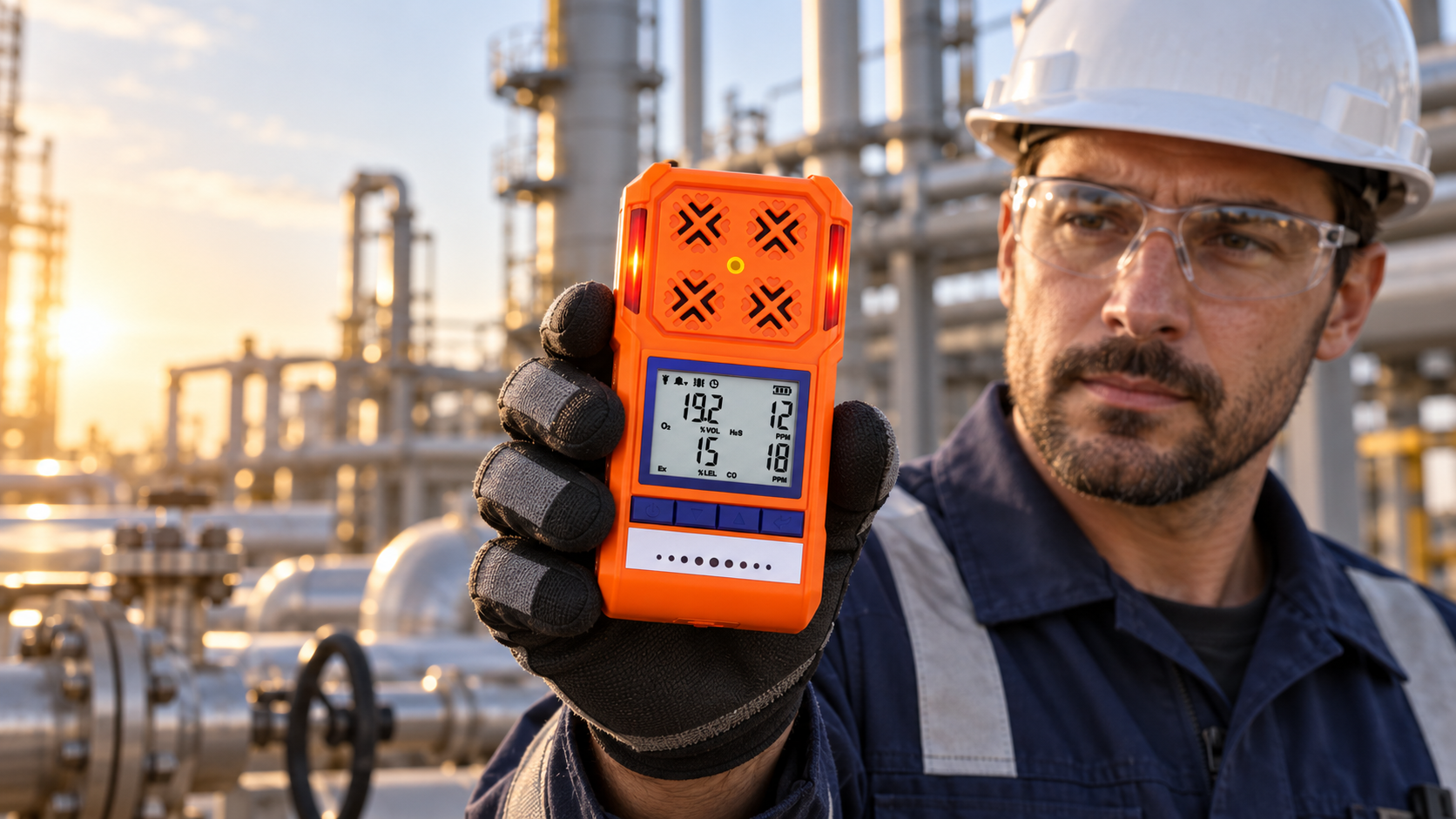
A safety-led review of the NOHAWK portable four-gas detector for oxygen, carbon monoxide, hydrogen sulphide and combustible-gas monitoring, with essential checks for calibration, certification and workplace use.
Affiliate disclosure and review basis
This article contains an affiliate link. Worksite Safety Hub may earn a commission if you make a qualifying purchase through it, at no additional cost to you. This is an independent assessment based on the supplied product photographs and marketplace information; we have not personally field-tested, bump-tested or calibrated the exact unit.
The short affiliate link did not expose a stable specification page during our review, and marketplace options can change. Treat every product specification below as an advertised claim that must be confirmed against the exact model, manual and package selected before ordering.
Quick verdict
The NOHAWK is presented as a compact personal monitor for four common atmospheric hazards: oxygen, carbon monoxide, hydrogen sulphide and combustible gas expressed as a percentage of the lower explosive limit. A clear four-channel screen, three-way alarm system and rechargeable battery make the concept attractive for maintenance, utilities, wastewater, oil and gas and other work where portable atmospheric awareness matters.
Its practical layout looks promising, but a gas detector is life-safety equipment—not a gadget to choose on price or appearance alone. Our verdict is therefore conditional: consider it only if the seller or manufacturer can provide credible documentation for the exact model, compatible calibration gas and regulator information, local service support, and the approvals required by your organisation and jurisdiction.
What the NOHAWK is designed to monitor
The supplied images show simultaneous readings for O₂, H₂S, CO and Ex. That combination is widely used for pre-entry checks and continuous personal monitoring where oxygen deficiency or enrichment, toxic gases and flammable atmospheres may occur.
The images advertise resolutions of 0.1% volume for oxygen, 1 ppm for carbon monoxide, 1 ppm for hydrogen sulphide and 1% LEL for combustible gas. Resolution is not the same as accuracy, response time or usable range. Buyers should obtain the full sensor specifications—including measuring range, accuracy, T90 response, cross-sensitivities, environmental limits and expected sensor life—before relying on the instrument.
- Oxygen (O₂) concentration shown as percent by volume.
- Carbon monoxide (CO) shown in parts per million.
- Hydrogen sulphide (H₂S) shown in parts per million.
- Combustible gas shown as percent of the lower explosive limit (%LEL).
Display, alarms and everyday handling
The large backlit LCD separates the four channels into an at-a-glance layout. That matters when a worker needs to identify which hazard caused an alarm without navigating menus. The orange enclosure is visually conspicuous, and the compact body shown in the photographs is advertised at approximately 126 × 64 × 28.5 mm.
The listing images show audible, visual and vibration alarms, plus adjustable alarm thresholds. Multiple alarm modes are valuable in loud, bright or high-movement environments where one signal might be missed. Alarm setpoints should be controlled by the employer’s programme and applicable limits—not changed casually by the wearer.
- Four readings visible on one backlit screen.
- Audible, flashing visual and vibration alarm indications.
- Rechargeable lithium battery with direct USB charging shown in the listing.
- Compact form intended for personal portable use.
- User-adjustable alarm settings are advertised; access control should be verified.
The non-negotiable test: bump checking and calibration
A detector cannot protect anyone if its sensors, alarm outputs or sampling path do not respond correctly. Follow the manufacturer’s written instructions and the workplace instrument programme for fresh-air zeroing, functional bump checks and full calibration. A bump check exposes the detector to a known gas concentration to confirm sensor response and alarms; calibration adjusts the reading to a traceable reference.
Before purchase, confirm that suitable calibration gas, tubing, regulator or docking equipment is obtainable in your location. Ask how calibration records are stored, whether the unit locks out after a failed test, and where it can be serviced. If the seller cannot supply a clear manual and calibration procedure for the exact model, it is not a defensible choice for safety-critical work.
Confined-space use: monitor, do not improvise
A four-gas detector can support atmospheric testing, but it does not by itself make a confined space safe. OSHA’s testing guidance calls for evaluation in the order of oxygen, combustible gases and vapours, then toxic gases and vapours. Representative testing may require remote sampling at different levels and locations because the atmosphere can stratify or change during the job.
Entry must remain inside the organisation’s permit, isolation, ventilation, communication and rescue arrangements. Continuous monitoring may be required, and a diffusion monitor held at the opening is not automatically equivalent to remote pre-entry sampling. Never use an unverified instrument as the sole basis for authorising entry or cancelling other controls.
Best-fit users and applications
If documentation and performance can be verified, this format may suit trained technicians, wastewater personnel, utility crews, maintenance teams, construction workers and oil-and-gas personnel who need a compact personal monitor. Its simple four-channel display may also make training and routine status checks easier.
It is a poor fit for buyers who need a certified hazardous-area instrument but cannot verify the exact approval, organisations that require traceable fleet management, tasks involving gases outside the installed sensor set, or teams without access to calibration supplies and competent support. Different hazards may require a pumped monitor, photoionisation detector, specialist sensor or area-monitoring strategy.
Critical checks before ordering
Request the model-specific manual and a clear photograph of the compliance label. Verify intrinsic-safety or hazardous-location approval against the issuing body’s database where applicable; a logo in a marketplace photograph is not enough. Confirm the sensor manufacturer or technology, full ranges, alarm defaults, battery runtime, ingress protection, operating temperature and humidity, charging restrictions and warranty.
Also confirm what the selected package contains. A low headline price may exclude the charger, calibration cap, tubing, pump or case. Check seller history, recent buyer feedback, delivery terms, import charges and the return process—but do not treat reviews as a substitute for certification or calibration evidence.
- Exact model number and independently verifiable approvals.
- Sensor ranges, accuracy, response time and cross-sensitivity data.
- Bump-test and calibration procedure, gas and accessories.
- Battery runtime, charging restrictions and ingress rating.
- Replacement sensors, service centre, warranty and recordkeeping.
- Compatibility with site alarm setpoints and instrument-management rules.
Final assessment
The NOHAWK 4-in-1 detector packages the expected essentials into a compact and readable unit: four common gas channels, a large LCD, multiple alarm modes and rechargeable power. Those features make it worthy of a closer look for budget-conscious buyers.
The deciding factor is the evidence behind the enclosure. For casual awareness, the feature set may look compelling; for occupational decisions, buy only when the exact unit’s approvals, sensor performance, calibration process and after-sales support satisfy a competent risk assessment. No marketplace discount is worth uncertainty in life-safety equipment.
Confirm the exact model, specification, certification evidence, shipping terms and current price before ordering.
Sources
- AliExpress — NOHAWK 4-in-1 multi-gas detector product listingPublished Product listing; accessed 19 September 2026
- OSHA — Permit-Required Confined Spaces, 29 CFR 1910.146Published Current standard; accessed 19 September 2026
- OSHA — Procedures for Atmospheric Testing, Appendix B to 1910.146Published Current guidance; accessed 19 September 2026
- HSE — Confined spacesPublished Current guidance; accessed 19 September 2026
Daily HSSE updates
Subscribe for practical HSSE updates.
Subscribe for the daily message, selected HSSE news and occasional new-resource alerts from Worksite Safety Hub.