Safety · Product Reviews · 10 min read
HP-950F Thermal Imager Review: Useful Budget Scanner or Too Low-Resolution?
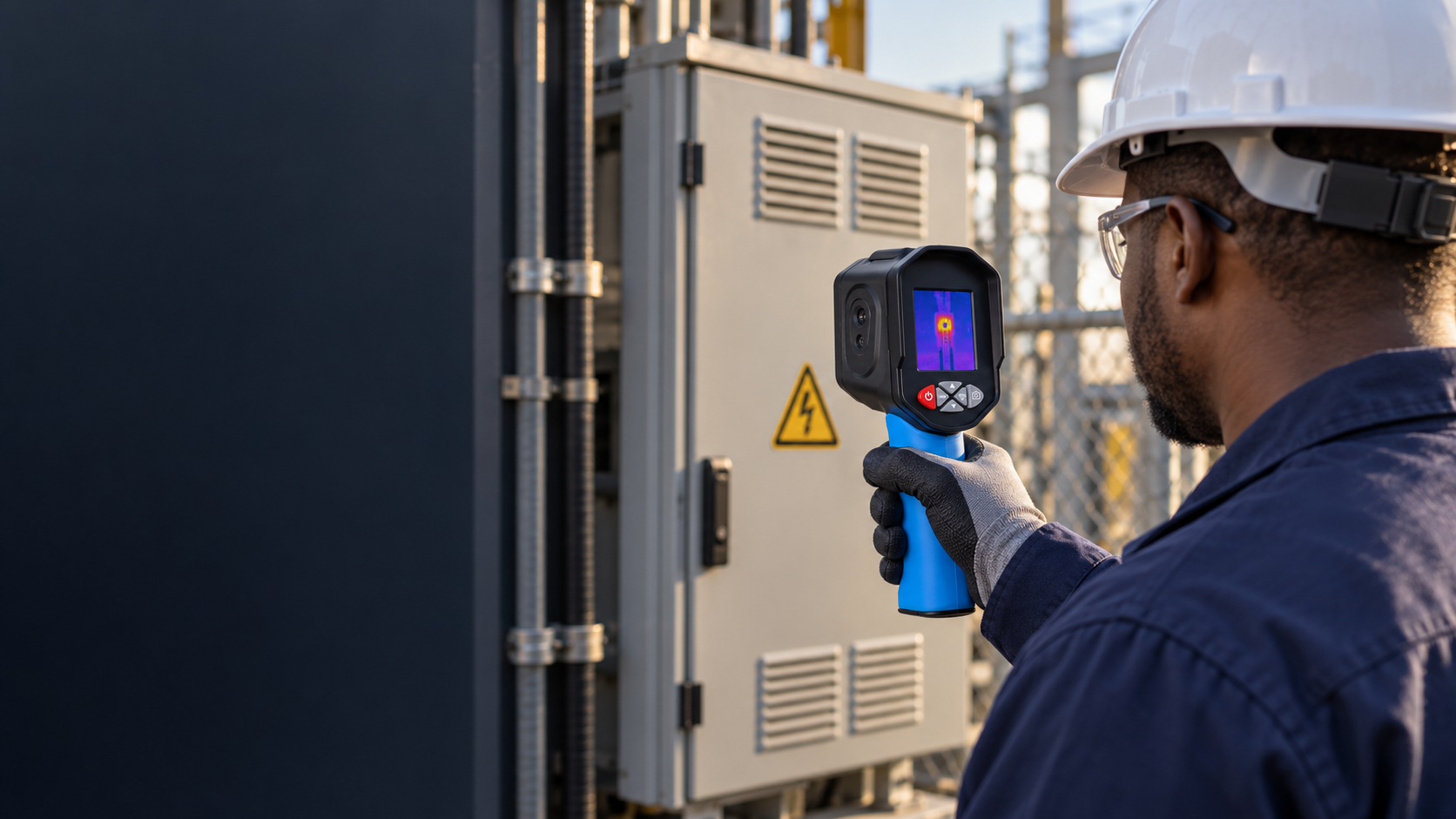
A practical review of the HP-950F handheld infrared camera, examining its 32×32 thermal detector, visible-light camera, emissivity controls, image storage, likely applications and important professional limitations.
Affiliate disclosure and review basis
This article contains an affiliate link. Worksite Safety Hub may earn a commission if you make a qualifying purchase through it, at no additional cost to you. Our assessment is based on the supplied product images and marketplace information; we have not independently calibrated or field-tested the exact camera.
The photographs identify the model as HP-950F and show a 32×32-pixel thermal sensor, visible-light camera, colour display, image storage and adjustable settings. Marketplace specifications and bundled accessories can change, so confirm the exact selected option, manual, temperature range, accuracy and warranty before payment.
Quick verdict
The HP-950F is an entry-level thermal viewer designed to reveal broad temperature patterns that an ordinary infrared thermometer can miss. Its pistol-grip body, thermal image, visible-light camera, adjustable emissivity, colour palettes, spot marker and image storage could be useful for basic home inspections, electronics troubleshooting and preliminary maintenance surveys.
The central compromise is severe: 32×32 means only 1,024 thermal measurement points. That may reveal a large warm bearing, obvious insulation gap or pronounced hot component, but it provides little spatial detail for small terminals, crowded switchgear or targets viewed from a distance. Our verdict: potentially useful as an affordable screening tool when expectations are realistic, but not a substitute for a higher-resolution, calibrated professional imager where safety or costly decisions depend on the result.
What the HP-950F offers
The listing describes a handheld infrared imager that combines non-contact surface-temperature measurement with a real-time thermal display. Visible controls include power, escape, up, down, menu/confirm and image-capture buttons. The rear houses an infrared sensor and a separate visible-light camera, while an SD-card slot is shown at the top.
User settings shown in the product graphics include Celsius or Fahrenheit selection, emissivity, reflected or background temperature adjustment, colour-palette selection, spot-temperature marking, date and time, image saving and display brightness. The listing also claims an approximately five-second startup. These are sensible functions, but buyers should ask for the full data sheet because detector resolution alone does not reveal measurement quality.
- 32×32 thermal detector shown on the housing.
- Separate visible-light camera.
- Spot, minimum and maximum temperature display shown.
- Adjustable emissivity and background temperature.
- Selectable palettes and temperature units.
- SD-card image storage and physical camera button.
- Simple menu operated through tactile keys.
The 32×32 resolution: what it means in practice
A 32×32 detector produces a thermal matrix of 1,024 pixels. The screen can enlarge and colour those pixels, but enlargement does not create additional measured detail. Small heat sources may occupy less than one pixel and become averaged with the cooler background, especially as distance increases.
For meaningful readings, move close enough for the target to fill several thermal pixels while remaining outside any required approach boundary. Use the image to find broad anomalies, then confirm important temperatures with an appropriate instrument or a higher-resolution camera. A colourful display should never be mistaken for a finely detailed radiometric image.
Controls, sensors and everyday handling
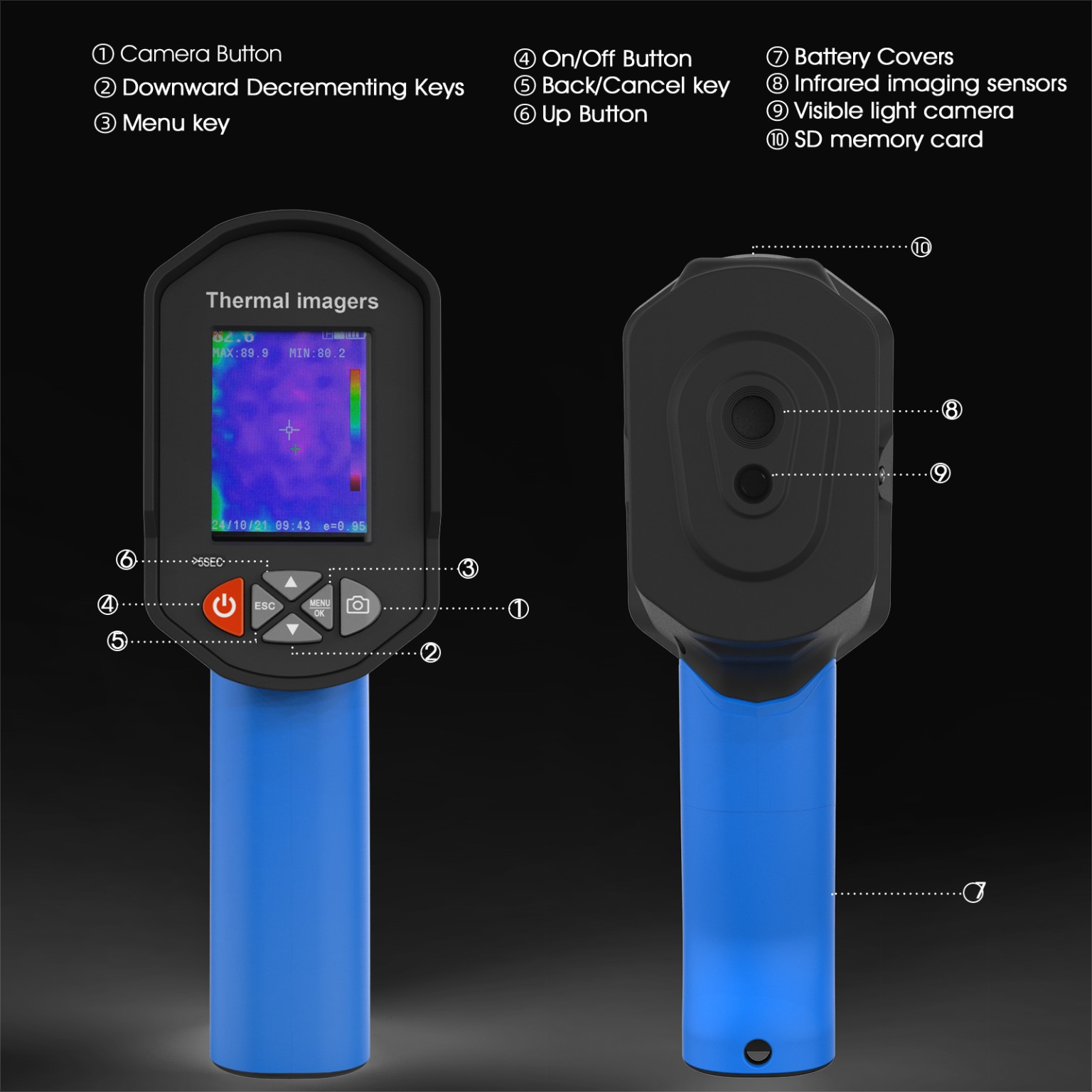
The pistol grip should be comfortable for short inspections and helps keep fingers away from the sensing head. Dedicated capture and menu buttons are preferable to a touchscreen when gloves or dirty environments are involved. The hooded display may also reduce glare, although screen brightness and outdoor readability are not established by the images.
Ask the seller whether the lens is fixed-focus, the closest focus distance, thermal field of view, spatial resolution, refresh rate, image format, storage limit and transfer method. These details determine whether the camera suits close electronics work, building surveys or larger industrial assets.
Emissivity and reflected temperature matter
Thermal cameras estimate surface temperature from detected infrared energy. Emissivity describes how effectively a surface emits that energy. Painted, oxidized and non-metallic surfaces are often easier to measure than clean, shiny metal, which can reflect the operator, sky, hot pipework or nearby machinery and create convincing but false hotspots.
The HP-950F's adjustable emissivity and background-temperature settings are important only if the operator knows how to use them. Identify the material, apply a defensible emissivity value, avoid steep viewing angles and compare like surfaces under similar loading. Where permitted, a known high-emissivity reference patch can improve repeatability. Never report a precise temperature simply because the screen displays a decimal value.
Storage and supplied package
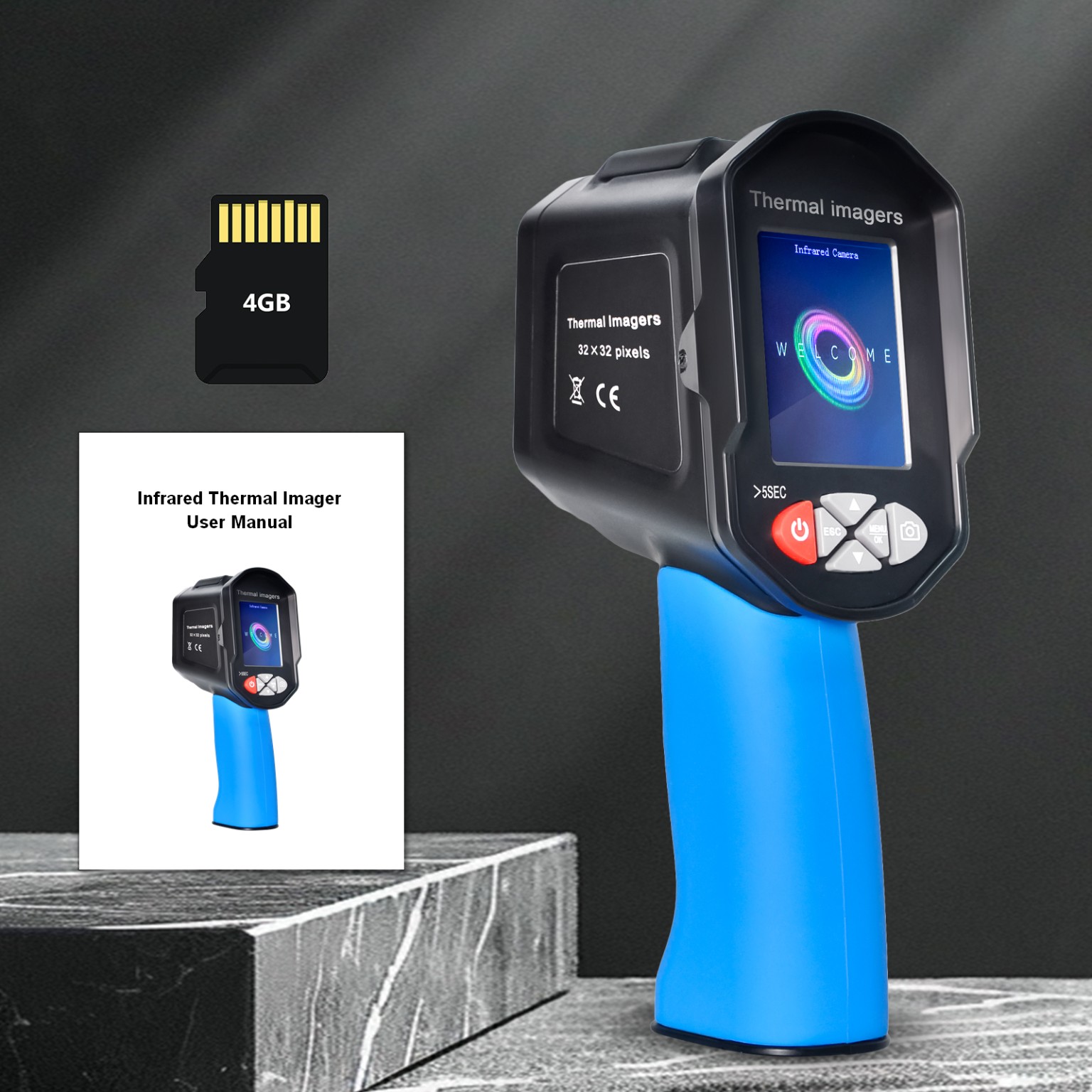
A listing graphic shows a 4 GB memory card and printed user manual. Image capture is valuable because it allows technicians to document the visible condition, thermal pattern, date and time for comparison after repair. Confirm whether saved files retain radiometric temperature data or are ordinary screenshots; that difference determines what can be analysed later.
Also confirm battery type, runtime, charging method, memory-card format, file naming and computer compatibility. For workplace records, photograph the asset label or record the asset ID, load, ambient conditions, distance, emissivity and inspection point alongside every thermal image.
Where this camera could be useful
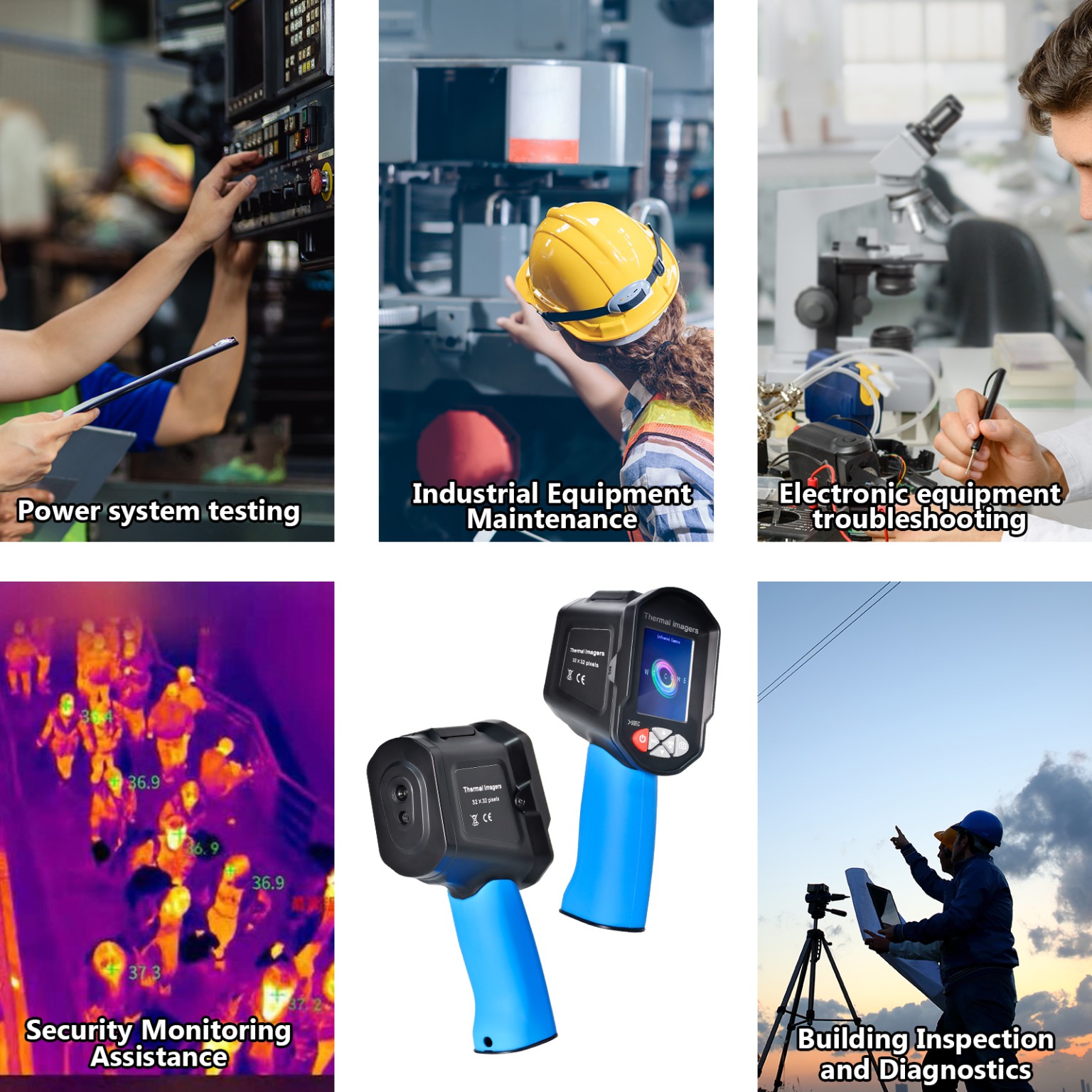
The camera is most credible where temperature differences are large and targets are reasonably close: checking radiators and underfloor heating, finding obvious building heat loss, comparing accessible bearings, locating a warm electronic component, or screening mechanical equipment for follow-up.
For electrical surveys, scan only from a position and through an access arrangement approved by the site's electrical-safety programme. Closed-panel inspection may reveal enclosure-level heating but can hide internal defects. Opening energized equipment introduces arc-flash and shock hazards and must never be done merely to improve the picture.
- Broad HVAC supply-and-return temperature patterns.
- Obvious insulation gaps and thermal bridges.
- Comparative bearing, coupling or motor-casing scans.
- Large electronic hotspots during controlled troubleshooting.
- Water-heating, radiator and underfloor-heating checks.
- Preliminary screening before higher-resolution investigation.
What it should not be trusted to do
Do not use the HP-950F as a medical thermometer, fever screener, fire-service camera, hazardous-area instrument or proof that electrical equipment is safe unless the exact model carries the required documented approval. A low-resolution image cannot rule out a small but dangerous loose connection, and a normal-looking temperature does not prove healthy insulation or adequate electrical protection.
Thermography detects temperature patterns, not root causes. A hotspot might reflect load imbalance, loose resistance, airflow restriction, friction, solar heating, reflection or normal process duty. A qualified person should correlate the image with load, ambient conditions, asset history and other measurements before deciding on repair or shutdown.
Critical specifications to verify before buying
The supplied graphics omit several figures needed for a professional buying decision. Request a current model-specific data sheet and sample native images. If the seller cannot provide the measurement range, accuracy, sensitivity and optical specifications, treat the device as a qualitative viewer rather than a dependable temperature-measurement instrument.
- Temperature range and accuracy across that range.
- Thermal sensitivity or NETD.
- Field of view and instantaneous field of view.
- Refresh rate and minimum focus distance.
- Fixed or adjustable focus.
- Emissivity adjustment range and reflected-temperature control.
- Battery type, runtime and charging arrangement.
- Ingress protection, drop resistance and operating environment.
- Whether saved files are radiometric or image-only.
- Calibration evidence, warranty and replacement support.
HP-950F versus a higher-resolution thermal camera
The HP-950F's likely advantage is price and simplicity. A higher-resolution camera costs more but offers smaller spot size, clearer component separation and more confidence when targets are compact or distant. Professional models may also add manual focus, better thermal sensitivity, analysis software, voice annotations, radiometric files and traceable calibration.
Choose the HP-950F when the task is broad screening and a missed small anomaly has limited consequence. Choose a documented higher-resolution instrument when inspecting dense switchgear, critical process equipment, elevated assets or anything where the result will justify expensive maintenance, continued operation or a safety decision.
Final assessment
The HP-950F turns invisible temperature differences into an accessible visual check and includes several controls that matter: emissivity, reflected temperature, palettes, spot marking and stored images. For learning, household diagnostics and simple maintenance comparisons, it may offer useful value.
Its 32×32 detector defines the limit. Use it close to suitably sized targets, compare trends rather than chasing false precision, and verify important findings. Buyers who need fine detail, defensible reporting or critical electrical diagnostics should invest in a higher-resolution camera with traceable specifications and support.
Confirm the exact model, specification, certification evidence, shipping terms and current price before ordering.
Sources
- AliExpress — HP-950F infrared thermal imager product listingPublished Product listing; accessed 19 September 2026
- HSE — Electrical safety at workPublished Current guidance; accessed 19 September 2026
- U.S. Department of Energy — Operations and Maintenance Best Practices GuidePublished Maintenance guidance; accessed 19 September 2026
Daily HSSE updates
Subscribe for practical HSSE updates.
Subscribe for the daily message, selected HSSE news and occasional new-resource alerts from Worksite Safety Hub.