Safety · 9 min read
A Fuel Tanker Is a Process Plant on Wheels
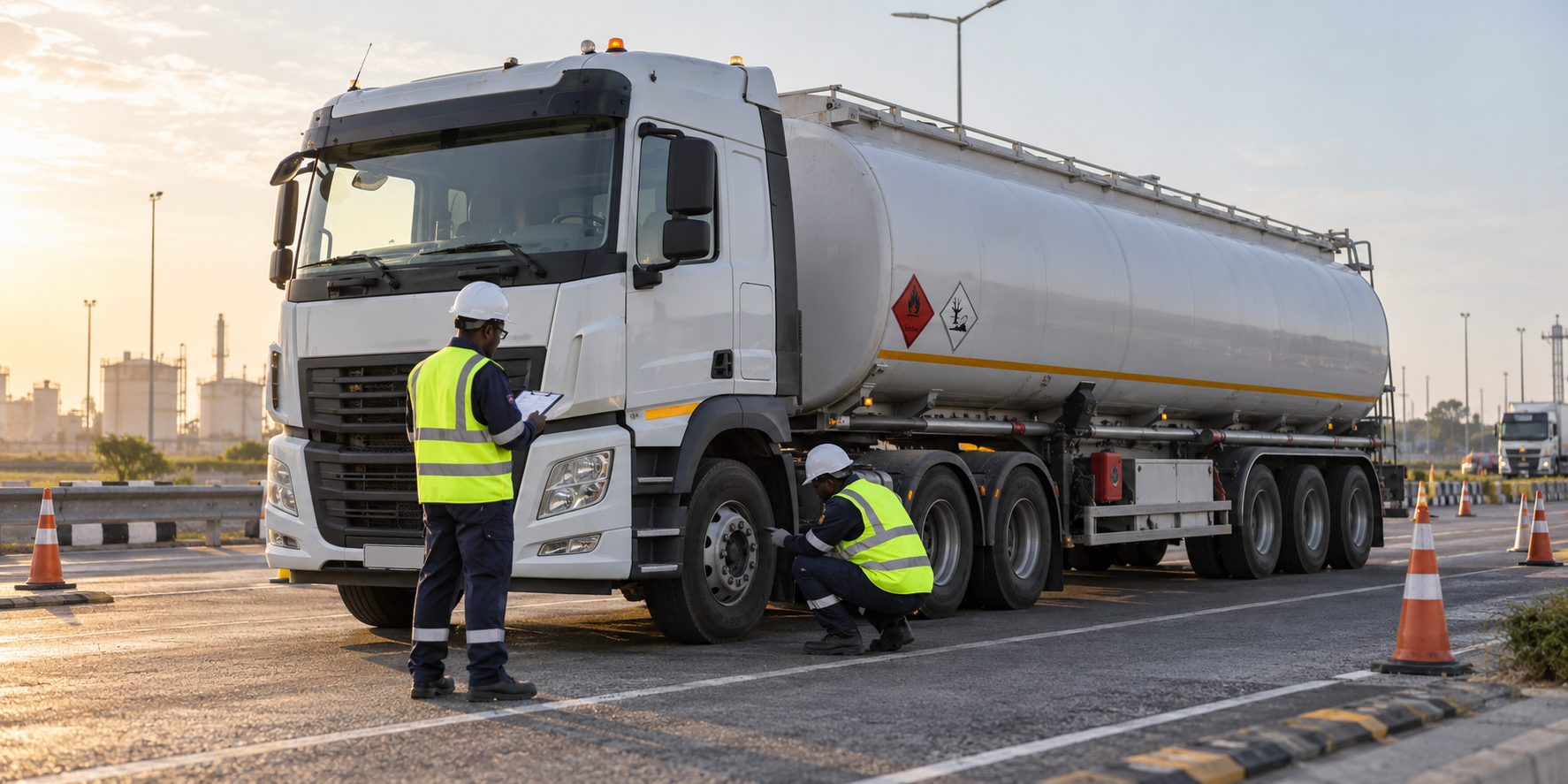
Practical lessons from the fatal Sanandaj tanker fire on treating hazardous-material road transport as a moving process system—with safety-critical equipment, changing exposure and emergency consequences beyond the facility fence.
What is confirmed—and what is not
On 5 September 2026, a fuel tanker caught fire near the Sanandaj–Hamedan traffic-police station in western Iran and several vehicles were set ablaze. The official report published by Iran's state news agency on 6 September recorded 11 fatalities and seven injuries. Iran's president ordered an immediate investigation, including examination of the causes and the circumstances surrounding the event.
At the time of publication, the official cause had not been established. That distinction matters. Early accounts after a major event can contain incomplete or conflicting information, and a responsible safety review must not convert an allegation into a finding. The lessons below are therefore not presented as the causes of this tragedy. They are practical questions that any organisation transporting fuel or other dangerous goods should test now, without waiting for the final investigation.
The process does not end at the facility gate
A road tanker is often managed as a logistics asset, but its risk profile is closer to a mobile process system. It carries a large hazardous inventory, contains multiple containment points, depends on safety-critical mechanical systems and moves continuously through changing environments. A loss of vehicle control, containment failure or ignition can expose the driver, other road users, responders, nearby communities and sensitive environmental receptors within seconds.
This is why transport risk cannot be reduced to driver behaviour or a valid licence. The operating system must connect product classification, tanker design, inspection, loading, route selection, fatigue controls, communications, emergency planning, contractor assurance and learning from defects. Every interface can either preserve containment and control or create a gap through which several small weaknesses align.
- Treat the tanker, prime mover, coupling, hoses, valves and emergency devices as one safety-critical system.
- Include the complete journey—from pre-loading checks to unloading and return—in the risk assessment.
- Identify who owns the risk when the vehicle crosses organisational and jurisdictional boundaries.
- Give drivers clear authority to reject an unsafe vehicle, load, route, schedule or delivery condition.
Verify roadworthiness as a barrier, not paperwork
A signed checklist is evidence only when the underlying inspection is competent, specific and capable of finding deterioration. Pre-trip checks should be supported by planned maintenance and periodic examination of safety-critical components, including braking systems, tyres, steering, suspension, electrical systems, couplings, tank shell, manlids, valves, vents, earthing arrangements and emergency shut-off equipment. The inspection standard should define acceptable condition and the response to defects rather than leaving critical judgments to habit.
Defect history is valuable process-safety information. Repeated brake adjustments, tyre damage, valve leakage, warning-light faults or overdue maintenance may reveal a weakening barrier even when each individual report appears minor. Organisations should trend these signals across their own and contracted fleets, verify the quality of repairs and prevent commercial pressure from returning a vehicle to service before the safety-critical defect is demonstrably closed.
- Separate safety-critical defects from items that can legitimately await routine repair.
- Require positive evidence of closure before releasing an isolated or restricted vehicle.
- Audit the physical vehicle against maintenance records and inspection declarations.
- Track recurring defects by component, vehicle, workshop, route and contractor.
Plan the route as a changing operating envelope
A journey risk assessment should reflect more than distance and travel time. Gradient, sharp bends, road condition, congestion, weather, schools, markets, settlements, tunnels, bridges, security concerns and emergency-service access can all change the consequence of an event. Approved rest locations and holding areas also matter: a place convenient for a normal truck may be unsuitable for a vehicle carrying flammable liquid.
The plan needs defined triggers for slowing, stopping, rerouting or postponing the journey. These may include severe weather, loss of communications, driver fatigue, route obstruction, vehicle warnings, evidence of leakage or a change at the receiving site. Dispatchers should be able to support a safe decision without turning schedule performance into subtle pressure to continue. Where a contractor performs the journey, the client should verify how these decisions work in practice, not simply accept a written procedure.
Prepare for escalation beyond the driver
The first minutes after a tanker collision, fire or suspected leak are dominated by uncertainty. Product properties, tank condition, ignition sources, wind, drainage, traffic and public movement all affect the safe response. Drivers need simple priorities: raise the alarm, communicate the load and location, keep people away and avoid actions that could worsen the release or expose them to fire. They should not be expected to fight a developing tanker fire beyond their training, equipment and a genuinely safe escape route.
Emergency plans should connect the transport operator with fire, police, ambulance, environmental authorities, road managers, the consignor and the receiving facility. Responders need rapid access to accurate dangerous-goods information. Pre-plans should consider evacuation or sheltering, traffic control, foam and water needs, contaminated runoff, drains and watercourses, damaged cargo transfer, vehicle recovery and preservation of evidence. Exercises are strongest when they test communications and decisions across organisations rather than demonstrating only one team's equipment.
- Make the product, quantity, hazards and emergency contact information immediately accessible.
- Define who establishes and adjusts the exclusion zone as information improves.
- Plan for secondary collisions, ignition, vapour movement and environmental runoff.
- Control bystanders and spontaneous helpers without delaying lifesaving assistance.
Protect people who approach to help
A visible road emergency naturally attracts assistance, but a tanker scene can expose helpers to heat, vapour, sudden escalation, moving traffic and contaminated runoff. Police and emergency services need an early method for stopping traffic, keeping ignition sources away and creating enough distance while the substance and tank condition are assessed. The correct boundary may change as the event develops; a cordon is therefore an actively managed control, not a one-time line on the road.
Organisations can support public safety by ensuring vehicle markings and transport documents are correct and by sharing credible emergency information with authorities along frequently used routes. Community awareness may also be appropriate where dangerous-goods traffic routinely passes populated areas. The message should be simple: move away, avoid flames and switches, do not enter smoke or liquid, call the emergency services and follow official instructions.
Control the environmental consequence
Fuel incidents are simultaneously safety and environmental emergencies. Firewater and released product can enter roadside drains, soil, streams and groundwater, extending the event far beyond the damaged vehicles. Route assessments should identify sensitive receptors and places where containment or access would be difficult. Emergency arrangements should include compatible absorbents, drain protection where practicable, specialist response capability, waste management and prompt notification under the applicable legal framework.
Response choices must remain risk based. No one should enter an unsafe area merely to place a drain cover or recover product. Fire control, life safety and environmental protection need a coordinated incident command that understands how one action affects another. Afterward, monitoring and remediation decisions should be based on the substance, pathway and receptor—not on the assumption that visible cleanup means the impact has ended.
Questions leaders should ask today
The value of an external incident is not in claiming that the same causes exist elsewhere. It is in using the warning to test whether local barriers are as dependable as people believe. Leaders should select a real tanker journey and trace it end to end with drivers, dispatchers, maintenance personnel, contractors and emergency responders. The conversation should compare written arrangements with the pressures, workarounds and uncertainties encountered on the road.
- Which single defect would place this tanker out of service, and can every driver apply that rule without negotiation?
- What evidence shows that safety-critical maintenance is effective rather than merely completed on time?
- Where along the route would a release create the greatest public or environmental consequence?
- How quickly could responders obtain verified product and load information after an incident?
- When was the transport emergency plan last exercised with external agencies and contractors?
- What recent defect, delay or near miss is telling us that the transport system is drifting?
Learn without getting ahead of the evidence
Serious events create understandable pressure for immediate answers. HSSE professionals should resist both delay and speculation: organisations can strengthen known controls now while keeping incident-specific conclusions open until investigators establish the evidence. If official findings later identify different or additional causal factors, the review should be updated transparently.
The enduring lesson is broader than one tanker or one country. Dangerous goods remain hazardous while they travel. When transport is treated as an outsourced delivery activity, critical interfaces become easy to overlook. When it is managed as a moving process—with defined limits, verified barriers, competent people and rehearsed emergency arrangements—the organisation is better prepared to prevent escalation and protect workers, road users, communities and the environment.
Sources
- Pezeshkian orders probe into fatal fuel tanker explosion in western Iran — Islamic Republic News AgencyPublished 6 September 2026
Daily HSSE updates
Subscribe for practical HSSE updates.
Subscribe for the daily message, selected HSSE news and occasional new-resource alerts from Worksite Safety Hub.