Safety · Construction · Demolition
Cutting a Wall Changes Its Stability: Plan the Removal Before the Lift
Published
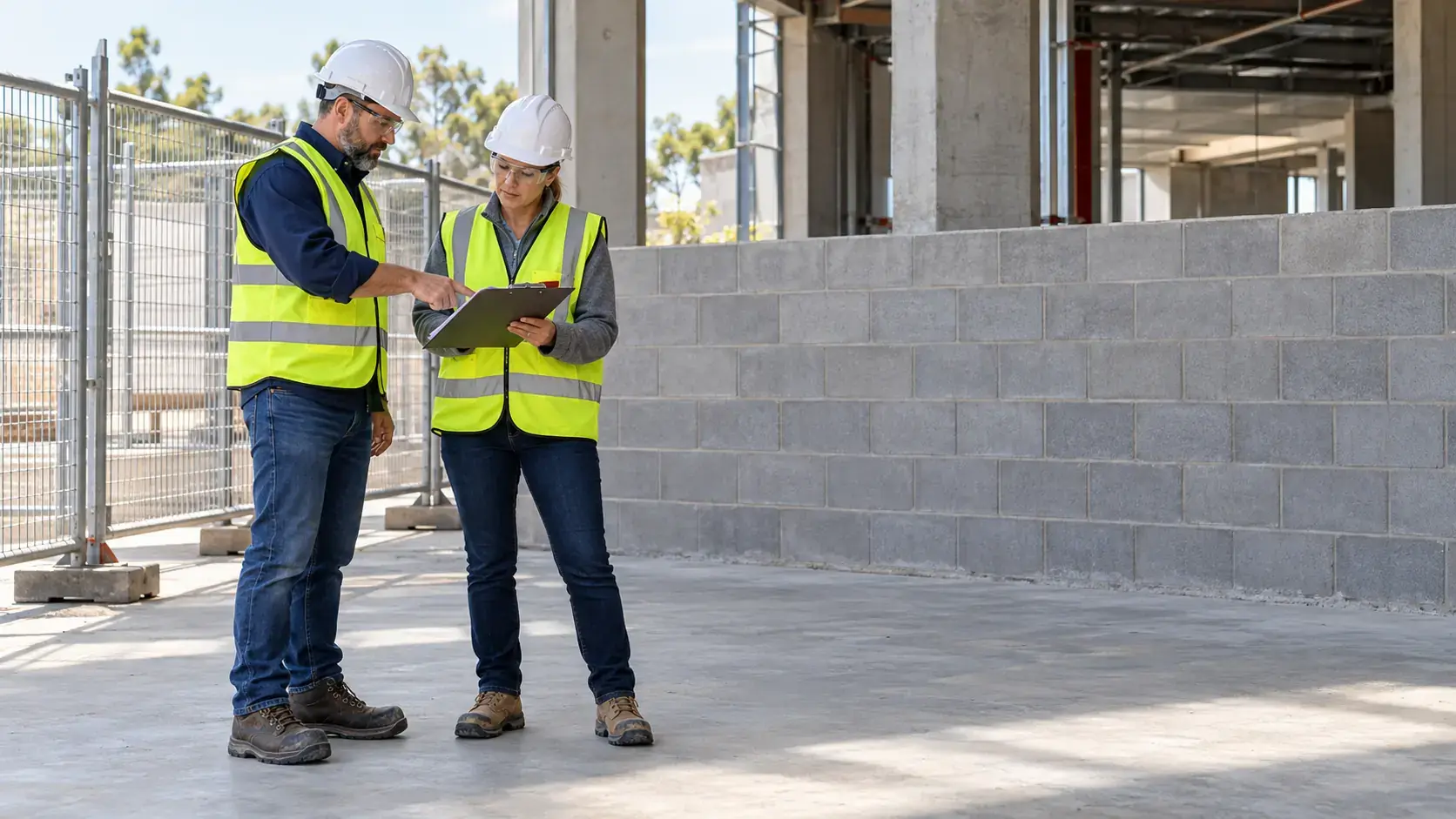
A removal plan is incomplete if it starts at the crane lift. The critical question comes earlier: what keeps the material stable while it is being separated, accessed and connected?
What the new Queensland alert says
WorkSafe Queensland published its falling-block-wall alert on 15 October 2026. It concerns a January 2026 construction incident, not an incident reported as occurring this week.
Early findings describe a cut masonry segment approximately 3.3 metres long and 0.7 metres high. Propping formed part of the planned process for fitting chains before a tower-crane lift. The section fell while a worker attached the chains, seriously injuring the worker’s lower leg. The regulator says these findings are not confirmed and the exact cause remains under investigation. The alert does not establish why the section fell. Read the primary incident alert.
Why cutting changes the risk
The regulator highlights that ordinary masonry walls are not normally designed as lifting elements. Separation changes their structural behaviour. For HSSE teams, the practical implication is to examine the complete removal sequence—not just the capacity of a crane or the final destination of the material.
A useful planning exercise is to ask the team to describe every intermediate condition in plain language: before cutting, during separation, during access for connections, during movement and after placement. This is a discussion framework, not an approved engineering sequence. If the team cannot explain how stability and worker protection will be assured at one of those stages, the method is not ready for release.
Start with competent structural assessment
The existing Queensland Demolition work Code of Practice 2021 (PDF) addresses planning, structural condition, demolition methods and sequencing. Its engineering-investigation guidance includes assessing whether the proposed method can avoid unintended collapse and considering deterioration and the structure’s current load-carrying capacity.
For a project review, request a clear record of what is known, what was checked and what remains uncertain. An old drawing is useful information; it is not, by itself, confirmation that the present structure matches it. Give the competent assessor access to relevant records and site conditions before a removal method is selected.
Treat temporary support as engineered work
The UK Health and Safety Executive’s structural-stability guidance calls for competent assessment and temporary supports designed for foreseeable loads. It explains that bracing and propping need installation, checking, inspection, maintenance and dismantling in line with the designer’s specification. Ordinary access scaffolding should not be assumed to restrain a structure.
Turn that principle into an assurance question: who accepts the support arrangement before work proceeds, and where is that acceptance recorded? Make the boundary between demolition planning, temporary-works design and lifting planning visible. A handover between contractors should transfer the necessary information, not leave an unowned gap.
This article does not specify prop positions, cut dimensions, lifting points or load capacities. Those decisions require a site-specific assessment and competent design. An arrangement that looks familiar is not evidence that it is suitable.
Keep people out of the collapse zone
HSE’s demolition guidance says the method should define safe working, exclusion and debris zones. Their extent depends on the technique and site conditions, and they may need to change as work progresses. If the available space cannot contain the risk, the method needs reconsideration.
Challenge tasks that require someone beside material whose stability has changed. Ask whether a different, competently assessed method can remove that exposure. A barrier is useful only when the planned work can actually be performed without defeating it. Include neighbouring workers, pedestrians and other trades in the discussion, not only the demolition crew.
Do not solve one hazard by overlooking another
Queensland’s demolition guidance also identifies mobile-plant interaction and airborne contaminants, including silica and asbestos. It explains the jurisdiction’s safe work method statement requirements for high-risk construction work involving structural demolition.
A method review should therefore include a short interface check: who else is exposed, what services or materials need assessment, how access will be controlled and how changes will be communicated. These are recommended review prompts, not findings about the January incident. Apply local law and obtain specialist advice where required; Queensland and UK guidance do not create identical legal duties everywhere.
Leadership and toolbox questions
- What evidence supports the chosen method, and which assumptions still need checking?
- Who owns the transition between cutting, temporary support, connection and movement?
- Can anyone be required to enter a potential fall zone to make the method work?
- What change would require work to stop and the competent designer or assessor to review the plan?
- Can the crew explain the method and escalation route without having to interpret several conflicting documents?
Use these questions before the job, not as an after-the-event test of an individual worker. Leaders should allow time for uncertainties to be resolved and make it straightforward for the crew to pause when actual conditions differ from the plan.
Key takeaway
Approve the whole removal process, including the period before a load is lifted. Ask for evidence of stability, protected access and coordinated responsibilities at each transition. The investigation remains open; the opportunity to review current work does not need to wait for a final causal finding.
Video and further reading
No directly relevant authoritative, embeddable video was verified for this alert. No unrelated footage has been added. Use the linked regulator documents for the technical discussion.
Continue with reassessing risk when the work changes, turning fatality statistics into a critical-risk reset, or browse the Articles archive.
Primary sources and dates
- WorkSafe Queensland — Falling block wall section incident alertPublished 15 October 2026; incident January 2026; preliminary findings, investigation continuing.
- Queensland — Demolition work Code of Practice 2021 (PDF)Existing code, not a new October 2026 law.
- HSE — Structural stability during alteration, demolition and dismantlingSupporting guidance; page dated 8 September 2026.
- HSE — DemolitionSupporting guidance; page dated 22 November 2024.
- WorkSafe Queensland — DemolitionSupporting jurisdiction-specific guidance; consulted 16 October 2026.
All sources checked 16 October 2026. The review prompts are original learning applications, not additional investigation findings or engineering instructions.
Share the lesson
Open the separate 9:16 Pinterest poster
The poster is an AI-generated illustration of a fictional pre-work discussion, not the incident or an approved support arrangement.
Your experience matters
Share your thoughts on this page
Have a question, a useful experience or a suggestion? Add your input below.
Comments are public. Keep them respectful and relevant. Do not share contact details, confidential information or emergency reports.
Comments on this page
Loading comments…