Safety · Vehicle Filming · Task Changes
When the Shot Changes, Reassess the Risk: Vehicle Filming Safety
Published
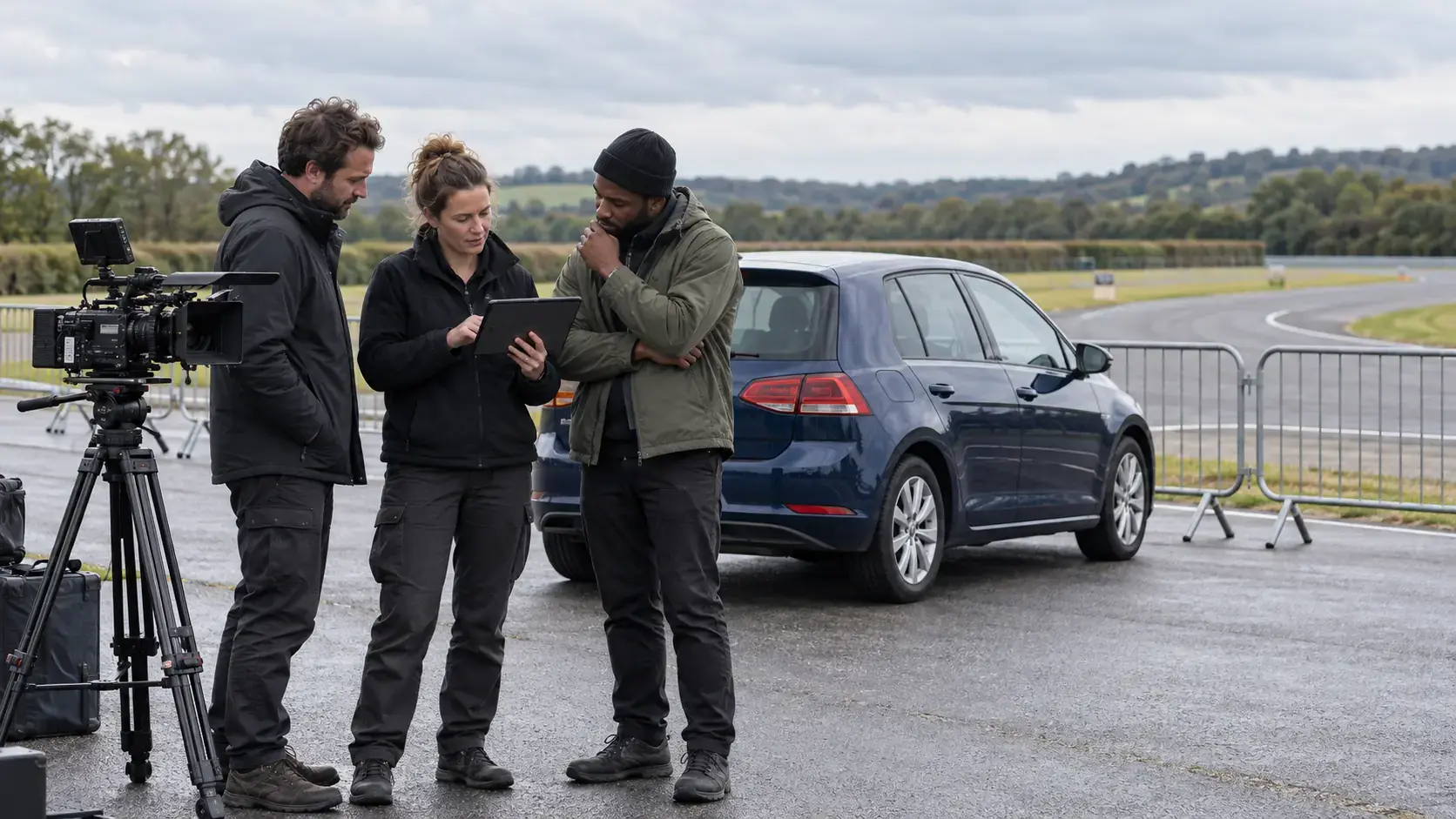
The planned work is finished. Someone suggests one more shot, one closer angle or one quicker way to capture the action. That suggestion can change the hazards, the equipment and the protection people need. The team needs a fresh decision before the vehicle moves.
What HSE reported on 15 October 2026
An employee of Superhub Ltd suffered life-changing head and brain injuries during filming at Broadsands car park in Paignton on 14 May 2021. HSE says a planned drone shoot had finished when additional filming from a moving car was proposed. The employee entered the boot; its liner slipped as the car began moving, and he fell onto the tarmac.
A joint police and HSE investigation found no risk assessment for the filming activity and an unsuitable vehicle, without provision to secure the employee or equipment safely. HSE reported a £45,000 company fine and a director’s 16-month prison sentence, suspended for two years, imposed at Exeter Crown Court on 14 October 2026. Read HSE’s enforcement account ↗
The incident, sentencing and publication dates are different. This is a new enforcement finding about a 2021 incident. It is not a report of an accident occurring today. The notice does not establish an exact vehicle speed; none is assumed here.
Why a changed method needs a new decision
The camera remained part of the job, but the way of using it changed. Treating the extra footage as a small addition could leave an entirely different exposure unexamined.
For HSSE teams, the broader lesson is a practical inference from the case: when people change a method, location, vehicle, position or sequence, the earlier plan may no longer describe the work. Test the change before relying on the original briefing.
This applies to a corporate video at a depot, a contractor photographing a project, a product demonstration or a training-film crew. Their presence on an industrial site also creates interfaces with the host’s traffic and work controls.
Start with a safer way to obtain the footage
HSE’s existing vehicle-filming information sheet, ETIS22(rev2), September 2017, covers filming in, from and around vehicles. Its controls include remote cameras where possible, competent drivers, suitable vehicles, secured equipment and planned rehearsals. Tracking work requires an appropriate vehicle whose structural integrity is maintained and crew who are suitably restrained.
It warns against filming through open boots, doors or sunroofs without suitable controls. Equipment must not compromise vehicle safety systems or expose bystanders. Public-road activity may require agreement with the relevant authorities. Read the official vehicle-filming guidance (PDF) ↗
Begin the creative discussion by asking whether the shot can be obtained from a suitable stationary position, with a remote camera or by changing the sequence. Each alternative needs assessment of its own hazards. A drone, a mounted camera or a specialist vehicle is not automatically safe because it avoids one particular exposure.
Use six checks before accepting a changed shot
These are Worksite Safety Hub planning prompts for a competent production team, not instructions for constructing a camera rig or selecting restraints:
- Describe the change. State where each person and item of equipment will be, which vehicles will move and how the sequence begins and ends.
- Confirm the method. Identify the competent person who can demonstrate that the vehicle, camera arrangement and crew protection suit the task.
- Check the surrounding work. Agree the filming area, access arrangements and separation from unrelated people and vehicles with the host site.
- Allocate control. Name the person coordinating the sequence and ensure the driver can concentrate on driving.
- Brief the stop instruction. Agree who can call a stop, how the message is received and what happens if communication is lost.
- Release the task deliberately. Give the people doing the work a chance to raise concerns before authorising the changed sequence.
If the explanation depends on someone holding on, improvising a support or remaining still despite unexpected movement, pause for competent review. A brief duration does not demonstrate that a method is suitable.
Keep responsibility clear across companies and freelancers
HSE’s film and broadcasting guidance calls for defined responsibilities, a health-and-safety management system, risk assessment and ongoing review. It explains that using a consultant does not transfer the employer’s duty to manage safety. Review production responsibilities ↗
Before filming on a worksite, identify the production lead and the host contact. Record who controls the vehicle route, who can authorise a change and who resolves a conflict between the desired shot and the site’s restrictions. Freelancers and small teams need the same clarity about the actual task.
The UK legal context described in the sources should not be presented as a universal rule for every country. Productions elsewhere should apply their local requirements and appropriate specialist advice.
Review controls where the work actually happens
HSE’s risk-management guidance says controls should be reviewed when changes introduce new risks, when existing controls may be ineffective, or when workers identify problems. It also emphasises controlling risks in practice rather than relying on paperwork. Use HSE’s risk-review guidance ↗
Ask the crew to explain the revised arrangement at the location. Compare the explanation with the positions, route and equipment in front of you. Resolve differences before continuing. Carry the decision into the next briefing so that an earlier rejected method is not revived by another shift or contractor.
For the host site, use the familiar workplace-transport checks: the site, the vehicle and the people involved all need attention. Explore HSE’s workplace-transport guidance ↗
Questions for leaders and toolbox talks
- What changed after the original plan was agreed?
- Could we obtain the footage with less exposure to moving vehicles?
- Who has the competence and authority to approve this method?
- Can every crew member explain the stop instruction?
- What keeps bystanders and unrelated work outside the filming activity?
- Would the team feel able to refuse an extra shot that has not been assessed?
Video note
No directly relevant authoritative, embeddable video for this enforcement case or its vehicle-filming controls was verified. Unrelated stunt footage and accident clips have not been inserted. The official written sources provide the learning material.
Primary sources and dates
- HSE — Media company fined and director sentenced after vehicle-filming injury ↗Published 15 October 2026; incident 14 May 2021; sentencing 14 October 2026
- HSE — Safe filming and recording in, from and around vehicles, ETIS22(rev2) ↗Existing guidance, September 2017; consulted 15 October 2026
- HSE — Safety in film, TV and broadcasting ↗Updated 11 June 2026; existing production-management guidance
- HSE — Steps needed to manage risk ↗Updated 10 June 2024; supporting risk-review principles
- HSE — Workplace transport ↗Supporting guidance; consulted 15 October 2026
The practical prompts are original learning applications. They do not establish additional findings about this incident or replace a task-specific assessment.
Share the lesson
Open the separate 9:16 Pinterest poster ↗
The poster is an AI-generated illustration of a fictional production-planning discussion. It does not show the incident or those involved.
Your experience matters
Share your thoughts on this page
Have a question, a useful experience or a suggestion? Add your input below.
Comments are public. Keep them respectful and relevant. Do not share contact details, confidential information or emergency reports.
Comments on this page
Loading comments…