Safety · Product Reviews · 10 min read
BH-4 Portable Four-Gas Detector Review: Diffusion Monitor and Pumped Sampling Options
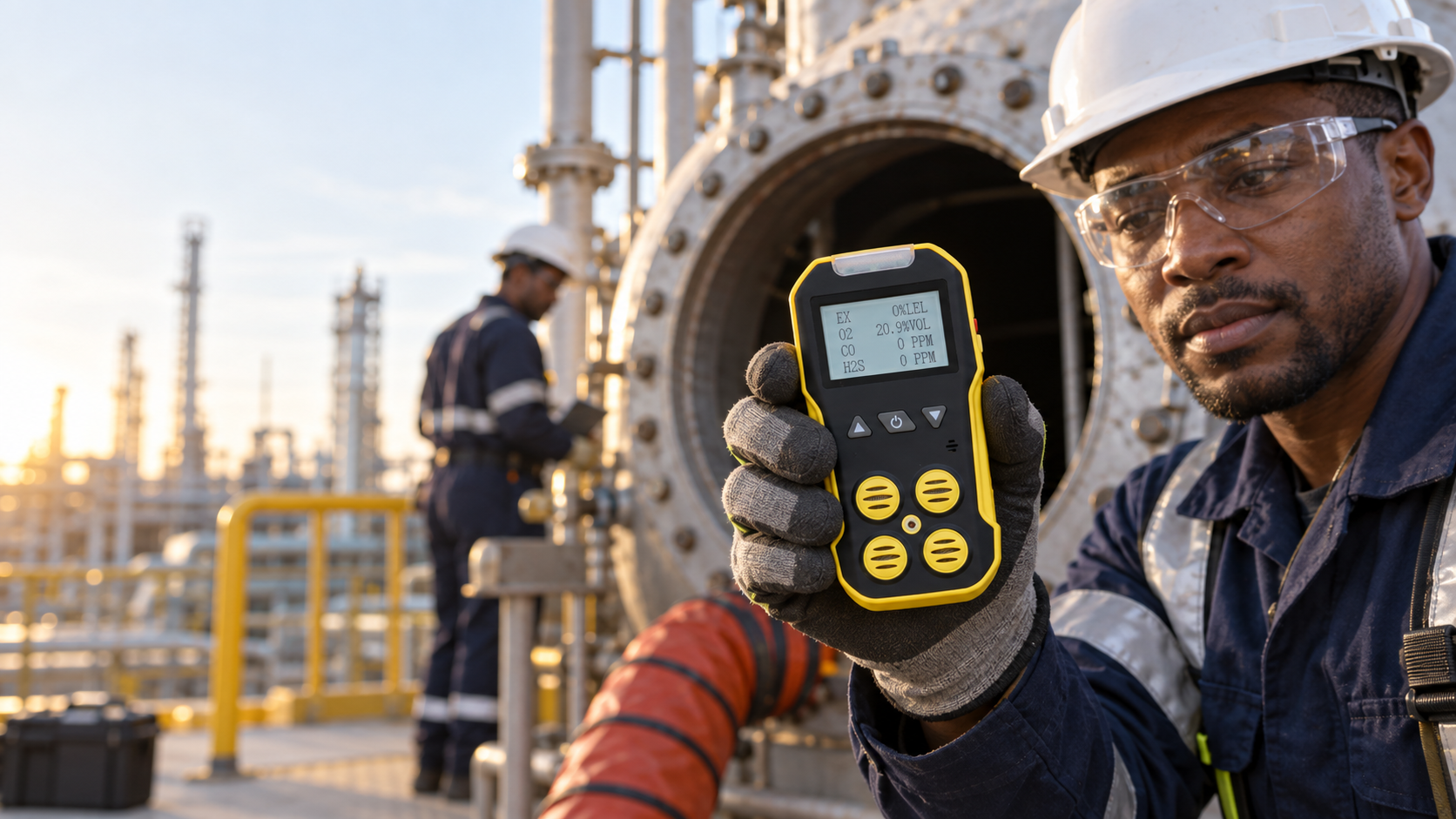
A professional safety review of the BH-4-style portable gas detector for O₂, CO, H₂S and combustible-gas monitoring, including diffusion-versus-pump selection, calibration and confined-space precautions.
Affiliate disclosure and review basis
This article contains an affiliate link. Worksite Safety Hub may earn a commission if you make a qualifying purchase through it, at no additional cost to you. This independent review is based on the supplied product photographs and marketplace information; we have not personally field-tested, bump-tested or calibrated the exact instrument.
The photographs appear to combine a compact BH-4-style diffusion monitor with a separate pumped detector and sampling probe. They may be different listing options rather than one package. Confirm the exact model, sensor combination, sampling method and included accessories shown in your basket before payment.
Quick verdict
The compact four-gas version offers the familiar combination of oxygen, carbon monoxide, hydrogen sulphide and combustible-gas monitoring in a belt-worn unit. Its uncluttered display, four exposed sensor inlets, three-button interface, clip and multi-mode alarms make it look suitable for routine personal monitoring when the exact model is properly approved, maintained and tested.
The listing also shows a longer pumped instrument with a metal probe. That option could be more appropriate for remote sampling before opening or entering a space, but a pump adds failure modes, tubing considerations and response delay. Our verdict is conditional: the product is worth considering only when the exact variant has verifiable approvals, complete sensor data, accessible calibration support and documented after-sales service.
What the four-gas version measures
The compact instrument’s screen shows EX, O₂, CO and H₂S simultaneously. This common configuration can warn of oxygen deficiency or enrichment, flammable atmosphere, carbon monoxide and hydrogen sulphide—but it cannot detect every hazardous gas or vapour.
The rear label visible in the supplied photograph appears to identify model BH-4 and shows example ranges, but small marketplace labels are not reliable specification documents. Obtain the model-specific manual and confirm measuring range, accuracy, resolution, T90 response, alarm setpoints, sensor technology, cross-sensitivities, environmental limits and expected sensor life.
- Oxygen (O₂), typically displayed as percent by volume.
- Carbon monoxide (CO), displayed in parts per million.
- Hydrogen sulphide (H₂S), displayed in parts per million.
- Combustible gas (EX), displayed as percent of the lower explosive limit.
Diffusion monitor or pumped detector?
A diffusion monitor relies on the surrounding atmosphere reaching its sensors. It is compact and well suited to personal continuous monitoring when worn in the breathing zone, but it cannot sample a remote location by itself.
A pumped monitor actively draws air through a probe and tubing. This can support testing through an opening or at different levels before entry. The pump option shown appears to use a roughly 220 mm metal probe, while the body is advertised at approximately 225 × 65 × 30 mm. Confirm those figures and the sampled gases for the exact variant; the images do not prove that the pumped model carries the same four sensors as the BH-4-style unit.
Remote sampling requires enough time for the atmosphere to travel through the probe and tubing and for the sensor to respond. Test pump flow, inspect tubing and filters, account for absorption or condensation, and sample representative locations under the approved procedure.
Display, alarms and package contents
The compact detector uses a monochrome screen with all four channels visible and a simple three-button menu. Listing images advertise audible, visual and vibration alarms, an industrial sensor, a high-definition screen, rechargeable battery and a protective enclosure. These are useful features, but claims such as “three-proof” or “anti-fall” need a stated test standard or ingress and drop rating.
One photograph shows an aluminium case, charger, data cable, lanyard and calibration cap. Do not assume they are included with every option. The presence of a calibration cap is helpful, but safe use also requires compatible certified gas, a suitable regulator, tubing, written procedures and trained personnel.
- Four-channel display on the diffusion monitor.
- Audible, visual and vibration alarm claims.
- Rear metal clip for breathing-zone wear.
- Rechargeable power and charging accessories shown.
- Case and calibration accessories appear option-dependent.
Bump testing and calibration are non-negotiable
A gas detector is trustworthy only when its sensors and alarm outputs respond correctly. Follow the manufacturer’s instructions and the workplace instrument programme for fresh-air zeroing, functional bump checks and full calibration. A bump check confirms response and alarm operation using known gas; calibration adjusts the indicated value to a traceable reference.
Before buying, confirm which calibration-gas mixture, regulator flow and adapter the exact unit requires. Ask whether the instrument records test history, locks out after a failed check, supports sensor replacement and has a competent service route. If the seller cannot provide a clear English manual and a credible calibration procedure, do not use it for life-safety decisions.
Confined-space limitations
Neither the diffusion unit nor the pumped option makes a confined space safe. Atmospheric testing must sit inside a complete system covering hazard assessment, isolation, ventilation, permits, communication, standby arrangements and rescue. OSHA guidance calls for testing in the order of oxygen, combustible gases and vapours, then toxic gases and vapours.
A single reading at the entrance may miss stratified or changing conditions. Sample representative depths and locations with appropriate equipment, continue monitoring as required and withdraw immediately when alarms or the entry procedure demand it. Never lower a person into a space simply because a marketplace detector displayed normal values.
Best use cases—and when to choose something else
After verification and acceptance testing, the diffusion four-gas monitor may suit trained workers in wastewater, utilities, construction, maintenance, tank work and oil and gas who need continuous personal monitoring. The pumped variant may suit competent teams conducting remote pre-entry or investigative sampling.
Choose another instrument when the hazard assessment identifies gases outside the installed sensor set, a photoionisation detector or specialist toxic sensor is required, the atmosphere may be immediately dangerous, remote sampling needs a certified pumped model, or the site requires traceable fleet management and approvals that this product cannot demonstrate.
Buyer’s verification checklist
Request evidence for the exact model—not a generic certificate or a photograph of a similar unit. Verify hazardous-location or intrinsic-safety approval in the issuing body’s database where required. Confirm the difference between every listing option before comparing prices.
- Exact model, sampling method and installed sensor set.
- Independently verifiable Ex or intrinsic-safety approval.
- Ranges, accuracy, resolution, T90 response and cross-sensitivity.
- Bump-test and calibration gas, regulator and adapter requirements.
- Pump-flow alarm, tubing limits and probe materials for a pumped unit.
- Battery runtime, ingress/drop ratings and charging restrictions.
- Case contents, replacement sensors, warranty and service support.
Final assessment
The BH-4-style monitor has a practical layout and the right headline gas combination for many industrial programmes. The optional pumped format could add valuable remote-sampling capability, while the compact diffusion unit appears more convenient for personal wear.
The listing’s mixed product photographs make careful option selection essential. Treat the screen, case and feature claims as a starting point—not proof of workplace suitability. Verified certification, correct sampling practice, successful daily checks and competent maintenance should decide whether this detector earns a place in your gas-monitoring programme.
Confirm the exact model, specification, certification evidence, shipping terms and current price before ordering.
Sources
- AliExpress — Portable multi-gas detector product listingPublished Product listing; accessed 19 September 2026
- OSHA — Permit-Required Confined Spaces, 29 CFR 1910.146Published Current standard; accessed 19 September 2026
- OSHA — Procedures for Atmospheric Testing, Appendix B to 1910.146Published Current guidance; accessed 19 September 2026
- HSE — Confined spacesPublished Current guidance; accessed 19 September 2026
Daily HSSE updates
Subscribe for practical HSSE updates.
Subscribe for the daily message, selected HSSE news and occasional new-resource alerts from Worksite Safety Hub.