Safety · 9 min read
Beyond the Fence: What the Miami Cargo Aircraft Overrun Teaches About Consequence Planning
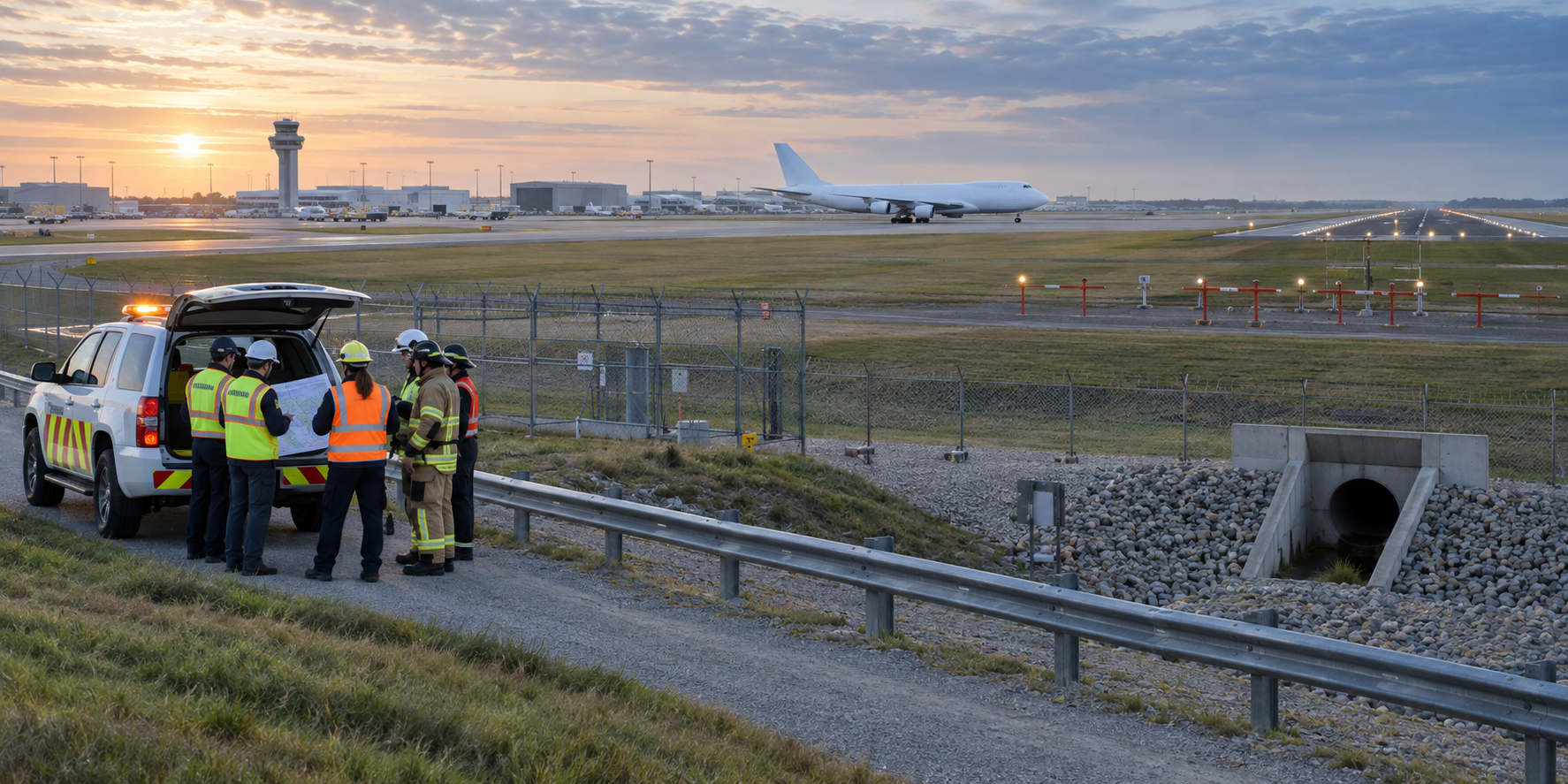
A fatal runway overrun in Miami shows why credible worst-case planning must follow energy and movement beyond the formal boundary—and protect contractors, neighbours and responders who cannot control the initiating event.
What is confirmed—and what remains under investigation
On 6 September 2026, 21 Air Flight 7598, a Boeing 767-33A cargo aircraft operating from San Juan to Miami, overran the end of Runway 30 while landing at Miami International Airport. The US National Transportation Safety Board has opened investigation DCA26MA352 and lists it as ongoing. The agency has not established a probable cause.
Authorities have reported that five people were killed and five others injured. Updated reporting identifies the five people who died as occupants of a van used to transport aircraft-cleaning workers. The aircraft struck the van on airport property, breached a perimeter fence and struck another vehicle on a public street. Those casualty and location details make the event especially relevant to every organisation whose hazards can travel beyond the operating area.
This article does not assign the event to weather, crew decisions, aircraft condition, runway design or any other factor. Those questions belong to the investigation. The practical lessons below arise from the confirmed consequence pattern: a high-energy operation crossed multiple boundaries and harmed people who had no control over the aircraft.
Investigation update: recorder information published 9 September
The NTSB has now published a preliminary summary of selected cockpit voice recorder and flight data recorder information. The agency explicitly states that the information is preliminary and subject to change. It is not a probable-cause finding and should not be used to assign blame.
The cockpit summary records a caution that the aircraft was too fast, followed by further comments about excessive speed without a consistent verbal response. It also records automated “sink rate” and repeated “too low terrain” alerts. The summary places a go-around call after touchdown. Flight data indicate a brief increase in thrust consistent with a go-around, followed by idle thrust and renewed braking; the recorded data contained no indication that speed brakes or thrust reversers deployed.
These data describe selected recorded events, not why they happened. The NTSB continues to examine the crew, aircraft, systems, weather, air traffic control, organisational factors and other evidence before determining probable cause.
- Require abnormal warnings to receive an explicit acknowledgement and response.
- Define stop, abort and recovery criteria before operational pressure develops.
- Make escalation language unmistakable when an initial warning receives no response.
- Clarify when a recovery action, once initiated, may be reversed and by whom.
- Use simulation to practise competing alerts, late decisions and incomplete communication.
A fence marks ownership—not the end of a hazard
Organisations often define risk around the land, equipment and people they directly control. Hazard energy does not respect that map. An aircraft can continue beyond a runway; a vehicle can leave a haul road; a suspended load can fall outside a barricade; pressure can project fragments; and a toxic or flammable release can travel with wind or drainage. The true consequence boundary is determined by physics, not property lines.
A credible assessment therefore has to follow the energy to its possible endpoint. It should identify workers, contractors, road users, neighbouring businesses, homes, utilities and environmental receptors that could be exposed. People outside the operating team may receive no alarm, have no protective equipment and know nothing about the hazard. Their vulnerability can be greater precisely because they are not part of the operation.
- Map credible trajectories, run-out distances, blast effects, dropped-object zones, vapour movement and contaminated drainage beyond the site boundary.
- Include routine and temporary occupancy: cleaners, delivery drivers, maintenance crews, roadside workers and members of the public.
- Review whether neighbouring land use has changed since the original assessment.
- Treat the perimeter as one control layer, never as proof that off-site consequence is impossible.
Plan for the credible overrun, not only the normal route
Normal-operation drawings show where equipment is intended to travel. Consequence planning asks where it could travel after control is lost. At an airport that means examining runway excursions and the areas beyond the runway end and sides. At other worksites it means checking downhill travel, vehicle breakthrough, crane overswing, rail movement, rotating-equipment fragments, pressure-release direction and the reach of fire or floodwater.
The exercise should be specific enough to drive controls. Identify the initiating conditions without pretending to predict one exact accident sequence. Then test whether terrain, separation distance, barriers, arresting features, drainage and access arrangements can limit the outcome. Design standards are essential, but compliance should be complemented by a local understanding of exposure, interfaces and change.
Protect contractors who work in the shadow of major hazards
The people most exposed may not operate the hazardous system. Cleaning crews, security guards, caterers, drivers, construction teams and utility workers often move through zones shaped by another organisation's risk decisions. Their route, timing and waiting locations can place them close to high-energy operations even when their own task appears low risk.
Contractor management must therefore go beyond induction and personal protective equipment. The host organisation should define where mobile crews may travel or wait, communicate abnormal restrictions quickly and verify that dispatchers and supervisors can account for them. Procurement boundaries must not become safety boundaries: the party controlling the major hazard needs a reliable way to protect everyone within its credible consequence area.
- Identify contractor routes and holding areas that intersect with high-energy operations.
- Use positive access controls for critical zones rather than relying only on signs or familiarity.
- Include mobile contractors in alarms, emergency communications and accountability systems.
- Reassess exposure when construction, closures or operational changes alter normal traffic patterns.
Keep critical exposure zones sterile
Separation works only while the separated space remains available. Informal parking, storage, temporary offices, queued vehicles and shortcut routes can quietly convert a protective buffer into an occupied work area. Because these changes may be temporary, they are easily missed by drawings and periodic audits.
Critical zones need an owner, a clear purpose and a controlled process for exceptions. Field verification should compare the approved layout with actual use across different shifts. Any temporary occupation should be supported by a time-limited risk assessment, defined controls and a person authorised to stop the activity when operating conditions change.
Build physical layers for residual energy
Prevention remains the priority, but major-hazard systems also need layers that reduce consequence after prevention fails. Depending on the operation, these may include engineered arresting systems, impact-rated barriers, clear zones, sacrificial structures, drainage isolation, blast-resistant siting, remote isolation or protected refuges. The appropriate solution must be selected by competent specialists for the actual loads and operating environment.
A barrier is not automatically beneficial. It may redirect a vehicle, create debris, obstruct response or transfer energy to another receptor. Every physical layer should have a defined performance requirement, inspection regime and management-of-change trigger. The question is not simply whether a barrier exists, but what event it is designed to withstand and what happens when its capacity is exceeded.
Integrate emergency response across the boundary
An event that leaves the operating area immediately becomes a multi-agency emergency. Site responders may have specialist knowledge and equipment, while public fire, police, medical and road authorities control resources and decisions outside the boundary. Neighbouring employers may need to shelter, evacuate or account for their people. A plan that stops at the gate will lose time at exactly the point when coordinated action matters most.
Exercises should test notification, command, access, common terminology, hazardous-material information, casualty management, traffic control, firewater and fuel containment, public warnings and preservation of evidence. They should include difficult conditions: blocked gates, damaged communications, incomplete personnel lists and simultaneous fire, rescue and environmental priorities.
- Confirm who can order road closures, evacuation, sheltering and changes to the exclusion zone.
- Provide responders with current site plans, hazards, isolation points and reliable contacts.
- Account for contractors and mobile workers without assuming they are in fixed locations.
- Plan how information will be verified before it is released internally or publicly.
Decision gates must work under operational pressure
High-energy operations need unambiguous points at which the safest action is to discontinue, stabilise or start again. Aviation uses defined criteria for continuing an approach or going around. The same principle applies to lifting, excavation, confined-space entry, line breaking, transport and process start-up: when conditions leave the approved envelope, the team needs a clear trigger and enough authority, time and capacity to act.
A procedure alone is insufficient if production pressure, hierarchy, uncertainty or poor communication makes the safer decision difficult. Leaders should examine real work records and near misses to see whether stop-work and restart decisions occur early, whether they are supported and whether deviations are normalised. This is a general control lesson, not a conclusion about the decisions made on Flight 7598.
Questions HSSE leaders should ask now
Use this event as a prompt to test one high-energy operation against actual surroundings. Bring operations, engineering, contractors, emergency responders and neighbouring stakeholders into the same review. Walk the boundary and look outward as well as inward.
- Where can our hazardous energy, equipment or material travel if primary control is lost?
- Who occupies that path during every shift, including contractors and temporary workers?
- Which protective spaces have gradually acquired parking, storage or routine traffic?
- What evidence shows that consequence-limiting barriers will perform as intended?
- Can we alert, protect and account for people beyond our direct supervision?
- When did we last exercise a cross-boundary emergency with external agencies and neighbours?
- What operational condition demands an immediate stop, and can anyone invoke it without hesitation?
Learn now—and update when evidence changes
Major incidents create pressure for fast explanations. Responsible learning separates immediate control questions from incident-specific findings. Organisations do not need to wait to verify their own buffers, contractor routes, emergency interfaces and decision gates. But they should avoid presenting assumptions about this flight as established causes.
The NTSB investigation remains ongoing. When preliminary and final findings are issued, safety teams should revisit their review, compare the evidence with their own systems and update controls where the findings are relevant. The durable lesson is already clear: if an operation can project energy beyond its boundary, responsibility for consequence planning must travel with it.
Sources
- Runway Overrun of 21 Air Flight 7598 — National Transportation Safety BoardPublished Updated 9 September 2026
- All 5 killed in Miami cargo jet crash were in a van used by plane cleaners — Associated PressPublished 9 September 2026
Daily HSSE updates
Subscribe for practical HSSE updates.
Subscribe for the daily message, selected HSSE news and occasional new-resource alerts from Worksite Safety Hub.