Safety · Product Reviews · 11 min read
956D Acoustic Imager Review: Faster Gas-Leak and Partial-Discharge Surveys?
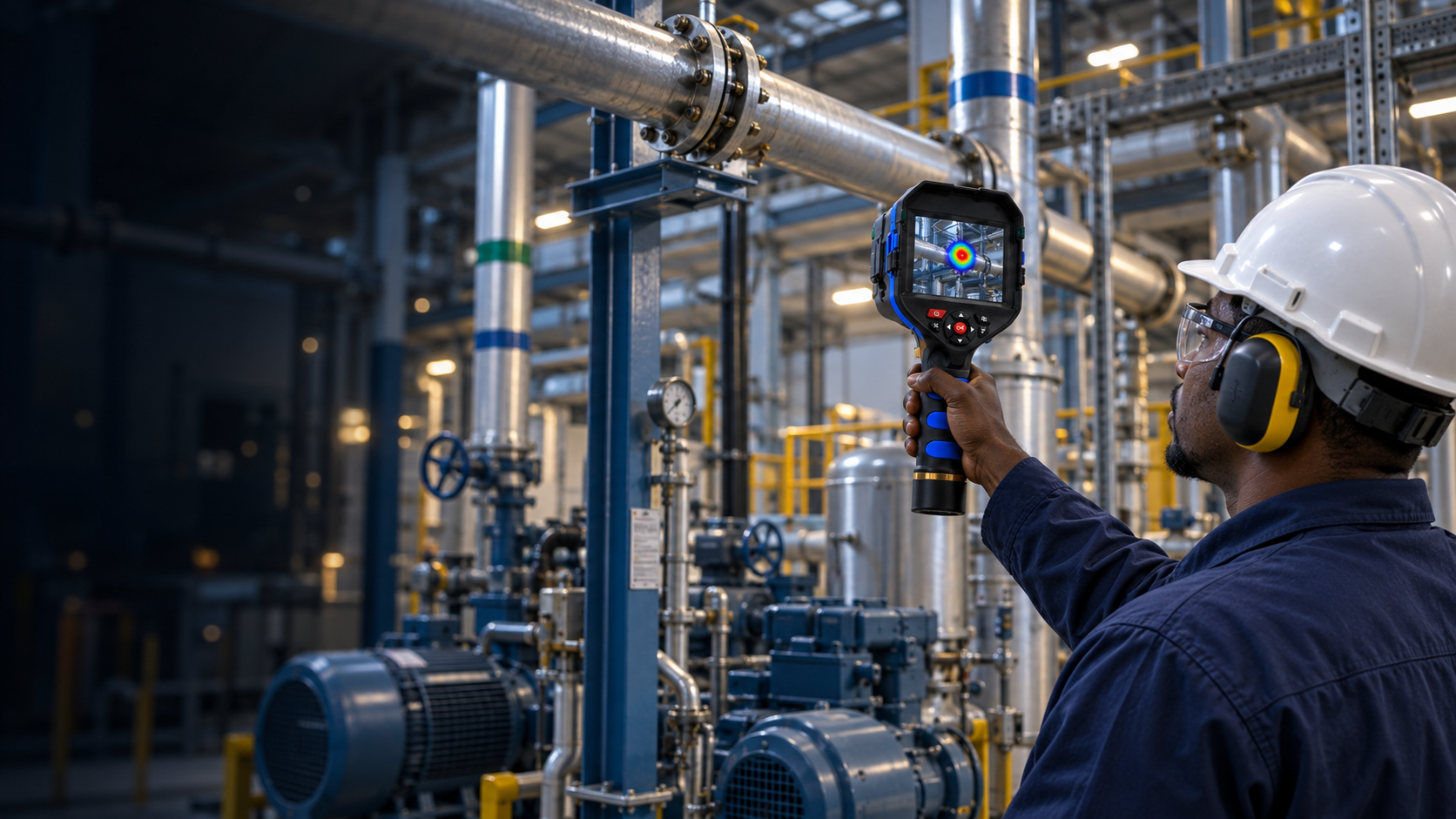
A professional review of the 956D handheld acoustic imaging camera, examining its advertised 64-channel microphone array, ultrasonic leak localization, partial-discharge screening, reporting tools and buyer-critical limitations.
Affiliate disclosure and review basis
This article contains an affiliate link. Worksite Safety Hub may earn a commission if you make a qualifying purchase through it, at no additional cost to you. This independent assessment is based on the supplied product images and marketplace claims; we have not field-tested, calibrated or independently verified the exact instrument.
The listing identifies the device as a 956D handheld acoustic imager. Firmware, sensors, wireless functions, certificates and included accessories may change between sellers or options. Treat every performance figure below as an advertised specification until it is confirmed in the current model-specific manual and acceptance-tested against a known source.
Quick verdict
The 956D has a compelling purpose: convert ultrasonic sound that people cannot reliably hear into a visual heat map overlaid on a camera image. That can help maintenance teams scan broad areas, localize compressed-air or gas leaks, and identify acoustic signatures associated with electrical partial discharge without walking every joint or making contact with energized equipment.
Its strongest advantages are speed, standoff distance and documentation. Its biggest risk is overconfidence. An acoustic hotspot is evidence for investigation, not automatic proof of leak rate, gas identity, electrical defect type or asset condition. Our verdict: potentially valuable for reliability teams that can validate its performance and build it into a disciplined inspection programme, but too consequential to buy on the headline specifications alone.
What the 956D is advertised to include
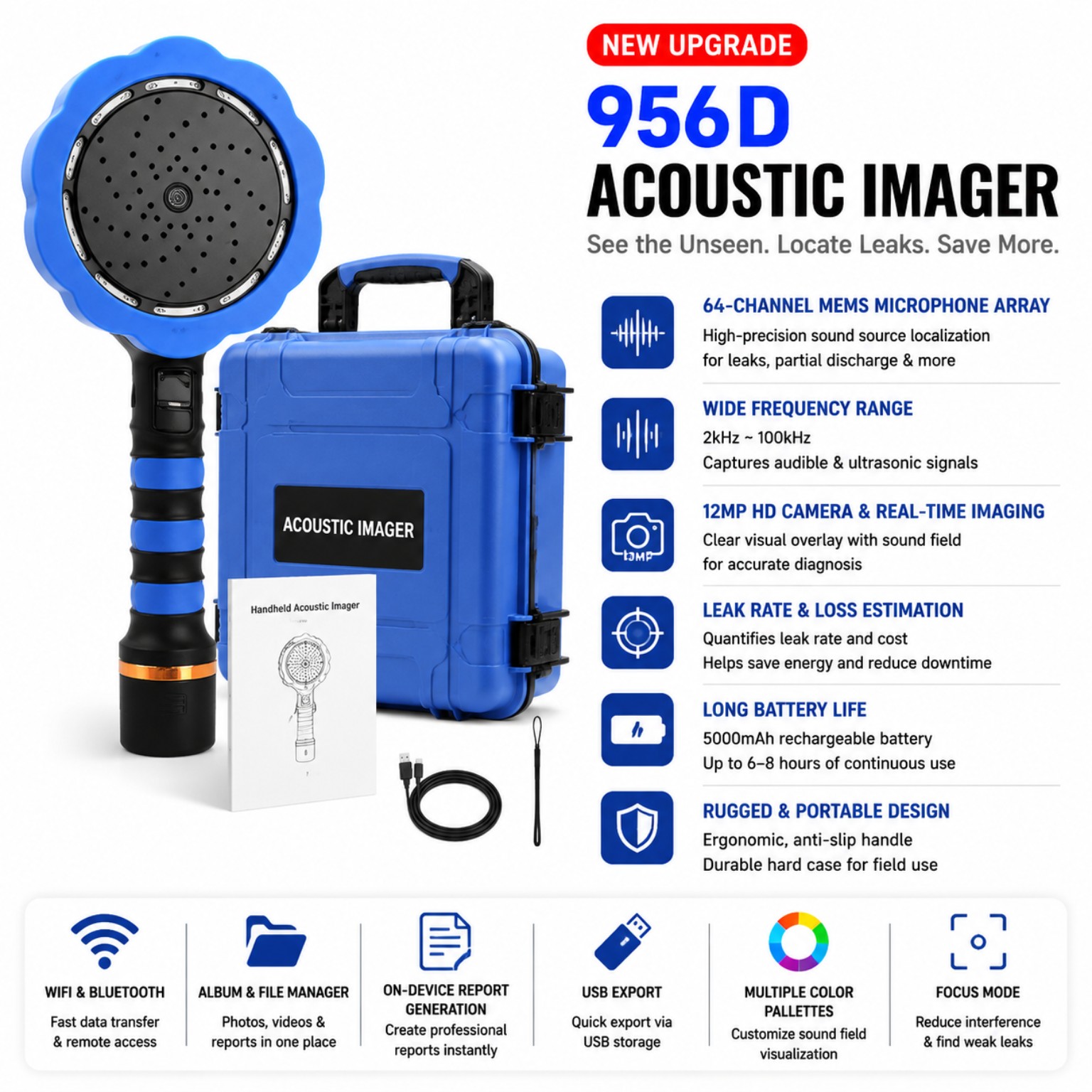
The supplied graphics advertise a 64-channel MEMS microphone array, a 2 kHz to 100 kHz acoustic range, a 12-megapixel camera, real-time imaging at 25 frames per second or more, and a nominal detection distance of 0.3 to 50 metres. The instrument is also shown with adjustable focus or filtering, multiple colour palettes, on-device analysis, image and video storage, report generation and USB export.
Wireless connectivity is described as Wi-Fi and Bluetooth for transfer or remote access. A 5,000 mAh rechargeable battery is claimed to provide roughly six to eight hours of continuous use, and another graphic states a portable weight of about 550 g. These features would support route-based surveys, but buyers should confirm whether the software, application, export templates and future updates are included without a subscription.
- 64-channel MEMS microphone array.
- Advertised 2 kHz–100 kHz range.
- Camera view with acoustic heat-map overlay.
- Advertised 0.3–50 m detection distance.
- Photo, video, alarm and report functions.
- Wi-Fi, Bluetooth and USB transfer claims.
- 5,000 mAh battery with claimed 6–8 hour use.
How acoustic imaging works
A microphone array receives sound at slightly different times and levels. Signal processing estimates the direction of arrival and places a coloured hotspot over the camera view. Filtering toward ultrasonic frequencies can suppress much of the audible plant noise and make turbulent leaks or certain electrical discharge activity easier to distinguish.
The display does not literally photograph escaping gas or electricity. It visualizes a calculated sound source. Reflections from walls and metalwork, several simultaneous sources, wind, distance, background ultrasound, angle and line of sight can shift or blur the apparent hotspot. A good survey therefore approaches the target from more than one position and confirms that the indication remains attached to the suspected component.
Compressed-air and gas-leak surveys
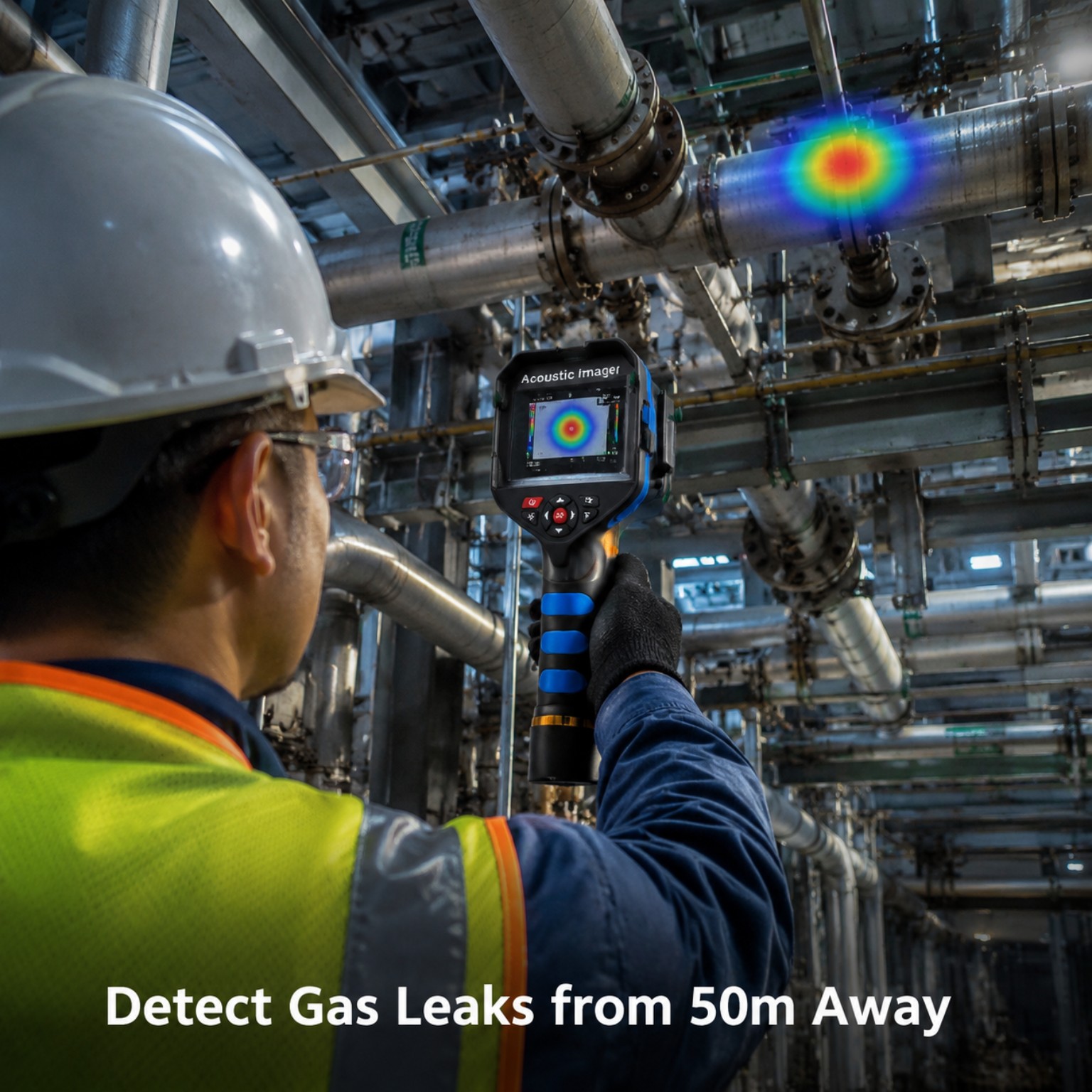
Turbulent flow through a small opening can generate broadband ultrasound, allowing an acoustic camera to screen flanges, valve stems, couplings, hoses, traps and fittings while equipment remains operating. This can reduce the time spent checking every joint and help teams prioritize repairs by making hidden energy losses visible.
The listing also promotes leak-rate and loss estimation. Treat these values as estimates whose accuracy depends on distance, pressure, gas properties, orifice geometry, calibration and environmental conditions. Ask the seller for the calculation method, supported gases, uncertainty, minimum detectable leak under stated conditions and required distance measurement. Use an approved confirmation method before raising a repair order or claiming verified savings.
For flammable, toxic or oxygen-displacing gases, remote detection does not make the atmosphere safe. Follow hazardous-area requirements, gas-testing rules, access controls and emergency procedures. Unless the exact 956D carries verifiable approval for the classified zone, keep it outside that zone.
Partial-discharge screening
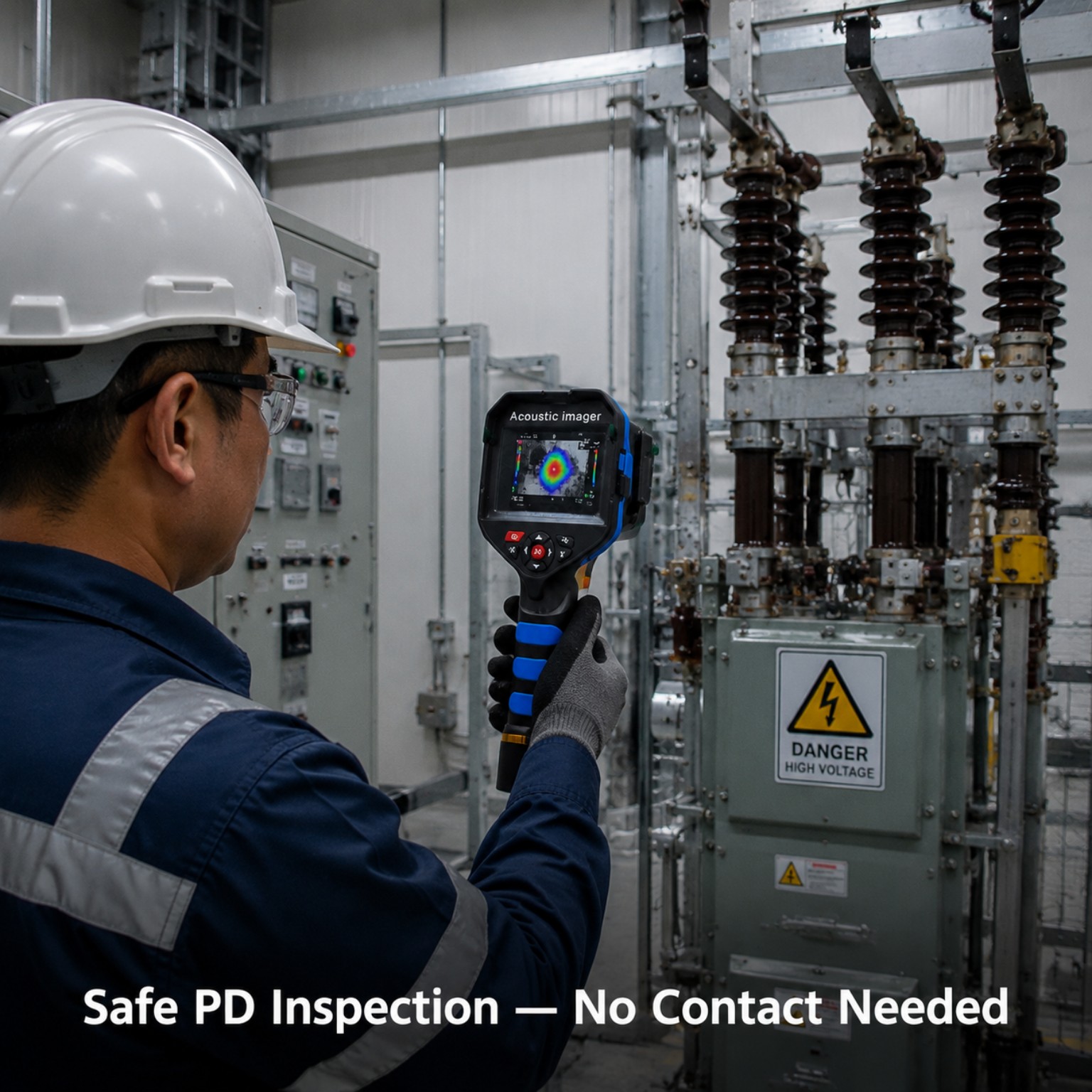
Corona, tracking and arcing can produce distinctive acoustic and ultrasonic activity. A handheld imager may help locate a suspect insulator, termination, bus connection or enclosure without opening equipment. That makes it useful for route screening and for deciding where a qualified electrical specialist should investigate further.
A heat map alone cannot reliably classify every discharge mechanism or determine remaining insulation life. Acoustic results should be correlated with loading, humidity, equipment design, trend history and suitable complementary methods such as infrared, ultrasonic contact sensors, transient-earth-voltage measurement, conventional partial-discharge testing or laboratory analysis. Never open, approach or bypass guarding on energized equipment merely to improve an image. Maintain the required approach boundaries and use site-approved PPE and procedures.
Is the advertised 50-metre range realistic?
A long maximum range is useful for elevated pipe racks and inaccessible electrical assets, but it is not the same as guaranteed detection at 50 metres. A strong leak in a quiet, open line of sight is very different from a weak source behind steelwork in a noisy compressor building.
Professional buyers should request a sensitivity curve or minimum detectable leak versus distance, the test pressure and gas used, field of view, angular resolution, focus behavior and environmental limits. During site acceptance, test known sources at several distances and angles, then document a practical maximum range for each inspection class rather than adopting the marketing limit as a procedure.
Display, capture and reporting workflow
The colour display appears designed to combine a visible image, hotspot, spectrum and measurement information. Multiple palettes can help preserve contrast against different backgrounds, while a narrow frequency band may isolate a target from competing noise. Operators still need a consistent setup: record the filter, distance, gain, asset ID, load, weather and viewing angle so later comparisons are meaningful.
On-device photos, video and report export could shorten the path from detection to work order. Before purchase, ask for a sample report and verify file types, timestamping, asset naming, removable or internal storage, export method, Wi-Fi security, Bluetooth permissions and data-retention controls. Industrial users should also establish whether the companion software is maintained and allowed on the corporate network.
Ergonomics, battery and field durability
The pistol-grip layout keeps the display and sensor array aligned with the target, and the hard case is appropriate for protecting the microphone face. A claimed 550 g instrument should be manageable, although extended overhead scanning can still cause fatigue; alternate hands, use planned routes and avoid awkward postures.
The stated 5,000 mAh battery and six-to-eight-hour runtime may cover a normal survey, but screen brightness, wireless use, temperature and recording will affect endurance. Confirm charge time, replaceability and low-battery behavior. The graphics call the enclosure rugged and dust or spill resistant without showing a numerical IP rating. Do not infer weatherproofing, drop resistance or hazardous-area suitability without documented test evidence.
What this instrument cannot replace
The 956D is a screening and localization tool. It does not identify an unknown gas, measure worker exposure, certify that an atmosphere is safe, or replace a calibrated personal gas detector. It cannot by itself establish the structural integrity of pressure equipment or confirm that a leak has been fully eliminated.
For electrical work, it does not replace isolation, proving dead, arc-flash controls, statutory inspection or specialist partial-discharge diagnosis. It also cannot justify approaching an unsafe asset. Inspection findings should enter the established defect-management process, with risk ranking, confirmation, repair, retest and documented close-out.
Buyer checklist
Before ordering, confirm who manufactures and supports the exact 956D, then compare the selected option with the current data sheet. Ask for demonstration files and documentation rather than relying only on promotional graphics. For a professional programme, budget for training, baseline surveys, acceptance checks and periodic verification—not just the instrument.
- Microphone count, frequency range and acoustic sensitivity.
- Detection performance versus distance under stated conditions.
- Leak-estimation method, supported gases and uncertainty.
- Camera resolution, frame rate, field of view and minimum focus.
- Partial-discharge modes, filters and classification claims.
- Storage capacity, export formats and sample reports.
- Wi-Fi/Bluetooth security and software support period.
- Battery runtime, charger, replacement policy and operating temperature.
- Numerical IP and drop-test ratings, if claimed.
- Calibration certificate, warranty, returns and local technical support.
Final assessment
The 956D acoustic imager packages an advanced maintenance concept into a portable form: scan quickly, see where the ultrasound originates, capture evidence and direct the next action. The advertised 64-channel array, broad ultrasonic range, camera overlay, reporting and long standoff could make it useful for compressed-air efficiency work and condition-based electrical surveys.
The business case should be built on verified sensitivity, repeatability and workflow—not on colourful hotspots. A buyer who validates the unit against known sources, trains operators, controls data and confirms findings with the correct method may gain a powerful survey tool. A buyer expecting one image to diagnose every leak or discharge will be disappointed—and may make unsafe decisions.
Confirm the exact model, specification, certification evidence, shipping terms and current price before ordering.
Sources
- AliExpress — 956D handheld acoustic imager product listingPublished Product listing; accessed 19 September 2026
- U.S. Department of Energy — Improving Compressed Air System PerformancePublished Compressed-air systems guidance; accessed 19 September 2026
- HSE — Maintaining portable and transportable electrical equipmentPublished Current guidance; accessed 19 September 2026
Daily HSSE updates
Subscribe for practical HSSE updates.
Subscribe for the daily message, selected HSSE news and occasional new-resource alerts from Worksite Safety Hub.