HSSE TIPS · Product Reviews · Mobile Laboratories / Specialist Vehicles
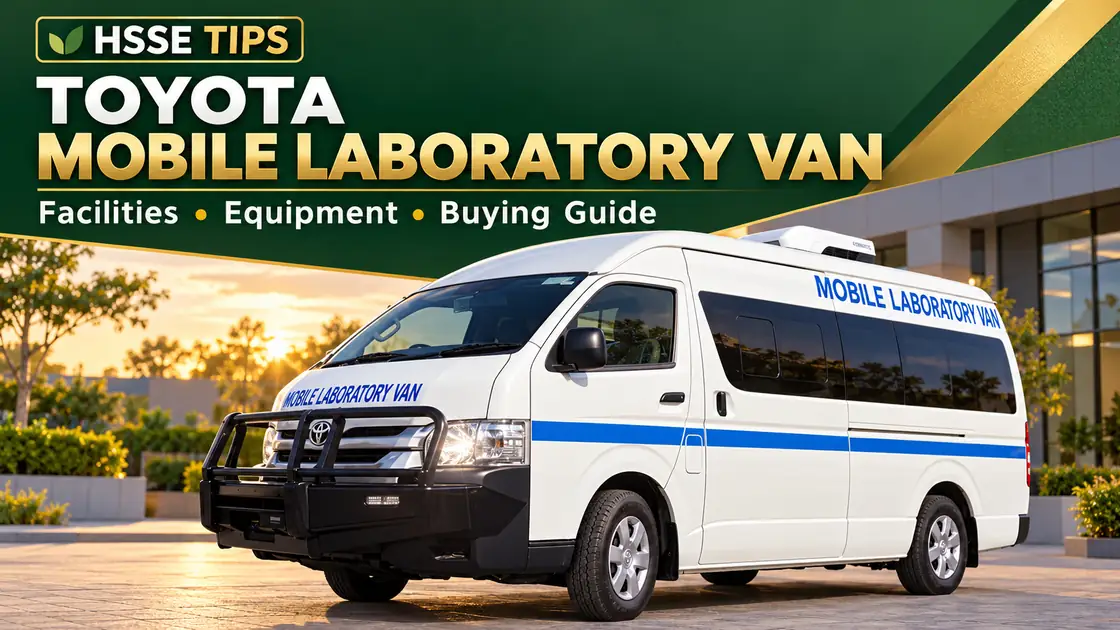
Toyota Mobile Laboratory Van Review: Facilities, Equipment, Specifications & Buying Guide
Introduction — Bringing Laboratory Infrastructure to the Field
A field team arrives at a sampling location with a carefully planned program. The next requirement is a suitable place to organize materials, handle samples and keep records. A mobile laboratory workspace can bring that infrastructure closer to the work, provided its equipment and operating conditions match the task.
The Toyota Mobile Laboratory Van is advertised as a configurable Hiace-based laboratory conversion. Its published specification describes storage, water and drainage facilities, refrigeration, an inverter and external electrical supply. Original gallery photographs show how worktops, cabinets and utility points are arranged within the van.
For an institutional buyer, the useful question is how that workspace fits the intended service. This review examines the advertised configuration, explains the difference between vehicle facilities and analytical capability, and sets out practical questions for a clear, comparable quotation.
Affiliate Disclosure: Worksite Safety Hub may earn a commission if you make a qualifying purchase through links in this article. This does not change the price you pay.
EXPLORE THE TOYOTA MOBILE LABORATORY VAN
Toyota Mobile Laboratory Van Overview
The affiliate destination identifies the product as Autoline WT41519. The corresponding Autozone UAE page presents a mobile laboratory van with a configurable interior. Both sources describe a Toyota Hiace high-roof platform, rather than establishing an inventory of analytical instruments.
Autoline places the advertisement in its ambulance category. That marketplace category should not be read as confirmation of emergency patient transport, ambulance certification or installed treatment equipment. The purchasing focus here is the laboratory conversion and the methods it may support once properly specified.
This is a desk-based review of published material and original gallery photographs. No physical inspection, seller contact, equipment test or accreditation assessment has been performed.
Toyota Hiace Platform and Vehicle Specifications
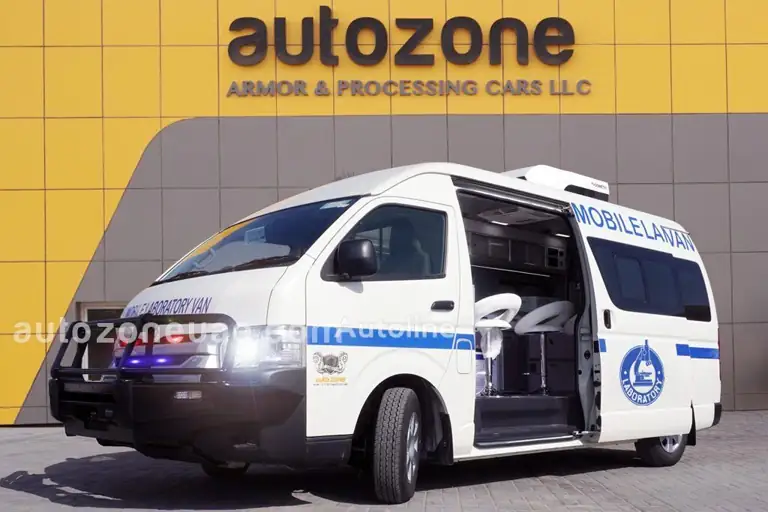
The seller describes a Hiace GL high-roof vehicle with a 2.5-litre diesel engine and manual transmission. The converter page also lists two-wheel drive and left-hand drive. These are published configuration details that should be reconciled with the actual chassis and build records.
Do not adopt specifications from a current Hiace brochure unless it covers this exact generation and market variant. Chassis number, model code, production year, dimensions, wheelbase, completed weight and remaining payload require confirmation.
The published 70-litre capacity refers to the vehicle fuel tank. It does not establish laboratory water capacity. Ask for axle-load information and an equipment weight schedule that includes water, accessories, consumables and people.
Laboratory Conversion and Interior Layout
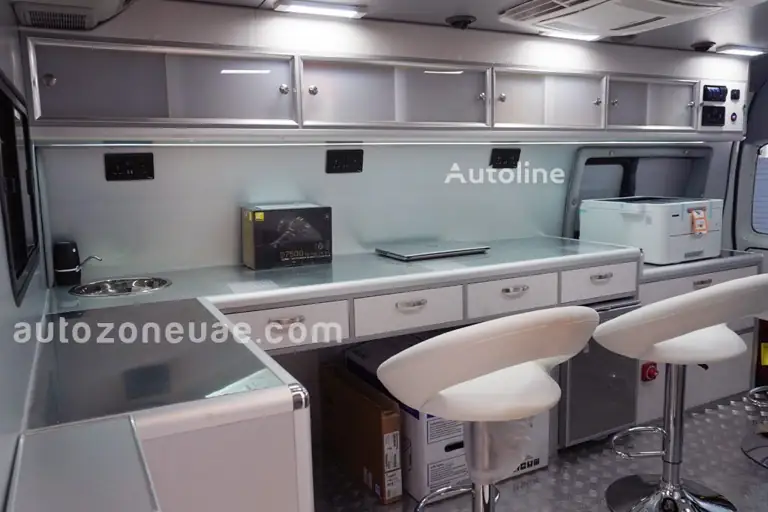
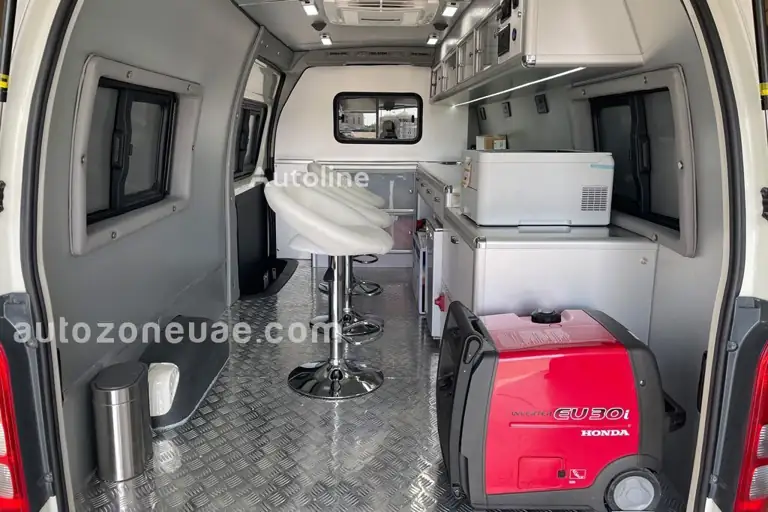
The gallery shows a workbench arrangement, overhead and lower storage, drawers, utility outlets and a window between the cab and working compartment. The side entrance and rear doors provide useful views of the access and circulation space.
Use these photographs to frame an acceptance inspection, then request a scaled layout. Check door clearances, working reach, service access and the space needed to load supplies and remove equipment for maintenance. Agree which components are fixed and which are carried separately.
Photographed stools are workspace furniture; their presence does not establish approved travel seating. Confirm the actual crew seating, belts and transport arrangements for the completed vehicle.
Work Surfaces, Storage and Sample Handling
The photographs show a continuous counter, multiple drawers and overhead cabinets. A sink is visible at one end. This layout is relevant to organizing materials, but final suitability depends on the size of the equipment, handling sequence and separation required by the intended methods.
Ask for surface and joint materials, cleaning compatibility and the specification of cabinet latches and equipment restraints. The description’s ambiguous flooring wording does not establish a particular grade of stainless steel, chemical resistance or slip rating.
Walk through receipt, identification, preparation, storage and dispatch using a proposed sample workflow. Locate clean supplies, used items and records deliberately, rather than treating available counter space as proof of a complete laboratory process.
Laboratory Equipment and Supported Testing Scope
The sources use broad language about scientific equipment and customizable testing applications. They do not provide a complete instrument schedule with manufacturers, models, quantities and accepted methods. A laboratory workspace and a validated testing service are different parts of the procurement.
Request the instruments, accessories, software, reagents, calibration evidence and service arrangements for each proposed test. Microscopes, centrifuges, analyzers, incubators, PCR systems and containment devices should not be assumed to be supplied.
Define whether the van will support sample collection, preparation, screening, measurement or transfer to a reference laboratory. Determine the required performance and acceptance criteria with qualified laboratory personnel. Generic descriptions do not establish detection limits, accuracy, turnaround time or legal acceptance of results.
DISCOVER THE LABORATORY FACILITIES & EQUIPMENT
Refrigeration and Sample Storage
A refrigerator is listed in the published description, and the photographs include a white countertop appliance. Its exact identity, operating range and supplied configuration need documentation; appearance alone does not establish sample-storage suitability.
Specify the materials to be stored, required temperature conditions, capacity, monitoring and alarm arrangements. Agree how temperature will be maintained during driving, setup, power changeover and unloading. Where temperature-controlled transport is necessary, include the container and transfer process in the plan.
A product labelled as a refrigerator does not by itself establish a validated cold chain. Ask for the applicable operating instructions, temperature records and commissioning checks for the intended use.
Inverter, External Power and Generator Provision
The published conversion includes an inverter and an external AC supply arrangement with connection accessories. The information reviewed does not establish continuous inverter output, battery energy, outlet ratings or demonstrated operating duration. Prepare a load schedule before selecting the final system.
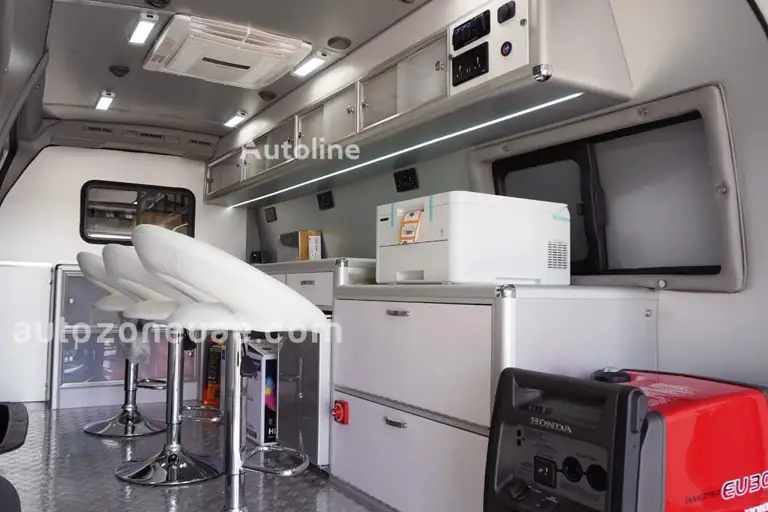
The description refers to storage accommodating a generator. A portable unit marked Honda EU30i is visible in the rear gallery photograph; that label observation does not confirm contractual inclusion, service condition or output. Obtain a written equipment schedule and the supplied unit’s documentation.
Specify voltage, frequency, starting demands, charging, isolation, protective devices and changeover arrangements. Agree who provides and checks the external connection. A portable combustion generator must not be operated inside the van; follow manufacturer instructions for outdoor placement away from doors, windows and air intakes. Its display position in a photograph is not an operating instruction.
Air Conditioning, Ventilation, Water and Drainage
The advertiser describes rear air conditioning, water storage, a covered sink, drainage and wastewater storage. The gallery shows ceiling cooling equipment and a sink, but does not establish cooling capacity, air-exchange performance, water volumes or the plumbing design.
Ask for the freshwater and wastewater arrangement, filling and emptying points, cleaning access and leak checks. Keep their capacities separate from the vehicle’s fuel-tank figure. Plan water quality and disposal according to the proposed work.
Air conditioning provides cooling; it does not establish laboratory extraction, negative pressure, biological containment or fume control. Likewise, “dust free” promotional wording is not a cleanroom classification. Have the required ventilation and containment defined for the actual activities and materials.
Technical Specifications and Facilities
The tables distinguish source descriptions from visual observations. Neither category replaces contractual confirmation of the delivered configuration. Missing ratings should be resolved against the proposed equipment package before acceptance.
Vehicle and Conversion Specifications
| Specification | Published Information | Buyer Confirmation Needed |
|---|---|---|
| Base vehicle | Seller describes Toyota Hiace GL high roof | Chassis number, model code, generation and market variant |
| Engine and transmission | Advertiser reports 2.5-litre diesel and manual gearbox | Engine code, output, emissions documents and gearbox details |
| Drivetrain and steering | Converter page lists 2WD and LHD | Applicability to this exact offered build |
| Vehicle fuel tank | Advertiser reports 70 litres | Vehicle documentation; distinct from laboratory water storage |
| Dimensions and weights | Not specified in the information reviewed. | Stowed dimensions, completed weight, axle loads and payload |
| Workspace and access | Bench, cabinets and driver-compartment window described and photographed | Scaled layout, clearances, mounting and crew travel seating |
| Water and wastewater | Storage, sink and drainage described | Tank volumes, plumbing, cleaning and disposal arrangements |
| Power and cooling | Inverter, external AC supply and air conditioning described | Ratings, protection, loads and operating conditions |
Laboratory Facilities and Equipment
| Facility or Equipment | Evidence Status | Practical Relevance |
|---|---|---|
| Worktops and storage | Visible in the exact gallery | Organized workspace; confirm material and restraint specifications |
| Sink | Listed and visible | Water facility; confirm its assigned use and supply quality |
| Refrigerator | Listed; white countertop appliance visible | Define sample-storage requirements and validate suitability |
| Inverter and external supply | Published configuration; ratings unspecified | Equipment power, subject to load and protection assessment |
| Generator | Compartment described; labelled portable unit photographed | Confirm inclusion, model documentation and outdoor deployment |
| Lighting and outlets | Visible; ratings and circuit details unspecified | Task visibility and equipment connections |
| Analytical instruments | Complete itemized package not established | Buyer-specified methods and equipment schedule |
| Containment and extraction | Not specified in the information reviewed. | Assess requirements for proposed activities |
| Waste container | Described; container visible in rear view | Segregated collection appropriate to the accepted work |
VIEW CURRENT PRICE & AVAILABILITY
Research, Inspection and Field Applications
Potential applications include field research, environmental sampling, educational demonstrations and industrial quality-control support. An organization may also use a mobile workspace to prepare or organize samples before dispatch to a reference laboratory. Each application depends on equipment, personnel and approved procedures.
For a water-quality project, start with the sampling and measurement plan, then specify suitable instruments and storage. For educational work, define the demonstrations, supervision and materials. For public-health work, obtain the appropriate clinical, laboratory and governance assessment.
Promotional references to food, milk, water or medical research do not establish that all those services are included. Match the accepted scope to the van’s documented configuration rather than treating the advertised applications as a universal testing menu.
Sample Integrity and Laboratory Quality Management
Plan sample identification, receipt, chain of custody, holding conditions and dispatch responsibilities. Specify method-dependent storage and holding times with the laboratory team. Include contamination prevention, cleaning, calibration, quality controls and records in the operating system.
ISO/IEC 17025 addresses the competence and operation of testing and calibration laboratories. Buying a converted vehicle does not establish accreditation, a recognized test scope or regulatory acceptance. Where clinical work is proposed, assess the appropriate laboratory framework separately.
Agree commissioning that demonstrates the installed equipment and workflow against written requirements. Assign responsibility for maintaining records and reviewing deviations. WHO’s laboratory-quality handbook offers management context; it is not evidence that this vehicle has been assessed or approved.
Operator Safety and Environmental Management
Start with the materials and tasks to be handled. WHO’s laboratory biosafety guidance uses a risk-assessment approach; any biological work needs appropriate assessment before activity selection and facility acceptance. A generic laboratory label does not establish a biosafety level.
Plan chemical identification, safety data, segregation, spill response, PPE and emergency arrangements. Provide appropriate cleaning methods and segregated biological, chemical and general waste pathways. Agree authorized wastewater disposal and access to waste collection at each deployment location.
Review electrical protection, fire precautions, safe external connections and equipment securing. Keep heavy or loose items restrained during movement and define safe loading methods. Include generator exhaust and fuel handling in the site plan where combustion equipment is supplied. These are operating and procurement requirements, not claims that every listed protection is installed.
Transportation, Parking and Deployment
Assess the route, destination access, ground support, parking permission and available utilities. Include clearance for doors, external cables, equipment handling and emergency access. Separate the working area from vehicle traffic and public movement where necessary.
Prepare the van for travel using the approved seating and restraint arrangements. Include water, samples, consumables and accessories in the load assessment. Establish shutdown and securing procedures, then define setup checks before work resumes.
For repeated field visits, assign responsibility for power, water, waste collection, cleaning, maintenance and sample transfer. The logistics around the van are part of the service design, even when individual components are supplied by different organizations.
Current Seller Offer — Verified 27 October 2026
Verification scope: This section records a check of the affiliate destination, published advertisement and corresponding converter page. It does not establish inspected condition, ready stock, laboratory readiness or a delivery commitment.
Advertised product: Toyota Mobile Laboratory Van, Autoline WT41519.
Advertised base: Toyota Hiace GL high roof; exact chassis/model code requires confirmation.
Condition: Advertised as new.
Year and mileage: Not specified in the information reviewed.
Asking price: On request.
Product Location: Ajman, United Arab Emirates.
Stock or production status and lead time: Not confirmed.
Offered package: Published conversion descriptions cover workspace storage and utilities; final analytical equipment and contractual inclusions require a signed schedule.
Training, commissioning, warranty and after-sales terms: Not specified for this vehicle in the information reviewed.
The converter makes a general worldwide-export statement. That does not identify product-specific destinations, freight charges, collection arrangements, insurance, customs responsibilities or Incoterms for WT41519.
Delivery destinations, shipping arrangements, and applicable transport terms were not specified in the information reviewed. Prospective buyers should confirm these details directly with the seller.
CHECK SHIPPING & EXPORT OPTIONS
What Buyers Should Confirm Before Purchasing
Begin with the required service and test scope, then write the equipment and facility requirements. Ask for a quotation identifying the exact chassis, conversion, supplied instruments, accessories and exclusions. Reconcile the photographs with the final proposed build.
Request drawings, weight information, utility ratings, device instructions, maintenance requirements and destination documentation. Define acceptance checks for storage, electrical connections, water, cleaning access and any method-specific conditions. Agree who conducts commissioning and provides training.
Compare complete delivery packages, including freight, import and registration responsibilities, consumables, service parts and support. Document warranty coverage and the process for obtaining assistance. A clear specification lets the supplier propose an appropriate configuration and lets the buyer assess offers on a consistent basis.
Frequently Asked Questions
What is the Toyota Mobile Laboratory Van intended to support?
It is advertised as a configurable mobile laboratory workspace. Supported services depend on the accepted instruments, methods, staffing and operating conditions.
What Toyota model is used?
The sources describe a Hiace GL high-roof platform with a 2.5-litre diesel and manual gearbox. Confirm the actual chassis number, model code and market variant.
Why is it listed as an ambulance?
That is the marketplace category. It does not independently establish emergency patient transport, medical equipment or ambulance certification.
Which analytical instruments are included?
A complete itemized instrument package was not established. Obtain manufacturers, models, quantities, accessories and documentation in the signed offer.
Can it test food, milk, water or clinical samples?
Those applications require suitable equipment and validated methods. Promotional application wording does not establish an included testing menu or approved scope.
Does it include sample refrigeration?
A refrigerator is advertised. Confirm its model, operating range, monitoring and suitability for the intended materials before treating it as a validated storage system.
Is a generator supplied?
The text describes accommodation for one and a portable labelled unit appears in photographs. Confirm contractual inclusion and documentation; do not infer output or runtime.
Can it run without external electricity?
Whole-system autonomy was not established. Request the battery, inverter and generation schedule with a defined load and operating scenario.
What are the water and wastewater capacities?
They were not specified in the information reviewed. The advertised 70 litres relates to vehicle fuel, not laboratory water.
Does the vehicle arrive as an accredited laboratory?
No accreditation or recognized analytical scope was established. Assess the required quality system, personnel, methods and commissioning separately.
What are its price, location and delivery terms?
At the published-information check, price was on request and the listed product location was Ajman, United Arab Emirates. Stock and vehicle-specific shipping terms require seller confirmation.
Final Verdict
The Toyota Mobile Laboratory Van presents a practical workspace-led proposal: a Hiace platform with storage, a sink and water arrangements, advertised refrigeration and flexible power connections. Its original gallery helps buyers visualize access, working surfaces and utility positioning.
The next step is to define the laboratory service and agree the configuration that supports it. Confirm analytical equipment, sample conditions, utility ratings, transport arrangements and commissioning. That evidence turns the advertised conversion into a procurement package a laboratory team can assess and prepare to operate.
Sources and Editorial Method
Sources checked on 27 October 2026 include the exact Autoline WT41519 advertisement reached through the publisher’s affiliate link and the Autozone UAE Mobile Laboratory Van page. Advertiser descriptions are identified as such. Original gallery images were inspected and reproduced under the publisher’s recorded permission, with watermarks retained. No product-specific advertiser video was identified in the sources reviewed.
Planning references: ISO/IEC 17025:2017; WHO Laboratory Quality Management System handbook; WHO Laboratory Biosafety Manual, fourth edition; and OSHA portable-generator carbon monoxide guidance. These inform general planning and do not certify the advertised vehicle. No physical inspection, seller interview or performance testing was conducted.
Related reading: Ford Transit Mobile Laboratory review and Toyota Mobile Food Testing Lab review. These concern separate advertisements and should not be used to infer this van’s equipment package.
Join the Conversation
If you were specifying a mobile laboratory van, which requirement would matter most—testing equipment, sample refrigeration, reliable power or workspace layout? Share your priorities and professional experiences in the comments below. Please do not include identifiable patient or confidential sample information.
Your experience matters
Share your thoughts on this page
Have a question, a useful experience or a suggestion? Add your input below.
Comments are public. Keep them respectful and relevant. Do not share contact details, confidential information or emergency reports.
Comments on this page
Loading comments…