Product Reviews · Forestry Equipment
PONSSE Scorpion King Review: A Clear View of Forestry Technology
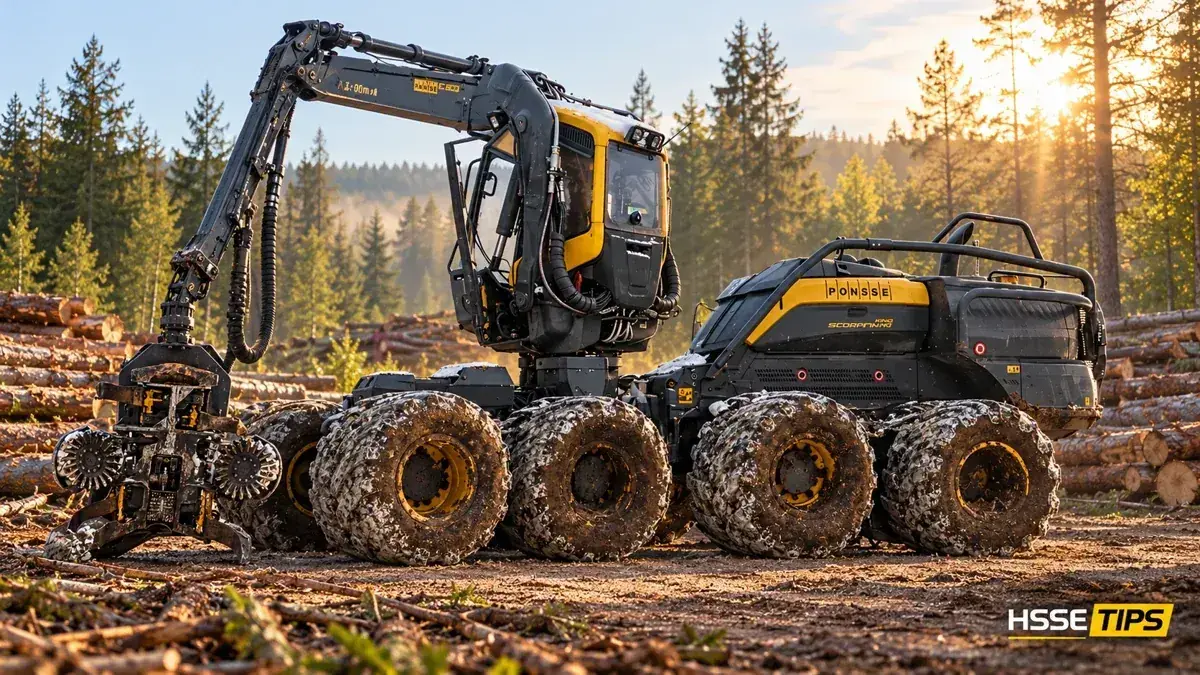
In a working forest, the operator is constantly reading the next tree, the harvesting head and the ground beneath the machine. The PONSSE Scorpion King puts that relationship at the centre of its design: a cab framed by an overhead crane arrangement, a chassis built around levelling, and harvesting equipment intended for professional timber production.
Its interest goes beyond its distinctive silhouette. For a contractor, the useful question is how visibility, hydraulic capacity and the installed head fit a particular forest and harvesting plan. This review examines those relationships, using PONSSE documentation and an independently researched 2021 machine advertised with a C50 crane and H7 head. It is a desk-based assessment, without personal inspection or operating experience.
Affiliate Disclosure: Worksite Safety Hub may earn a commission if you make a qualifying purchase through links in this article. This does not change the price you pay.
EXPLORE THIS PONSSE SCORPION KING
PONSSE Scorpion King: Professional Forestry Harvesting
The Scorpion King is a purpose-built wheeled forestry harvester. Its role is to handle standing timber and process stems through a harvesting head, as part of a mechanized cut-to-length operation. It is not a forwarder carrying a load of logs: its crane and head perform the harvesting and processing work.
PONSSE introduced the Scorpion family in 2013. The King version paired the family’s operator-centred architecture with two-circuit working hydraulics. That combination gives buyers a clear starting point: examine the complete relationship between carrier, crane, head and controls, rather than judging the machine by engine output alone.
The reviewed offer identifies a 2021 Scorpion King. Production year is important, but the serial-number specification is more precise. PONSSE announced a renewed Scorpion range during 2021, so a year field alone does not establish the cabin generation or every installed electronic function.
Distinctive Scorpion King Machine Architecture
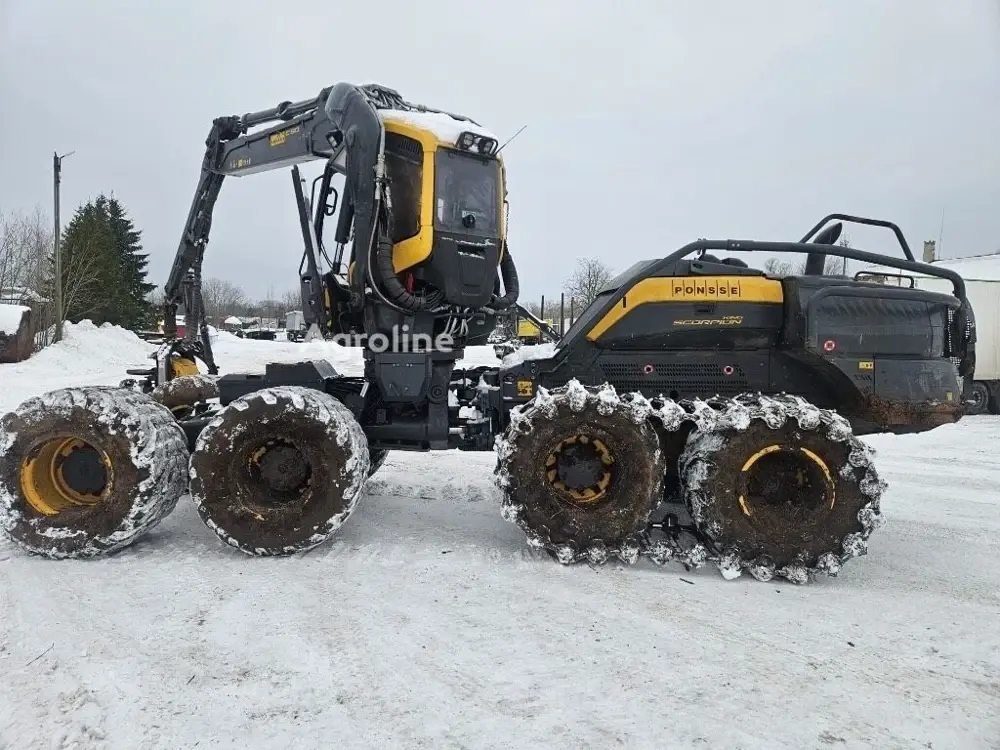
The Scorpion’s recognisable feature is its split lifting structure, which reaches over the cab. PONSSE describes the cab and crane as sharing a slewing arrangement within a three-part frame architecture. The design places the operator close to the working equipment while allowing the boom to pass above the viewing area.
In the advertiser’s photographs, the yellow-and-black machine has four wheel positions on each side, a raised glazed cab and a separate rear engine body. The listing also states four axles. These views are useful for understanding the actual configuration and planning a more detailed inspection of the joints, service access and transport position.
Cabin Stabilization Technology
Two connected ideas explain the Scorpion design. Cab and crane levelling uses the articulated frame arrangement to manage the position of the central working structure. PONSSE describes a low levelling pivot that limits sideways movement directed at the operator.
Active stabilization responds to the crane’s position and load. In the manufacturer’s explanation, stabilizing cylinders press the rear frame and wheels towards the working direction, supporting the machine when the crane works to the side. The system was designed to operate during machine movement as well.
These are manufacturer-described operating principles, not a measured comfort result for the advertised used machine. Ask for a competent demonstration of its levelling and stabilization, together with the correct manuals and any relevant maintenance records. The system does not establish a universal safe slope angle or remove the need to assess ground conditions.
This architecture should also be understood on its own terms. The Scorpion King’s three-frame arrangement is not a reason to copy the equipment description of a PONSSE Ergo Active Frame. Identification, system settings and service requirements must follow the actual machine.
DISCOVER HARVESTING TECHNOLOGY
Operator Visibility and Working Environment
Visibility is central to the Scorpion’s appeal. The manufacturer links the overhead double-arm crane and glazed cab to the operator’s view of the harvesting head. The practical interest is clear: an operator needs to observe the stem, head placement and intended processing area while coordinating crane movement.
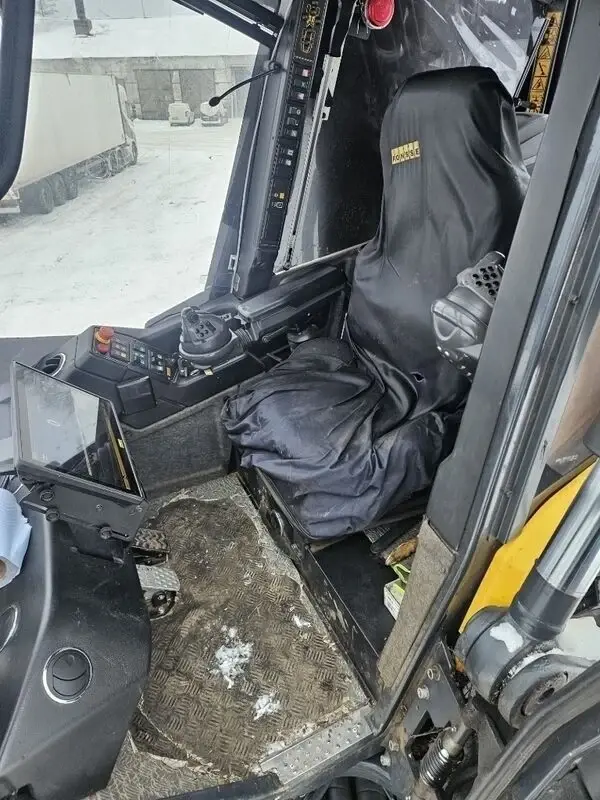
The exact-machine gallery includes front-cab views and interior photographs. A seat, armrest-mounted controls, a display and a red emergency-stop control are visible. Photographs establish their presence, not their adjustment range, software version or operational condition. Work lights are visible around the cab and crane area; their lighting performance requires a demonstration.
PONSSE’s February 2021 launch release described a new cabin, a roof-reaching one-piece front window and Opti 5G, initially introduced in selected markets. The advertisement does not identify this unit’s build month, cabin designation or information-system version. Those updates should not be assigned automatically. Climate control, seat suspension and any supplementary heater also need confirmation for this sale.
Engine, Powertrain and Mobility
The advertisement does not give an engine code, displacement, power rating, emissions stage or transmission specification. These are important purchasing details, and should be obtained from the machine plate and serial-number records rather than filled from a similar-looking harvester.
For clearly separated model context, PONSSE’s Japanese Scorpion King technical page describes an MB OM 936 LA EU Stage V engine rated at 210 kW, with 1,200 Nm in its stated operating band. That published configuration is not confirmation of the advertised 2021 machine’s engine or emissions certification. No displacement figure is assigned here.
The reviewed machine is visibly an eight-wheel carrier, but its precise drive specification, transmission identification and traction settings are not stated. Ask for those details alongside tyre information. An engine rating describes only one part of a harvesting system; it does not predict timber output or fuel consumption for a particular stand.
Crane, Boom and Working Reach
C50 is the crane model given in the seller’s description. The gallery shows its overhead arrangement, extension and hose routing. For a buyer, reach matters together with tree size, head mass and the working position allowed by the crane documentation.
The seller’s reach entry is “Ulatus: 1000.00”, without a displayed unit. It is left unconverted here. PONSSE model references describe C50 configurations with 10 or 11 metres of reach, but that does not resolve the unit or certify this installation. Obtain the crane plate, boom specification and approved load information.
During an inspection, request a demonstration of extension, slewing and coordinated movements by an authorized operator. The useful objective is to establish the fitted crane’s identity and condition, including its controls, lubrication arrangements and documented maintenance.
Harvester Head and Timber Processing
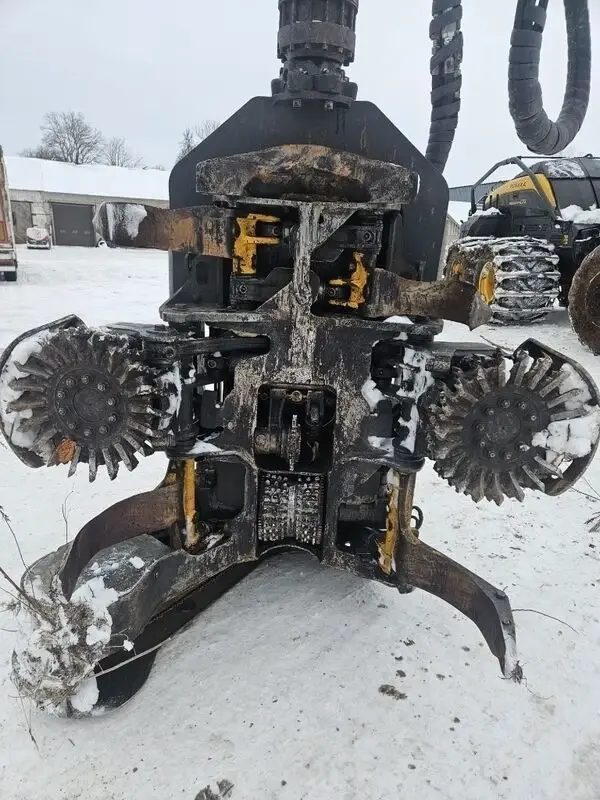
The offer specifies an H7 harvesting head. Original photographs show the head from several angles, including its feeding rollers, knives and external hose connections. These are especially useful images because the installed head determines much of the machine’s practical relationship with the timber.
PONSSE describes the H7 family as serving both thinning and clear-cutting applications. In a harvesting workflow, the head grips the stem, feeds it through the processing mechanism, removes branches and cuts lengths according to the installed measuring and control arrangement. Suitability still depends on the exact head specification, tree form and operating instructions.
The H7 name covers development over time. PONSSE announced a substantially renewed H7 in 2024, including Active Speed as a new feature. That later specification cannot be applied to this 2021 carrier’s head without identification evidence. The sale does not establish the head’s own year, serial number, maximum cutting diameter, feed speed or roller configuration in technical terms.
Ask for the head plate, saw-equipment specification and measuring-system details. A practical demonstration should address the intended timber assortment and measurement checks, without treating a quoted maximum cutting diameter as a guaranteed productive stem size.
Hydraulic Systems and Machine Controls
Two-circuit hydraulics are an important manufacturer-described distinction of the Scorpion King. PONSSE’s model documentation separates the crane and harvesting-head pumps. This gives a more useful explanation of the King identity than an unsupported statement about speed or production volume.
The current Japanese technical reference lists Opti Control and separate pump displacements of 145 cm³ for the crane and 190 cm³ for the head. These are model-reference figures, not measured pump delivery or a verified specification for the used machine. The seller supplies no hydraulic pressure, pump condition report or software inventory.
For fleet integration, establish which information system and measuring functions are installed, how production files are transferred and what support is available. Opti 5G and Active Crane were part of the 2021 renewal announcement, but neither is confirmed in this advertisement. Request screen photographs and a working demonstration rather than inferring a licence or software feature from a display.
Terrain Applications and Mobility
Eight wheels and an articulated levelling concept explain why the Scorpion King attracts interest for varied forest ground. They do not provide a blanket permission to travel or work on any terrain. Ground bearing, obstacles, weather, load direction and the manufacturer’s limits remain part of site planning.
The seller records front and rear tyres as 800/26.5, also written 800/26,5 in the description. That is the published notation, not a complete tyre sidewall specification. Some gallery views show bogie tracks, while others show uncovered tyres. Confirm whether tracks, chains or spare wheels are included and approved for the intended use.
Transport planning needs the actual machine’s travel dimensions, attachment position and weight. PONSSE’s published model dimensions provide context, but a transport operator needs the documented configuration being collected, including any separately carried equipment.
Safety and Operational Considerations
Original cabin photographs show a red emergency-stop control. Its function, the machine’s other safeguards and the relevant inspection records should be demonstrated and documented. Photographs do not certify protective glazing, cab protection standards, fire suppression or the operation of any safety system.
Professional operation requires trained personnel, controlled exclusion zones and communication arrangements appropriate to moving timber and harvesting equipment. Follow the correct operating manual for terrain assessment, stability, head handling and maintenance isolation. Establish an agreed safe state before anyone approaches the working area.
PONSSE’s transport instructions specifically require verification of actual weight before lifting. Collection should therefore use an agreed transport plan and the correct machine instructions. This is normal preparation for moving a large forestry machine, not a substitute for a qualified operator or transport specialist.
Forestry Applications and Ideal Buyers
Commercial harvesting contractors can examine the C50-and-H7 combination against their stand sizes, species and timber assortments. Both thinning and final-felling work may be relevant, but machine access, residual-tree clearance and actual head capability need to suit the contract.
Established forestry fleets should consider operator familiarity, service access, diagnostic support and compatibility with their production-data requirements. A useful purchase assessment connects the machine to the people, maintenance arrangements and forwarding operation that will support it.
Forest-management businesses and machinery buyers can use this review to define the information required for a viewing. No hourly output, fuel economy or financial return is assumed. A demonstration in representative conditions and a documented inspection give a stronger basis for selection.
For related equipment, explore our PONSSE Ergo Active Frame review, Logset 10H review, HYPRO 500 review and Silvatec Sleipner Mountaineer review. Their configurations and operating arrangements differ; compare each on its documented merits.
PONSSE Scorpion King Technical Specifications
| Make / model | Ponsse Scorpion King |
|---|---|
| Carrier configuration | Four axles listed; eight wheel positions visible |
| Crane | C50, seller description |
| Harvesting head | H7, seller description |
| Tyre notation | 800/26.5 front and rear, as advertised |
| Operator equipment pictured | Seat, armrest controls, display, red emergency-stop control and work lights |
Separate manufacturer reference: PONSSE’s Japanese Scorpion King page lists 8,020 mm length, 2,690–3,085 mm width, 3,720 mm transport height, 655 mm ground clearance, 22,200 kg minimum weight and 23,200 kg typical weight. These figures describe its published model configuration, not confirmed dimensions or weights for this offer. Engine and hydraulic reference data are identified separately above.
VIEW CURRENT PRICE & AVAILABILITY
Current Seller Offer — Verified 24 October 2026
Advertised machine location: Vilusi, Estonia. The description further identifies Mustvee municipality, Jõgeva County. This comes from the vehicle-location fields; it is not inferred from the seller’s registered address.
- Seller: MFO OÜ.
- Listing reference: Agroline XQ49206.
- Asking price: on request; no numeric price was advertised.
- Year: 2021.
- Operating hours: 15,225, as advertised.
- Condition: used.
- Configuration: Scorpion King, four axles, C50 crane and H7 head.
- Availability: the advertisement was accessible when reviewed; confirm unsold status and collection readiness.
The page displays generic “Remote inspection” and “Vehicle delivery service” options. Those marketplace service prompts do not establish a seller undertaking, a delivery destination or an included transport price.
Delivery destinations, shipping arrangements, and applicable transport terms were not specified in the information reviewed. Prospective buyers should confirm these details directly with the seller.
Warranty terms, service-history details and included track equipment were not established. Last verified: 24 October 2026. This offer section can be updated independently when the listing changes or the machine sells.
Questions Buyers Should Ask Before Contacting the Seller
Request the machine serial number, build specification, engine plate and a current hour-meter photograph. Establish the exact cabin generation, stabilization configuration, transmission and installed software. Ask for separate identification of the crane and head, including head age, reach in metres and the approved working limits.
Review service records with a competent forestry-machine specialist. Arrange inspection of the chassis, joints, crane, head, hydraulic functions and safety equipment, plus a demonstration of levelling and measurement calibration. Discuss parts availability, diagnostic access, operator familiarisation and any written warranty.
Before collection, agree the included attachments and accessories, actual transport dimensions and weight, loading responsibility and destination costs. Obtain a written quotation identifying the contracting entity, payment procedure, handover documents and any export assistance.
Buyer FAQs
What is the PONSSE Scorpion King?
It is a wheeled forestry harvester with the Scorpion family’s distinctive overhead crane arrangement, levelling architecture and King-model two-circuit hydraulics.
How does cabin stabilization work?
PONSSE describes levelling through the three-part frame and active stabilization responding to crane position and load. Confirm the advertised machine’s configuration and operation through its records and a demonstration.
What forestry work may it suit?
Professional timber harvesting, including appropriate thinning and final-felling applications. Match the actual C50-and-H7 equipment to tree size, access, terrain and the harvesting plan.
What engine and powertrain are installed?
The advertisement does not identify them. Manufacturer reference data includes an OM 936 LA 210 kW configuration, but the used machine’s plate and build records must establish its engine, emissions and drive details.
What harvesting head is included?
The seller lists H7. Confirm its serial number, year, technical limits and measuring-system configuration; do not assume the later renewed H7 specification.
Where is the advertised machine located?
Vilusi, Estonia, with Mustvee municipality and Jõgeva County identified in the description. Arrange the exact viewing and collection point with the seller.
Does the seller provide delivery or export?
No destinations or seller-specific transport terms were established. Request written confirmation of any collection, loading, delivery or export arrangements and costs.
How can I request a price?
Use the seller-offer buttons in this review. They use the supplied affiliate link to reach the offer for a current quotation and availability enquiry.
Original Advertiser Images and Official Video
The listing contains 18 original photographs. Exterior, cab and head images are included here under the affiliate reuse permission confirmed by the publisher, with watermarks retained where present. They are hosted on this website. The featured artwork is separately captioned promotional imagery.
No exact-machine video was identified in the advertisement. The following official PonssePlc clip is a general Scorpion-family transport briefing, linked from PONSSE’s port instructions. It is not footage of the sale machine or a replacement for its manuals and a qualified handover.
Sources and Editorial Basis
Research checked 24 October 2026: listing XQ49206 and its original gallery; PONSSE’s 2013 design explanation; 2021 renewal announcement; Scorpion King technical reference; 2024 H7 development report; and manufacturer transport instructions. Manufacturer context is identified separately from sale-specific equipment. No personal test, rating or customer testimonial is claimed.
Final Verdict
The Scorpion King gives forestry buyers a distinctive combination to examine: operator-oriented visibility, a three-frame levelling concept and the King’s dual-circuit hydraulic architecture. The advertised C50 crane and H7 head provide a specific equipment package to assess against a real harvesting programme.
Its strongest purchasing case will come from matching that configuration to the timber, operator and support arrangements available. Explore the original photographs, confirm the build specification and arrange a detailed demonstration of the actual machine.
Join the Conversation
What matters most in a forestry harvester—operator visibility, harvesting capacity, crane reach or machine mobility? Share your thoughts in the website’s comments below.
Your experience matters
Share your thoughts on this page
Have a question, a useful experience or a suggestion? Add your input below.
Comments are public. Keep them respectful and relevant. Do not share contact details, confidential information or emergency reports.
Comments on this page
Loading comments…