HSSE TIPS · Product Reviews · Specialist Patient Transport
Mercedes-Benz Sprinter Infection-Type Ambulance Review: Features, Specs & Buying Guide
Affiliate Disclosure: Worksite Safety Hub may earn a commission if you make a qualifying purchase through links in this article. This does not change the price you pay.
Introduction — Specialized Patient Transportation for Infection-Control Operations
An ambulance selected for infection-control operations needs a clear chain of evidence: how patients are accommodated, how the clinical team works, how air moves and how the vehicle is cleaned and maintained. The conversion should support the operator’s approved transport procedures, with equipment and performance matched to the intended mission.
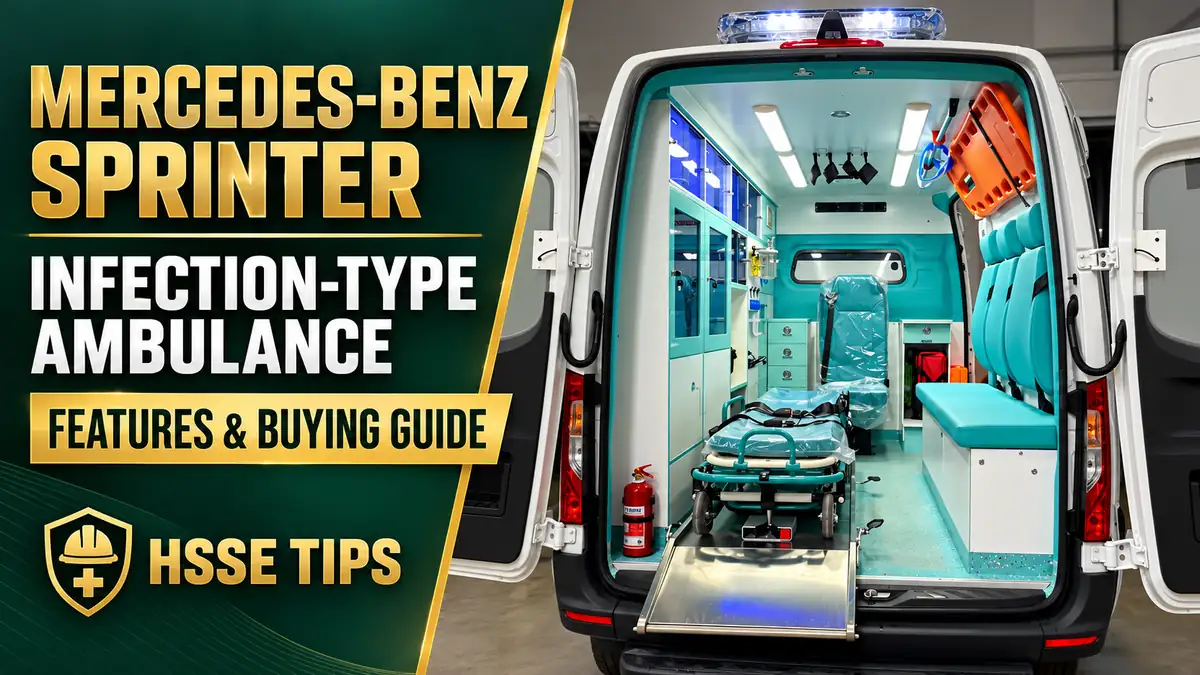
The advertised Mercedes-Benz Sprinter Infection-Type Ambulance presents a teal patient interior with a stretcher, loading platform, attendant accommodation and medical storage. Its description goes further, claiming negative pressure and HEPA filtration. This review separates those advertised specifications from visible equipment and independently documented performance, helping institutional buyers turn the offer into a testable procurement specification.
EXPLORE THE SPRINTER INFECTION-TYPE AMBULANCE
Mercedes-Benz Sprinter Infection-Type Ambulance Overview
Autoline UU35878 identifies a Mercedes-Benz Sprinter marketed for infection-related transport. AmbulanceMed names itself as the developer and offers specification changes. The six-image gallery includes a promotional exterior visual and five interior/access photographs; four distinct interior views are reproduced here without unnecessary duplication.
The appropriate classification is an advertiser-described infection-type ambulance with claimed negative-pressure and filtration systems. A patient isolation capsule, certified biological containment system and disease-specific operating authorization have not been established. This documentary review does not establish operating performance.

Understanding the Mercedes-Benz Sprinter Platform
The advertised family is Sprinter, but the precise derivative, chassis series and VIN-linked build record are absent. Confirm the derivative before assessing maintenance, load limits and registration.
Mercedes-Benz publishes Body and Equipment Guidelines for vehicle modifiers. Ask the converter to identify the edition relevant to the actual chassis and explain its equipment mounts, electrical integration and completed-vehicle loading. Assess the finished conversion as an integrated installation.
Engine, Transmission and Drivetrain
The listing’s powertrain fields describe diesel fuel, four cylinders, 2,143 cm³ displacement, 195 HP / 143 kW, Euro 6, six gears and a 4×2 axle configuration. These remain advertiser entries until reconciled with manufacturer records. Neither manual versus automatic transmission nor the driven axle is reliably established.
Obtain engine and gearbox identification, emissions documentation and the vehicle build sheet. Do not interpret 4×2 as all-wheel drive or infer off-road capability. No engine code, torque or completed-ambulance fuel consumption is independently verified, so performance and range estimates would not provide a sound purchasing comparison.
Chassis, Dimensions and Gross Vehicle Weight
The advertisement records 3,500 kg gross weight, 2,000 kg net weight and 1,500 kg load capacity. They are not a completed-ambulance weighing certificate. Medical furniture, filtration equipment, batteries, cylinders and consumables must be included when establishing what remains available for patient and crew loading.
Its dimensional fields also require clarification: a listed 1.4 m overall width and 2 m overall height should not be accepted as validated route-clearance measurements. Request actual external dimensions, wheelbase, interior working clearances and axle ratings. Weigh the intended operating configuration and check each axle, rather than assuming the advertised load-capacity figure is usable clinical payload.
Ambulance Conversion and Exterior Design
The supplied exterior graphic shows a white van body, red markings and warning-light elements. Interior photographs show rear-door access, fitted cabinetry, a front partition and a side-access area. Confirm that the quoted vehicle matches these reference images.
AmbulanceMed is the advertised developer; EOW branding is visible on the interior control panel. Request the legal converter identity, finished-vehicle documentation and precise materials schedule. The seller mentions TS EN 1789, but no vehicle-linked certificate or test report was supplied in the information reviewed. Such a claim should remain attributed until its scope is documented.
Patient Compartment Layout
The rear view shows a central stretcher position, a metal loading platform, cabinets along one side, teal side seating and a forward attendant chair. An orange immobilization board is retained high on the opposite side. Ceiling strips and cabinet lighting illuminate the working area.
Evaluate this layout with the intended crew and equipment in place. Check access to the patient, reach to essential controls while restrained, passage through doors and access to service panels. Photographed seating does not establish approved travel positions or total crew capacity, and no measured care-space dimensions were supplied.

Infection-Control Features
Visible features include a partition with a window towards the cab, fitted cabinet doors, formed interior panels and a continuous-looking floor finish. These are relevant surfaces and boundaries to inspect, but photographs cannot verify seal integrity, disinfectant compatibility or cleanability of concealed joints and fittings.
The seller describes specialized ventilation and finishes intended for decontamination. Ask for the exact installed materials, installation drawings, cleaning instructions and test records. A touchscreen is visible, but its presence does not identify a calibrated pressure monitor. The blue-violet cabinet illumination is not evidence of germicidal ultraviolet equipment or automatic disinfection.
DISCOVER THE INFECTION-CONTROL FEATURES
Ventilation, Filtration and Airflow Management
The description claims fan-driven airflow with staged F9/H13 filtration, partial discharge and recirculation. It names a maximum airflow of 1,800 m³/h and a filtration-related figure of 99.95%. These are advertiser-described values, not independently verified installed-system performance. The related manufacturer page repeats the concept under a Hyundai heading, so it is not a Mercedes-specific commissioning certificate.
Require the installed ventilation manufacturer, model, filter identification and air-path drawing. The acceptance documents should distinguish fresh air, recirculated air and exhaust, with measurements at the relevant operating settings. A maximum airflow figure cannot establish air changes per hour without a verified compartment volume and clarity about which airflow is being counted.
NIOSH-published ambulance research using a cough simulator found that ventilation reduced aerosol exposure without eliminating it. That study did not test this vehicle. Its useful procurement lesson is to assess the actual airflow arrangement and retain the operator’s other precautions, rather than treating a fan or filter label as a complete protection system.
Negative-Pressure Capability: What Is Actually Verified?
Negative pressure is explicitly claimed in the advertisement. It mentions 260 Pa and an adjustable 100 Pa value, but supplies no clear signed pressure differential, reference location, vehicle-specific test procedure or calibration record. These figures must not be presented as measured negative setpoints for the offered Sprinter.
Ask for a commissioning report identifying the tested vehicle, operating mode, measurement points, doors/windows condition, instruments and acceptance criteria. It should explain alarms, loss of airflow or power, and the maintenance checks needed to retain the agreed performance. A filter certificate alone does not validate leakage paths, pressure control or the finished installation.
Verified status: the seller makes a negative-pressure claim; demonstrated negative-pressure capability for the offered vehicle is not confirmed. No high-consequence pathogen suitability is established by the listing’s terminology.
Stretcher, Patient Securing and Loading Systems
Photographs show a teal wheeled stretcher with black straps and rails, positioned above a metal rear loading platform. The model, rated patient load, floor-lock specification and any powered functions are not readable or documented. Do not transfer stretcher specifications from another AmbulanceMed or Sprinter review.
Require compatible stretcher, mount and restraint identification, supported by relevant test documentation and a loading demonstration. Check locking, release and recovery arrangements with the intended crew. Also verify that fitted and portable medical devices remain secured during travel, with cabinets latched and access to exits maintained.
Medical Equipment and Storage
Close-ups show oxygen-labelled outlets, a vacuum-labelled connection, regulators/flow components, collection jars and an Aspira-branded Flaem suction device. An AED-marked bag, an orange first-aid case, drawers and enclosed storage also appear. Branding identifies product families or labelled containers, not their contents, service condition or contractual inclusion.
Flaem’s official catalogue contains several Aspira models with different specifications. Without the exact model and serial plate, no suction flow, duty cycle or battery specification should be assigned here. A monitor, transport ventilator, infusion pumps and a defined defibrillator package are not verified as included.

Cleaning, Decontamination and Waste Management
Cabinets and storage can support an organized cleaning workflow, but no dedicated handwashing station, verified sharps container or automatic decontamination device was identified. An orange first-aid case is not a clinical-waste container. The seller’s finish claims need the actual coating specification and approved cleaning-product instructions.
CDC core infection-prevention guidance addresses trained staff, hand hygiene, equipment reprocessing and environmental cleaning. The fleet should define responsibilities, supplies and records for its authorized service. Obtain maintenance and cleaning instructions for reusable devices, upholstery, controls, gas fittings and ventilation components. No automatic sterilization capability is established by coloured lighting or a glossy surface.

Electrical Power and Backup Systems
The medical panel is labelled with 12 V outlets and 220 V inverter-electric sockets. Those labels describe intended supplies; they do not establish measured voltage, available power, inverter rating, protective devices or battery endurance. No included generator or documented ventilation backup duration was verified.
Request the circuit diagram and load schedule covering medical equipment, warning lights, comfort systems and any isolation ventilation. Establish what remains powered during engine shutdown or loss of the external supply, and how faults are indicated. Commission the actual equipment combination, including any separately ordered monitoring or filtration controls.
Heating, Ventilation and Air Conditioning
Comfort temperature control and infection-control airflow serve different purposes, even where they share components. The listing includes air conditioning and describes controlled environmental parameters, but no unit-specific heating/cooling capacity, humidity specification or operating-temperature range is documented.
Ask the designer how comfort settings interact with the claimed pressure and filtration modes. Confirm maintenance access and approved filter-replacement procedures. Do not equate a ceiling vent, cooling outlet or touchscreen with a validated isolation system.

Infectious Disease Transport Applications
The offer is a candidate for healthcare organisations defining infection-control transport capacity, including hospital transfers, specialist fleets and preparedness programmes. Suitability depends on the required precautions, clinical staffing, selected equipment and accepted technical performance. Define the intended mission before acceptance.
No specific high-consequence infectious disease approval is established. Humanitarian and public-health purchasers need the same documented acceptance process as hospital fleets, together with referral coordination and maintenance support. Confirm authorization for the intended mission.
Infection-Type Ambulance vs Conventional Ambulance
A conventional ambulance also requires cleaning, staff precautions, secure patient handling and appropriate ventilation. The advertised distinction here is the proposed additional airflow and filtration arrangement. Its practical significance depends on documentation of the installed system, ongoing inspection and the operator’s approved procedures.
For a different equipment brief, see our Mercedes-Benz intensive care ambulance review. A critical-care label does not prove isolation performance, just as infection-type wording does not establish a complete critical-care inventory. The Sprinter dental clinic is a separate clinical conversion.
Safety, Hygiene and Regulatory Considerations
Clinical and technical teams should jointly review patient and crew restraints, equipment mounts, cylinder securing, fire protection, electrical safety and axle loading. NIOSH’s ambulance crash-testing resources identify separate test areas for seats, cots, floor mounts, storage and equipment retention. None of those resources certifies this vehicle.
The operator must define staff training, PPE, cleaning, clinical waste, ventilation maintenance and filter replacement for its authorized transport role. Destination-country import, emissions, vehicle inspection, ambulance registration and warning-equipment rules also need confirmation. Vehicle entry approval and permission to provide a healthcare service are separate decisions.
Technical Specifications
The tables distinguish visible hardware and seller-stated information from performance still requiring acceptance evidence.
| Item | Evidence and scope |
|---|---|
| Advertised platform | Mercedes-Benz Sprinter Infection-Type Ambulance; precise derivative unverified |
| Powertrain entry | Diesel; four cylinders; 2,143 cm³; 195 HP / 143 kW; Euro 6 — seller-stated |
| Transmission / axles | Six gears and 4×2 listed; gearbox type and driven axle unconfirmed |
| Weight acceptance | 3,500 kg gross, 2,000 kg net and 1,500 kg load listed; completed operating payload unverified |
| Item | Evidence and scope |
|---|---|
| Developer identity | AmbulanceMed named by seller; EOW-marked control panel visible |
| Patient handling | Stretcher, black straps, rails and rear metal platform photographed; ratings unverified |
| Interior | Teal attendant accommodation, cabinets, cab partition/window and ceiling lighting visible |
| Approval | TS EN 1789 claimed in text; vehicle-specific certificate not reviewed |
| Item | Evidence and scope |
|---|---|
| Filtration / airflow | F9/H13 and fan-driven system claimed; installed identification and measurements required |
| Negative pressure | Advertiser-described; vehicle-specific demonstrated capability not confirmed |
| Medical hardware | Gas/vacuum-labelled panel, jars and Flaem Aspira-branded suction unit photographed |
| Electrical / climate | 12 V and 220 V inverter labels visible; ratings, backup duration and HVAC performance unverified |
VIEW CURRENT PRICE & AVAILABILITY
Current Seller Offer — Verified 25 October 2026
“Verified” identifies the source-check date, not a physical or clinical inspection. The signed offer should identify the actual chassis, conversion and included equipment.
- Product: Mercedes-Benz Sprinter Infection-Type Ambulance; Autoline UU35878
- Product Location: Türkiye — listing country only; physical dispatch address not specified. The seller’s contact region is not substituted for the vehicle location.
- Manufacturer / Seller: Mercedes-Benz / AMBULANCEMED LTD.ŞTİ
- Exact Model: Infection-Type Sprinter designation; precise derivative and VIN unverified
- Asking Price: On request
- Production / Condition: 2026 / new — advertiser entries
- Mileage / First Registration: Not established
- Engine / Transmission / Weight: Seller fields summarized above; manufacturer and completed-vehicle records required
- Conversion / Medical Equipment: AmbulanceMed-described conversion; exact included inventory to be agreed
- Infection-Control / Power: Filtration and negative pressure claimed, not independently validated; electrical supply labels photographed
- Availability: Listing accessible; allocated vehicle and build lead time unconfirmed
- Delivery / Export: No vehicle-specific delivery destinations, shipping quotation or Incoterms verified
The supplier’s general stock page mentions dispatch to Turkish ports and separately discusses equipment air freight. Those statements concern broader stock services and older examples; they do not confirm this ambulance’s delivery schedule, stock allocation or destination eligibility.
Delivery destinations, shipping arrangements, and applicable transport terms were not specified in the information reviewed. Prospective buyers should confirm these details directly with the seller.
What Buyers Should Confirm Before Purchasing
Start with the VIN, current complete-vehicle photographs, corrected dimensional sheet and signed inventory. Separate fixed installations, included portable items, photographed demonstration equipment, options and buyer-supplied consumables. Require warranty terms, device manuals, training, spare-filter availability and service responsibilities.
Make ventilation acceptance specific: installed components, filter documentation, airflow measurements, pressure reference, control settings, alarms and commissioning report. Agree repeat checks after servicing and filter replacement. Confirm gas and electrical tests, stretcher compatibility, loaded weights and the medical team’s working access. Define collection point, insurance, customs documents and export terms without assuming worldwide delivery.
Frequently Asked Questions
Does “infection-type” mean certified negative pressure?
No. The seller claims negative pressure, but no vehicle-specific commissioning report or certification was verified.
Does the advertisement mention HEPA filters?
Yes, it describes staged F9/H13 filtration. Installed filter identity and whole-system performance still need supporting records.
Are the pressure figures verified operating setpoints?
No. The stated values lack a clear signed differential, reference location and vehicle-specific test conditions.
Is there a patient isolation capsule?
None was verified in the reviewed gallery. A cabin-level airflow claim and a dedicated patient isolation chamber are different configurations.
What medical equipment is visible?
The photographs show stretcher hardware, gas/vacuum-labelled fittings, collection jars, a Flaem Aspira-branded suction device and labelled medical bags/cases. Inclusion requires a signed inventory.
Is the stretcher powered or bariatric-rated?
Neither capability is established. Obtain the model, rated load, compatible floor-lock information and loading instructions.
Where is the ambulance and what does it cost?
The advertisement specifies Türkiye and price on request. The physical dispatch address and complete configuration price need seller confirmation.
Can it transport any infectious patient category?
No universal suitability is established. The clinical operator must match the vehicle, procedures, staff and authorizations to the proposed mission.
Is there a current vehicle video?
No unit-specific video was verified. Request a live walkthrough and demonstrations tied to the quoted vehicle.
Final Verdict
The advertised Sprinter presents a practical patient-transport layout with visible stretcher hardware, storage, attendant accommodation and gas/suction components. Its proposed infection-control specification gives institutional buyers a clear subject for technical evaluation: the installed ventilation and filtration system, supported by vehicle-specific evidence.
Use the original photographs to define the equipment package, then assess the claimed isolation performance through agreed documentation and commissioning. That approach preserves the offer’s intended purpose while giving healthcare purchasers a concrete basis for comparison and acceptance.
Join the Conversation
Which evidence would your fleet prioritise for an infection-type ambulance: airflow testing, cleaning access, crew accommodation or maintenance support? Share your procurement experience in the discussion below. Every Task. Every Person. Home Safe.
Sources and Editorial Method
Research: Autoline UU35878 and six-image gallery, checked 25 October 2026. Context: AmbulanceMed infection-type concept page, headed Hyundai; supplier stock-service information; Mercedes-Benz Body and Equipment Guidelines; and Flaem Aspira product range. Independent operational references: NIOSH-published ambulance ventilation research, NIOSH ambulance crash-test resources and CDC core infection-prevention practices. No vehicle-linked isolation test report, filter certificate or unit video was verified. Commercial enquiries use the tracked offer buttons.
Your experience matters
Share your thoughts on this page
Have a question, a useful experience or a suggestion? Add your input below.
Comments are public. Keep them respectful and relevant. Do not share contact details, confidential information or emergency reports.
Comments on this page
Loading comments…