Process Safety · Lesson 35 · 8 min read
Fireproofing Protects the Supports That Prevent Escalation
The coating on a structural column may look like a fabric-maintenance detail. In a major fire, it can help keep the supports carrying hazardous inventory standing while other safeguards act. Passive fire protection is therefore part of the escalation-control strategy, not simply the appearance of the plant.

When a support becomes an escalation path
A pipe rack does more than organise lines. Its structure carries loads and helps maintain the position of connected equipment. Fire exposure can threaten that function. If a support fails, the consequences may extend beyond the original release to other lines and inventories.
The CSB's investigation of the February 2007 Valero McKee refinery fire identified an early collapse of a non-fireproofed pipe-bridge support that increased the fire's size and duration. Its recommendation called for evaluation of jet-fire scenarios and more protective fireproofing for pipe-rack support steel near highly pressurised flammables. The case demonstrates escalation through structural failure; it does not prescribe a universal offshore coating specification. [1]
The operational question is therefore not merely whether fireproofing is present. Ask what it protects, which credible fire it was selected for, and what happens to the surrounding process if that member loses its function.
Passive does not mean maintenance-free
Research by Health and Safety Laboratory, HSE and engineering specialists examined damaged and repaired passive fire protection under jet-fire conditions. The work showed that damage type, location and coating condition can affect performance. Edge features and combinations of cracking and loss of bonding warrant particular attention. Application quality also matters. These are findings from specific tested systems, not generic acceptance limits for every coating. [2]
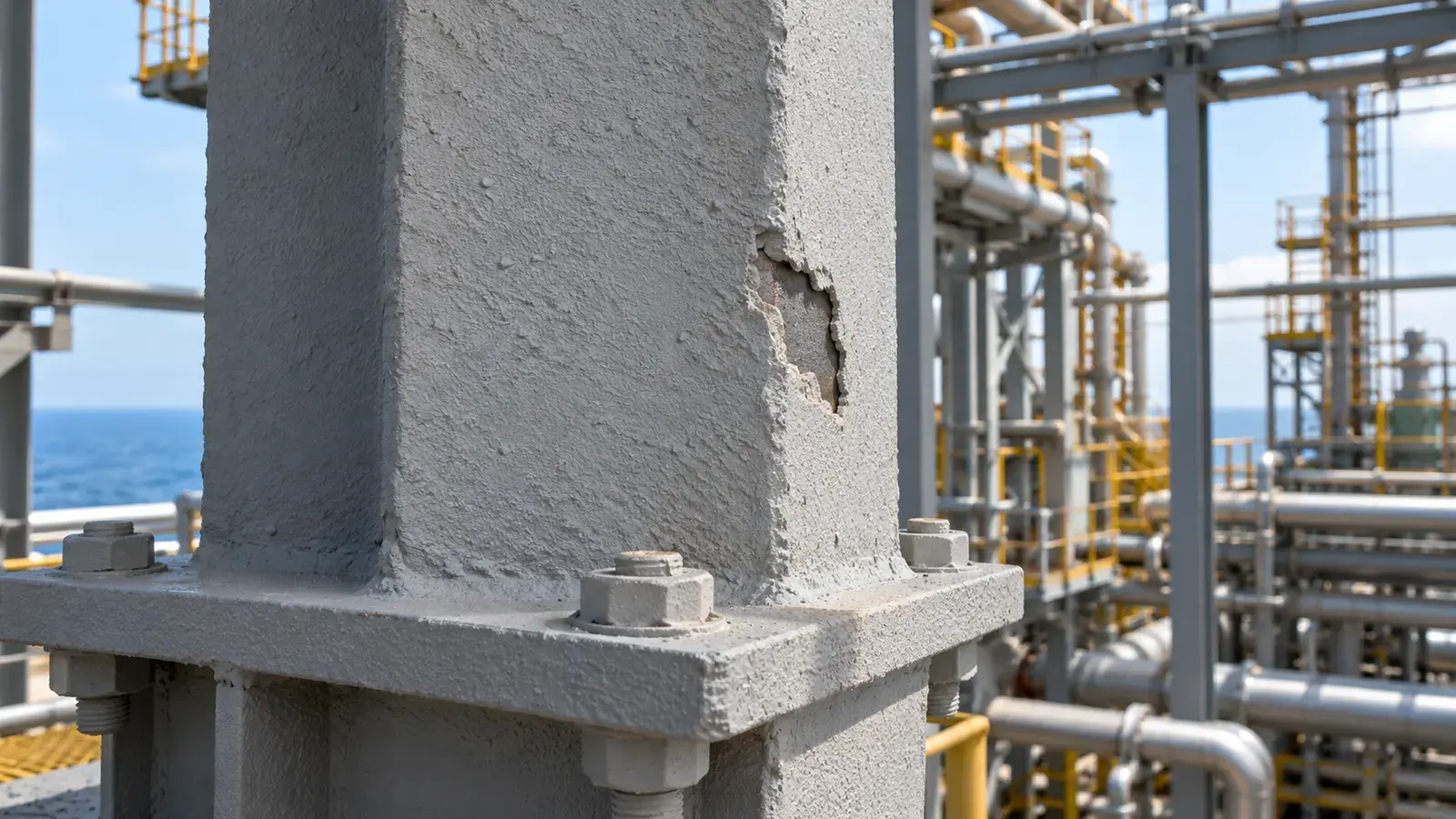
A photograph of a small chip cannot, on its own, establish remaining fire resistance. Equally, every surface mark should not automatically be declared a failed barrier. Competent assessment must distinguish what is observed from what is demonstrated. Avoid assigning a remaining protection time from appearance or borrowing damage limits from a different product.
Hypothetical FPSO example: the repair that is not yet closed
Hypothetical example—not a documented incident: During an FPSO maintenance walkdown, an operator notices a gouge in the fire-protection coating on a process-module column near a recently completed lifting activity. A work order describes it as minor coating damage, but does not identify whether the column has a credited fire-protection function.
The supervisor asks the integrity team to reconcile the location with the approved fire-protection drawings and performance requirements. The damage is recorded with its position and extent, without scraping away more material. The responsible specialists assess the condition and define any interim controls through the installation's approved impairment process.
The original repair material is unavailable. Rather than accepting a visually similar substitute, the team obtains the necessary compatibility and application evidence. Closure requires the authorised repair scope and inspection records, not just an after-photo or a completed work-order status. No coating thickness, fire rating or permitted operating period is implied by this scenario.
A matching specification is not proof of a compatible repair
Step Change in Safety warns that replacement PFP products can have similar specifications without being compatible with existing coatings. Its alert recommends early engagement with the original manufacturer and supporting independent fire and pre-fire durability evidence for repair methods. Where a product change is proposed, it calls for management-of-change assessment. [3]
In practice, the handoff needs to connect the installed system, approved repair method, application requirements and acceptance evidence. Procurement should not select a substitute solely by availability. Contractors need an authorised scope. Inspectors need to know what must be verified. Operations needs a clear statement of the barrier's status until that evidence is accepted.
Keep the protection linked to the hazard basis
DNV's offshore PFP research initiative combines structural fire analysis, fire risk analysis and operational insight in developing application criteria. A practical inference is the importance of understanding the protected structure and exposure. This is a research initiative, not a site approval or a universal regulatory requirement. [4]
For an installation team, a useful application is to ask whether modifications have changed the relationship between the release source, the protected member and the loads it carries. Route changes, new equipment or altered operating conditions should enter the approved engineering review. A historical drawing should remain connected to today's plant.
Leadership actions and three practical checks
Leaders should give fire-protection defects an owner and a technical disposition that reflects their safety function. Track unresolved assessments and repair acceptance separately from routine appearance work. Ask what evidence is still missing before describing the barrier as restored.
- Identify the function: Select one protected support and confirm its identity, credited duty and applicable inspection requirements.
- Report without improvising: Record missing material, gouges, cracking or suspected detachment through the approved defect process. Do not chip, drill, repaint or patch the system without authorisation.
- Close on evidence: Confirm the approved materials, repair method, inspection records and authorised acceptance before closing an impairment.
Official incident-learning video
The CSB's Fire From Ice explains the Valero McKee fire, including structural escalation. Its initiating event involved freezing in idle piping; the learning focus here is the subsequent pipe-rack failure, not a claim that the incident began with damaged PFP.
Watch on the official USCSB YouTube channel if the embedded player is unavailable.
Team discussion question
Which fire-protected support on our installation has an unresolved defect, and what evidence is needed to confirm that its credited function remains available?
Continue the learning
Connect this escalation lesson with mechanical-integrity evidence, management of change and shutdown resilience.
Verified primary sources
Sources checked on 17 October 2026. General learning only: apply the installation's approved fire and explosion assessment, engineering basis, performance requirements and procedures. This article supplies no damage acceptance limit, repair approval or permission to operate with impaired protection.
- CSB: Valero McKee recommendation 2007-5-I-TX-R7 status-change summary, 29 December 2015
- Kerr, Willoughby, Thurlbeck and Connolly: Acceptance Criteria for Damaged and Repaired Passive Fire Protection, HSL/HSE collaborative research, 2008
- Step Change in Safety: PFP acceptance of repair materials and methods
- DNV: Passive fire protection on offshore structures—joint industry research initiative
- CSB: Fire From Ice, official incident-learning video, 9 July 2008
Your experience matters
Share your thoughts on this page
Have a question, a useful experience or a suggestion? Add your input below.
Comments are public. Keep them respectful and relevant. Do not share contact details, confidential information or emergency reports.
Comments on this page
Loading comments…