Process Safety · Lesson 36 · 8 min read
A Temporary Cabin Still Needs a Siting Assessment
A portable cabin can be installed quickly and used for only a few weeks, yet expose its occupants to a major process event. Its temporary status does not make the people inside temporary risks. Choosing where people work is a process-safety decision, not only a logistics decision.
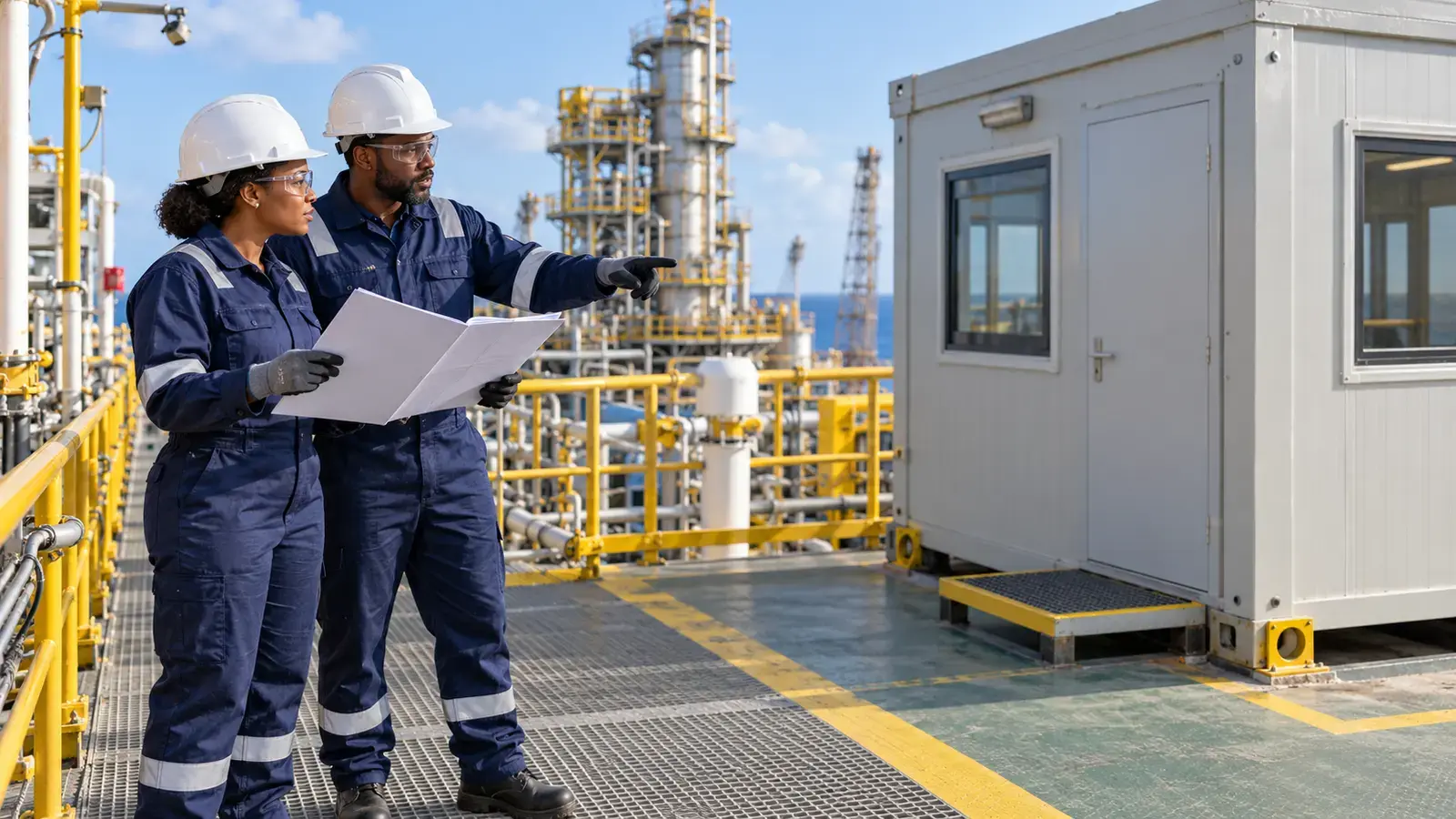
The hazard crosses the cabin boundary
HSE's plant-layout guidance identifies the protection of occupied buildings as a layout objective. It considers explosion, fire and toxic exposure, together with evacuation routes and the potential for escalation. A convenient position near a worksite must therefore be examined against the surrounding process hazards, not simply against whether the cabin physically fits. [1]
For an offshore team, the practical application is to connect three questions: what can be released nearby, how could the resulting event reach the cabin, and what would happen to the occupants? A familiar walkway or a tidy internal workspace cannot answer those questions. The assessment needs the actual location, use, occupancy and credible operating conditions.
Incident learning: the people were not operating the unit
Following the 23 March 2005 BP Texas City explosion, the CSB issued urgent recommendations on occupied trailers. It reported that all fifteen fatalities occurred in and around contractor trailers near the process area. The contractors' maintenance work was unrelated to the unit restart that produced the release. [2]
The CSB's accompanying recommendation identified convenience-driven siting, gaps in assessment and failure to consider the combined occupancy of nearby trailers. These are historical findings, not a statement about today's editions of industry standards. [3]
The lesson extends beyond the operating crew. A worker can be outside the job's direct scope but inside its consequence area. Coordination meetings, permit support and planning activities also place people in locations that need assessment.
Hypothetical FPSO example: the stores cabin becomes an office
Hypothetical example—not a documented incident: An FPSO receives a portable cabin to hold shutdown materials. As the campaign grows, a desk and chairs are added. Contractors begin using it for planning, and supervisors hold short coordination meetings there. The cabin has not moved, so the change is treated as an administrative convenience.
At a planning review, the team asks whether the original approval covered routine occupancy rather than storage. They also ask whether restart activities in the adjacent module were considered. The responsible technical specialists review the proposed use against the installation's approved hazard and layout assessments before the cabin is released for that use.
If the location or proposed occupancy cannot be justified, the team uses an authorised alternative arrangement. They do not declare the cabin acceptable because meetings are short or because it has been used without incident. No safe separation distance, building rating or permitted occupancy is implied by this example.
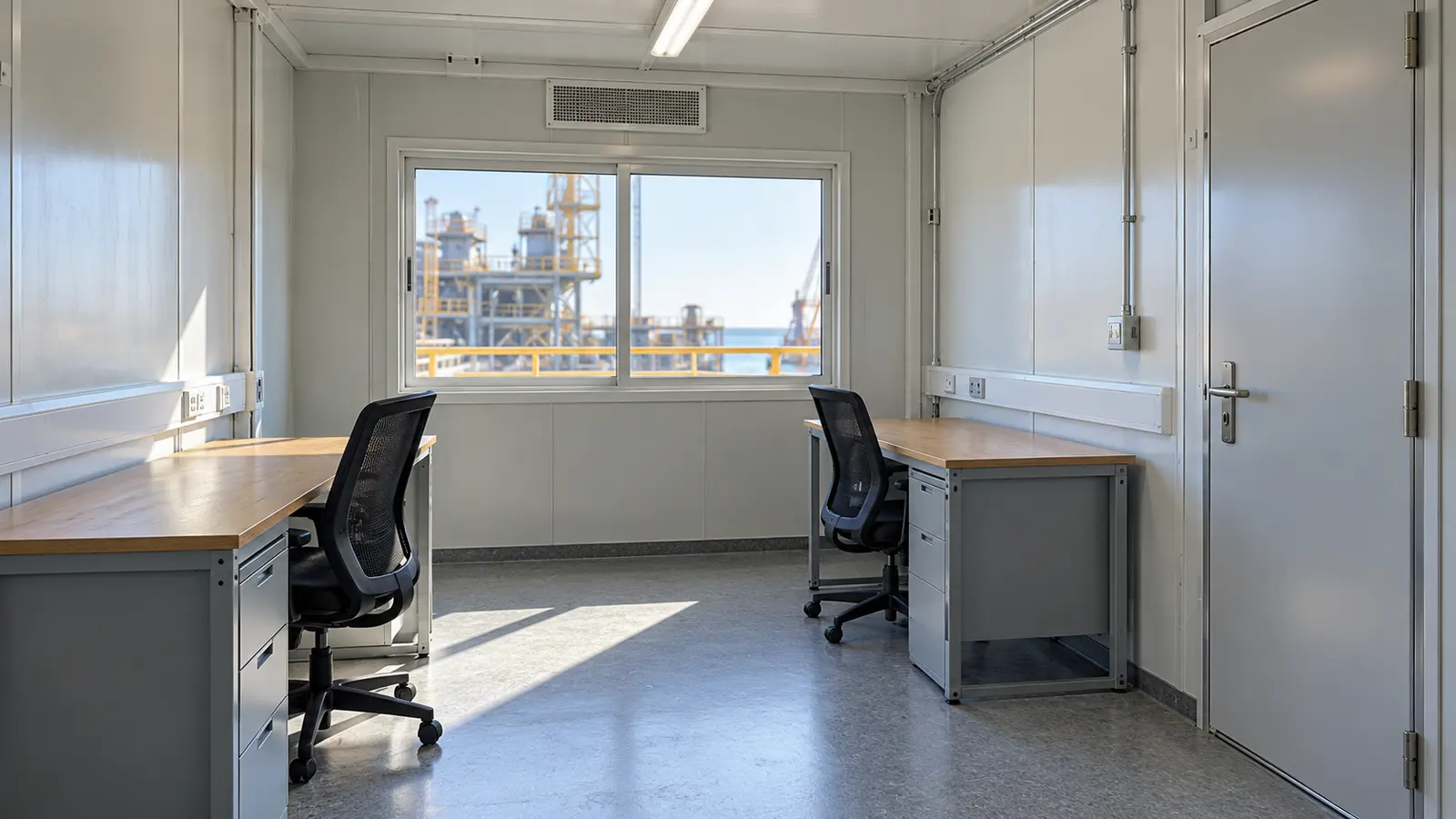
Assess the protection that the building actually provides
HSE's control-room guidance addresses structural response to major events, windows and internal fixtures, fire exposure, gas ingress and ventilation arrangements. It also links protection to the room's intended emergency function. These considerations show why a building should be assessed as a complete system. [4]
A practical inference for temporary cabins is that evidence addressing one hazard must not silently become approval against every hazard. An enclosure described as strong is not automatically a toxic-gas refuge. A weatherproof door is not proof of an effective emergency shelter. Ask the technical authority what the documented design basis actually covers, including the installed condition and interfaces.
Manage changes in people, purpose and process
OSHA's process-safety standard explicitly includes facility siting in process hazard analysis. Its management-of-change provisions address changes to facilities affecting a covered process, including technical basis, safety effects, authorisation and updates to relevant information. These are U.S. requirements for covered processes, not an assertion that they automatically govern every FPSO. [5]
The offshore application is to use the installation's approved change-control process when a cabin's location, use or occupancy changes. Include changes around it: a new release source, different operating inventory or a restart can challenge an earlier assessment. Approval belongs to a defined configuration, not to the cabin's name alone.
Leadership actions and three practical checks
Leaders should make ownership visible between project planning, marine or lifting coordination, operations and technical safety. A delivery plan is not the same as an occupancy release. Keep siting decisions, restrictions and unresolved actions available to the people allocating workspaces. Check how cabins are actually being used rather than relying only on their original descriptions.
- Verify the basis: Select one temporary cabin and confirm the approved location, intended use and occupancy assumptions.
- Check the interfaces: Confirm that current process conditions, building protection and escape arrangements remain covered by the assessment.
- Control the change: Escalate an unassessed move or change of use; obtain authorised review before people occupy the cabin for the proposed purpose.
Official incident-learning video
The CSB's updated Texas City animation, released on 23 March 2020, explains the refinery explosion and its consequences. Use the trailer-siting discussion to examine who may be exposed beyond the operating team; it does not establish offshore separation distances.
Watch on the official USCSB YouTube channel if the embedded player is unavailable.
Team discussion question
Which temporary cabin has changed from its originally approved use, and what evidence confirms that today's occupants and surrounding process conditions are covered?
Continue the learning
Connect cabin-siting decisions with management of change, combined SIMOPS risk and controlled startup.
Verified primary sources
Sources checked on 18 October 2026. General learning only: apply the installation's approved fire and explosion assessment, engineering basis, performance requirements and procedures. This article supplies no cabin-placement approval, separation distance, building rating or permission to occupy an unassessed location.
- HSE: Plant Layout—occupied buildings, fire, explosion, toxic releases and escape
- CSB: urgent trailer-siting recommendations, 25 October 2005
- CSB: original urgent recommendation on occupied trailers and temporary structures, October 2005
- HSE: Control room design—structural response, fire, gas ingress and ventilation
- OSHA: 29 CFR 1910.119—facility siting in hazard analysis and management of change
- CSB: official updated Texas City animation, 23 March 2020
Your experience matters
Share your thoughts on this page
Have a question, a useful experience or a suggestion? Add your input below.
Comments are public. Keep them respectful and relevant. Do not share contact details, confidential information or emergency reports.
Comments on this page
Loading comments…