Original summaries of relevant industry developments, with clear source attribution and direct links to official publications.
Page 7 of 11 · HSSE news items 73–84 of 125
Safety · UK Marine Accident Investigation Branch ·
Argos Georgia Foundering: How an Open Hatch and Delayed Response Cost 13 Lives
MAIB’s final investigation finds that an unexpectedly opened line-hauling hatch led to progressive flooding and the loss of 13 lives aboard Argos Georgia. The hatch could not be closed, internal doors allowed flooding to spread, and emergency decisions reduced rescue time.
Why it matters: Shell-opening security, compartment integrity, resilient controls and prompt distress and abandonment decisions form a connected safety system.
WWF warns that weakening species safeguards can also weaken habitat protection
WWF responded to a reported change in interpretation of the United States Endangered Species Act, arguing that limiting prohibited harm to intentional actions would undermine the law’s ability to protect endangered species and the habitats and natural systems on which they depend.
Why it matters: For environmental managers, biodiversity risk is not limited to deliberate harm. Routine land clearing, drainage changes, lighting, noise, traffic, water abstraction and maintenance can create indirect or cumulative effects. Projects should identify sensitive receptors and habitat pathways early, apply the mitigation hierarchy and verify outcomes even where legal interpretation is changing.
HSE case shows why end-of-life pressure equipment still needs engineered restraint
HSE reported that a worker was fatally injured when a cartridge-type fire extinguisher released pressure suddenly and exploded during end-of-life processing. Its investigation found that the risk assessment and system of work were unsuitable, old extinguishers were not stored properly and the discharge process lacked a suitable restraint system to contain ejected parts.
Why it matters: Decommissioning does not remove stored energy or uncertainty about internal condition. Sites should segregate suspect pressure equipment, use equipment-specific procedures, control orientation and line of fire, provide engineered restraint or remote operation where required, and verify the safe state before dismantling, recycling or disposal.
ILO coffee-sector programme connects labour compliance with safer, sustainable work
The ILO reported capacity-building sessions for coffee-sector stakeholders in Ethiopia’s Sidama and South Ethiopia regions, with a further rollout planned in Oromia. The programme integrates labour law, working conditions, wages, productivity and social dialogue, including occupational safety and health, fundamental labour rights, workplace organisation and practical action planning.
Why it matters: Responsible supply chains depend on conditions at farms, processors and supporting enterprises, not only on the quality of the final product. Buyers and operators should connect supplier due diligence with worker participation, competent inspection, safe systems of work, fair employment practices and evidence that agreed improvements reach the workplace rather than ending at policy level.
World Ozone Day 2026 links ozone protection with sustainable cooling
UNEP OzonAction set out the 2026 World Ozone Day theme, ‘Global action for a cooler planet,’ and marked ten years since adoption of the Kigali Amendment. Its material connects continued implementation of the Montreal Protocol with lower-impact refrigerants, energy-efficient cooling, responsible servicing, refrigerant recovery and stronger technical capacity.
Why it matters: Cooling is an operational necessity in offices, accommodation, control rooms, cold chains and process support, but its environmental performance depends on decisions across the asset life cycle. Sites should connect procurement, leak prevention, competent maintenance, energy performance, refrigerant records and end-of-life recovery so that a cooling improvement does not merely move emissions, waste or safety risk elsewhere.
HSE warning shows why gas-work credentials must be independently verified
The UK Health and Safety Executive warned households and businesses about using unregistered gas fitters after reporting a rise in convictions for illegal gas work. Its examples include a trader who used a false Gas Safe logo, an unregistered installer who issued a fraudulent certificate and work that resulted in multiple gas leaks. HSE advises checking an engineer's credentials through the official Gas Safe Register before allowing gas work to begin.
Why it matters: A logo, certificate, social-media profile or contractor's assurance is not independent evidence of competence or current authorisation. Organisations should verify required credentials directly with the applicable official register, match the individual and scope of work, retain the evidence, and stop or quarantine suspect work. Contractor selection and permit controls must prevent an apparently legitimate supplier from introducing fire, explosion or toxic-exposure hazards.
EPA begins source-control cleanup of migrating mine waste at Rumsey Mill
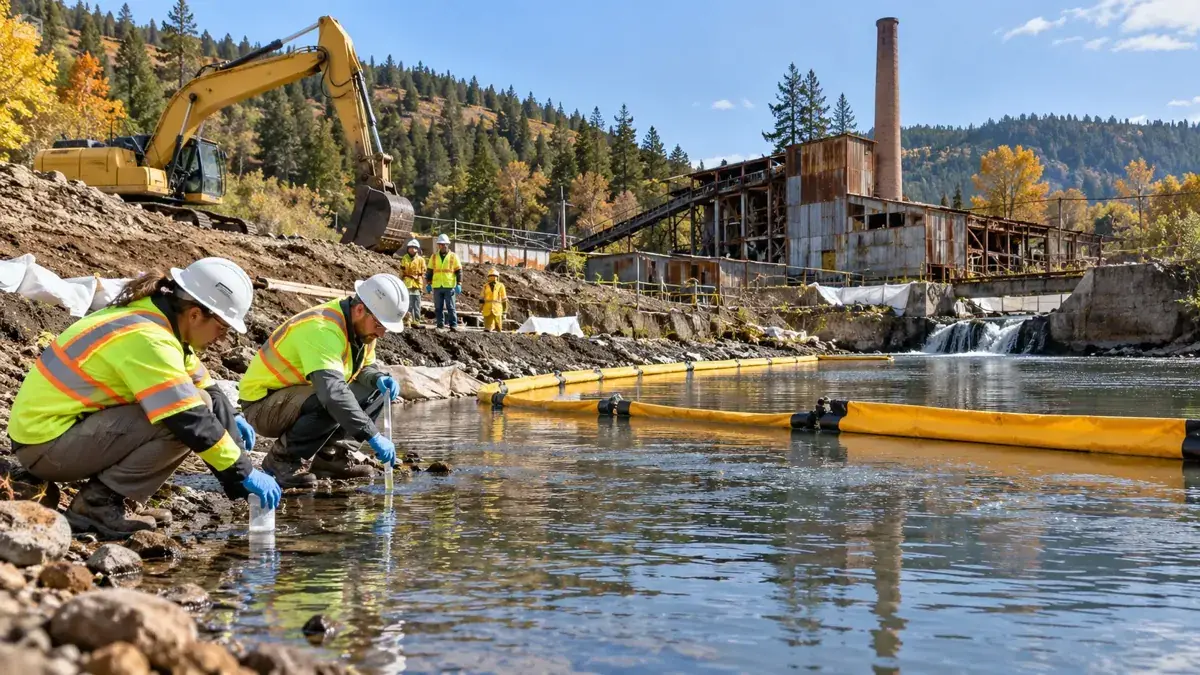
EPA announced a time-critical removal action at the former Rumsey Mill in Montana after sampling identified arsenic, lead and mercury contamination and continuing movement of material into the Fred Burr Creek area. Planned work includes excavation, consolidation in a protected repository, erosion and surface-water controls, and restoration of disturbed ground and the stream corridor.
Why it matters: Legacy contamination remains an active management problem when rain, erosion or unstable ground keeps moving it beyond the original source. Environmental teams should trace the source, transport pathway and exposed receptors together, verify containment performance, and plan drainage, stabilisation and restoration alongside removal rather than treating excavation alone as the endpoint.
HSE trench-collapse case shows the consequence of entering unsupported ground
The UK Health and Safety Executive reported sentencing after a worker was fatally buried when the walls of a deep trench collapsed during pipe-replacement work. A joint investigation found that the excavation had no supports and that excavated soil had been placed immediately beside the edge. It also found that another worker had been observed in the same unsupported trench earlier that day without the required protective measures being put in place.
Why it matters: An excavation must be treated as a temporary structure whose stability is deliberately designed, installed and maintained before entry. Contractors and supervisors should select a suitable protective system, keep spoil and plant loads away from the edge, control access, inspect changing conditions and stop work whenever the field setup does not match the approved method. Seeing someone enter without an immediate collapse is a warning to intervene, not evidence that the trench is safe.
HSE scrap-yard case links public access, mobile plant and an unstable stockpile
The UK Health and Safety Executive reported enforcement after a father and son were injured while unloading scrap near an operating excavator. Part of a large metal stockpile collapsed onto them, and HSE found that the site had not adequately separated members of the public from mobile machinery and the unstable pile. The event followed an earlier near miss in which the same excavator struck a visitor’s vehicle during unloading.
Why it matters: A customer or visitor inside an operational yard needs the same deliberate protection from vehicle movements, slewing equipment and unstable materials as a worker. Sites should separate public unloading from plant operations, control pedestrian and vehicle routes, define safe stockpile boundaries and treat a near miss as evidence that the traffic system needs correction before the next movement—not as proof that no harm occurred.
HSE ATV case connects rollover risk with training, restraints and pre-use checks
The UK Health and Safety Executive reported enforcement after an employee was fatally crushed when an all-terrain vehicle overturned on a hillside. HSE found that neither occupant had received adequate training or was wearing a seat belt, routine pre-use inspections were not carried out, tyre pressures differed, the vehicle was being operated in an unsuitable gear and drive mode, and its keys were not adequately controlled.
Why it matters: Vehicle safety depends on a complete operating system rather than driver familiarity. Sites should authorise and train users for the equipment and terrain, control keys, verify tyres and other safety-critical conditions before use, select the correct operating mode and use fitted restraints whenever required. A short journey or routine vegetation task does not reduce the consequence of an overturn.
HSE conveyor case shows why switching off is not a substitute for guarding
The UK Health and Safety Executive reported enforcement after a worker suffered multiple fractures when her arm became caught in a conveyor roller during cleaning. The line had initially been switched off but began operating while she had access to the unguarded danger area. HSE found that the manufacturer had failed to prevent access to the rotating parts.
Why it matters: Routine cleaning often places hands close to rollers, nip points and other moving machinery. A normal stop control does not provide the physical protection of effective fixed or interlocked guarding, and it is not an energy-isolation method. Sites should verify the cleaning design, prevent access while dangerous movement is possible and use a controlled isolation procedure whenever the task requires entry into the danger zone.
NIOSH warns that misrepresented respirator components can undermine protection
NIOSH’s September newsletter describes its work to identify respirators, filters and cartridges that misuse registered certification marks or are marketed as though they belong to an approved configuration. NIOSH explains that untested replacement components may not provide the claimed protection and that fitting them to an approved respirator can invalidate the approval of the complete configuration.
Why it matters: Respiratory protection depends on the entire approved assembly, not a familiar logo or a component that appears to fit. Procurement and users should verify the exact manufacturer, model, approval marking and compatible components through authoritative records, maintain supply-chain traceability and quarantine suspect products rather than relying on marketplace descriptions or visual similarity.
 Safety · UK Marine Accident Investigation Branch ·









Your experience matters
Share your thoughts on this page
Have a question, a useful experience or a suggestion? Add your input below.
Comments are public. Keep them respectful and relevant. Do not share contact details, confidential information or emergency reports.
Comments on this page
Loading comments…