Health · 9 min read
The Hazard Arrives on the Wind: Preparing Workplaces for Wildfire Smoke and Heatwaves
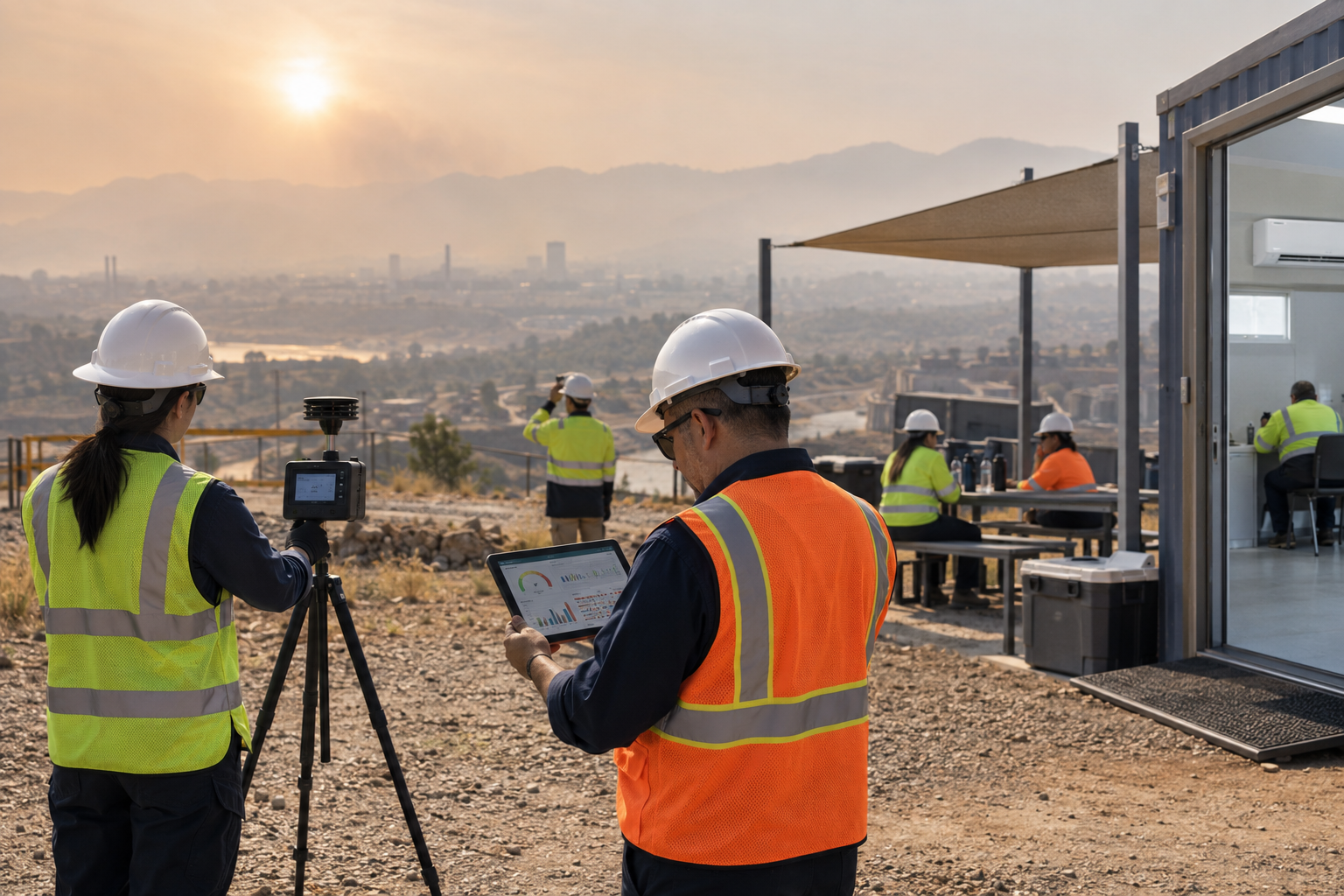
WMO's latest air-quality bulletin shows why wildfire smoke, heat-driven ozone and long-range pollution must be managed as dynamic workplace health hazards—even when their source is far beyond the site boundary.
What the WMO bulletin changes
The World Meteorological Organization published Air Quality and Climate Bulletin No. 6 on 7 September 2026. It warns that increasing pollution from wildfires and heatwaves risks undermining progress achieved by reducing industrial and transport emissions. The message for workplaces is direct: ambient air quality cannot be treated as a fixed background condition or an issue that belongs only to environmental regulators.
The bulletin connects several hazards that are often managed separately. Fine particulate matter from fires can penetrate deep into the lungs and bloodstream. Heatwaves promote the formation of ground-level ozone, which affects respiratory health. Black carbon and airborne microplastics can travel far from their source, while monitoring remains incomplete in many locations. A worksite may therefore face significant exposure even when it did not generate the pollutant.
Why conventional air-quality plans may be too narrow
Many occupational-hygiene programmes focus on contaminants produced by the task: welding fume, silica dust, diesel exhaust, process vapour or chemical mist. That remains essential, but it does not capture smoke and ozone arriving from outside. Regional haze can combine with local emissions, and heat can increase both physiological strain and atmospheric chemistry. The result is a changing exposure profile that a periodic survey may miss.
WMO reports that wildfire-related PM₂.₅ exposure is increasing even where regulation has reduced other sources. It also highlights research indicating that conventional models based only on total PM₂.₅ concentration may underestimate the toxicity of fire-derived particles. HSSE teams should not translate that observation into a universal workplace exposure limit; instead, they should recognise that source, composition, duration and worker vulnerability matter alongside the displayed air-quality number.
Build an external-air hazard trigger system
A useful plan starts with reliable information and predefined actions. Identify the national or regional air-quality service, meteorological warnings and wildfire-smoke products appropriate to each location. Decide who monitors them, how often conditions are reviewed and what triggers increased observation, worker notification, work modification or suspension. A forecast should prompt preparation; a field reading should verify what workers are actually experiencing.
Triggers should consider more than one indicator. PM₂.₅, ground-level ozone, visibility, temperature, humidity, wind direction, task intensity and duration can interact. Sites with workers spread over a wide area may need several monitoring points because exposure at the gate may not represent a low-lying excavation, rooftop, roadside or downwind process area.
- Name an accountable person or role for reviewing air-quality and heat information.
- Use calibrated or quality-assured instruments suited to the decisions being made.
- Define escalating actions before poor conditions arrive.
- Record readings, forecasts, work conditions and decisions so the plan can be improved.
Use the hierarchy of controls
Outdoor smoke cannot usually be eliminated by the employer, but exposure can still be reduced. Reschedule strenuous work, move tasks indoors, shorten exposure periods, rotate only where this genuinely reduces individual dose, increase recovery time and provide a suitably filtered clean-air space. Vehicle and building ventilation settings should be reviewed so contaminated outdoor air is not drawn inside without adequate filtration.
Respiratory protection may be necessary, but it is not a substitute for reducing exposure. Selection must match the hazard and applicable legal requirements. Workers need fit testing where tight-fitting respirators are used, medical suitability, training, inspection and a realistic understanding of how heat, exertion and facial hair affect protection. Surgical masks and improvised face coverings should not be presented as equivalent to approved particulate respirators.
Manage heat and polluted air as one exposure
Heat stress and air pollution can pull controls in opposite directions. A respirator adds breathing resistance and can increase discomfort; opening doors for cooling may admit smoke; heavy exertion increases both heat production and the volume of polluted air inhaled. The risk assessment must consider the combined load rather than approving separate heat and air-quality plans that conflict in the field.
Provide cool drinking water, shaded or cooled recovery, acclimatisation, work-rest arrangements and observation for symptoms. Where indoor refuge is used, verify temperature as well as filtration. Supervisors should know when symptoms require removal from exposure and medical assessment, and workers should be encouraged to report early without fear that doing so will be treated as poor performance.
Protect workers with greater vulnerability
Smoke and ozone do not affect everyone equally. People with asthma, cardiovascular or respiratory disease, pregnant workers and others with relevant medical conditions may require additional protection. Occupational-health support should establish a confidential route for individual assessment without requiring workers to disclose diagnoses to their line supervisor.
Emergency plans should also consider medication access, transport, communication and the possibility that regional smoke affects hospitals, roads and community services at the same time as the worksite. Contractors and temporary workers must receive the same warnings and protective arrangements as directly employed personnel.
Do not overlook environmental pathways
The bulletin also reinforces the environmental dimension. Aerosols can cross oceans and continents, deposit black carbon on snow and ice, and carry microplastics to remote environments. Worksites should control their own combustion, dust, open burning and waste-management practices even when regional pollution dominates the sky. External conditions are not an excuse to add avoidable emissions.
Following a nearby fire, deposited ash may contaminate roofs, yards, drainage systems, equipment and water supplies. Cleanup should be assessed before sweeping or pressure washing redistributes fine material. Waste and wash-water routes, worker protection and environmental notification requirements may all need review.
Questions HSSE leaders should ask today
Choose one outdoor workgroup and trace how an air-quality deterioration would be detected, communicated and controlled. Test the arrangement against a rapidly changing shift rather than an ideal office-hours scenario.
- Which authoritative forecast and monitoring sources do we use at each location?
- What readings or conditions trigger notification, reduced work, relocation or suspension?
- Can our ventilation and filtration maintain a genuinely cleaner indoor refuge?
- How do respirator controls account for heat, exertion, fit and medical suitability?
- Are contractors, drivers and remote workers included in alerts and accountability?
- Have we considered simultaneous smoke, ozone, heat and locally generated contaminants?
- How will we review the decision afterward and improve the trigger levels?
Turn environmental intelligence into work decisions
Air-quality information creates value only when it changes what happens at the workface. The strongest system connects forecasts, field monitoring, occupational-health expertise, supervisor authority and worker communication. It makes conservative action easier when conditions deteriorate and defines the evidence needed for a safe return to normal work.
The enduring lesson from WMO's bulletin is that the atmosphere connects climate, environment and worker health. The pollution source may be beyond the fence, beyond the region or beyond national borders. The responsibility to recognise exposure and protect people at work remains local.
Sources
- WMO bulletin shows air quality and climate interlinkages — World Meteorological OrganizationPublished 7 September 2026
Daily HSSE updates
Subscribe for practical HSSE updates.
Subscribe for the daily message, selected HSSE news and occasional new-resource alerts from Worksite Safety Hub.