Health · Product Reviews · 14 min read
Belt-Mounted Powered Respirator Review: Useful PAPR-Style Kit or Unverified ‘Fresh Air’ Claim?
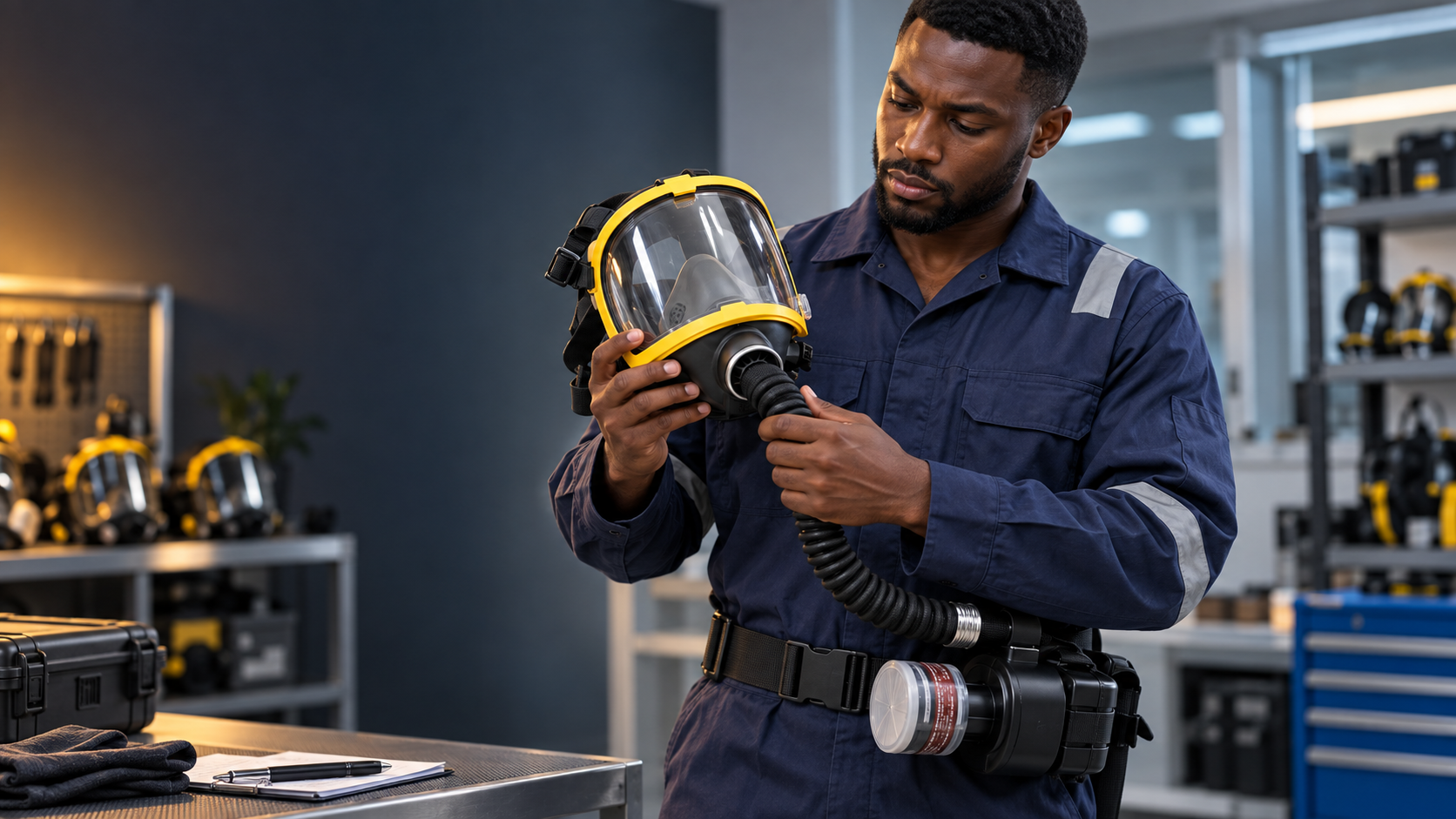
A safety-first review of this belt-mounted powered respirator kit, including its full-face and half-mask options, canister, hose, battery, airflow claims, approval gaps and prohibited uses.
Affiliate disclosure and review basis
This independent review contains an affiliate link. Worksite Safety Hub may earn a commission if you make a qualifying purchase through it, at no additional cost to you. We assessed the supplied marketplace photographs and visible seller claims; we have not laboratory-tested, flow-tested, fit-tested or authenticated the exact blower, facepiece, hose, battery or canister.
This article concerns the belt-mounted powered respirator system shown with a black blower, corrugated breathing hose and either a full-face or half-mask connection. It is a different product from the passive black full-face respirator and the grey 6200-style half mask reviewed earlier. Marketplace bundles vary, so every conclusion must be tied to the exact configuration selected and delivered.
Quick verdict
The concept is appealing. A powered blower can draw air through an appropriate filter and deliver it to the wearer, reducing the breathing effort associated with a conventional negative-pressure respirator. The listing also shows a wide full-face visor, portable belt mounting, two airflow settings and a rechargeable battery.
The decisive safety evidence is missing from the photographs: no traceable approval for the complete system, no loaded-flow performance, no visible low-flow or low-battery alarm specification, no assigned protection factor, and no verified canister schedule for the advertised gases and vapours. Our verdict is therefore conditional: potentially useful as an inexpensive PAPR-style system for a precisely assessed hazard, but not suitable for occupational exposure until the complete assembly, approvals, airflow, alarms, fit and filter selection are independently verified.
What this system is—and what it is not
This appears to be a powered air-purifying respirator, or PAPR-style device. The belt unit uses a battery-powered fan to pull ambient air through a canister and send that filtered air through a hose to the facepiece. It does not produce air, add oxygen or draw breathing air from a remote clean-air compressor.
Calling the outlet ‘fresh air’ can therefore mislead buyers. The delivered air can only be as safe as the surrounding atmosphere, the selected canister, the seal and hose, and the blower's maintained flow. This is not a supplied-air respirator or self-contained breathing apparatus. It must never be used where oxygen may be deficient, where the atmosphere is immediately dangerous to life or health, or where the contaminant and concentration are unknown.
What appears to be included
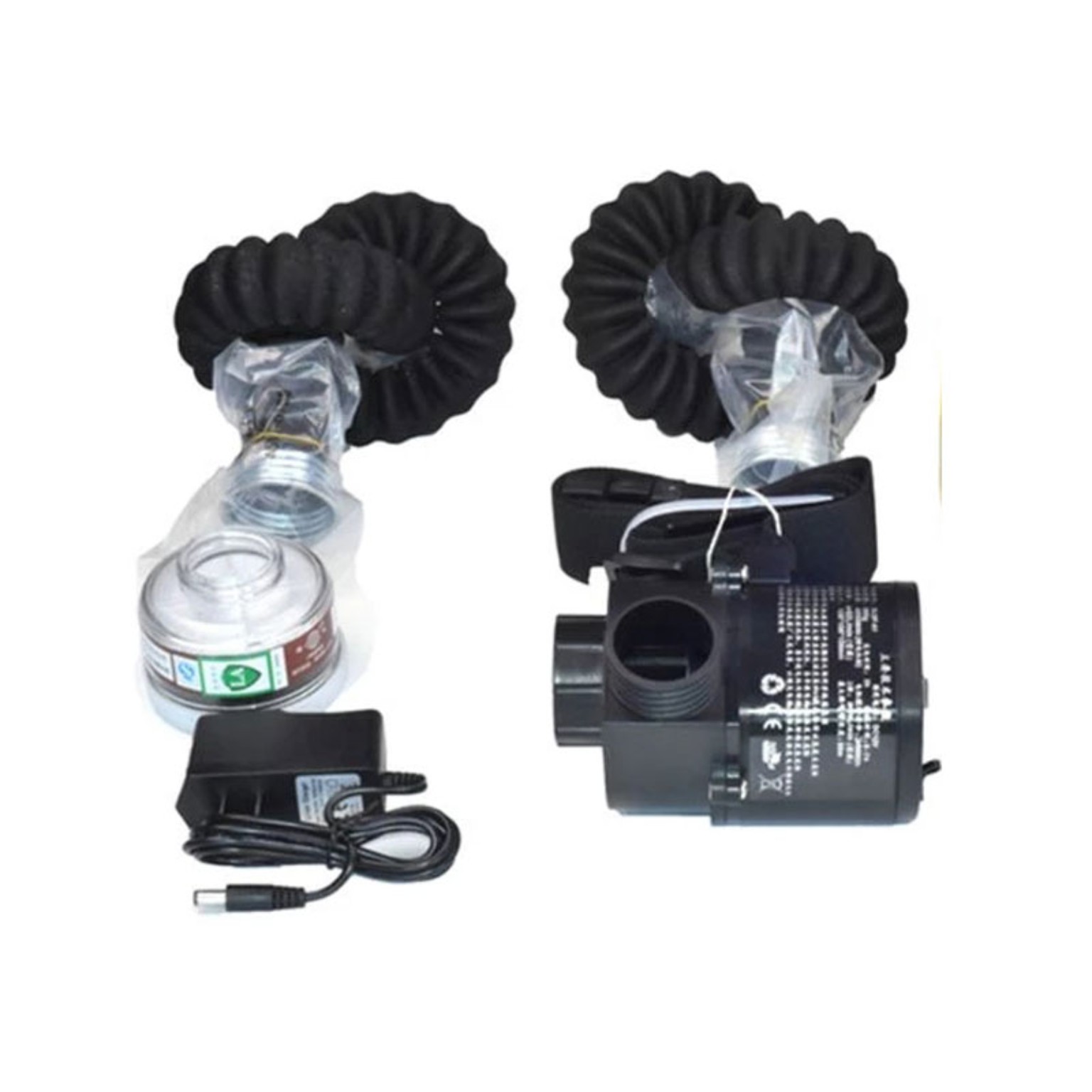
The seller photographs show a black belt-mounted blower with an integral battery, a charger, a screw-on canister and corrugated hoses with metal-coloured collars. Other images show the system attached to a full-face mask or a smaller half mask. One kit photograph appears to include more than one hose, but the checkout option—not the gallery—determines what arrives.
Ask the seller for a single dated photograph or packing list for the exact variant. Confirm the facepiece, blower model, battery, charger plug, hose length, hose connectors, canister part number, belt and instructions. A component pictured elsewhere in the listing should not be assumed to be included.
- Powered belt blower and adjustable waist belt.
- Rechargeable lithium battery integrated with the blower.
- Corrugated breathing hose with threaded collars.
- One screw-on filter or chemical canister.
- 12.6 V charger shown with a regional mains plug.
- Full-face or half-mask option, depending on the selected bundle.
Airflow claims need an in-use test
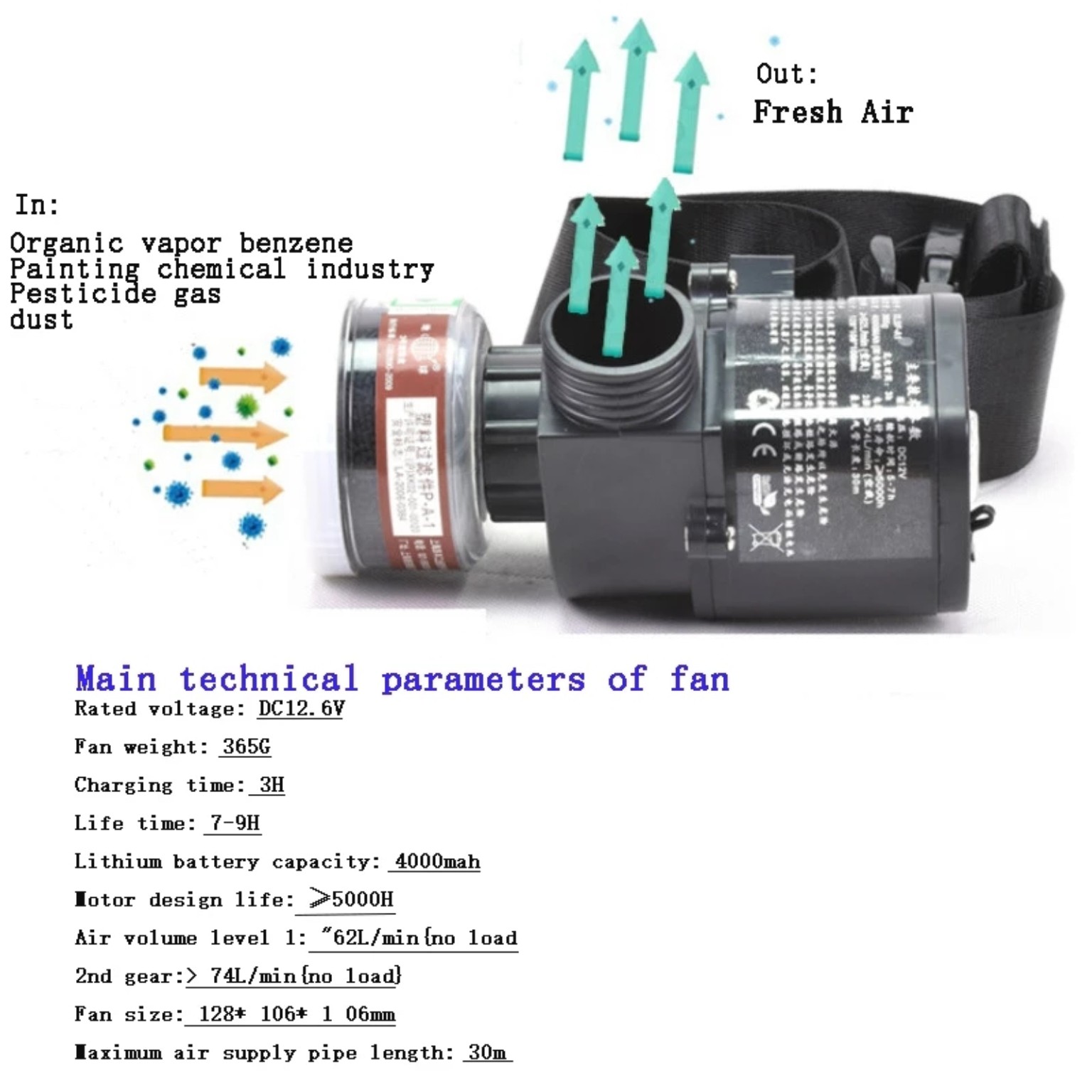
The listing advertises two airflow levels: 62 L/min and more than 74 L/min, explicitly marked ‘no load’. No-load fan output is measured without the real resistance created by the canister, hose, bends, facepiece, filter loading and battery state. It cannot be treated as the breathing-zone flow available to the wearer.
A credible powered respirator needs a manufacturer-defined minimum flow, a pre-use flow-check method and an effective warning if flow falls below the safe threshold. The supplied images do not establish a low-flow alarm, flow indicator or automatic compensation. Before every use, verify flow with the model-specific test device and procedure; never rely on sound, hose movement or the sensation of air alone.
Battery and charger: useful claims, incomplete assurance
The seller states a 4,000 mAh lithium battery, approximately three hours of charging and seven to nine hours of operation. It also lists a 12.6 V rated voltage, a fan weight of about 365 g and a motor design life greater than 5,000 hours. These are marketplace claims, not independently confirmed results under filter load, temperature extremes or an ageing battery.
A nominal shift-length runtime leaves little margin if the filter loads rapidly, the high setting is used, the battery is cold or the cell has degraded. Confirm run time on each flow setting, low-battery warning behaviour, battery replacement method, charge-state indication and whether the charger is certified for the destination country. Charge only in a clean, dry, non-hazardous location with the specified charger. A battery and motor without an intrinsic-safety rating can be an ignition source in flammable atmospheres.
The canister claim is the highest-risk part
A seller graphic mentions organic vapour, benzene, paint or chemical work, pesticides and dust. Those words do not make one generic canister universal. Gas-and-vapour cartridges are contaminant-specific, have finite capacity and may be affected by concentration, humidity, temperature, breathing rate and storage history. Particulate filtration is a separate capability that must also be identified.
Benzene is a particularly consequential claim and should never be accepted from a gallery graphic. Obtain the exact canister model, manufacturer, approval, contaminant classes, maximum-use concentration, shelf life, service-life data and change-schedule method. Do not wait for odour, taste or irritation as a replacement signal. If the seller cannot provide traceable documentation for the complete respirator-and-canister combination, do not use it for gases, vapours, pesticides or hazardous dust.
Full-face configuration: coverage does not prove protection
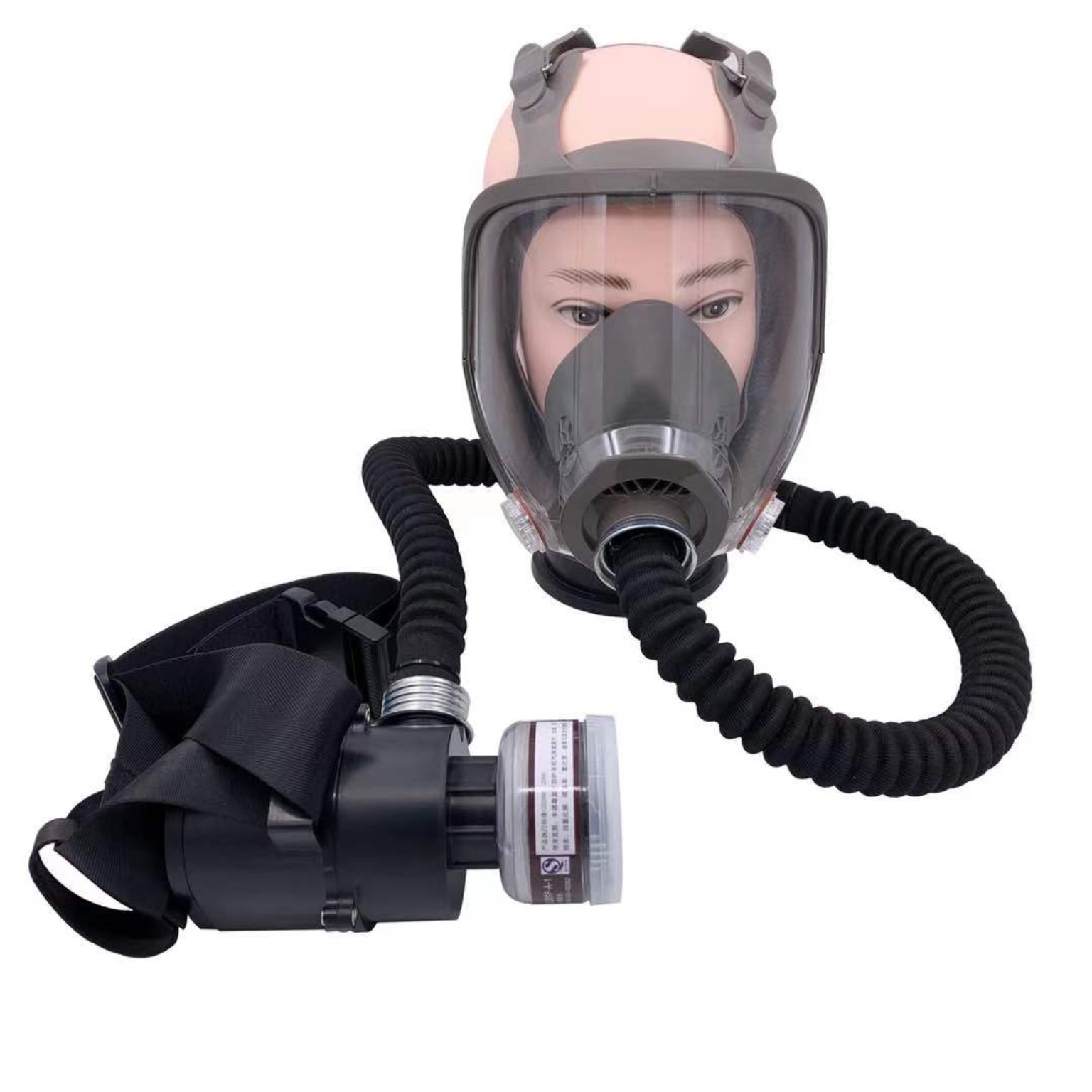
The full-face option offers a broad clear lens and may protect the eyes and face from certain contaminants when the exact model is approved for them. Buyers should verify lens material, optical class, impact rating, chemical resistance, anti-fog provision and replacement availability. A large visor is not automatically safety eyewear or splash protection.
The pictured full-facepiece appears tight-fitting. Under OSHA's respiratory-protection rule, tight-fitting PAPRs require fit testing, and the wearer must complete the manufacturer's seal check whenever the facepiece is donned. Facial hair, stubble, hair, eyewear or clothing must not cross the sealing surface. Positive pressure can reduce inward leakage during normal operation, but it does not rescue a failed fit, damaged seal or stopped blower.
Half-mask configuration: less coverage, same verification burden
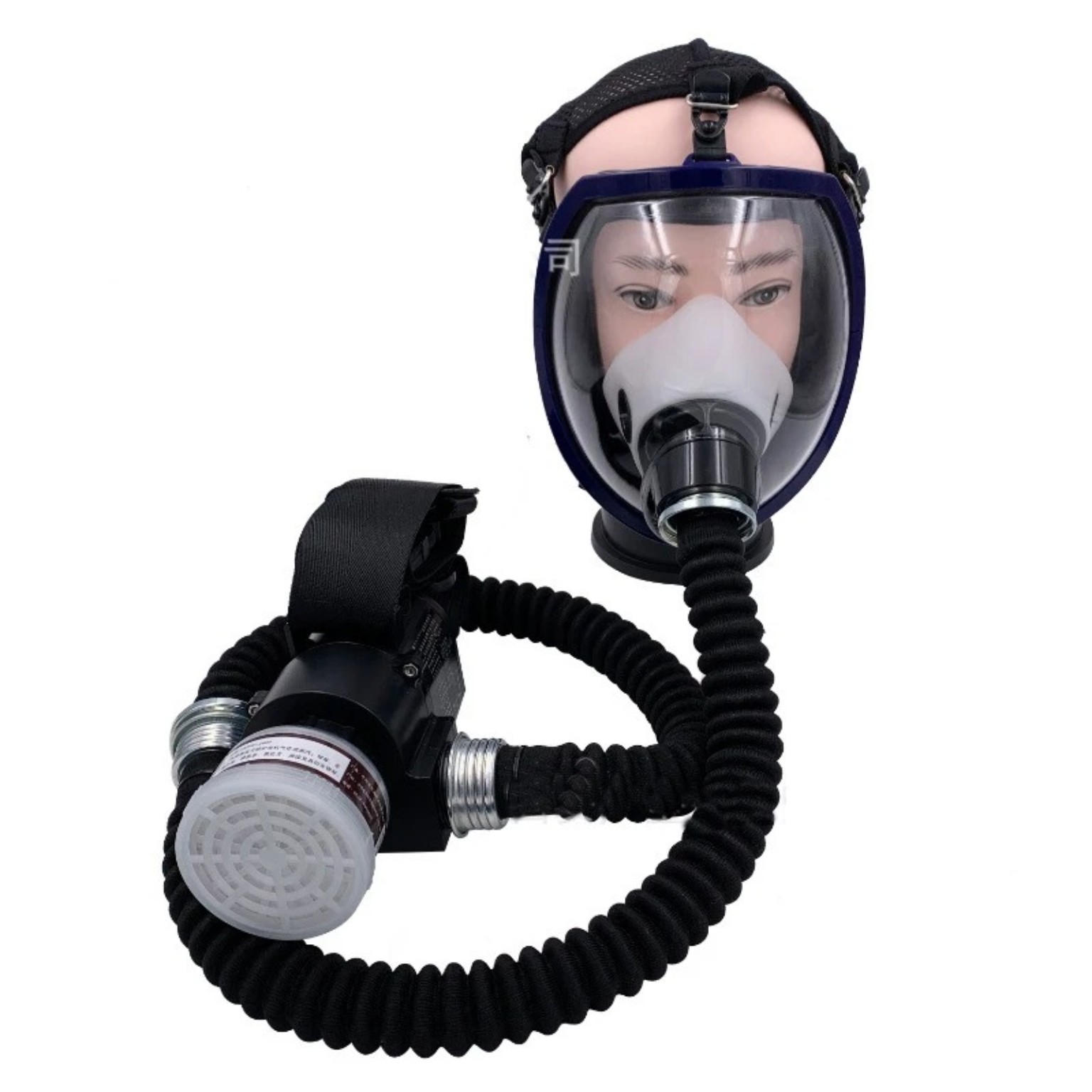
The smaller facepiece may reduce weight and improve visibility, but it leaves the eyes and face exposed. Goggles or other protection may be needed for particles, splash or irritating vapours, and the eyewear must not disturb the mask seal. For substances that can injure or be absorbed through the eyes, a competent assessment may rule out a half mask entirely.
Do not assume the full-face and half-mask options deliver the same assigned protection factor, flow requirement or approval. Approval belongs to a specific combination of blower, hose, facepiece and filter. Changing even one component can create an unapproved assembly, regardless of whether the threads appear to fit.
Fit testing, medical evaluation and facial hair
A tight-fitting powered respirator is still a tight-fitting respirator. Workplace users need medical evaluation before required use, the correct size, model-specific fit testing, training and repeat testing under the applicable respiratory-protection programme. They also need a user seal check each time the respirator is put on.
A beard, stubble or any item that lies between the face and the sealing surface can compromise protection. If facial hair cannot be removed, the alternative is a verified loose-fitting hood or helmet configuration designed and approved for the blower—not treating a tight facepiece as loose-fitting because air is flowing.
Hose and belt ergonomics
Moving the filter weight to the belt can improve head comfort, but it introduces hose, belt and snag hazards. Route the hose so it cannot catch on ladders, scaffolds, machinery, door hardware or sharp edges. Avoid tight bends that restrict flow, and keep the hose away from hot work, welding spatter, rotating equipment and chemical splash.
The blower should remain secure in the manufacturer's intended orientation with its inlet unobstructed. Check whether the belt supports the combined weight without slipping and whether the canister collides with tools or fall-arrest equipment. A respirator must be evaluated as part of the whole PPE ensemble, including hearing, eye, head, protective clothing and harness systems.
Where this product must not be used
Do not use this air-purifying system in oxygen-deficient or oxygen-enriched atmospheres, confined spaces with unknown conditions, immediately dangerous to life or health conditions, emergency rescue, firefighting, CBRN incidents, uncontrolled chemical releases or atmospheres above the canister's approved limit. It also must not be used in a flammable or explosive atmosphere without a documented hazardous-area or intrinsic-safety rating for the complete powered assembly.
Loss of blower power can change the breathing characteristics and protection of the system. The response to an alarm, reduced airflow, unusual smell or taste, dizziness, irritation, hose disconnection or battery failure must be established before entry: leave the contaminated area immediately by a safe route, then troubleshoot in clean air.
Cleaning, inspection and maintenance
Before each use, inspect the face seal, visor, valves, hose, collars, belt, blower housing, filter connection, battery and charger. Confirm the canister is correct, in date, undamaged and within its change schedule. Run the manufacturer's airflow and alarm checks. Any cracked hose, damaged thread, distorted seal, weak battery or uncertain alarm should remove the unit from service.
After use, move to a designated clean area, prevent contaminated filter media from spreading exposure and follow the manufacturer's decontamination instructions. Do not immerse the blower, battery, canister or charger unless the manual explicitly permits it. Clean reusable facepiece and hose parts with compatible products, dry completely, protect connectors from debris and store the system charged and sealed away from chemicals, heat, sunlight and impact.
Who should consider it?
A fully documented version could suit workers who benefit from powered airflow during longer particle or vapour tasks and whose hazard assessment selects an air-purifying respirator. Examples might include controlled painting, pesticide handling, manufacturing or dusty maintenance—but only with the exact approved canister, known concentrations, required eye and skin protection, and a complete respiratory-protection programme.
The present listing is not sufficient evidence for those uses. DIY buyers should apply the same discipline: use engineering controls first, identify the contaminant, avoid unknown or high-consequence atmospheres, and select an approved system from a supplier that supports fit, flow checks, replacement parts and genuine filters.
Pre-purchase verification checklist
Do not buy this as a generic ‘gas mask’. Request evidence tied to the exact selected system and compare every delivered marking with the approval record before it enters service.
- Manufacturer, model and serial or batch identification for every major component.
- Searchable approval number for the complete blower, hose, facepiece and canister combination.
- Minimum in-use airflow and the supplied flow-check method.
- Low-flow and low-battery alarms, including how they are tested.
- Assigned protection factor and full list of limitations.
- Canister contaminant class, maximum-use concentration and objective change schedule.
- Battery runtime on each speed under filter load, plus replacement-battery support.
- Charger certification, correct plug and input voltage for your country.
- Facepiece sizes, fit-test access, visor impact/chemical rating and spare parts.
- Ingress protection, cleaning limits, temperature range and intrinsic-safety status.
- Exact package contents, English manual, warranty and return policy.
Final assessment
This belt-mounted powered respirator has the ingredients of a useful PAPR-style system: a portable blower, replaceable canister, corrugated hose, rechargeable battery and a choice of facepieces. Moving the filter and fan to the waist may improve breathing comfort compared with a passive respirator.
But the gallery's strongest claims—fresh air, broad chemical use and no-load airflow—are not a substitute for approval and performance evidence. Treat the product as unverified until its complete configuration appears in the relevant approval database, the minimum loaded flow and alarms are demonstrated, the canister is selected for the assessed contaminant, and the wearer passes every programme requirement. In respiratory protection, a low price cannot compensate for an unknown protection factor.
Confirm the exact model, specification, certification evidence, shipping terms and current price before ordering.
Sources
- AliExpress — Belt-mounted powered respirator product listingPublished Product listing; accessed 20 September 2026
- OSHA — Respiratory Protection, 29 CFR 1910.134Published Current standard; accessed 20 September 2026
- OSHA — User Seal Check Procedures, Appendix B-1Published Current mandatory appendix; accessed 20 September 2026
- NIOSH — Respirator Types and UsePublished Current guidance; accessed 20 September 2026
- NIOSH — Certified Equipment ListPublished Current approval database; accessed 20 September 2026
Daily HSSE updates
Subscribe for practical HSSE updates.
Subscribe for the daily message, selected HSSE news and occasional new-resource alerts from Worksite Safety Hub.