Health · Product Reviews · 12 min read
2UUL Aiolos Fan Review: A Useful 3-in-1 Solder Smoke Extractor for Repair Benches?
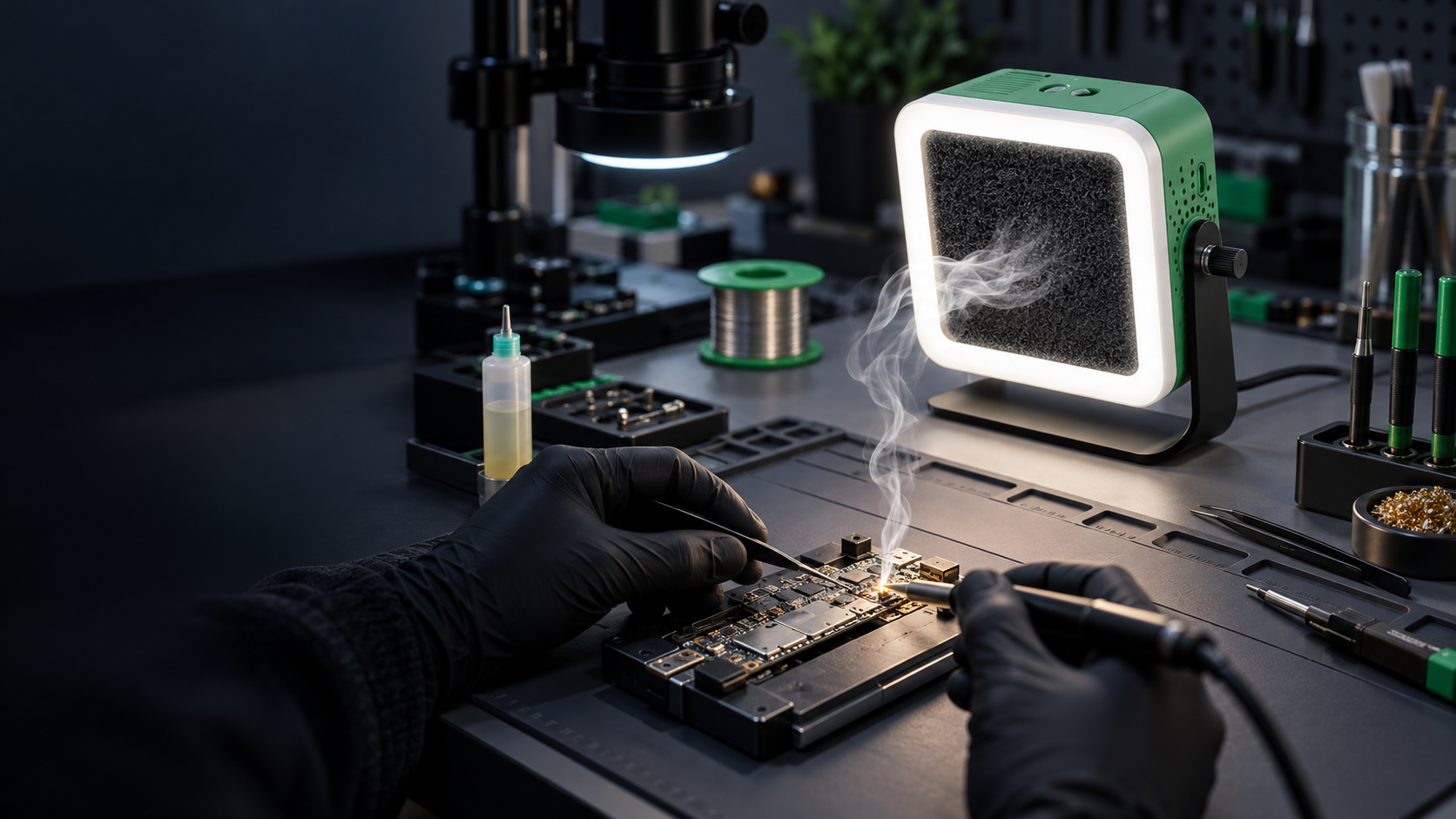
A professional review of the 2UUL Aiolos Fan for phone and electronics repair, covering smoke capture, activated-carbon filtration, task lighting, component cooling, battery convenience and important exposure-control limitations.
Affiliate disclosure and review basis
This independent review contains an affiliate link. Worksite Safety Hub may earn a commission if you make a qualifying purchase through it, at no additional cost to you. Our assessment is based on the supplied marketplace images and visible claims; we have not independently measured the exact unit's airflow, illuminance, acoustic output, filter efficiency, battery runtime or electrical safety.
This article concerns the compact green-and-white 2UUL Aiolos Fan shown for mobile-phone and electronics repair. It combines solder-smoke extraction, component cooling and front work lighting. It is not an air monitor, room air purifier or respiratory-protection product reviewed elsewhere on this site.
Quick verdict
The 2UUL Aiolos Fan is a clever space-saving bench accessory. Its adjustable stand, square intake, replaceable activated-carbon pad, perimeter light and battery-powered portability address three everyday repair-shop needs without adding separate devices around a crowded microscope or soldering mat.
Its usefulness depends on expectations. Positioned close to a small solder joint, it should help draw the visible flux plume away from the technician's breathing zone and may reduce some odour. The supplied images do not establish capture velocity, filtration efficiency, carbon mass, battery endurance or workplace local-exhaust performance. Our verdict is positive for light, intermittent electronics repair as a supplementary control, but it should not be treated as proof that hazardous fume exposure is adequately controlled.
What the Aiolos Fan is designed to do
The listing presents three functions: smoke extraction, cooling and lighting. In extraction mode, the fan pulls air through a front foam-like activated-carbon filter. For cooling, the unit can direct airflow across a circuit board or recently heated component. The bright front border acts as a compact task light when inspecting connectors, pads and fine-pitch components.
The body pivots inside a black U-shaped stand using side knobs, allowing the face to be aimed toward the soldering point or the rear fan toward a workpiece. That adjustability is central to performance: a small extractor is effective only when the plume enters its capture zone before reaching the operator.
- Compact square green-and-white body.
- Front activated-carbon filter pad.
- Rear axial fan and protective grille.
- Illuminated front perimeter for task lighting.
- Adjustable black desk stand with side knobs.
- Built-in rechargeable battery claimed by the listing.
Activated-carbon filter: useful, but not a complete exposure guarantee
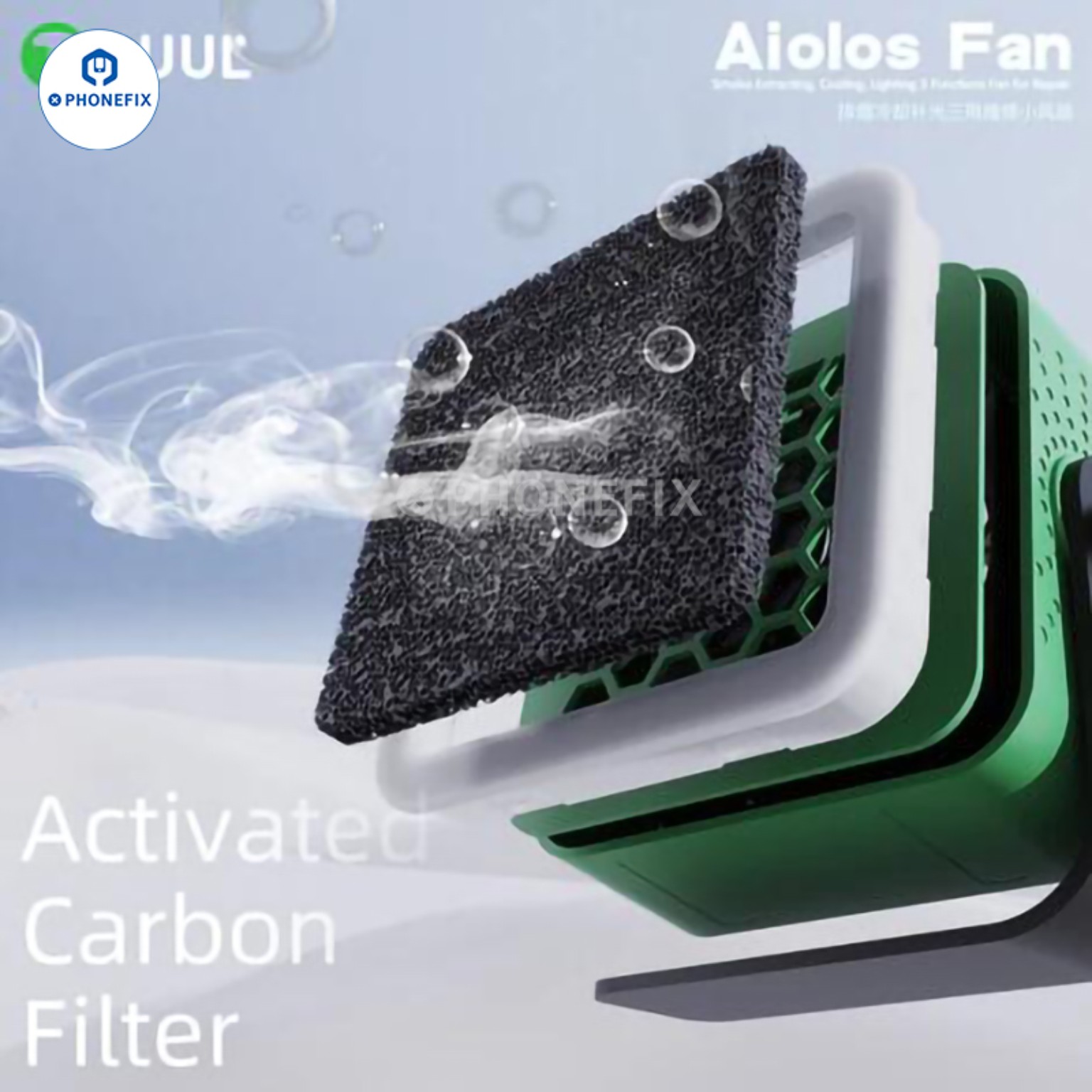
The supplied graphic identifies a removable activated-carbon filter. Carbon can adsorb some vapours and reduce odour, while the pad may collect some aerosol and condensed flux material. However, a thin open-cell pad is not automatically a high-efficiency particle filter, and visible smoke disappearing into it does not prove that every airborne contaminant has been removed.
The listing images do not disclose the filter's test standard, particle efficiency, adsorption capacity, pressure drop or service life. Saturated carbon may continue to look usable while its adsorption performance has declined. Ask the seller for the replacement-pad model, material specification, recommended interval and cost. Replace it sooner if airflow falls, odour breaks through, the pad becomes visibly loaded or the manufacturer's instructions require it.
Why solder-fume control matters
The visible plume during electronics soldering is largely generated by heated flux. HSE identifies rosin-based solder flux fume as an important cause of occupational asthma. Lead-free solder does not mean fume-free work: the flux chemistry, work temperature, task duration and proximity of the technician's face all influence exposure.
The goal is to capture the plume at source before it crosses the breathing zone. Do not lean over the work, blow the plume sideways toward another person or assume that a pleasant smell means low risk. Employers need a substance assessment, effective controls, instruction, maintenance and—where indicated—exposure or health surveillance under the rules that apply to their location.
Placement will determine real-world performance
A small desktop fan loses capture effectiveness quickly with distance. Place the intake close to the joint and slightly behind the work so the natural plume and induced airflow move away from the face. The exact distance should be established by observing the smoke path during normal hand positions without allowing the unit to obstruct the microscope, tools or safe access.
Use a simple smoke visualisation or other suitable check to confirm that the plume consistently enters the filter at the left, centre and right of the working area. Recheck after changing fan angle, speed, bench layout or microscope position. If fume escapes upward or around the pad, move the extractor closer or use a more capable local-exhaust arrangement.
Lighting: a genuinely practical second function
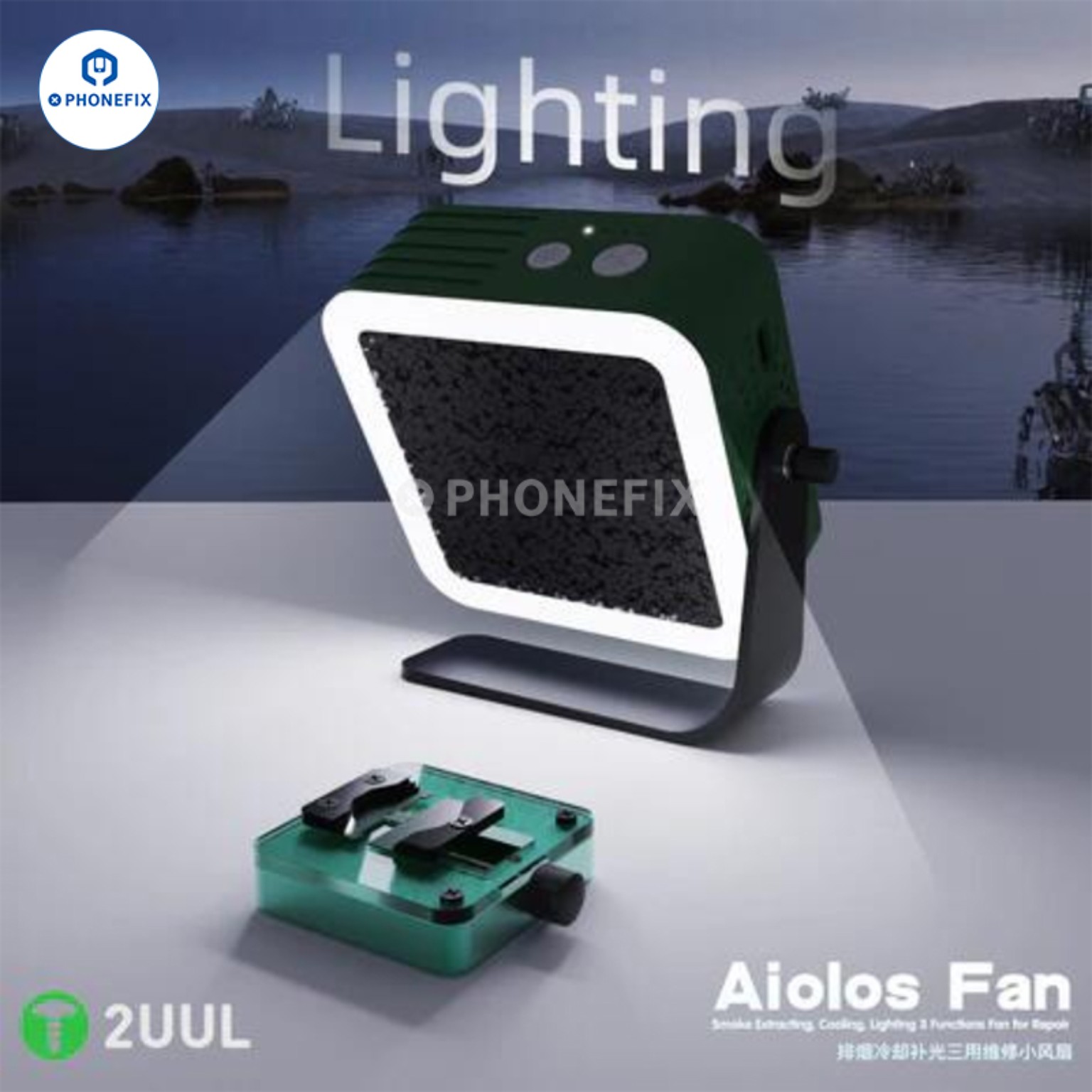
The illuminated front border could be valuable under a microscope or at a crowded bench, especially when an overhead lamp creates hand shadows. A broad ring around the intake should produce more even near-field illumination than a single point source and keeps the light aligned with the extraction direction.
No illuminance, colour-rendering index, colour temperature or flicker specification is visible in the supplied material. Those details matter for colour-coded wires, PCB inspection and long sessions. Treat the light as supplementary until you confirm that it renders colours accurately, does not flicker on camera and can be dimmed or switched independently of the fan.
Cooling mode: helpful for components, not a thermal shortcut
Directed airflow can speed cooling after rework, reduce waiting time before handling and help during some low-power diagnostic tasks. The adjustable stand makes the unit easier to aim at a board than a fixed desk fan.
Cooling must not replace correct soldering temperature, dwell time, heat sinking or component limits. Fast airflow can spread dust, disturb lightweight parts, cool a joint before it forms correctly or conceal an overheating fault without addressing the cause. It may also move flux fumes toward the technician when the unit is reversed. Use cooling only after the smoke-control function is no longer required and keep loose components secured.
Internal design and built-in battery
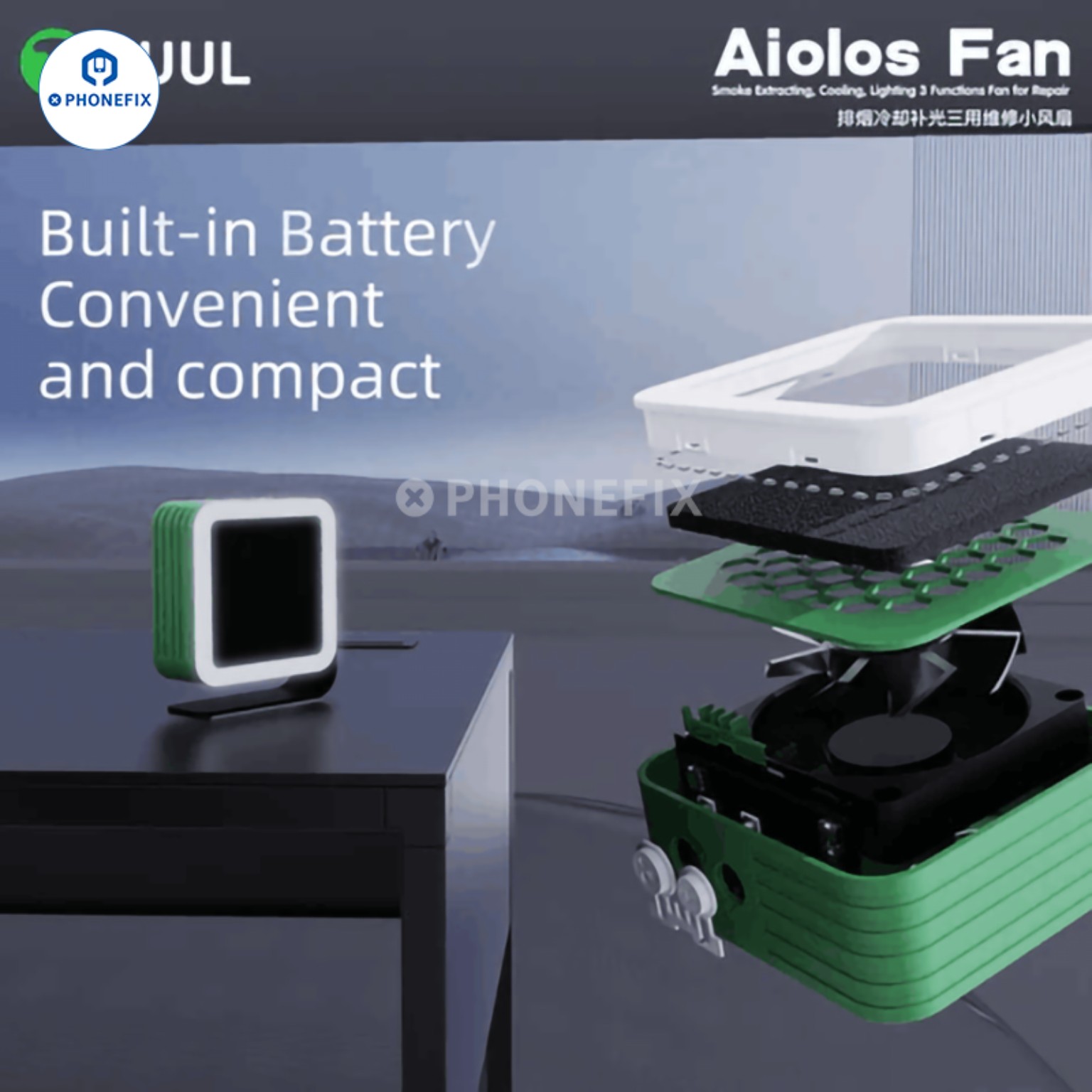
The seller describes a built-in battery and the exploded view appears to show internal cylindrical cells beneath the fan. Cordless operation is convenient around microscopes and hot tools, and it allows the extractor to be placed where the plume is generated rather than where a cable reaches.
The supplied images do not state battery capacity, runtime by fan speed, charging time, input rating, battery-replacement method or protection certifications. Ask whether the fan can operate while charging and whether speed or lighting shortens runtime significantly. Use the supplied or specified charger, keep charging away from flammable materials, inspect for swelling or unusual heat and stop using a damaged unit.
Noise, airflow and stability need verification
No airflow rate, face velocity or sound level is visible in the supplied images. A fan can sound powerful while producing weak capture through a loaded filter. Conversely, high airflow may add enough noise or vibration to become distracting during precision work. Buyers should request measured airflow and noise data—or test the unit immediately after delivery.
The wide stand looks stable, but pulling the adjustment knobs too loose or routing a charging cable across the bench could make the unit shift. Set the angle before bringing a hot iron near it, tighten both sides evenly and keep the base outside the tool path. Ensure the rear intake or exhaust openings remain clear.
ESD and electronics-repair considerations
The listing does not show an electrostatic-discharge rating. For sensitive electronics, place the fan without interrupting the grounded mat, wrist strap or common-point ground. Confirm that the housing, stand and charging arrangement do not introduce an uncontrolled conductive path or charge-generating surface near exposed components.
Air movement can also lift dust, clipped leads and lightweight insulating films. Keep the workstation clean, use parts trays and position the fan so debris is not blown across an open device. Do not allow flux residue or cleaning solvent to enter the battery compartment or controls.
What this fan cannot replace
The Aiolos Fan should not be presented as certified local exhaust ventilation unless the manufacturer supplies the relevant performance and test evidence. It is not a respirator, and its front pad is not a breathing filter. It also does not establish compliance with an occupational exposure limit or guarantee protection from every flux, solvent or cleaning chemical used in repair work.
High-volume production, long daily soldering sessions, multiple operators, lead processing, aggressive fluxes, solvent cleaning, laser work or tasks generating substantial smoke may require a purpose-designed extraction arm, larger filtered unit or externally exhausted LEV system selected by a competent person. General room ventilation remains important but should not be used to justify poor source capture.
Routine filter and unit care
Inspect the front pad before each session and confirm the fan draws air through the entire face. Keep replacement filters in clean sealed storage and record installation dates if the unit is used occupationally. Never wash or vacuum an activated-carbon pad unless the manufacturer specifically permits it; that can damage media and spread captured residue.
Switch the unit off before removing the filter or cleaning the grille. Use a dry or manufacturer-approved method around electronics, and prevent liquid entering the controls, motor or battery. After any repair involving lead solder or hazardous residues, wash hands before eating or touching the face and manage contaminated wipes and debris appropriately.
Who should consider it?
The strongest fit is a hobbyist, phone technician or occasional electronics-repairer who wants a compact first-line plume catcher, supplementary bench light and gentle cooler in one footprint. It is especially attractive where a large ducted extractor is impractical and work is brief, localised and performed one joint at a time.
Professional workshops should consider it only after confirming that it controls the assessed task in real working positions. Where capture is inconsistent, filters load rapidly or several stations operate together, move to a documented extraction system rather than adding more small recirculating fans.
Pre-purchase checklist
Marketplace specifications and bundles can change. Confirm the exact selected option and obtain a current manual before payment.
- Airflow rate or face velocity with a clean filter installed.
- Number of fan speeds and whether lighting is independently controlled.
- Battery capacity, runtime, charge time and charging input.
- Filter material, efficiency, carbon quantity and replacement interval.
- Availability and price of genuine replacement pads.
- Noise level and vibration at each speed.
- Dimensions, weight and full adjustment range.
- Electrical-safety, battery and ESD information.
- Included cable, charger or power adapter.
- Warranty, returns and spare-parts support.
Final assessment
The 2UUL Aiolos Fan is thoughtfully shaped for the realities of small-device repair: bench space is limited, the work is visually demanding, components are heat-sensitive and the flux plume rises directly toward the technician. Combining extraction, lighting and cooling in one adjustable unit is genuinely useful.
The limitation is evidence. The photographs demonstrate features, not exposure-control performance. Buy it as a compact bench aid, position it close, verify the capture pattern and replace the carbon pad proactively. For frequent or safety-critical occupational use, assess the fumes and confirm performance—or choose a documented LEV solution with known airflow and filtration.
Confirm the exact model, specification, certification evidence, shipping terms and current price before ordering.
Sources
- AliExpress — 2UUL Aiolos three-function repair fan listingPublished Product listing; accessed 21 September 2026
- HSE — Solderer: rosin-based solder flux fume controlsPublished Current occupational-health guidance; accessed 21 September 2026
- HSE — COSHH: controlling substances hazardous to healthPublished Current guidance; accessed 21 September 2026
- MIT EHS — Soldering Safety and Health GuidelinesPublished EHS guidance; accessed 21 September 2026
Daily HSSE updates
Subscribe for practical HSSE updates.
Subscribe for the daily message, selected HSSE news and occasional new-resource alerts from Worksite Safety Hub.