Health · Product Reviews · 11 min read
Color-Screen Digital Sound Level Meter Review: Useful Noise Logger or Compliance Tool?
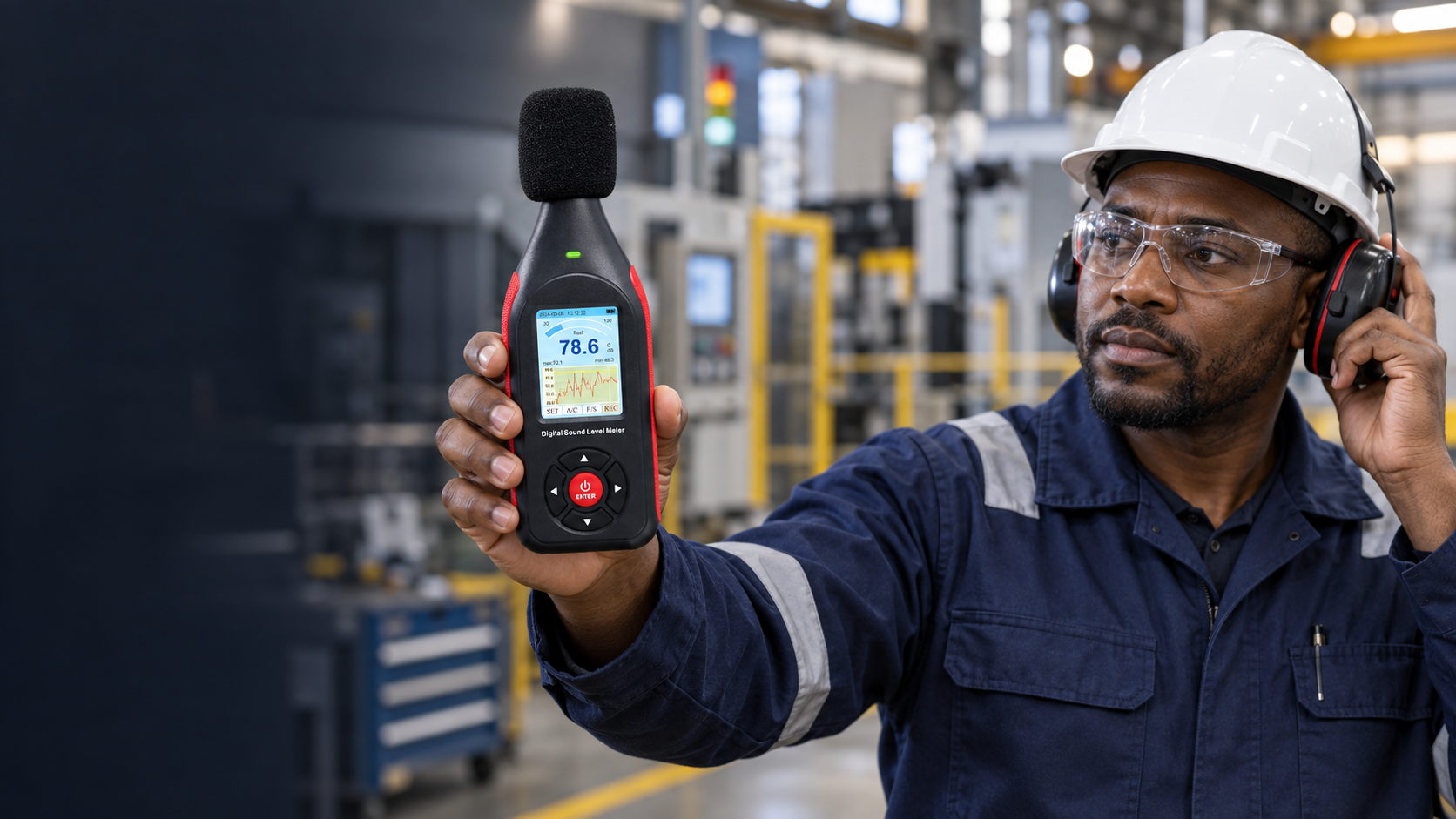
A professional review of the black-and-red digital sound level meter with A/C weighting, Fast/Slow response, 43,000-record logging, alarm indicators and USB PC analysis.
Affiliate disclosure and review basis
This independent review contains an affiliate link. Worksite Safety Hub may earn a commission if you make a qualifying purchase through it, at no additional cost to you. Our assessment is based on the supplied listing images and seller claims; we have not independently calibrated, laboratory-tested or field-verified the exact meter.
This product is a black-and-red handheld sound level meter with a foam-covered microphone, colour trend display, A/C frequency weighting, Fast/Slow time weighting, internal logging and USB PC connectivity. It is not any of the gas detectors, electrical test instruments or personal air monitors reviewed earlier on this site.
Quick verdict
The meter offers an unusually strong feature set for its apparent price class: a readable live graph, minimum and maximum values, A and C weighting, Fast and Slow response, configurable visual alarms, up to 43,000 advertised records, PC download, tripod mounting and an AC/DC signal-output socket. Those functions make it attractive for preliminary workplace surveys, machinery comparisons, community-noise checks, training and troubleshooting.
The decisive limitation is evidence. The supplied material advertises ±1.5 dB accuracy but does not show a model number, IEC 61672 Class 1 or Class 2 designation, calibration certificate or third-party approval. Our verdict is positive for screening and trend logging, but conditional for occupational compliance: only use it for formal exposure decisions when the exact instrument, calibrator, method and traceability satisfy the applicable standard and your competent noise assessor's procedure.
What this instrument measures
A sound level meter converts microphone pressure into a decibel reading. The rear label shown in the listing advertises 30–130 dB(A), 35–130 dB(C), 0.1 dB resolution, ±1.5 dB accuracy and a frequency response of 31.5 Hz to 8.5 kHz. These are seller specifications, not independently verified performance data.
A single instantaneous dB value is not the same as a worker's daily noise exposure. Occupational assessment may require time-averaged levels, task durations, exchange rate, criterion level, threshold and peak measurements defined by the applicable regulation. This device appears to be a sound level meter and logger, not a wearable personal noise dosimeter.
- Advertised A-weighted range: 30–130 dB(A).
- Advertised C-weighted range: 35–130 dB(C).
- Advertised resolution: 0.1 dB.
- Advertised accuracy: ±1.5 dB; conditions and class are not shown.
- Advertised frequency response: 31.5 Hz–8.5 kHz.
- Real-time display with maximum, minimum and trend graph.
Controls, microphone and physical design
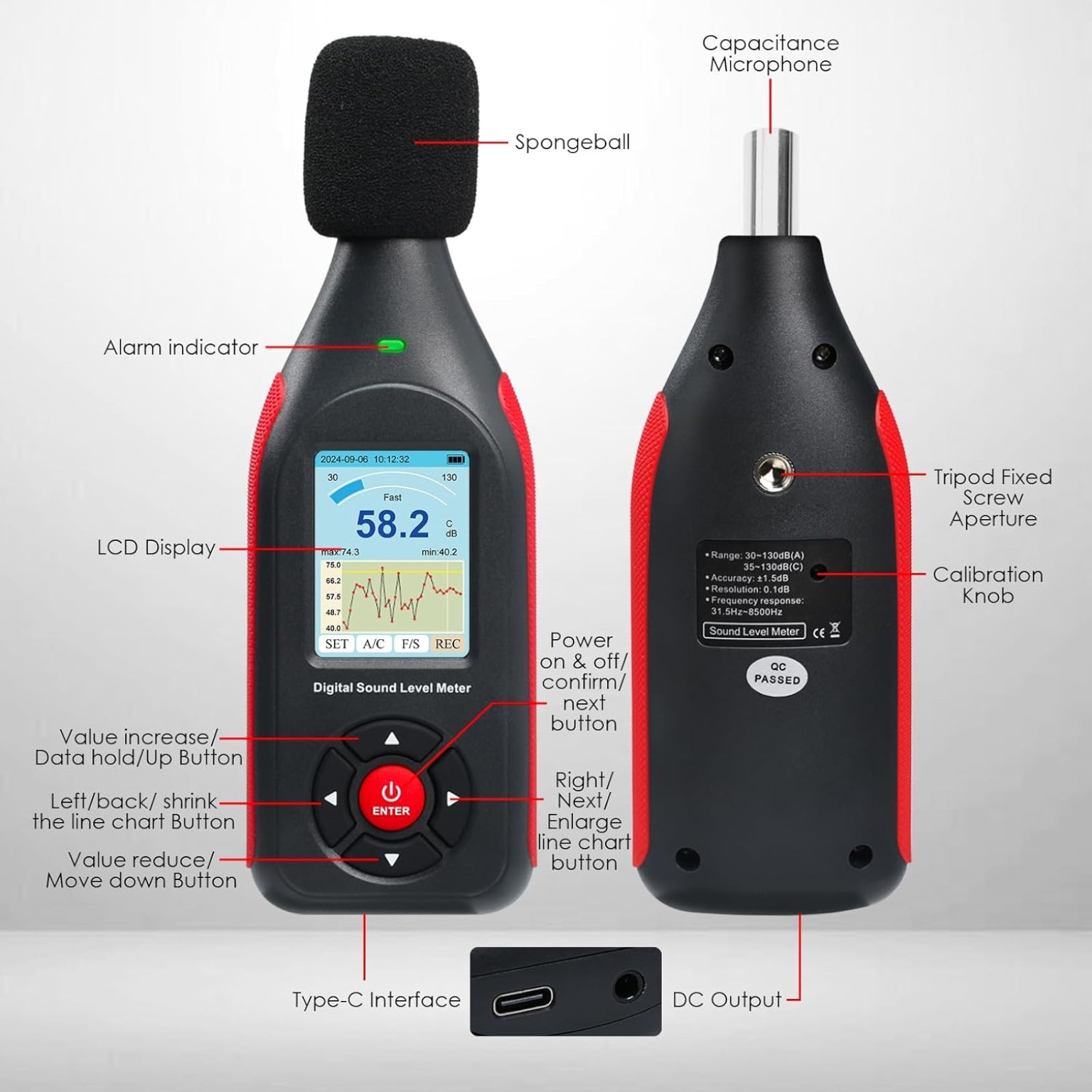
The top-mounted condenser microphone is protected by a removable foam windscreen, while the tapered body and red side grips support one-handed use. The circular navigation pad provides menu control, hold, graph scaling and value adjustment around the central power/enter button. A tripod socket is valuable for repeatable unattended logging because it reduces handling noise and keeps the microphone position fixed.
The USB-C interface is advertised for power and PC communication. A separate 3.5 mm-style socket is labelled DC output, and the rear panel shows a calibration adjustment point. That adjustment should be used only under the manufacturer's documented procedure with a compatible acoustic calibrator; turning it casually can invalidate every subsequent reading.
A weighting versus C weighting
A weighting reduces the contribution of very low and very high frequencies to approximate human hearing sensitivity at common occupational levels. It is widely used for general environmental and workplace noise measurements and is normally displayed as dB(A). C weighting is flatter across much of the audible range and retains more low-frequency energy; it is useful for evaluating high-level or low-frequency-rich noise and for comparing LC and LA values.
The listing's phrase that C weighting is for engine sound-pressure analysis is an oversimplification. Weighting selection must follow the measurement objective and applicable method. A and C readings are not interchangeable, and neither by itself is a frequency-band analysis. If octave-band information is needed for engineering controls or hearing-protection selection, use an instrument that explicitly supports that analysis.
Fast and Slow time weighting
The meter advertises Fast sampling at eight updates per second and Slow at one update per second. Display-update rate is not necessarily identical to the standardized exponential time weighting, so buyers should confirm that the settings conform to the intended measurement standard.
Fast response helps show changing or intermittent noise, while Slow steadies the display for relatively constant conditions. Neither captures true impulse peak unless the meter provides a compliant Peak function with suitable dynamic range. Use the time weighting specified by the survey procedure and record it with every result.
Data logging and PC analysis
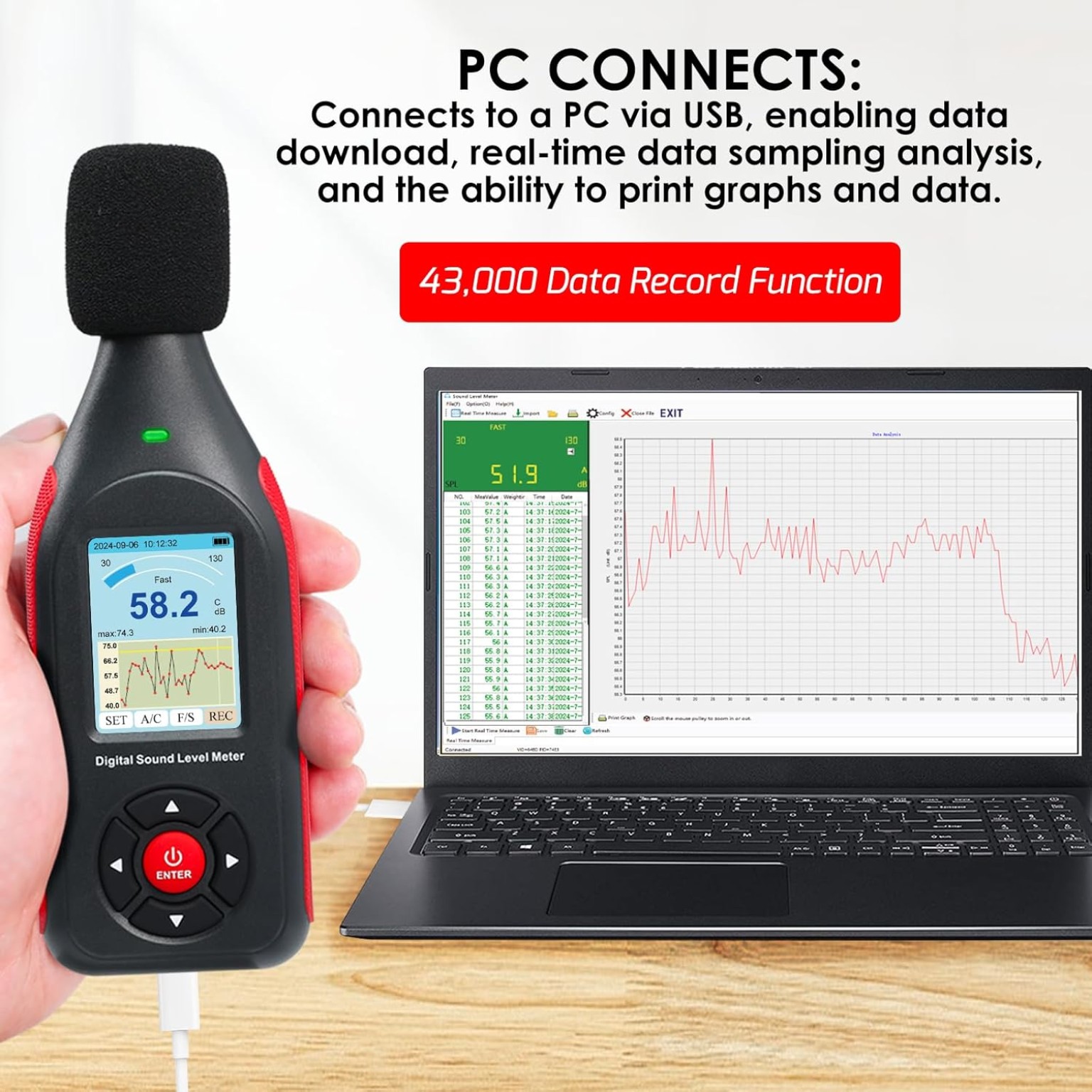
The standout feature is the advertised capacity for 43,000 records. The listing also shows Windows-style PC software for real-time sampling, data download, graphing and printing. This could make the meter useful for documenting noise changes during a shift, comparing machinery before and after maintenance, or demonstrating the effect of an engineering control.
Ask whether records include date, time, weighting, response setting, interval, minimum and maximum values; whether data can be exported as CSV; and which Windows versions and USB drivers are supported. Confirm whether the software is digitally signed and supplied from a trustworthy source. A graph is evidence only when the instrument identity, calibration status, settings, microphone position and operating conditions are documented.
- Confirm the 43,000-record capacity for the exact variant.
- Check adjustable logging interval and memory-full behaviour.
- Verify live sampling versus stored-data download.
- Confirm CSV or other open export format.
- Check operating-system and driver compatibility.
- Record instrument serial number and calibration status with each dataset.
Alarm indicators are helpful—but not exposure alarms
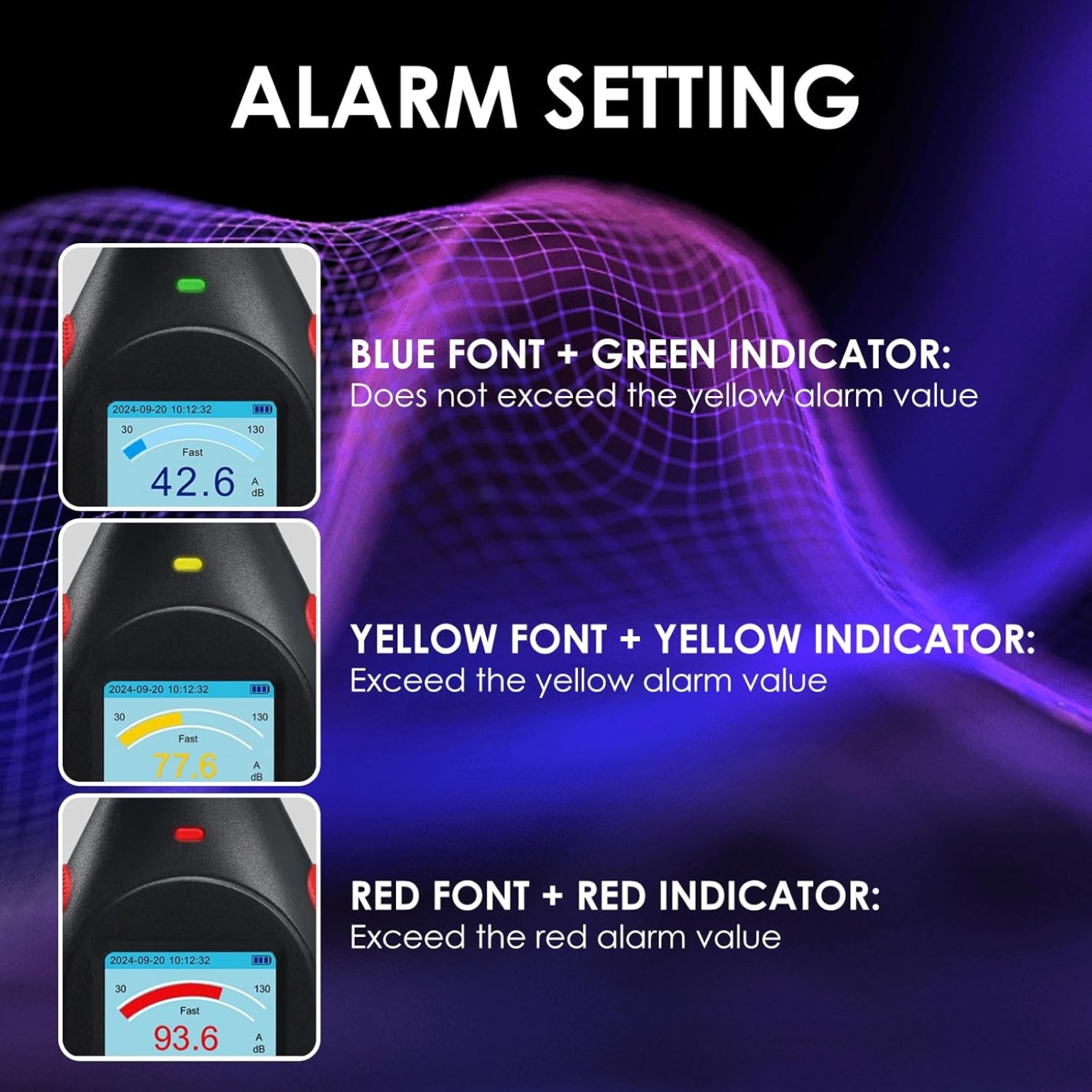
The meter uses a coloured screen segment and front indicator LED to show normal, caution and high states. Adjustable thresholds can help operators see when a machine, room or event exceeds a local screening level without watching the digits continuously.
Noise risk depends on both level and duration. A momentary red indication does not calculate daily dose, while a green instantaneous reading does not prove that an eight-hour exposure is acceptable. Set alarm values through a competent noise-management plan, lock or record the settings and avoid presenting the colours as regulatory pass/fail results.
Calibration and field checks
A credible survey begins and ends with an acoustic field check using a compatible calibrator that produces a known level at the microphone. The calibrator must fit the microphone correctly, have suitable accuracy and hold current traceable calibration. Record the pre- and post-measurement results and apply the procedure's drift acceptance criterion.
The listing image shows a rear calibration control but no calibrator in the pictured package. Before buying, obtain the manual, nominal microphone diameter, required calibrator level and frequency, adjustment procedure and recommended laboratory-calibration interval. A device that cannot be checked with traceable equipment should not drive compliance, hearing-protection or enforcement decisions.
How to obtain a defensible reading
Mount or hold the microphone at the measurement position defined by the survey plan, away from the operator's body and reflective surfaces unless the method specifies otherwise. Fit the windscreen outdoors or where air movement can disturb the microphone, aim the instrument according to its free-field or random-incidence design, and note nearby operating conditions.
Select the correct range, A or C weighting and Fast or Slow response before logging. Avoid speaking, touching the body or moving the meter during a reading. Document equipment state, task, distance, duration, weather or ventilation conditions and unusual events. Repeat measurements when conditions vary and use a personal dosimeter when exposure changes with the worker's movement and tasks.
- Check calibration before and after the survey.
- Use a tripod where practical for fixed-position monitoring.
- Keep microphone position and orientation consistent.
- Document weighting, response, range and logging interval.
- Measure representative operating conditions—not an unusually quiet moment.
- Use dosimetry for mobile workers or variable full-shift exposure.
Package contents and power
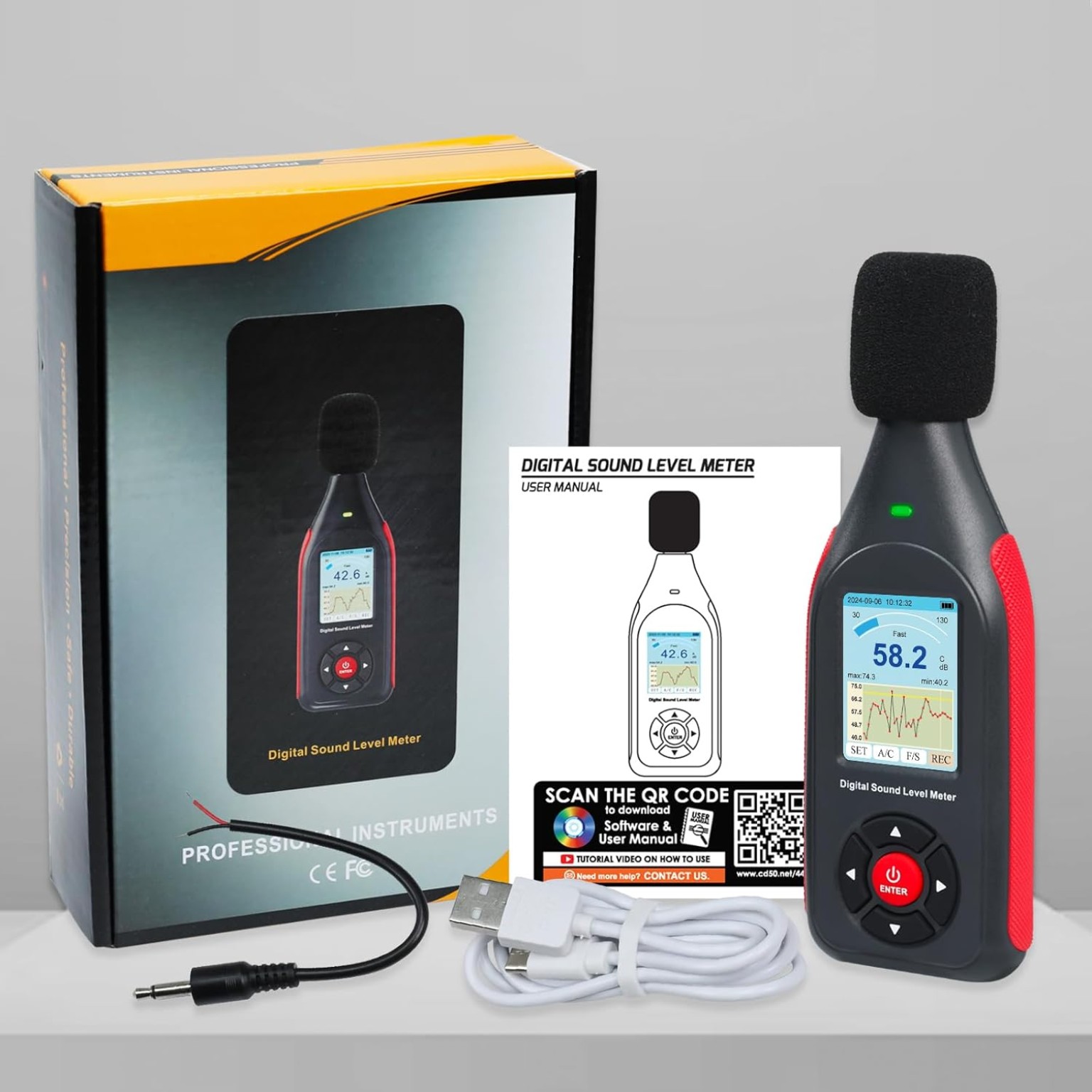
The seller's package image shows the meter, foam windscreen, USB cable, 3.5 mm output lead, box and documentation card. Confirm whether the battery is internal or replaceable, charging time, operating runtime, low-battery behaviour and whether logging continues while powered through USB.
A tripod, acoustic calibrator and certified calibration report are not shown. Those items may cost more than the meter but are essential to a professional measurement system. Confirm the selected bundle at checkout because accessories and software availability can vary by option or region.
Who should consider it?
This meter may be useful to maintenance teams, educators, musicians, facility managers, event staff, community-noise investigators and safety practitioners who need preliminary measurements, before-and-after comparisons or unattended trend records. The colour interface and PC logging make it more informative than a basic one-number meter.
Choose a verified IEC 61672 Class 1 or Class 2 instrument from an established calibration ecosystem when measurements support statutory compliance, enforcement, engineering design, legal disputes or occupational exposure decisions. Choose a compliant personal dosimeter when the aim is individual shift exposure, and a frequency analyser when control design requires octave or one-third-octave data.
Buyer checklist
The listing does not visibly identify a model or performance class, so obtain written answers for the exact unit before purchase. A generic CE or FCC mark is not proof of acoustic performance.
- Manufacturer and exact model number on the unit, box and manual.
- IEC 61672 performance class and complete declaration or test report.
- Measurement ranges, dynamic range, linearity, frequency range and Peak capability.
- Compatible acoustic calibrator and traceable calibration route.
- Logging interval, record fields, export format and memory behaviour.
- PC software source, supported operating systems and driver requirements.
- Battery type, runtime, USB-power behaviour and warranty.
- Tripod, carrying case, windscreen and output lead inclusions.
Final assessment
This color-screen digital sound level meter combines a clear interface with useful measurement controls, threshold indicators, substantial advertised memory and PC connectivity. For comparing equipment, teaching noise concepts and collecting preliminary trends, it appears more capable than many entry-level handheld meters.
Its professional value remains conditional on traceability. The ±1.5 dB claim, graph and record count do not establish an IEC performance class or a defensible occupational survey by themselves. Buy it as a feature-rich screening logger unless the seller can prove the exact model's class, calibration and software support; for compliance work, verified instrumentation and competent measurement practice must take priority over price.
Confirm the exact model, specification, certification evidence, shipping terms and current price before ordering.
Sources
- AliExpress — Color-screen digital sound level meter listingPublished Product listing; accessed 20 September 2026
- OSHA — Occupational Noise Exposure, 29 CFR 1910.95Published Current standard; accessed 20 September 2026
- OSHA Technical Manual — NoisePublished Current technical guidance; accessed 20 September 2026
- NIOSH — Criteria for a Recommended Standard: Occupational Noise ExposurePublished Current reference; accessed 20 September 2026
Daily HSSE updates
Subscribe for practical HSSE updates.
Subscribe for the daily message, selected HSSE news and occasional new-resource alerts from Worksite Safety Hub.