Health · 7 min read
A Clean Kitchen Cannot Fix a Contaminated Supply Chain: Food-Safety Lessons for Workplace Catering
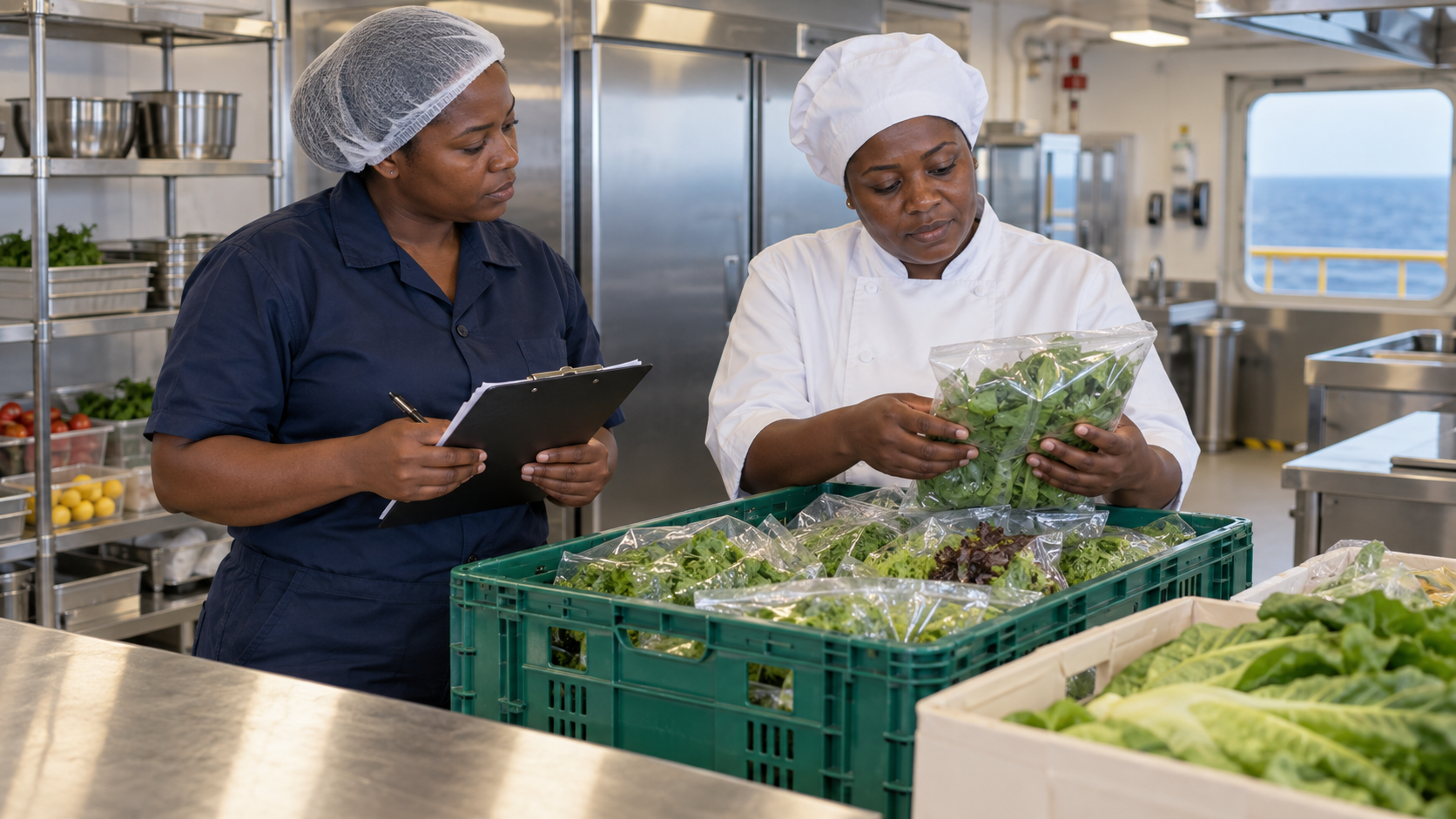
The FDA’s September Cyclospora alert puts supplier assurance in the spotlight. Workplace canteens, offshore galleys and camp kitchens need controls that start before fresh produce reaches the door.
The hazard may arrive before the chef starts work
A well-run galley can have polished counters, clean uniforms and a completed hygiene checklist—and still receive an ingredient whose safety has already been compromised. Fresh produce passes through growing, harvesting, packing, processing and transport before anyone prepares a meal. The kitchen is one link in that chain.
For an offshore crew or a remote construction camp, shared meals create a shared exposure. Our practical lesson from the FDA alert is to connect procurement, catering, occupational health and HSSE assurance. Food safety belongs in operational planning as well as kitchen inspections.
What the FDA has confirmed—and what remains unresolved
On 11 September 2026, the FDA issued a prevention letter to the produce supply chain. Its response update reports 19,595 laboratory-confirmed U.S. cyclosporiasis cases through 8 September, including more than 12,000 linked to an iceberg-lettuce outbreak associated with Taylor Farms de Mexico. The total covers multiple investigations; it is not the case count for one outbreak.
CDC declared the lettuce outbreak over on 11 September. FDA continues investigating its root cause and other outbreak clusters. An outbreak ending does not mean the contamination mechanism has been established. These U.S. reports do not establish that produce supplied to any particular Nigerian workplace was affected.
Why washing is an incomplete barrier
Cyclospora is a microscopic parasite acquired through contaminated food or water. FDA says rinsing may not reliably remove it, standard chlorine-based sanitizers may be ineffective, and commercial pre-washing may be insufficient. It advises against washing produce with soap or bleach. Routine hand hygiene and cleaning remain necessary.
This is a reason to strengthen upstream prevention, not to abandon kitchen hygiene. A delivery that looks fresh or carries a “pre-washed” label still needs an assured source. Refrigeration, visual inspection and tidy storage serve useful purposes, but teams should not treat them as proof that this parasite has been removed.
What the industry letter changes
The letter reinforces existing U.S. requirements on agricultural water, worker health and hygiene, sanitation and effective supplier programs, including foreign supplier verification where applicable. It calls for stronger implementation and collaboration; it is not a newly enacted regulation. FDA connects prevention with human health, sanitation, water quality and environmental conditions.
Workplaces elsewhere should apply relevant local requirements and use the alert to challenge their own assurance. The questions below are Worksite Safety Hub’s recommended review actions, not findings about the outbreak’s cause or a claim that every U.S. requirement applies worldwide.
Supplier assurance: ask for evidence behind the certificate
A supplier certificate is a starting point for discussion. The more useful question is whether the supplier can explain how its produce is grown, handled and traced, and what happens when a control fails. Procurement should understand which assurances come from the grower and which come from a distributor.
Apply the depth of review according to product risk, supply-chain complexity and the vulnerability of the people being served. Record gaps, agree corrective actions and make acceptance decisions through the organisation’s food-safety process.
- Identify the grower, packing or processing facility and distributors for higher-risk fresh produce.
- Review evidence for water-quality management, sanitation and worker-hygiene controls at relevant stages.
- Confirm how lot identities survive repacking, transport and delivery to the caterer.
- Ask how supplier changes, adverse findings and recalls are communicated to buyers.
- Assign a procurement owner who can obtain traceability information promptly, including outside office hours.
At the receiving door: preserve the trail
Traceability can fail when packaging is discarded, ingredients are decanted into unlabelled tubs, or several deliveries are combined without a record. A kitchen may then know who delivered the lettuce but be unable to identify which lot was served.
Build receiving checks around a recoverable record: product, supplier, lot or batch information where provided, delivery date and storage location. Link ingredients to preparation or service records using a proportionate system. Make it easy for a relief chef or night-shift team to follow the same trail.
- Keep identifying labels or reliable copies before discarding outer packaging.
- Segregate deliveries with missing or inconsistent information pending an acceptance decision.
- Check relevant regulator and supplier recall notices against actual stock identifiers.
- Mark and secure stock placed on hold so it cannot return to service accidentally.
When an alert arrives: stop serving, then reconcile
If a recall or credible notice identifies an ingredient held on site, follow that notice and the catering incident procedure. Notify the catering lead and responsible health or HSSE contact, secure affected stock, and review whether it has already been prepared or served. Do not assume that another wash makes recalled produce suitable for use.
Trace both remaining stock and meals already distributed. Preserve delivery and preparation records, record the decisions taken, and coordinate supplier return or disposal under the applicable instructions. If workers report illness, occupational health should guide assessment and any required public-health notification while protecting personal medical information.
Protect food handlers and the workforce
FDA identifies watery diarrhoea, abdominal symptoms and fatigue among the signs of cyclosporiasis; illness often begins about a week after exposure. It advises that people with vomiting or diarrhoea should not handle food and that suspected illness warrants medical advice. Diagnosis and treatment belong with a healthcare professional.
Make reporting practical and free from pressure to work through illness. Catering supervisors need an agreed route for arranging cover, restricting food handling and obtaining clearance under local policy. In remote operations, confirm how workers can access clinical assessment without waiting for their next routine trip ashore.
A realistic drill for your next catering review
Use a tabletop scenario: a supplier calls during the evening shift about a specific produce lot delivered three days earlier. Some stock remains, some has been used in mixed salads, and the usual procurement contact is unavailable. Ask the team to work through the first decisions using its real records.
Test whether the team can identify stock, stop further use, trace meals, reach decision-makers and inform the health team. Measure the time taken and the information missing. Close the gaps before the next exercise rather than judging success by whether the procedure exists.
- Can we identify the affected lot without relying on one person’s memory?
- Can we trace ingredients after repacking or preparation?
- Who decides when held stock may be released or disposed of?
- Can the night shift contact the supplier and occupational-health support?
- What evidence would reassure us that the supply-chain control is working?
The leadership question
A clean kitchen is a visible achievement. An assured food supply is harder to see, but just as necessary. At the next catering assurance visit, pair the hygiene walkthrough with a traceability demonstration and a supplier-control review.
Ask: “If today’s salad ingredient were recalled tonight, could we identify its source, secure every remaining portion and determine where it was served?” The answer reveals whether food-safety assurance reaches beyond the kitchen door.
Sources
- FDA — Post-outbreak response: multistate Cyclospora illnessesPublished September 2026; accessed 13 September 2026
- FDA — Letter to industry on preventing future Cyclospora outbreaksPublished 11 September 2026
- FDA — Cyclospora: prevention and food-service guidancePublished Current guidance; accessed 13 September 2026
Daily HSSE updates
Subscribe for practical HSSE updates.
Subscribe for the daily message, selected HSSE news and occasional new-resource alerts from Worksite Safety Hub.