Health · Product Reviews · 12 min read
6200-Style Half-Face Dust Respirator Review: Practical Particle Protection or Unverified Look-Alike?

A professional safety review of this grey 6200-style reusable half-mask kit with 5N11CN filter pads, 501 covers and 503 adapters, including fit, certification, filtration limits and buyer checks.
Affiliate disclosure and review basis
This independent review contains an affiliate link. Worksite Safety Hub may earn a commission if you make a qualifying purchase through it, at no additional cost to you. Our assessment is based on the supplied marketplace images and visible seller claims; we have not laboratory-tested, fit-tested or authenticated the exact facepiece, filters, adapters or retainers.
This article concerns the grey 6200-style reusable half-face respirator kit shown with white 5N11CN particulate pads, 501-style covers and 503-style adapters. It is not the black full-face respirator reviewed earlier. The use of familiar model numbers and a visually similar bayonet connection does not establish that this product was made or approved by any well-known respirator manufacturer.
Quick verdict
The concept is useful: a compact reusable half mask, two filter mounts, replaceable particulate pads, an adjustable harness and a downward-facing exhalation valve. For sanding, woodworking and other particle-generating tasks, a properly approved and correctly fitted half mask can be more comfortable and economical than disposable respirators.
The listing creates a serious verification question. The supplied pad is marked 5N11CN and references Chinese standards, while the facepiece is described with 6200-style component numbers. Nothing in the images proves a NIOSH-approved configuration or genuine compatibility with another manufacturer's system. Our verdict is therefore conditional: attractive as a low-cost kit, but unsuitable for occupational exposure until the exact manufacturer, approval, complete configuration and fit are independently verified.
What the kit appears to contain
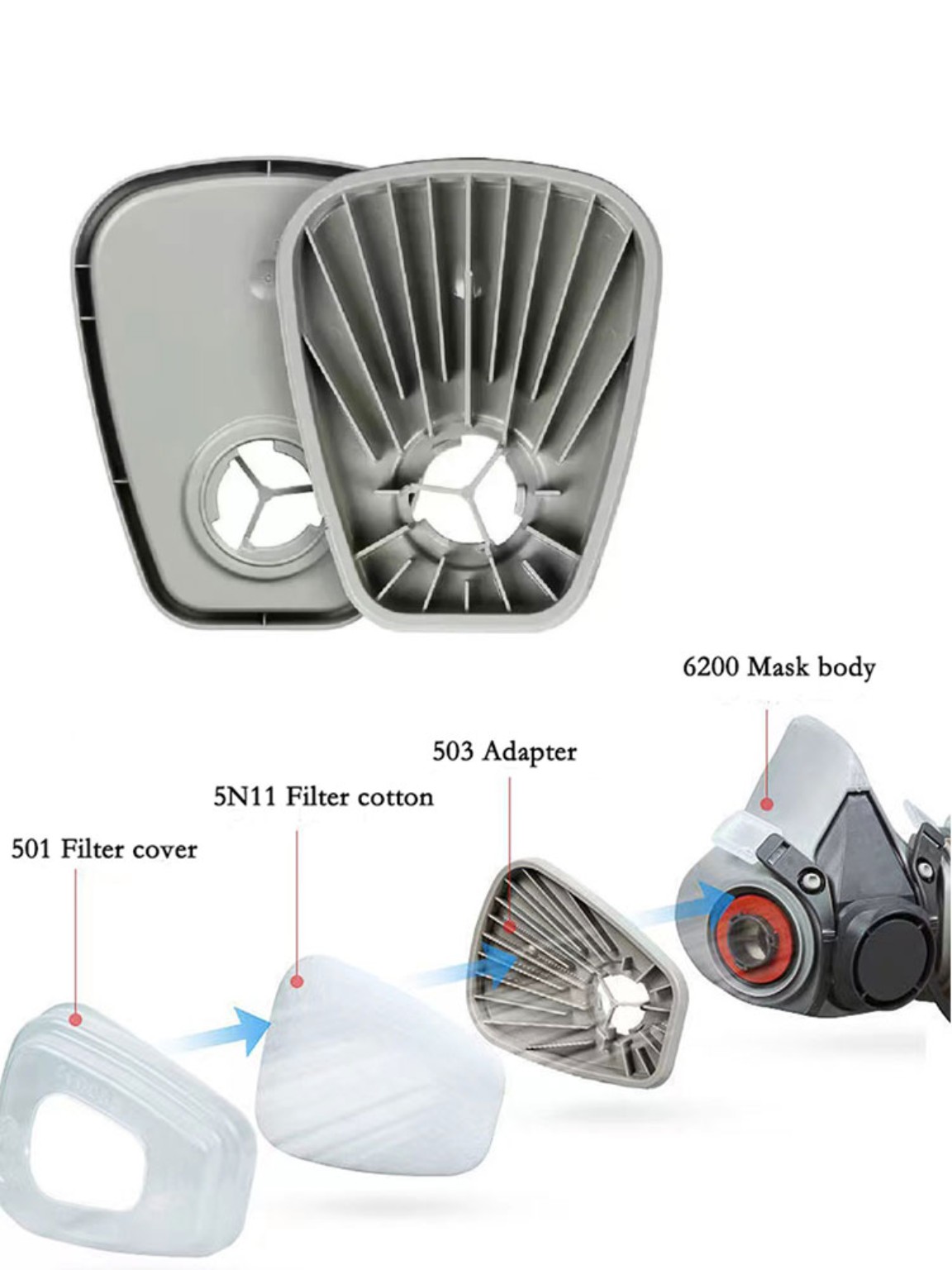
The seller's exploded image identifies a 6200 mask body, 503 adapter, 5N11 filter cotton and 501 filter cover. Two identical filter assemblies are normally required—one on each side—to keep breathing resistance balanced. The checkout option may contain only pads, only retainers or the complete facepiece kit, so the selected bundle matters.
The facepiece appears to use a soft grey sealing body, a twin-strap harness, two side bayonet-style ports, inhalation valves and a central exhalation-valve cover. Those are functional design features, not proof of performance. Before purchase, ask for one photograph showing every supplied component, its packaging and its permanent markings.
- Grey reusable half-facepiece.
- Two side filter connections.
- Two 503-style pad adapters.
- Two 5N11CN particulate filter pads.
- Two translucent 501-style retaining covers.
- Head cradle, upper straps and lower neck strap.
The 5N11CN pad is a particle filter—not a gas cartridge
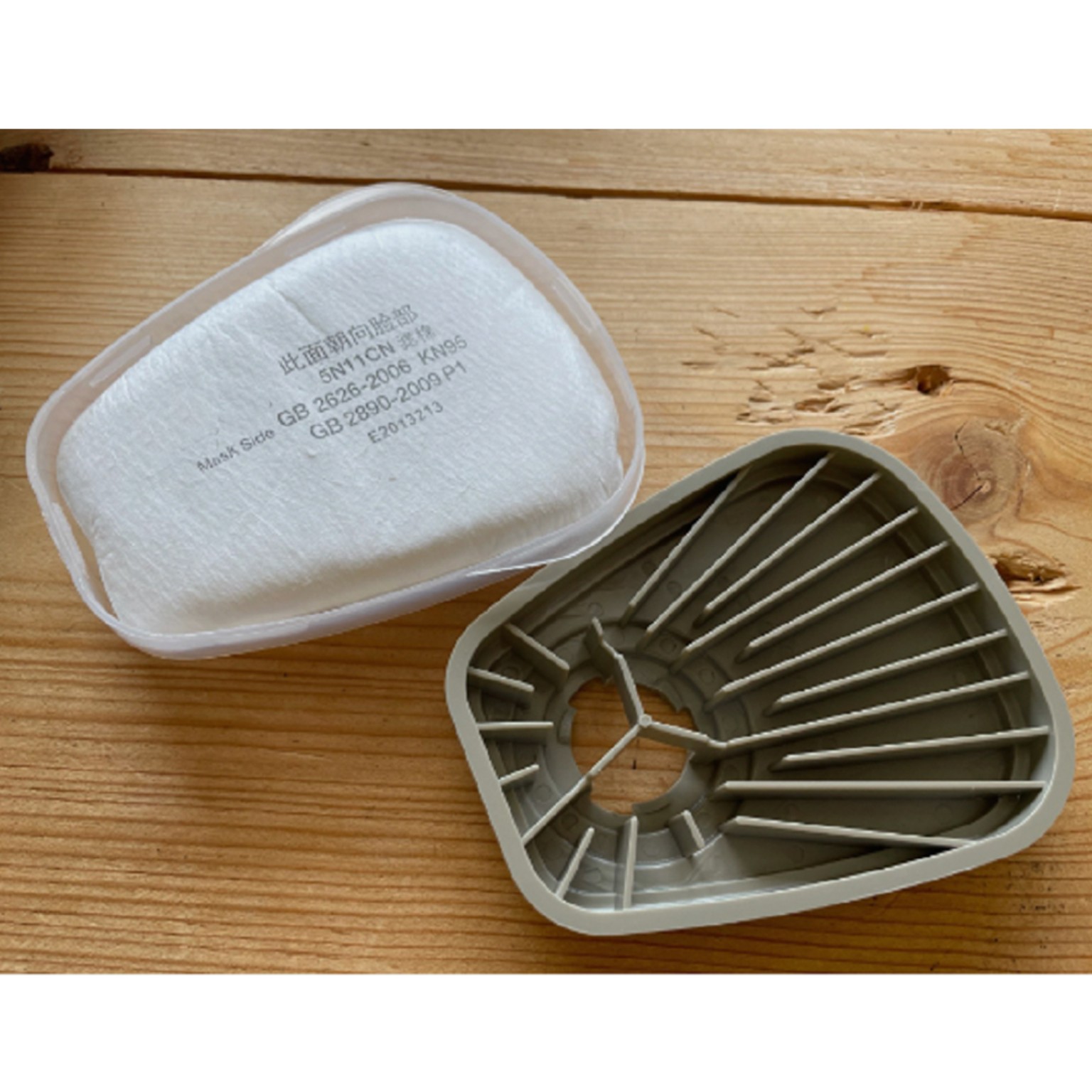
The pad image carries the text “5N11CN” and references GB 2626-2006 KN95 and GB 2890-2009 P1. That is not the same as a NIOSH N95 approval. A legitimate approval claim should be traceable to the responsible manufacturer, product model, applicable standard and test or certification documents for the exact product delivered.
A nonwoven particulate pad may reduce certain airborne particles when installed correctly and used within its rating. It does not adsorb organic vapours, acid gases, carbon monoxide or unknown chemicals. The seller's “dustproof cotton” language and graphics mentioning PM10, PM2.5 and PM0.3 do not establish suitability for every aerosol, nor do they identify a workplace protection factor.
Bayonet fit does not prove approved compatibility
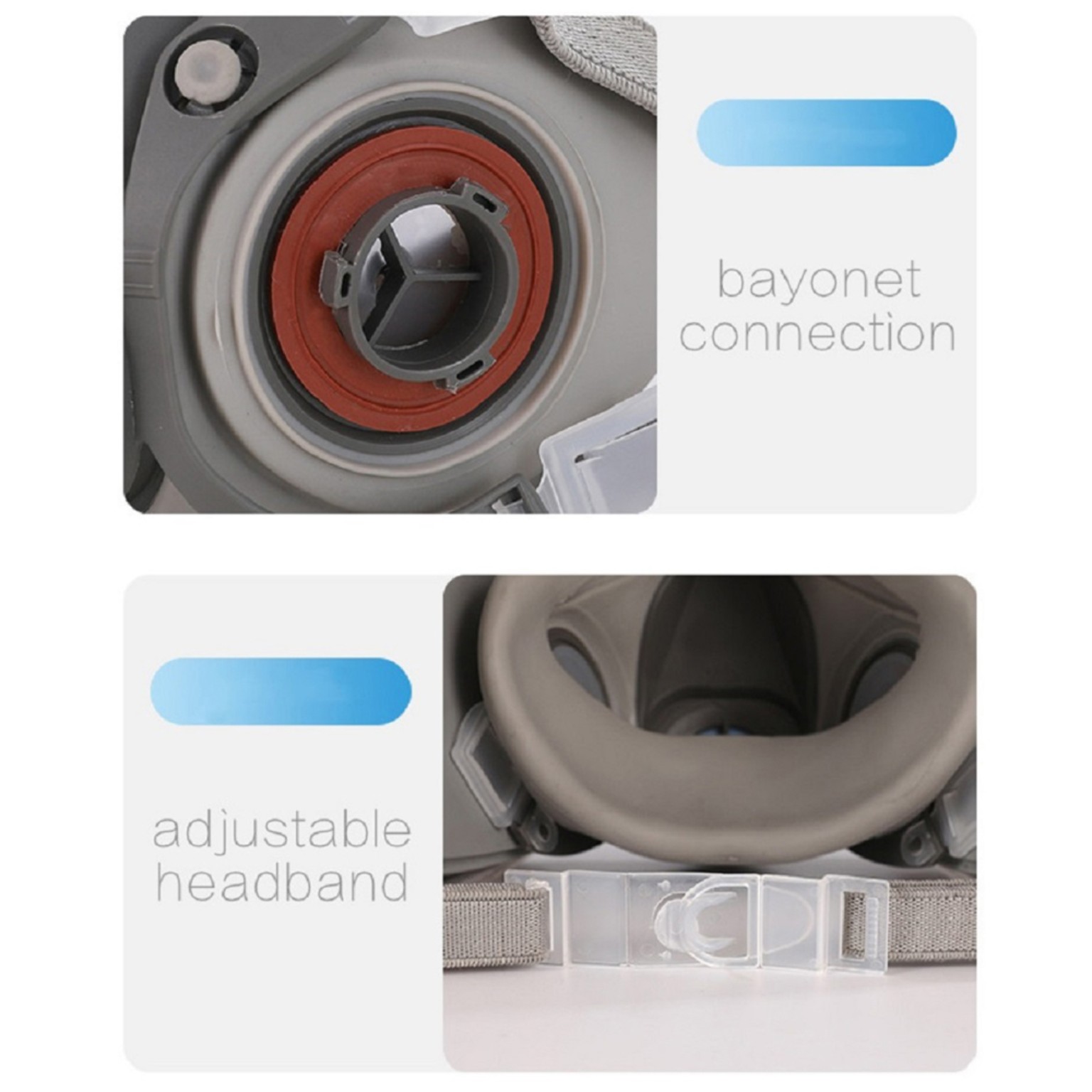
The side connection is marketed as a bayonet design. It resembles connections used by established respirator systems, but appearance and mechanical engagement do not prove that dimensions, valve flow, seals, materials or quality controls are equivalent. Mixing an unverified facepiece with branded filters—or the reverse—can invalidate approval and create leakage.
In the United States, NIOSH approval applies to the complete respirator configuration listed under a specific TC approval number. Verify the facepiece, adapters, retainers and filters together in the Certified Equipment List. In other markets, use the relevant national approval database and obtain the declaration, certificate, manufacturer and model-specific instructions. A stand-alone material test is not enough.
Fit and seal are as important as filter efficiency
A high-efficiency pad cannot protect a wearer if contaminated air leaks around the nose, cheeks or chin. A tight-fitting workplace respirator requires the correct size, medical evaluation and fit test before use under OSHA's respiratory-protection rule, with repeat testing as required. The wearer must also complete the manufacturer's user seal check every time the mask is donned.
The two-strap harness should position the facepiece evenly without folding the seal or forcing the mask upward. Facial hair, stubble, jewellery, hair, head coverings and eyewear must not cross or disturb the sealing surface. If the model cannot pass a fit test, tightening harder is not the solution—select another size or approved facepiece.
Rubber seal, valves and breathing comfort
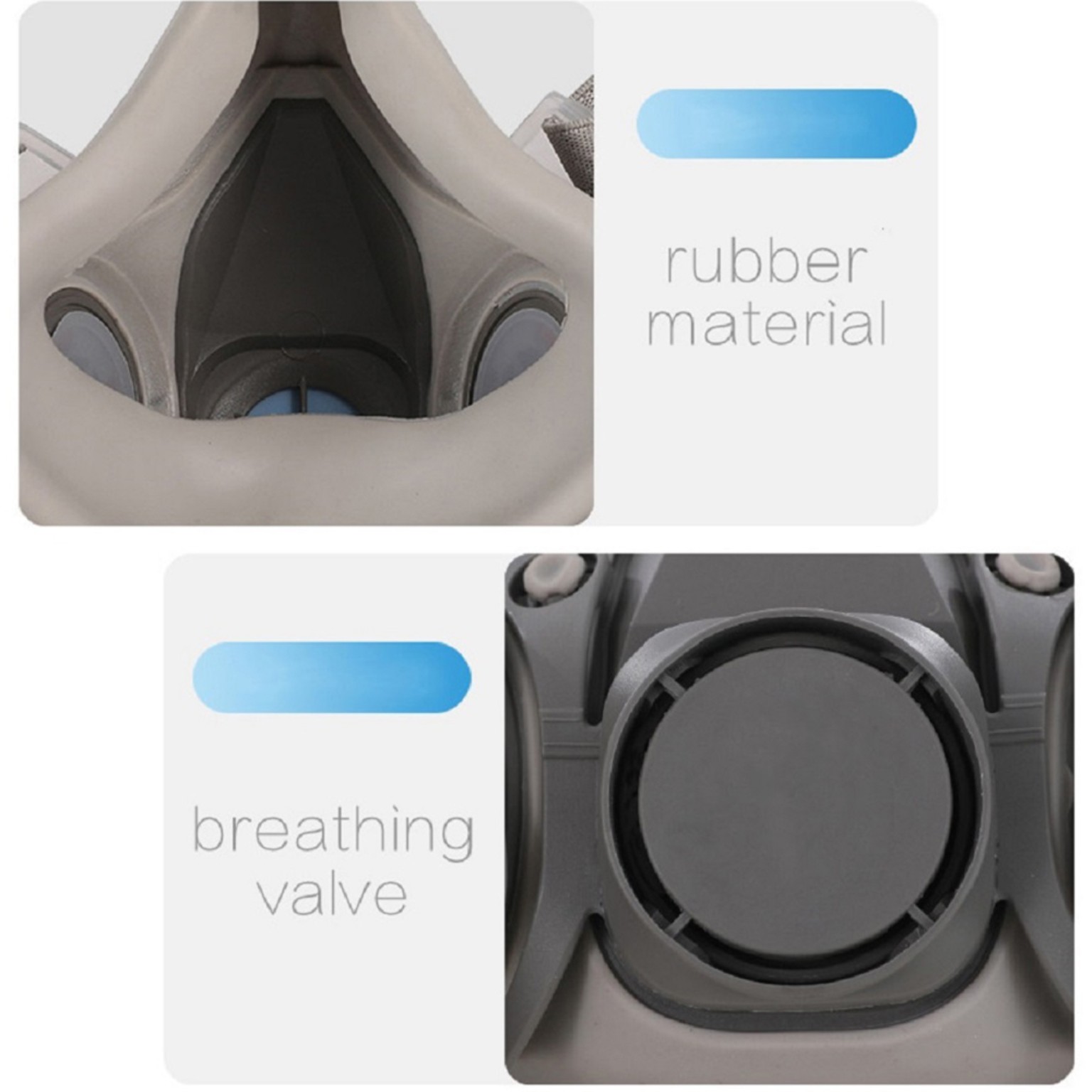
The listing calls the sealing material rubber and promotes a low-resistance exhalation-valve design. A supple seal can improve comfort, while a functioning exhalation valve releases warm, humid breath and may reduce heat inside the mask. Actual breathing resistance depends on both filter pads, their loading and the condition of the inhalation and exhalation valves.
Inspect the seal for cracks, stickiness, permanent deformation and chemical damage. Check that valve discs are present, clean, flat, flexible and correctly seated. A warped, missing or contaminated valve can bypass the filter or increase resistance. Users with latex or material sensitivities should obtain a precise material declaration rather than relying on the generic word “rubber”.
Eye protection remains separate
This half mask covers the nose, mouth and chin but leaves the eyes exposed. Properly selected safety spectacles or goggles may therefore still be required for flying particles, splash or irritating dust. Check that the eyewear does not press on the mask, lift the seal or create an unstable combination.
For substances that irritate or can be absorbed through the eyes, a competent risk assessment may require a full-face respirator or another control—not simply goggles added to this kit. Respiratory PPE sits below elimination, substitution, enclosure, extraction and other engineering controls in the control hierarchy.
What this kit must not be used for
This is an air-purifying half mask; it does not supply oxygen. Never use it in an oxygen-deficient atmosphere, an immediately dangerous to life or health atmosphere, a confined space with unknown conditions, an emergency release or any environment where the contaminant and concentration are not known and controlled.
With only the pictured white particulate pads, do not use it for solvent vapours, paint spraying, fuel vapours, toxic gases, pesticides requiring chemical cartridges, carbon monoxide, firefighting, smoke entry, asbestos removal or CBRN hazards. Even a genuine chemical cartridge must be selected for a known contaminant and managed under an objective service-life and change schedule.
The exhalation valve has a source-control limitation
The central exhalation valve directs the wearer's breath outward without passing it through the incoming-air filters. That may improve comfort, but it means the respirator should not be assumed to control respiratory emissions from the wearer. In healthcare, clean manufacturing or other settings where source control matters, follow the facility's requirements and choose an appropriate device.
The valve cover is not itself a filter. Keep it intact and unobstructed, and never tape or modify it unless the manufacturer explicitly authorises a tested configuration.
Cleaning, filter changes and storage
The seller says the mask body can be washed. That statement should apply only to washable facepiece components—not the disposable filter pads. Remove pads, retainers and any non-washable components according to the instructions. Clean and disinfect the facepiece with approved products, rinse, dry completely and reassemble only after checking every valve and seal.
Replace particulate pads when they are damaged, soiled, wet, difficult to breathe through or due under the manufacturer's instructions and workplace programme. Do not wash or blow them out. Store clean respirator parts away from sunlight, dust, chemicals, extreme temperatures and deformation; keep unused pads sealed and traceable to their expiry information.
Who might consider this product?
A verified version could suit competent DIY users and workplaces controlling nuisance or hazardous particulates from sanding, woodworking, grinding or similar work—only after the hazard assessment confirms an air-purifying half mask and the chosen filter class are appropriate. Occupational users still need the full programme requirements, not merely the product.
If the seller cannot provide traceable manufacturer details, exact approval documentation and an authorised component combination, treat the kit as unverified. For safety-critical work, buy through an authorised respiratory-protection supplier that can support selection, fitting, replacement parts and authenticity.
Pre-purchase checklist
Marketplace variants and component bundles can change. Capture the selected option and obtain the current model-specific manual before payment.
- Exact manufacturer and model—not only “6200 style”.
- Approval number and searchable record for the complete configuration.
- Standard, filter class and limitations printed on the delivered pads.
- Two adapters, two pads and two covers in the selected bundle.
- Available facepiece sizes and access to fit testing.
- Material declaration for the seal and valve components.
- Replacement valves, straps, adapters, covers and genuine filters.
- Manufacture/expiry dates, sealed packaging, warranty and returns.
Final assessment
This 6200-style kit has a familiar, serviceable format and the replaceable-pad arrangement could be economical for particle work. The separate covers make pad changes straightforward, the twin-port layout should distribute weight, and the central valve may improve comfort.
Those advantages do not answer the decisive question: is the exact assembly authentic, approved and suitable for the assessed hazard? The 5N11CN markings shown should not be translated into a NIOSH N95 claim, and the bayonet interface should not be treated as permission to mix components. Verify the full configuration, pass the fit test and use it only within a competent respiratory-protection programme.
Confirm the exact model, specification, certification evidence, shipping terms and current price before ordering.
Sources
- AliExpress — 6200-style half-face respirator and 5N11CN filter listingPublished Product listing; accessed 20 September 2026
- OSHA — Respiratory Protection, 29 CFR 1910.134Published Current standard; accessed 20 September 2026
- OSHA — User Seal Check Procedures, Appendix B-1Published Current mandatory appendix; accessed 20 September 2026
- NIOSH — Certified Equipment ListPublished Current approval database; accessed 20 September 2026
Daily HSSE updates
Subscribe for practical HSSE updates.
Subscribe for the daily message, selected HSSE news and occasional new-resource alerts from Worksite Safety Hub.