Safety · Vehicle Maintenance · 8 min read
Tyre Inflation Is a Stored-Energy Task: Lessons from WorkSafe’s New Alert
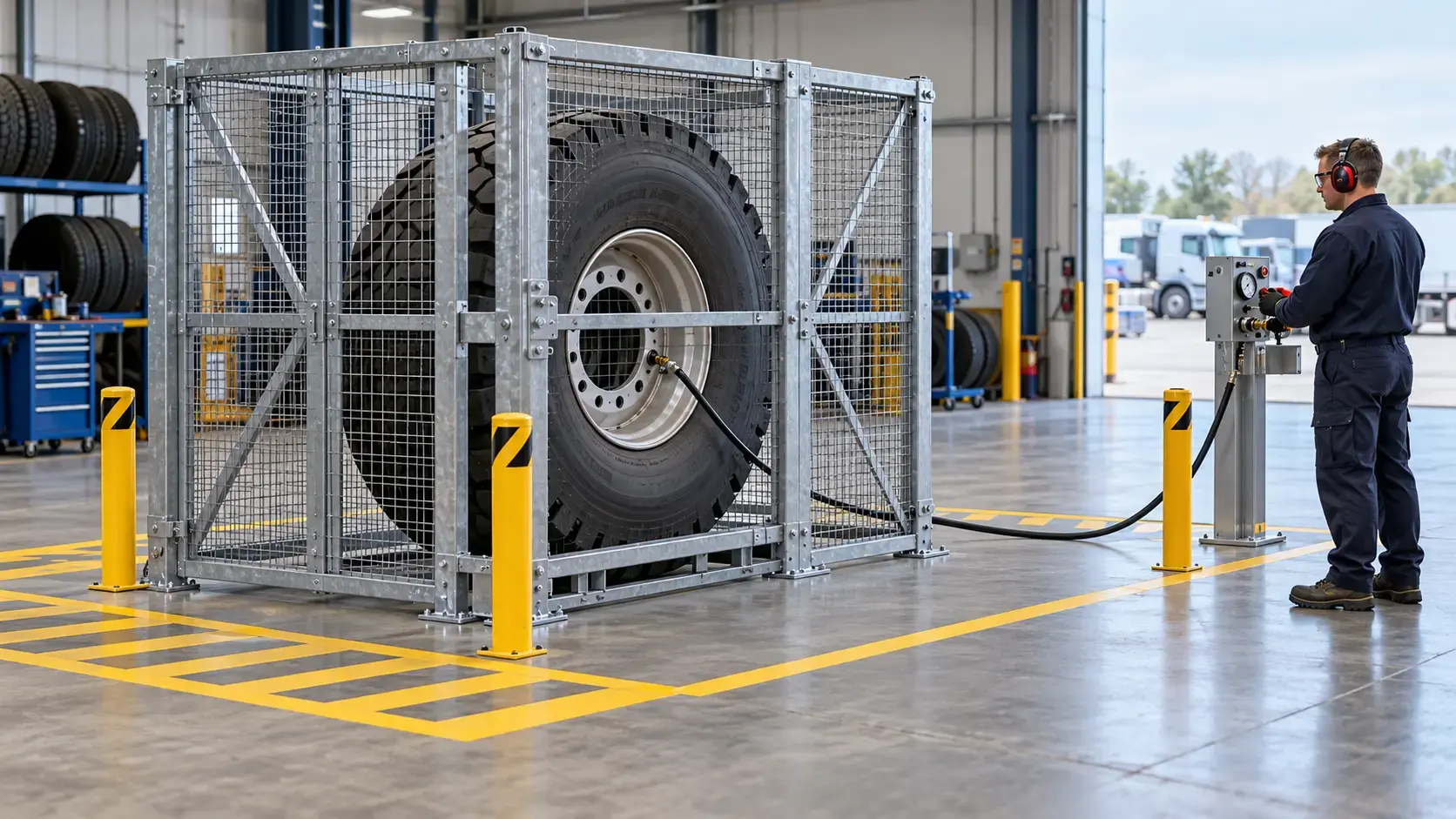
A familiar air hose can connect a worker to a powerful stored-energy hazard. Tyre inflation deserves the same disciplined planning as other maintenance tasks that can release pressure or throw heavy components.
What changed on 12 October 2026
WorkSafe Western Australia issued Health and Safety Bulletin No. 28 after learning of three recent tyre-inflation incidents causing serious injuries. They involved a truck driver working with a flat tyre, a mechanical worker servicing a grader tyre and multi-piece assembly, and an agricultural worker injured during a split-rim tyre change.
The bulletin was published on 12 October 2026. It does not identify the incident dates, workplaces or investigation outcomes. This is a new regulator warning based on recent incidents—not a report that three accidents occurred on publication day.
WorkSafe describes violent compressed-air release, components and debris becoming projectiles, and blast effects capable of causing fatal or life-changing harm. Its warning spans mining, agriculture, road transport, construction and mechanical workshops. Read the official bulletin (PDF) ↗
The global lesson: make the hidden energy visible
Teams often recognise lifting and vehicle-movement hazards but underestimate the energy introduced during inflation. A tyre can look ordinary while its pressure, damage history or wheel configuration demands specialist controls.
Use the alert as a prompt to walk through the actual job: who chooses the method, how the wheel is identified, where the operator stands, how bystanders are excluded and what happens if something looks wrong. A procedure that cannot answer those questions is not ready for use.
Identify the wheel before choosing the method
Safe Work Australia uses “split rim” broadly to include divided wheels and multi-piece rims or wheels. They are not all constructed or serviced in the same way. Obtain the relevant manufacturer’s instructions and use clean, serviceable, compatible parts. Do not decide that components match merely because they appear to fit.
Some divided wheels develop their full strength only when fitted to the vehicle. Others require a suitable restraint for inflation. A generic instruction to “put every wheel in a cage” is therefore not a complete procedure. The competent person must determine the correct sequence for that assembly. See the General Guide for Split Rims ↗
Restraint and distance are separate safeguards
WorkSafe’s cage guidance warns against bolting a cage to a floor or over-restraining it without consulting the manufacturer. Incorrect installation can interfere with its intended deformation and may itself create projectiles. Do not copy a photograph as an installation specification.
A cage does not make it safe to lean against the structure, shrink the exclusion zone or remain in a possible blast path. Verify suitability for the wheel and tyre, manufacturer-approved installation, condition and inspection requirements. Keep operator positioning and bystander exclusion as independent controls. Read WorkSafe’s cage-installation warning ↗
Control inflation without standing beside the tyre
HSE guidance stresses a clip-on connection and enough hose between the tyre and the gauge/control for the operator to remain outside the likely explosion trajectory. The needed separation depends on tyre size and position. A painted line is a reminder, not evidence that the chosen distance is adequate.
Arrange controls so that pressure can be monitored and inflation stopped without approaching the wheel. Keep the route clear of trip hazards. Test the intended deflation arrangements under the approved procedure before the task, not after a fault appears. See HSE tyre-service guidance ↗
Stop rather than correct a pressurised assembly
OSHA’s large-vehicle rim-wheel standard requires trained workers, appropriate restraint, component inspection and an inflation line with a clip-on chuck, pressure control and sufficient hose. It prohibits hammering or forcing side and lock rings into position while pressurised. Adjustment requires deflation under the correct procedure.
The standard has specific U.S. scope and exclusions; it is not a universal legal rule for every industry or vehicle. Use it as an additional technical reference and check the law applicable to your operation. Do not heat, weld or improvise repairs to damaged rim components. Read OSHA 29 CFR 1910.177 ↗
A supervisor’s control-verification conversation
- Can the worker identify this assembly and locate its correct service instructions?
- Who decides whether a flat or damaged tyre must go to a specialist?
- What evidence shows the restraint is suitable and installed correctly?
- Can the operator monitor, stop and safely release pressure from the planned location?
- Could a delivery driver, cleaner or colleague enter the exclusion zone?
- Does roadside or field work meet the same control standard as the workshop?
- Which unusual sound, movement or pressure behaviour triggers a stop?
- Who checks the controls when a contractor performs the work?
Turn the warning into an assurance action
Assign a maintenance leader to review every inflation location and service arrangement, including mobile equipment and contractors. Record the assembly types, approved methods, equipment condition and competence evidence. Correct gaps before the next job, then observe a planned task to verify that the controls are usable in practice.
This is an HSSE assurance review, not a substitute for tyre-fitter training. Stop work when the right procedure, competent person or suitable equipment is unavailable.
Video note
No directly relevant authoritative and embeddable video for this bulletin was verified at publication. Unrelated footage has not been added. Use the regulator’s bulletin and wheel-specific manufacturer instructions for the task.
Primary sources
- WorkSafe WA — Health and Safety Bulletin No. 28 (PDF)Issued 12 October 2026; underlying incident dates not stated
- Safe Work Australia — General Guide for Split Rims (PDF)December 2015; supporting technical guidance, not a new rule
- WorkSafe WA — Mines Safety Bulletin No. 122: Use of tyre inflation cagesSupporting cage-installation guidance
- HSE — Tyre removal, replacement and inflationSupporting motor-vehicle-repair guidance
- OSHA — Servicing multi-piece and single-piece rim wheelsU.S. standard; check its scope and applicable local requirements
Your experience matters
Share your thoughts on this page
Have a question, a useful experience or a suggestion? Add your input below.
Comments are public. Keep them respectful and relevant. Do not share contact details, confidential information or emergency reports.
Comments on this page
Loading comments…