Safety · Lifting and Loading
A Spotter Is Not a Load Restraint: Plan Forklift Loading
Published
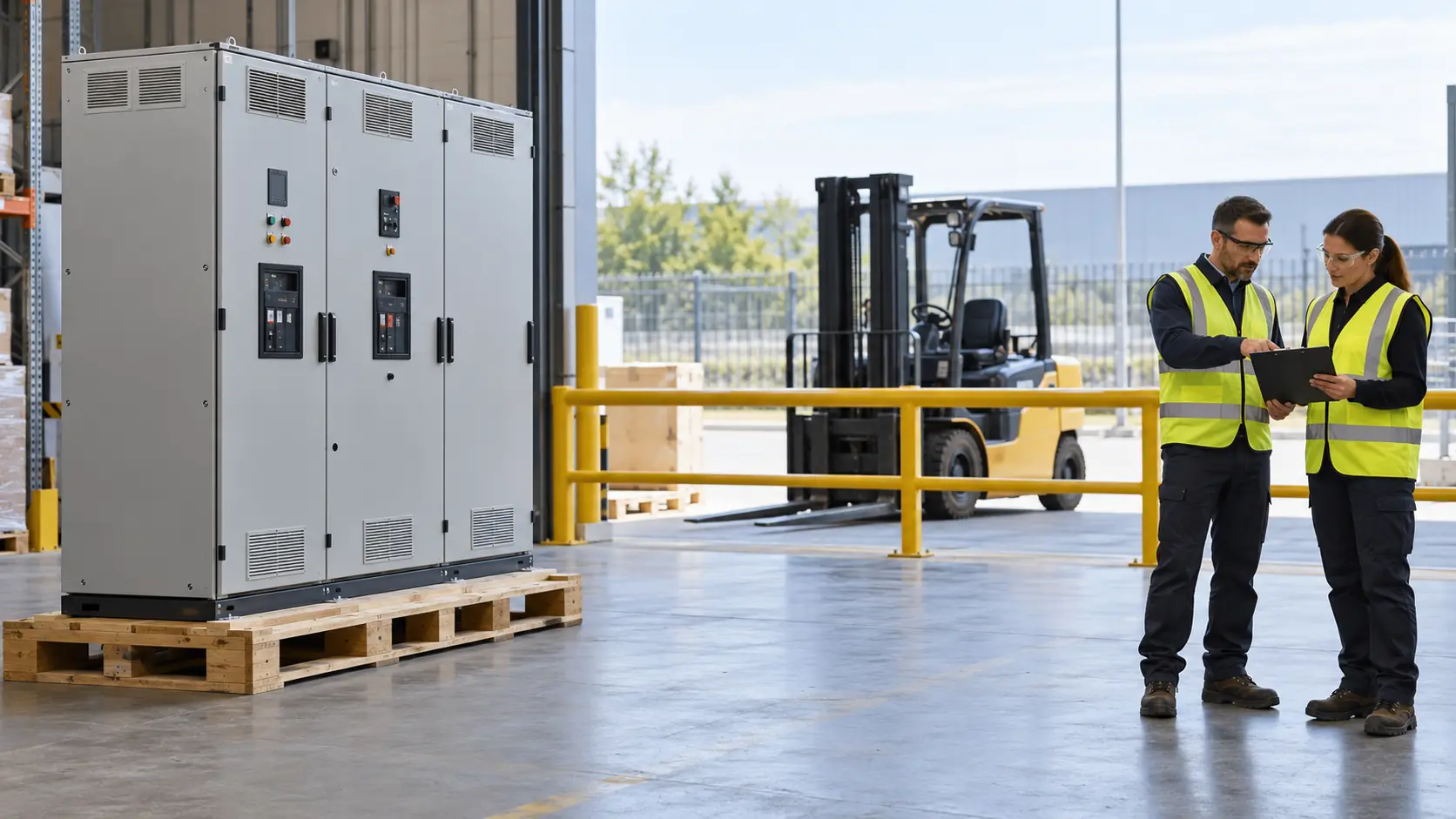
If a loading method depends on someone holding heavy equipment steady while a forklift moves it, stop and review the method. A new HSE case shows why a person beside a load must never be treated as its restraint.
A new enforcement finding about a 2024 incident
On 16 October 2026, HSE reported that City Electrical Factors Limited was fined £4 million at Birmingham Magistrates Court. The company pleaded guilty under section 2(1) of the Health and Safety at Work etc. Act 1974.
The injury occurred on 4 October 2024 during loading at its Proteus Switchgear Industrial Division. A 231 kg switchboard load fell from a forklift onto an employee acting as a spotter, causing life-changing injuries. HSE found no risk assessment or lift plan, inadequate instructions and an unsafe arrangement in which workers steadied loads. Its investigation identified available safer options, including a lorry-mounted crane. Read HSE’s primary enforcement account.
The central lesson: do not use people as restraints
A spotter can have a defined communication or observation role within a safe system. That is different from placing a person beside equipment so that their hands compensate for an unstable or unsecured load. The planning question is not whether someone is willing to help. It is whether the method protects that person from foreseeable movement.
For your next review, ask the crew to describe what would happen if the load shifted without warning. If the answer relies on a worker’s strength, reaction speed or ability to get out of the way, refer the method for competent reassessment. Do not ask a worker to demonstrate the unsafe movement.
Select the method for the actual load
HSE’s lifting-operations guidance calls for competent planning, resources and supervision proportionate to the risks. Planning includes how loads are attached, detached and secured, as well as visibility, surroundings and stability. A straightforward recurring operation may use a valid generic plan, but that plan needs review when conditions change.
This case does not establish that every switchboard must be moved by a crane. The appropriate equipment, lifting accessories, load condition and connection arrangements need assessment for the specific operation. Do not copy an attachment or restraint arrangement from a photograph or assume that lifting eyes, anchor points or a forklift’s headline capacity alone establish suitability.
Plan the whole transfer
Use a simple discussion sequence before the task: where does the load start, how is it supported during the transfer, where can people safely stand and how will it be placed at the destination? This is a review framework, not a rigging instruction.
Have the competent planner identify the boundaries of the method. Changes to load configuration, packaging, vehicle, route or receiving location should be visible to the supervisor. A plan for yesterday’s arrangement should not silently become approval for a different lift today.
Make the loading area match the plan
HSE’s loading-area guidance emphasises space, safe movement and keeping uninvolved people away. It asks employers to consider visibility, access, platform differences and training. These surrounding conditions matter even when the load and equipment have been properly selected.
Walk the area before release. Ask whether the delivery driver, visiting contractor or colleague on foot could enter the work zone without understanding the operation. Agree how the driver and site team will communicate, and where someone can wait without being exposed to the moving equipment or load.
Give the spotter a role that does not require contact
Where a spotter is justified by the assessment, define the purpose of the role, the communication method and the safe position. The team should know what happens if sight or communication is lost. These are original review prompts; the competent plan must determine the arrangements.
Do not allow a vague instruction such as “help the driver” to expand into handling, steadying or retrieving something inside the danger area. The person doing the work should be able to explain the limits of the task without guessing.
Questions for leaders and toolbox talks
- What prevents the load from moving independently of the lifting equipment?
- Has a competent person assessed this load and the available handling methods?
- Does anyone need to touch or steady the load during movement?
- Are the driver, lifting team and receiving team working to the same plan?
- Which changes would invalidate the method and require a fresh decision?
A useful leadership check is to watch a planned operation from the agreed safe area and compare it with the briefing. Discuss differences with the team before work continues. Repeated successful completion does not, on its own, prove that exposure has been controlled.
Video note
No directly relevant authoritative, embeddable video for this case or this specific loading method was verified. Unrelated forklift clips have not been added.
This article applies confirmed findings to practical review questions. It is not a lifting plan or an equipment-selection specification. Apply local law, manufacturer instructions and competent advice.
Primary sources and dates
- HSE — Electrical wholesaler fined after worker’s crush injuries ↗Published and sentenced 16 October 2026; incident 4 October 2024.
- HSE — Planning and organising lifting operations ↗Updated 29 October 2024; existing lifting guidance.
- HSE — Loading areas ↗Page dated 9 January 2026; supporting workplace-transport guidance.
Sources checked 16 October 2026. Supporting guidance is distinguished from the new development. Practical prompts are original learning applications.
Share the lesson
Open the separate 9:16 Pinterest poster
The poster is a fictional AI-generated planning illustration, not an actual incident or an approved technical arrangement. Branding appears only in its designed footer.
Your experience matters
Share your thoughts on this page
Have a question, a useful experience or a suggestion? Add your input below.
Comments are public. Keep them respectful and relevant. Do not share contact details, confidential information or emergency reports.
Comments on this page
Loading comments…