Safety · Fire Prevention · Investigation Lessons
Shantou Fire Report: Fire Protection Must Work, Not Just Exist
Published · Official report released 16 October 2026 · Fire occurred 9 December 2025
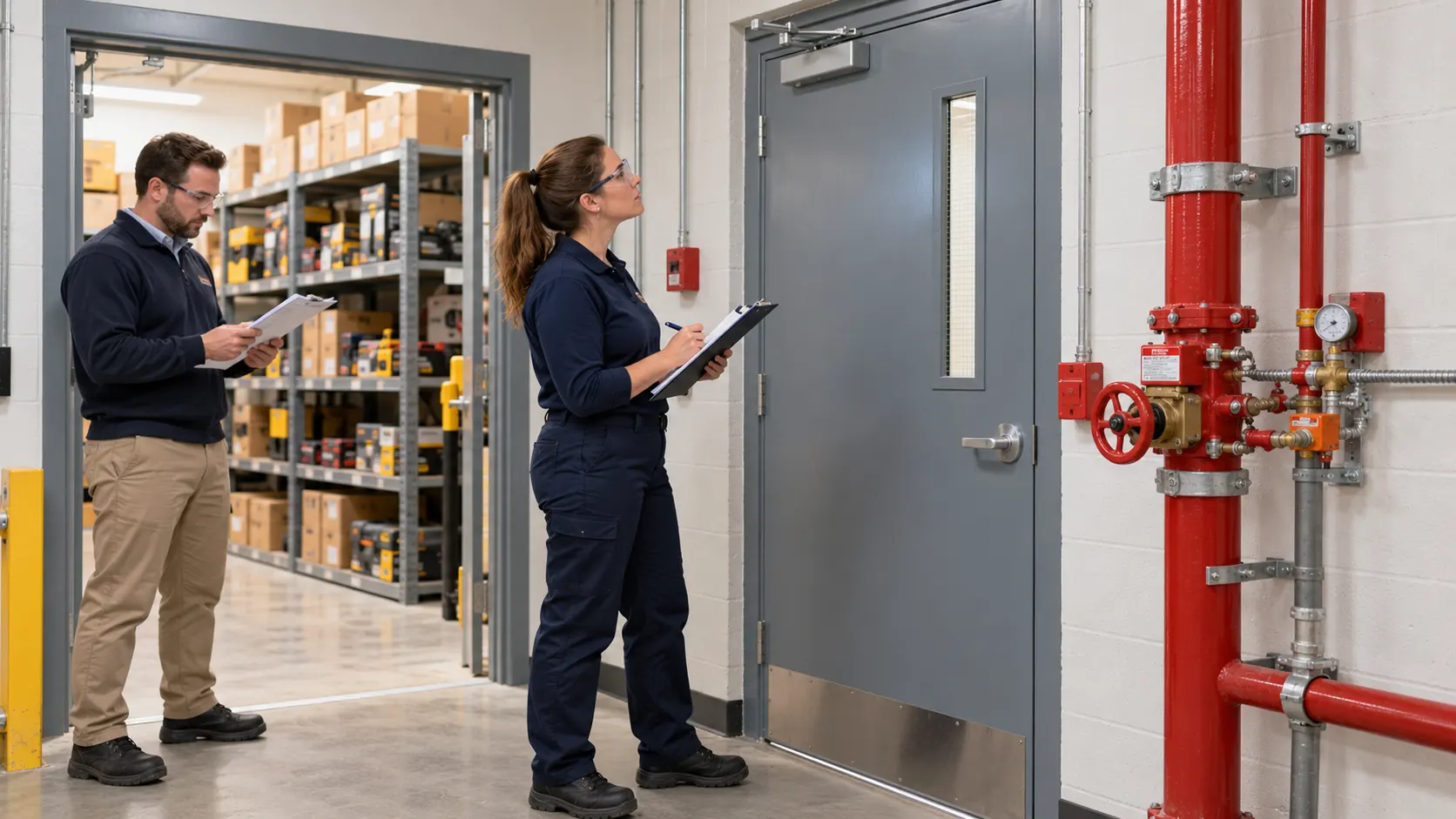
A sprinkler head is not proof of available water. A sounding detector is not proof that everyone receives a warning. A fire door is not protection if it cannot close. A newly published investigation into a fatal fire in Shantou, China, shows why fire safety must be verified as a working system—not counted as a list of installed items.
What changed: an investigation, not a new fire
On 16 October 2026 at 17:00 local time, Guangdong’s Department of Emergency Management published the provincial government investigation findings into the 9 December 2025 fire in Shantou’s Chaonan district. Twelve people died. The building combined a ground-floor hardware shop, a second-floor warehouse and homes above.
This is the published, government-approved investigation—not a preliminary cause theory or a report of a new incident. The release also records referrals for judicial handling and disciplinary review. Those referrals must not be described as convictions or completed court outcomes.
Small ignition, connected hazards, rapid escalation
Investigators identified a burning mosquito-repellent incense stick as the initial ignition source. It ignited nearby combustible material in the shop’s reception area. Heat then caused stored lithium-ion batteries to enter thermal runaway, with explosive ejection, and involved products including canned polyurethane foam, butane canisters, spray paint and rust remover.
The batteries intensified the fire; the report did not identify them as its initial ignition source. Nor does it establish a charging incident or a product-wide battery defect. Dense combustible stock and mixed storage of hazardous goods helped turn a local ignition into a much larger threat.
Installed protection did not deliver the required protection
- Suppression: the shop’s simple sprinkler installation had a closed inlet valve. Heads activated but there was no water supply to suppress the early fire.
- Separation: ground-floor fire doors were not kept closed. A partition near the fire failed, and smoke entered the stairways. Glass sliding doors at the residential levels did not adequately stop hot smoke.
- Warning: ground-floor standalone smoke detectors sounded, but they were not networked and did not promptly alert residents farther away on the upper floors.
- Escape: both stairways discharged through the ground-floor shop. The homes had no independent escape stairway; the report also identified inadequate separation and missing auxiliary escape provision.
The lesson is not that one new device would have solved every weakness. Prevention, storage, compartmentation, warning, suppression and escape all needed to support one another.
Why an assessment report was not enough
The investigation also examined a third-party assessment of fire-risk-area remediation carried out in 2019. It found serious failures in field assessment and report quality. Assessors used the presence of sprinkler heads as evidence of an installation without confirming effectiveness, and accepted fire-separation performance without adequate supporting verification. Review processes did not substantively check the underlying field information.
These were findings about the assessed programme and the named organisation—not proof that every assessor or fire certificate is unreliable. The transferable question is sharper: what evidence supports each safety-critical conclusion, and who checks that evidence?
Practical controls: verify the whole protection chain
The following are Worksite Safety Hub’s practical learning applications. Use competent fire-safety professionals, the approved building strategy, equipment instructions and applicable local law. The Chinese report’s specific legal provisions are not worldwide requirements.
1. Remove avoidable ignition and control hazardous stock
Prohibit unattended smouldering incense and other unauthorised ignition sources in commercial stock areas. Review smoking, heaters, hot work and electrical hazards. Check the actual inventory, product safety data, quantities and storage arrangements—not just the business’s label as a “hardware shop”. Segregate hazardous products appropriately and keep stock clear of escape routes and heat sources.
2. Test suppression as a system
Have authorised, competent personnel verify the relevant supply, valve status, pumps where fitted, supervision and inspection/test records. Manage an impaired system through a formal process: identify affected areas, assess whether occupancy or operations can continue safely, provide necessary interim controls and verify reinstatement. Do not randomly operate fire-system valves or create a live-fire test. Visible pipework is not a substitute for documented, suitable functional testing.
3. Check doors, partitions and the protected route together
Confirm that required fire doors close and latch, are not wedged open and have compatible, undamaged components. Ask a competent specialist to assess partitions, penetrations and separation from hazardous storage. Walk the complete escape route to the outside: two stairways are not independent protection if the same shop fire can compromise both. Escalate unsafe sleeping arrangements or compromised routes immediately; do not continue their use without an appropriate safety decision and necessary controls.
4. Verify warning where people actually are
Assess detection, alarm coverage and notification across all occupied areas, including sleeping accommodation, out-of-hours use, noisy spaces and people needing assistance. Demonstrate performance through a planned, competent test under realistic conditions. Do not assume a detector heard on the shop floor will wake someone several floors away.
5. Make assurance traceable
For each critical finding, retain the location, asset identity, method, test results, limitations and person responsible. Require a clear defect description, risk-based action, named owner and evidence of closure. Sample the assessor’s underlying records and challenge unsupported “satisfactory” conclusions. Reassess after changes in use, stock, layout or accommodation; a historical assessment cannot prove today’s condition.
Leadership and toolbox questions
- Which fire-protection claim can we demonstrate today, rather than merely point to on a drawing?
- Can one fire disable both escape routes or cut off sleeping accommodation?
- Who knows about a closed valve, isolated alarm or defective fire door, and who authorises continued use?
- Does the alarm reach every person who needs to act, including outside normal working hours?
- What field evidence supports our latest assessment, and which unresolved limitations matter most?
Relevant video: a sprinkler demonstration, not incident footage
The National Fire Sprinkler Association publishes NFSA Washington DC Fire Sprinkler Demo Part of USFA Fire Stop Tour. It illustrates the difference functioning sprinklers can make in a demonstration setting. It does not recreate Shantou, prove a particular installation is adequate or provide design criteria for mixed hazardous stock or battery fires.
Watch the verified publisher’s video directly ↗. No authoritative embeddable video of the Shantou investigation itself was verified.
Primary sources and dates
- Guangdong Department of Emergency Management — Shantou “12·9” investigation release (Chinese) ↗Official release dated 16 October 2026, 17:00 local time; accident 9 December 2025.
- Guangdong provincial government investigation team — full investigation report (Chinese PDF) ↗October 2026 report, linked from the official release. Printed pages 6, 14–19 and 34–37 address protection systems, escalation, assessment failures and recommendations.
- London Fire Brigade — Living above business premises fire safety guide ↗Existing supporting guidance, checked 19 October 2026; not a new global rule or a statement of Chinese law.
- London Fire Brigade — Fire doors: property management ↗Existing guidance on compatible components, competent installation and effective closure; legal provisions are jurisdiction-specific.
- National Fire Sprinkler Association — NFSA Washington DC Fire Sprinkler Demo Part of USFA Fire Stop Tour ↗Publisher and exact title verified through YouTube metadata on 19 October 2026; embeddable general demonstration, not footage of this fire.
Sources checked 19 October 2026. Chinese report findings are summarised in original English wording; practical applications are identified separately. Referral and recommended action are not presented as court findings.
Share the lesson
Open the separate 9:16 Pinterest poster
The poster shows a fictional AI-generated fire door and sprinkler illustration, not the actual incident. HSSE TIPS branding appears only in its designed footer.
Your experience matters
Share your thoughts on this page
Have a question, a useful experience or a suggestion? Add your input below.
Comments are public. Keep them respectful and relevant. Do not share contact details, confidential information or emergency reports.
Comments on this page
Loading comments…