Safety · Maintenance · Maritime Operations
Gantry Crane Maintenance: Hidden Fasteners, Visible Warning Signs
Published · Final report released 16 October 2026
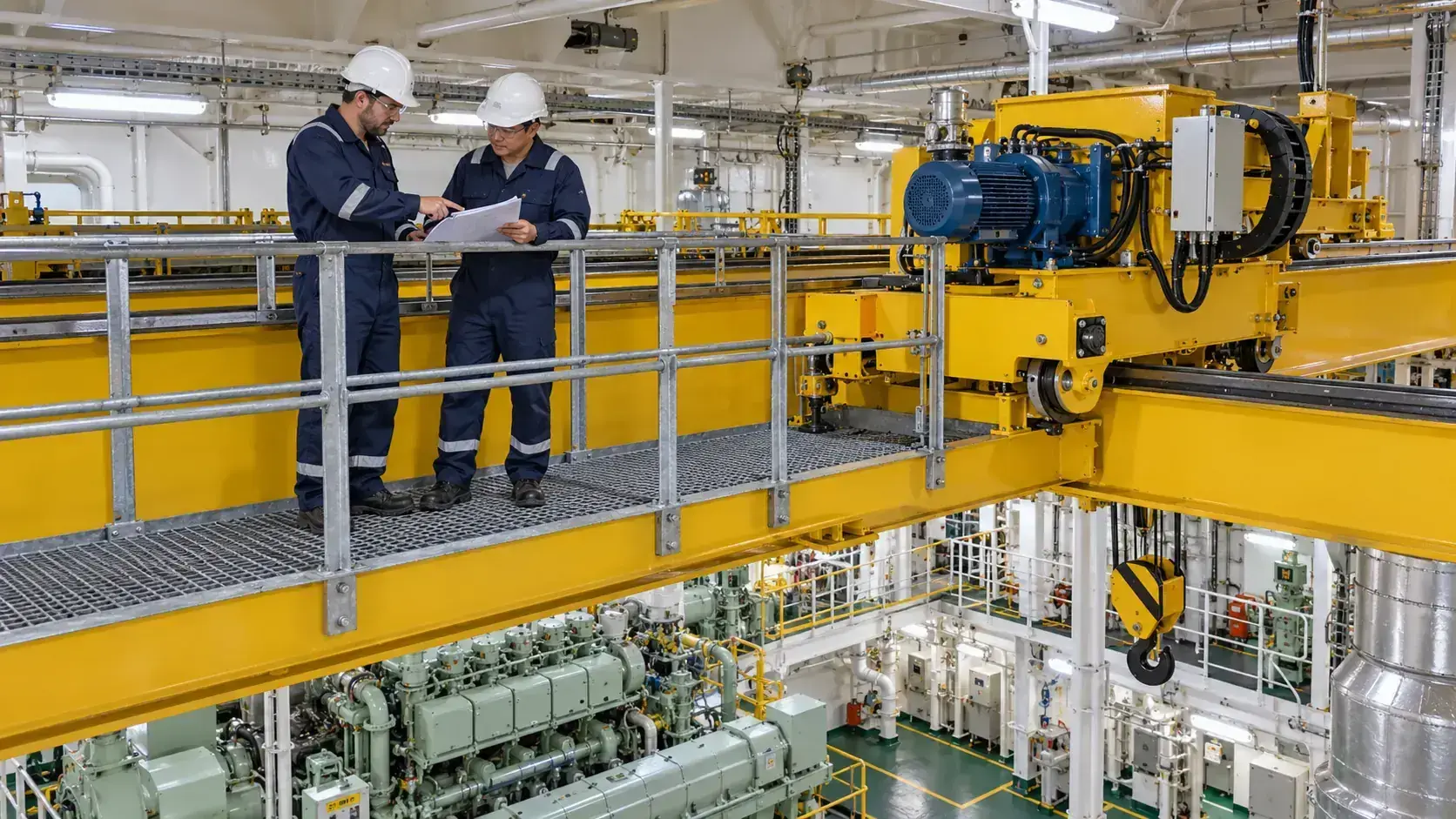
A crane can finish a lift safely and still leave people exposed to a falling component. The inspection question is not only whether the hook and sling are sound. It is whether the machinery above the work area is secure—and whether the maintenance team can actually inspect it safely.
What changed: final findings published on 16 October
The Australian Transport Safety Bureau released its final report MO-2025-006 on 16 October 2026. The accident happened on 23 June 2025, aboard the bulk carrier RTM Weipa near Gove, Australia. A roughly 25 kg traversing motor fell about six metres from an engine-room gantry crane and struck a crew member, causing minor injuries. The crane was stationary after a lifting task.
The new development is the final investigation and its published lessons, not a new accident. Corrective actions described in the report occurred earlier; the manufacturer’s revised service guidance was already published in March 2026.
Three weaknesses connected the warning to the failure
ATSB found that internal securing bolts were not visible without dismantling the assembly, and the original maintenance instructions did not adequately identify or cover them. Wobbling had been observed about four months before the accident, but it was not properly investigated and recorded. The report says imbalanced operation likely contributed to the fasteners loosening; that contribution is an investigation assessment, not a certainty about every crane with similar symptoms.
Across the manager’s four ships, suitable maintenance access was also missing. Crews described improvised platforms and work without the necessary working-aloft permits. These are findings about this fleet, not evidence that all gantry cranes have the same defect.
What the published safety actions show
The manufacturer revised its inspection guidance, including monthly visual checks, and recommended manufacturer-certified inspection at least every five years. The manager updated maintenance arrangements, strengthened defect reporting and installed permanent access platforms with associated working-at-height controls. ATSB records the maintenance-procedure and access safety issues as closed—adequately addressed.
Those intervals concern the equipment and actions described by ATSB. They are not a blanket inspection schedule for every crane, and a five-yearly specialist visit does not replace routine checks or action on a suspected defect.
Practical review 1: map what keeps overhead components in place
As an original HSSE learning application, choose one crane or other overhead assembly and walk through its maintenance plan with a competent equipment specialist. Identify which motors, gearboxes, guards and other components could fall into occupied space if their attachments deteriorated. Ask whether the inspection instructions identify each safety-critical connection and explain an approved way to assess it.
Do not instruct workers to dismantle equipment merely because a fastener is hidden. Seek the current manufacturer’s procedure for the exact model, its configuration and service history. Establish what can be checked externally, what requires specialist examination and how an inaccessible component is managed until a sound inspection method is available.
Practical review 2: treat unusual movement as a defect to resolve
A description such as “it always wobbles” should prompt assessment, not become an acceptance criterion. Give the concern a formal record, an accountable owner and a documented decision on continued use. Where a potentially dangerous defect is suspected, stop the affected operation, control access and arrange competent assessment under the site’s equipment-isolation procedures.
Record what was observed, the equipment identity, when it occurred and what action followed. A shift handover or informal message can help raise the concern, but should not replace the defect system. Closure should show the diagnosis, authorised correction and evidence supporting return to service—not simply that a reminder was sent.
Practical review 3: make the inspection task safe and achievable
Review the access route and working position with the person who performs the task. Can they see the relevant component, use the required tools and keep a stable position without improvised steps or overreaching? Select suitable access equipment or engineered access, with competent design and the required protection from falls.
Plan isolation, stored-energy control, any required support of components, dropped-object protection and rescue arrangements before work starts. A permit documents agreed controls; it does not make an unsuitable platform safe. Keep people clear of the area below maintenance and prevent unintended crane movement through the approved isolation process.
Maintenance, inspection and examination are different checks
HSE’s existing lifting-equipment guidance distinguishes routine maintenance, inspections and thorough examination by a competent person. It also recognises that examination methods may include internal inspection or some disassembly. A satisfactory certificate is not a reason to ignore a subsequent abnormality.
Use the equipment inspection guidance to challenge vague checklists: specify the safety-related parts, the method, the interval and what to do with a defect. Apply the law and marine, flag-state, class or workplace requirements relevant to your operation. The cited HSE legal framework is specific to Great Britain and is not presented as worldwide law.
Leadership and toolbox questions
- Which overhead attachments are absent from our current inspection instructions?
- What reported vibration, wobbling or unusual movement is still awaiting a competent decision?
- Can the team inspect the actual component safely, rather than complete the checklist from too far away?
- Who receives a defect report, decides whether use must stop and verifies closure?
- Have revised manufacturer instructions reached every equivalent asset, including contracted equipment?
Video note
No directly relevant authoritative video with a verified publisher, title and embeddable URL was found for this investigation. Unrelated crane footage has not been inserted. The ATSB final report provides the authoritative investigation record and technical illustrations.
The practical review questions above are Worksite Safety Hub learning applications. They do not replace a manufacturer’s instructions, a competent inspection, an approved maintenance method or applicable legal requirements. Do not copy bolt torque settings, adhesives or repair methods from another model without equipment-specific authorisation.
Primary sources and dates
- ATSB final report MO-2025-006 — RTM Weipa crew injury ↗Released 16 October 2026; incident 23 June 2025, near Gove, Northern Territory, Australia.
- ATSB — Guidance updated after motor falls from gantry crane ↗News release listed by ATSB on 16 October 2026; summary of final findings and earlier corrective actions.
- ATSB safety issue — Maintenance procedures ↗Issue released 16 October 2026; describes manufacturer guidance already published in March 2026, monthly inspections and recommended five-yearly specialist inspection.
- ATSB safety issue — Access arrangements ↗Issue released 16 October 2026; records permanent access improvements and working-at-height controls.
- HSE — Inspection of work equipment ↗Existing guidance, updated 29 October 2024; supporting inspection principles, not a new rule or a universal legal requirement.
- HSE — Thorough examinations and inspections of lifting equipment ↗Existing Great Britain guidance, updated 29 October 2024; explains maintenance, inspection and competent examination as distinct activities.
Sources checked 18 October 2026. Final investigation findings are distinguished from the report’s likely contributing mechanism and this article’s practical learning applications.
Share the lesson
Open the separate 9:16 Pinterest poster
The poster is a fictional AI-generated inspection illustration, not an image of the accident. HSSE TIPS branding appears only in its designed footer.
Your experience matters
Share your thoughts on this page
Have a question, a useful experience or a suggestion? Add your input below.
Comments are public. Keep them respectful and relevant. Do not share contact details, confidential information or emergency reports.
Comments on this page
Loading comments…