Safety · HSSE Watch
Roof Hot Work: Prove the Controls Before the First Spark
Published
Incident: 26 July 2024 · Sentencing: 29 October 2026 · HSE publication: 30 October 2026
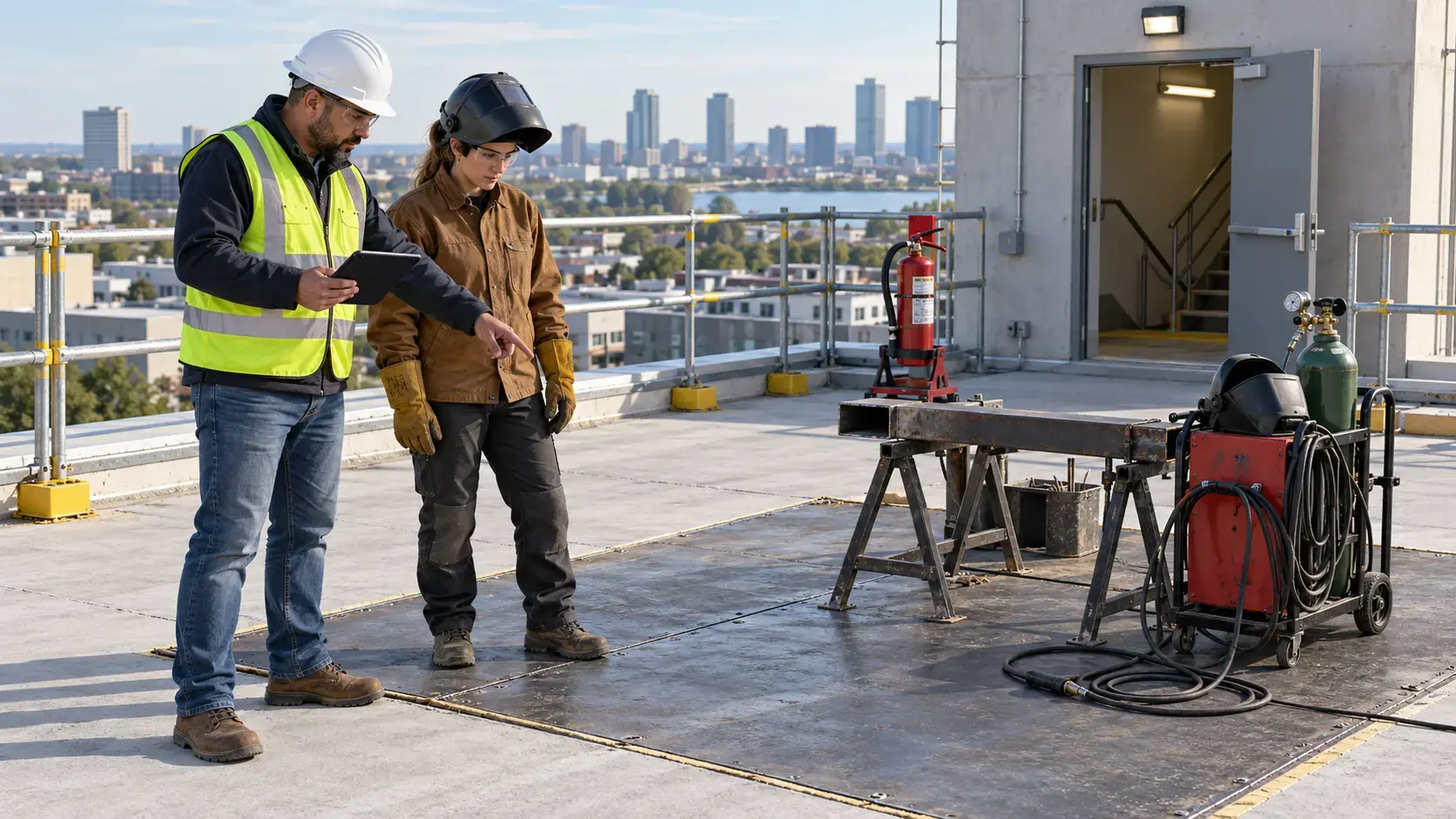
A hot-work procedure stored in an office cannot protect a roof crew unless its controls are present where the work happens. HSE’s latest prosecution describes welding beside exposed insulation, no permit, no means of raising the alarm and a single escape opening. Four people escaped, but that outcome does not show the work was adequately controlled.
What happened—and what is newly published
HSE published its enforcement findings on 30 October 2026. The fire occurred on 26 July 2024 at the Old Telephone Exchange development in Staines-upon-Thames, Surrey. Four subcontractors working under the control of C Watkins Plumbing Limited were installing an air-source heat pump on the roof of a 14-storey apartment building under construction.
According to HSE, welding sparks ignited uncovered rigid foam insulation laid across the roof. Fire spread quickly across the roof space. The workers escaped through one opening in the floor and down a ladder to Level 14. HSE found no alternative roof escape, no means of raising an alarm and no fire extinguishers.
The company’s policies required hot-work controls, but HSE found no risk assessment or method statement and no welding permit. The company pleaded guilty to breaching Regulation 15(2) of the Construction (Design and Management) Regulations 2015. It was fined £20,000 plus £8,270 costs on 29 October 2026.
Why the lesson reaches beyond construction
Hot work occurs during fabrication, plant maintenance, vessel repair, utilities work and shutdowns as well as construction. Temporary insulation, packaging, coatings, membranes or other materials can change the fire risk while the task still looks familiar. Work at elevation adds an escape problem when fire or smoke threatens the route.
The following are Worksite Safety Hub practical applications. They are not additional findings about the contractor, a universal permit form or a substitute for competent assessment, HSG168 and the requirements applying to the location.
1. Challenge whether hot work is necessary
Consider whether fabrication can be completed in a controlled location or whether a suitable cold method can achieve the task. Have competent people assess alternatives against structural, mechanical and other requirements. Avoid transferring risk from fire to another uncontrolled hazard.
If hot work remains necessary, define its exact location, duration, work method, adjacent activities and responsible people. A generic approval covering an entire roof or shift may miss the conditions at the actual spark-producing point.
2. Inspect the complete ignition pathway
Identify combustible materials around, beneath and beyond the visible work face. Review insulation, roof build-ups, openings, penetrations, voids, stored materials and areas where sparks or hot particles could travel. Confirm material information rather than assuming that a surface is noncombustible.
Remove combustibles where practicable. Where removal is not possible, have competent specialists determine suitable protection and whether work can proceed safely. A screen around the welder does not prove that concealed layers, lower levels or adjacent spaces are protected.
3. Make the permit a field verification
The person authorizing the task should verify conditions at the work location with the performing team. Confirm the assessment, method, ignition controls, isolation where relevant, fire watch, alarm, extinguishers, access, escape and simultaneous activities before authorizing work.
Specify the task boundaries and conditions that invalidate authorization. Reassess when materials arrive, protection moves, weather changes, access is obstructed or another contractor starts work nearby. A signature cannot make a missing control present.
4. Treat escape as an operating constraint
Walk the route from the actual work position to a place of safety. Ask whether a credible fire could obstruct it, how multiple people would use it and whether materials, leads, hoses or equipment reduce access. Escalate dependence on a single vulnerable route to the competent fire-safety team.
Do not assume that an access ladder is automatically an adequate evacuation arrangement. Decide whether the task can start only after the assessed escape provisions are available, protected and communicated. Include workers on other levels who may also be affected.
5. Prove alarm and response arrangements
Confirm how the team raises the alarm, who receives it and how others are warned. Test coverage, audibility or other suitable warning methods against the construction or maintenance environment. A mobile telephone is not a complete alarm strategy without a reliable response arrangement.
Provide suitable, accessible firefighting equipment through competent selection and inspection. Only trained people should attempt an initial response within their competence and without compromising escape. Extinguishers are not permission to conduct otherwise unsafe work.
6. Set fire-watch and closeout requirements
Assign a competent fire watch where the assessment requires it, with a clear area to monitor, means of communication and authority to stop work. Include hidden or adjacent areas where heat could create delayed ignition. Do not assign incompatible duties that prevent effective observation.
Determine post-work checks and monitoring duration from the risk assessment and applicable rules; this article does not prescribe a universal time. Record handover, unresolved concerns and the person accepting closeout. Ending the welding does not necessarily end the fire risk.
7. Coordinate changing site conditions
Make the controlling contractor, work team and adjacent employers share information about materials, access, protection systems and other activities. Include roof works, insulation installation, temporary power, lifting and occupation of lower floors in the review.
Supervisors should observe whether the agreed controls remain effective during the job. Where the real arrangement differs from the method, stop and re-plan rather than treating the deviation as normal practice.
Leadership and toolbox questions
- Could this task be completed without hot work at this location?
- What could ignite beyond the visible work face?
- Who has physically verified the permit conditions?
- Could fire or smoke cut off the crew’s escape?
- Can everyone raise and recognize the alarm?
- Who watches for fire during and after the work?
- Which change requires immediate suspension and reassessment?
Authoritative video availability
No directly relevant authoritative embeddable video was verified for this enforcement case. HSE’s written release and HSG168 are linked below. Unrelated roof-fire footage has not been inserted.
Sources and dates
- HSE — Apartment roof blaze: workers lucky to escape ↗Official enforcement release published 30 October 2026. Incident occurred on 26 July 2024; sentencing at Staines Magistrates’ Court took place on 29 October 2026.
- HSE — HSG168: Fire safety in construction ↗Official construction-fire guidance identified in the enforcement release. Use the current guidance and a competent site-specific assessment.
Sources checked 30 October 2026. Source statements and original practical applications are distinguished above. Always consult current official advice and applicable local requirements.
Share the lesson
Open the separate 9:16 Pinterest poster
Illustrative prevention visual, not an actual incident or a technical procedure. HSSE TIPS branding appears only in the designed poster footer.
Your experience matters
Share your thoughts on this page
Have a question, a useful experience or a suggestion? Add your input below.
Comments are public. Keep them respectful and relevant. Do not share contact details, confidential information or emergency reports.
Comments on this page
Loading comments…