Safety · Vehicle Recovery
Control Rollaway Risk at Every Stage of Vehicle Recovery
Published
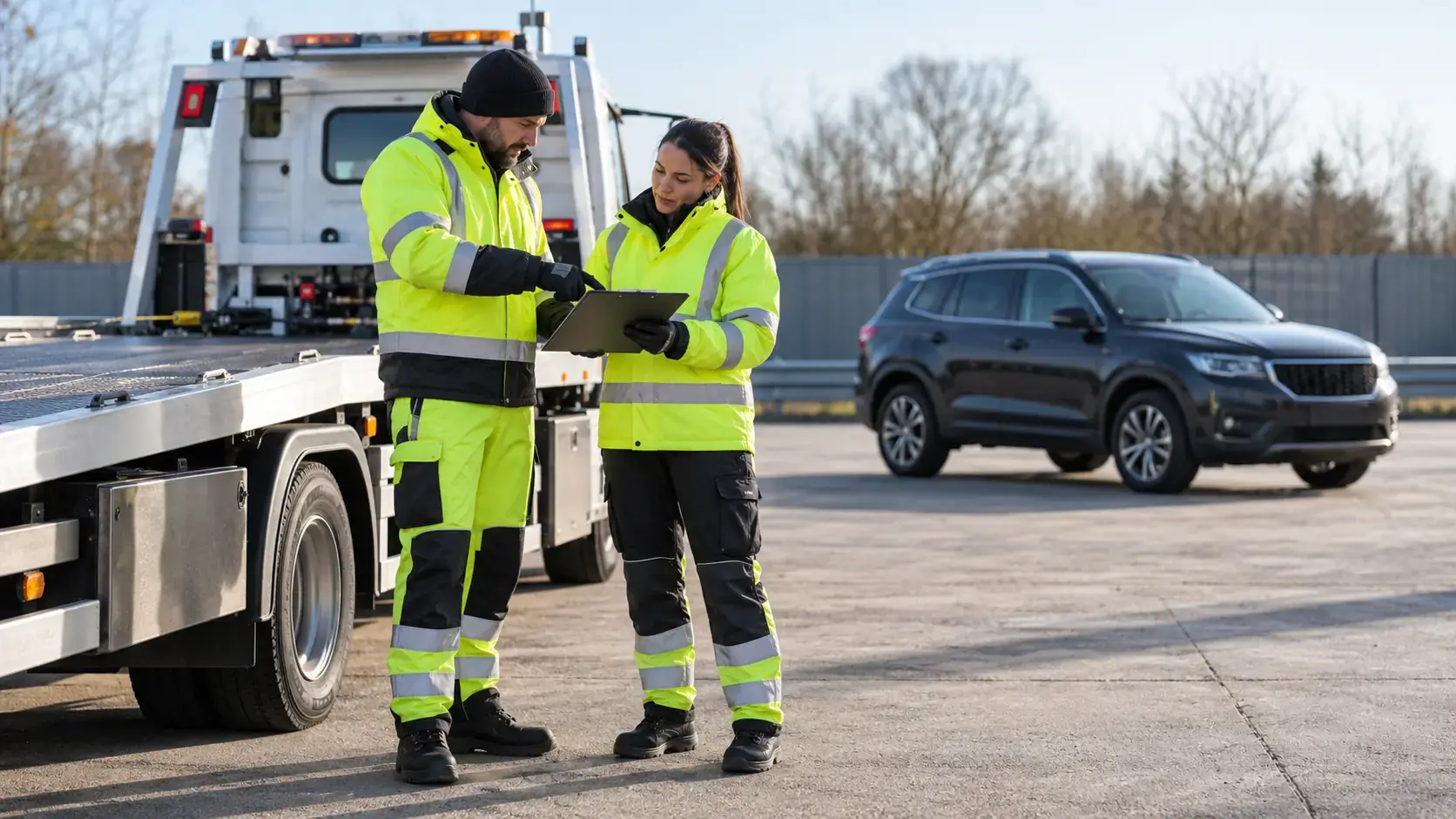
A recovery operation can lose its protection at a transition: a connection is removed, the support arrangement changes, or the vehicle is lowered. The control question is simple: what will prevent movement at the next stage?
What HSE reported on 16 October 2026
HSE published new enforcement findings after a recovery driver received a 14-week prison sentence, suspended for one year, at Bournemouth Crown Court on 16 October 2026. He pleaded guilty under section 7 of the Health and Safety at Work etc. Act 1974.
During a recovery on a steep Bournemouth road, a Range Rover rolled away and seriously injured a passer-by who tried to help. HSE found that a winch connection had been removed before the vehicle was lowered onto skates; chocks and breakaway cables were not in place. The release does not provide an exact incident date, so none is assumed here. This is a new enforcement report, not a claim that the incident happened today. Read the primary HSE account.
Why the transition deserves a fresh check
The wider lesson is an inference from the findings: a control that protected one stage cannot be relied on after it has been removed or the configuration has changed. The next movement needs its own competent confirmation.
That principle matters in vehicle recovery, maintenance yards and other operations where equipment is raised, supported, repositioned or transferred. A clear sequence should identify the condition in which the vehicle will be left at each transition. Do not replace that assessment with confidence that an experienced operator will notice a problem in time.
Use a task-specific recovery method
HSE’s roadside-repair precautions call for assessed risks, a safe system of work, suitable maintained equipment and adequate training. The guidance also addresses the need to advise vehicle occupants on precautions. It applies to the environment around the operation as well as the recovery task itself.
Before changing the arrangement, ask the competent recovery professional to explain the next step and how unintended movement will be controlled. The answer must suit the vehicle, condition, location and equipment. This article does not prescribe chock positions, winch connections, jacking methods or recovery equipment ratings.
Protect people beyond the recovery team
A roadside operation takes place among people who may not recognise the danger. Include pedestrians, nearby workers, vehicle occupants and other road users in the assessment. Someone who sees a developing emergency may approach to help, increasing the number of people exposed.
For an assurance review, check whether the agreed work area is understandable from outside it. Can a person approaching from either direction recognise where not to enter? Who can communicate with occupants or manage an unexpected approach while the recovery professional concentrates on the task? Resolve those roles before work starts.
Build a pause into changes of configuration
The following are original briefing questions for a competent team, not a recovery procedure:
- State the next change. What support, connection or equipment position is about to be altered?
- Explain the resulting condition. What could move, and who might be in its path?
- Confirm the planned protection. Does the competent person accept the next stage under the task-specific method?
- Check the surroundings. Has a person, vehicle or other activity entered the area?
- Proceed only when the team is ready. If the explanation or conditions differ from the method, stop for reassessment.
A pause is useful only if it leads to a real decision. Make it acceptable for someone to say they cannot see the protection described in the briefing. The response should be to resolve the uncertainty, not to continue while someone tries to understand the arrangement.
Prepare for an emergency without encouraging improvisation
Discuss how the team will raise the alarm, warn others and keep people away from danger. An emergency plan should not depend on someone trying to hold a moving vehicle or entering beneath an inadequately supported one. Follow the relevant emergency-service instructions.
For supervisors, use a tabletop discussion to test the communication and escalation arrangements without moving equipment. Include a scenario where a member of the public approaches unexpectedly. Record what needs to change in the work planning or briefing.
Questions for leaders
- Does the method remain safe after each connection or support is changed?
- Can the operator explain the limits of the equipment and the conditions requiring specialist advice?
- Have uninvolved people and potential helpers been considered?
- Who can stop the operation if the surroundings change?
Optional official video: distressing incident footage
Publisher: Health and Safety Executive. Title: CCTV captures terrifying incident that left passer-by with life-changing injuries. This is actual incident footage, not a demonstration of a safe method. It includes distressing scenes and is optional viewing.
View HSE’s CCTV footage — distressing scenes
Open the verified HSE video directly on YouTube. The publisher, title and embedding availability were checked on 16 October 2026.
The practical questions are learning applications, not additional investigation findings. Use trained recovery professionals, applicable local requirements and a site-specific method.
Primary sources and dates
- HSE — Runaway Range Rover enforcement case ↗Published and sentenced 16 October 2026; exact incident date not stated in the release.
- HSE — Essential precautions for working roadside ↗Updated 11 February 2026; existing guidance.
- Health and Safety Executive — official CCTV video ↗Publisher, exact title and embeddability verified through YouTube oEmbed on 16 October 2026; distressing footage.
Sources checked 16 October 2026. Supporting guidance is distinguished from the new development. Practical prompts are original learning applications.
Share the lesson
Open the separate 9:16 Pinterest poster
The poster is a fictional AI-generated planning illustration, not an actual incident or an approved technical arrangement. Branding appears only in its designed footer.
Your experience matters
Share your thoughts on this page
Have a question, a useful experience or a suggestion? Add your input below.
Comments are public. Keep them respectful and relevant. Do not share contact details, confidential information or emergency reports.
Comments on this page
Loading comments…