Safety · HSSE Watch
Chain Sling Safety: Check Condition, Configuration and Withdrawal
Published
HSE publication: 20 October 2026 · Sentencing: 14 October 2026 · Incident: 12 October 2021
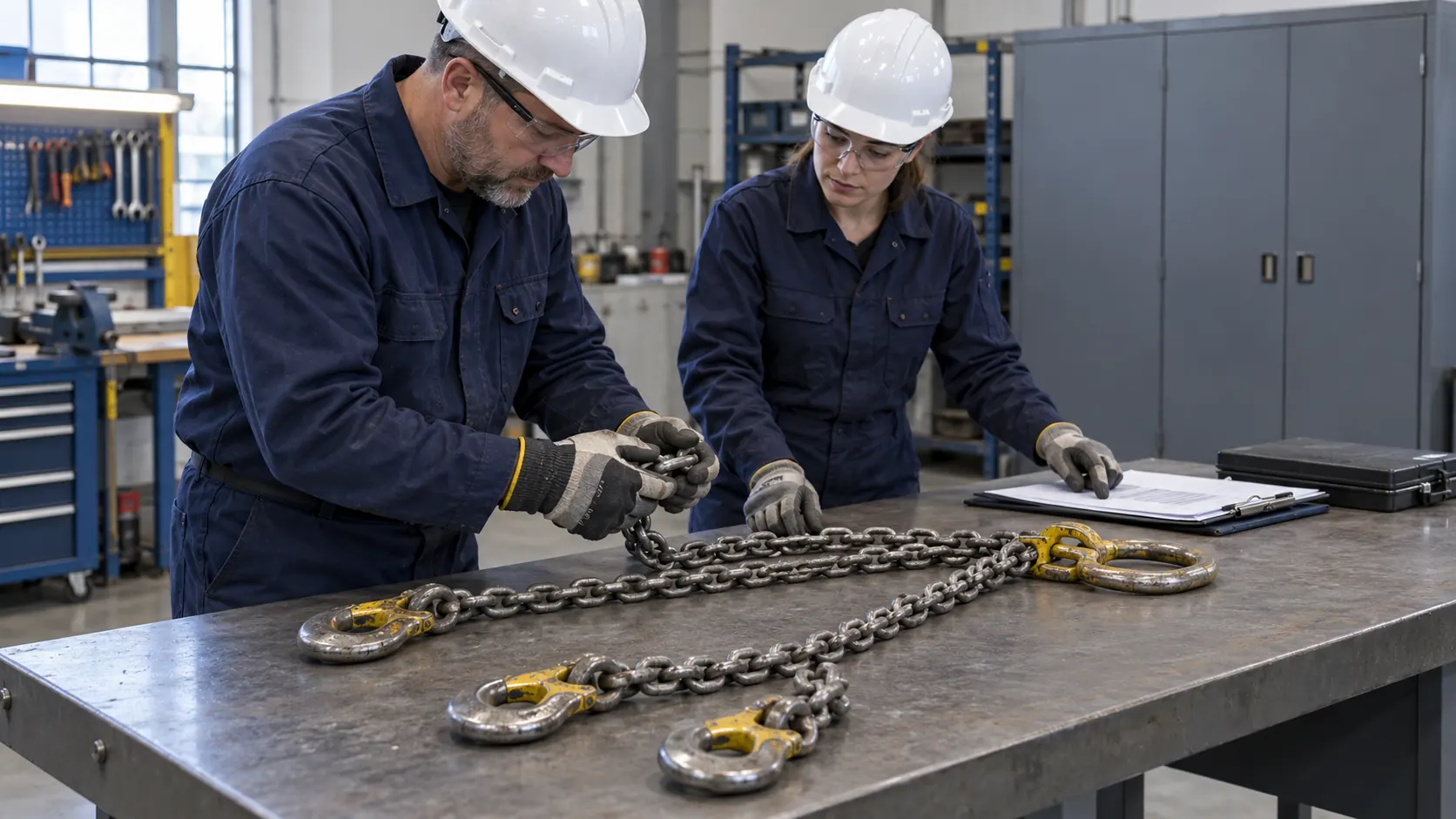
A chain sling can be unsuitable because it is damaged—or because a sound sling is used in a configuration that exceeds its permitted capacity. A new HSE enforcement report shows why a lifting plan must deal with both questions and make withdrawal from service easy to enforce.
What happened, and what is new
In its report published on 20 October 2026 ↗, HSE describes a 12 October 2021 incident at a Crediton galvanizing site. A chain failed while carrying a nearly three-tonne steel beam over a galvanizing bath. The falling beam displaced molten zinc and seriously burned a worker.
HSE found that damaged, deteriorated chains had not been withdrawn, required regular inspections were missing, and the slinging configuration placed a load above the chains’ safe capacity. The immersion-and-swilling risk assessment did not address chain checks or configuration. Wedge Group Galvanizing Limited was fined £566,666 at Bristol Magistrates’ Court on 14 October 2026, after pleading guilty under section 3(1) of the Health and Safety at Work etc. Act 1974. The new development is publication of these findings, not a new accident.
1. Ask two separate release-to-lift questions
The following checks are Worksite Safety Hub’s practical application of the findings and HSE guidance, not additional findings about this company. First: is this identified accessory in an acceptable condition for its intended service? Second: is its capacity adequate for the actual load, geometry, attachment method and environment?
A legible identification tag or an examination report cannot answer both questions on its own. Ensure the competent lift planner can match the accessory to the relevant information. If identification, condition or the correct capacity cannot be established, pause the lift and resolve the uncertainty through the authorised process.
2. Make a failed check remove the equipment
A checklist is useful only if its result changes what happens next. Establish how a suspect accessory is identified, segregated and prevented from returning to a lifting rack. Give workers a clear route to stop the job without having to improvise a substitute.
Record who decides whether further examination, replacement or another action is required. Do not make an informal repair or return damaged chains to service because the next load appears lighter. Review whether replacement availability or production pressure could undermine the withdrawal process.
3. Keep checks, inspections and thorough examination distinct
HSE’s thorough-examination guidance ↗ distinguishes systematic examination by a competent person from checks and inspections needed in service. For lifting accessories, the usual LOLER examination interval is six months, unless a competent person’s written examination scheme specifies otherwise. Other circumstances can also require examination. This is not a universal worldwide interval.
Do not treat a current examination report as proof that no damage has occurred since. Define the in-service checks and inspection arrangements appropriate to the equipment, manufacturer’s instructions, use and deterioration risks. Confirm that findings reach the person who can take equipment out of service—not just an electronic filing system.
4. Plan for the actual environment and configuration
HSE’s lifting-planning guidance ↗ calls for competent planning proportionate to risk, addressing foreseeable hazards, equipment integrity and relevant derating. A familiar task still needs a review when the load, accessory, geometry or conditions change.
In corrosive, hot or otherwise demanding service, have competent specialists establish the accessory’s suitability and the inspection arrangements. Do not extrapolate a manufacturer’s instruction for one application to every chain. Do not calculate a new safe capacity from a photograph or copy another team’s sling arrangement without verification.
5. Include the consequences around the load
A lifting assessment should consider what a dropped or displaced load could strike or release. Around hot processes, tanks or hazardous materials, the consequence can extend beyond the load’s footprint. Review people’s locations, exclusion arrangements and process interfaces with the relevant operators.
Do not rely on PPE or a spotter to compensate for an unsuitable lifting system. Confirm the planned method, supervision and safe position before the lift starts. If the required conditions cannot be established, the useful outcome of the assessment is a stopped or redesigned job.
Leadership and toolbox questions
- Can we prove both condition and capacity for this configuration?
- What happens physically to a sling after a failed check?
- Who receives and closes out examination defects?
- Which environmental conditions change suitability or inspection needs?
- What could a falling load release, displace or damage?
- Can the crew stop without pressure to find an unverified substitute?
Video availability
No suitable, non-graphic, directly relevant authoritative embeddable training video was verified for this article. HSE’s written findings and guidance are linked instead; injury footage is not needed to explain the controls.
Sources and dates
- HSE — Galvanizing company fined following chain failure ↗Published 20 October 2026; reports the 14 October sentencing and 12 October 2021 incident. Findings, not a new incident today.
- HSE — Planning and organising lifting operations ↗Official guidance on competent planning, supervision, foreseeable risks, derating and changing conditions.
- HSE — Thorough examination of lifting equipment (INDG422 PDF) ↗Explains examination, inspections, reporting and the written examination-scheme alternative. Local law and equipment-specific requirements still apply.
Sources checked 20 October 2026. Source statements and original practical applications are distinguished above. Always consult current official advice and applicable local requirements.
Share the lesson
Open the separate 9:16 Pinterest poster
AI-generated illustration, not an actual incident or a technical procedure. HSSE TIPS branding appears only in the designed poster footer.
Your experience matters
Share your thoughts on this page
Have a question, a useful experience or a suggestion? Add your input below.
Comments are public. Keep them respectful and relevant. Do not share contact details, confidential information or emergency reports.
Comments on this page
Loading comments…