Product Reviews · Fire and Rescue Vehicles
Ford Transit Fire Truck Review: Six Seats, 400-Litre Tank and Fleet Buying Guide
Affiliate Disclosure: Worksite Safety Hub may earn a commission if you make a qualifying purchase through links in this article. This does not change the price you pay.
A fire vehicle earns its place in a fleet by bringing the right people and equipment together. For a small brigade or an industrial response team, that can mean a crew cab, accessible equipment lockers and an onboard water supply in a vehicle that fits the organization’s routes and procedures.
The Ford Transit fire truck reviewed here combines six advertised seats with a separate equipment body and a listed 400-litre water tank. Its seller describes it as new, with a 2.0-litre diesel engine rated at 140 hp. Those facts make it an interesting starting point for a light fire-apparatus procurement exercise. The decisive question is how the completed conversion matches the brigade’s equipment list, loaded weight and response duties.
This is a desk-based review of the advertised vehicle, manufacturer material and converter information. We have not inspected or tested it. Seller claims, gallery observations and general procurement guidance are distinguished throughout.
EXPLORE THIS FORD TRANSIT FIRE TRUCK
Ford Transit Fire Truck: Overview
This offer concerns a red Ford Transit listed by IPS StrażakSAM, a Polish fire-vehicle manufacturer. The advertisement specifies a January 2025 production date, six seats, a 3,500 kg gross vehicle weight and a 400-litre water tank. The seller also states that its firefighting vehicles and extinguishing system are produced in Poland.
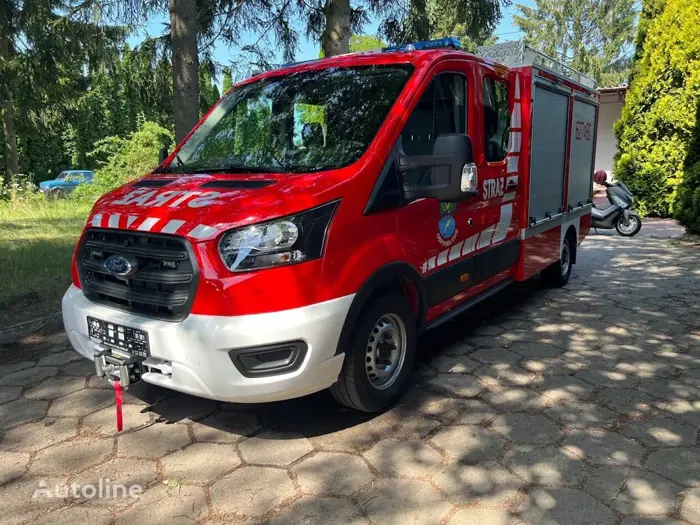
The configuration is more specific than the broad marketplace label “fire truck.” The gallery shows a crew-cab Transit with a separate shuttered equipment body. It therefore deserves evaluation as a crew-carrying light fire vehicle with an advertised onboard water supply, rather than simply a passenger van carrying warning lights.
Its final operational role depends on the supplied pump, hose equipment, tools and documentation. A 400-litre tank alone does not establish fire class suitability, extinguishing performance or compliance with a particular fire-service standard.
Ford Transit Platform and Vehicle Engineering
Ford’s official Transit chassis-cab information explains why the platform is used for specialist bodies: the range offers different cab arrangements and chassis configurations for conversion. A chassis-cab installation lets a bodybuilder develop equipment accommodation behind the crew compartment rather than working entirely within a panel van.
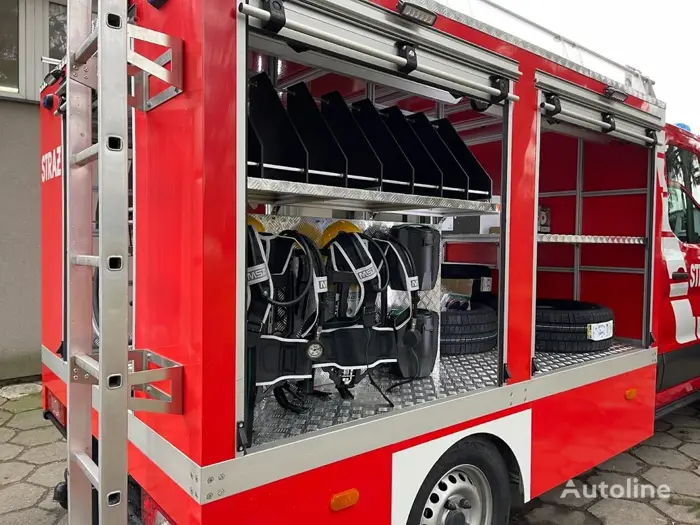
The reviewed gallery follows that approach, with a red cab and a distinct rear body incorporating silver roller shutters. Open-compartment photographs show metal shelves, dividers and equipment mounting areas. The layout offers a useful basis for discussing how a brigade’s inventory can be distributed and accessed.
The listing does not provide a complete Ford derivative, VIN or wheelbase. The gallery’s appearance does not prove the exact production generation or specification code. Buyers should obtain the base-vehicle build record and completed-vehicle documents before matching this offer to a Ford brochure. Current Transit range equipment must not automatically be attributed to this particular conversion.
Engine, Transmission and Drivetrain
The advertiser specifies a four-cylinder diesel engine with 2,000 cm³ displacement and output of 140 hp, also displayed as 103 kW. Euro 6 emissions classification and a particulate filter are listed. These are seller-reported specifications for this offer; an engine code and torque figure are not supplied.
No transmission type, gear count or drive arrangement was confirmed in the information reviewed. In particular, this advertisement should not inherit the four-wheel-drive description of a different Transit fire truck. Ford offers multiple drivetrain configurations across the Transit family, making the exact build information important.
For procurement, the useful next step is to match the engine, gearbox and driven axle arrangement to the duty cycle: town response, repeated short journeys, station access and fully loaded operation. Performance and fuel consumption require appropriate vehicle-specific evidence. No acceleration, economy or off-road claims are made here.
Firefighting Conversion and Body Design
IPS StrażakSAM identifies itself as a producer of fire vehicles. Its own website describes specialist bodywork and integrated equipment arrangements. This supports the converter’s role in developing the fire-service installation, while the precise construction specification of the vehicle offered still belongs in the purchase contract.
The listing gallery shows more than one livery and equipment arrangement. Some images have white lower bumpers, while another shows a dark bumper; markings also vary. These photographs should be treated as the seller’s presentation of its conversion work until the seller identifies which images document the exact vehicle being supplied.
Ask for a current walk-around linked to the vehicle identification, together with a signed equipment schedule. That is the clearest way to connect the advertised six-seat, 400-litre specification with a particular completed build. It also helps the buyer choose compartment locations and mounting arrangements that suit existing operating procedures.
Firefighting Equipment and Systems
400-litre water storage
The advertisement explicitly lists a 400-litre water tank. That provides a concrete specification around which to assess the apparatus. A tank of that nominal capacity represents approximately 400 kg of water when full, before allowing for the tank itself, pump, hoses, crew and other equipment.
Operational endurance cannot be calculated without verified usable water volume and the selected discharge rate. The tank’s capacity is therefore a storage figure, not a promise of a particular firefighting duration. Buyers should establish the filling arrangement, drain access, tank construction, internal control of water movement and inspection requirements with the converter.
Pump, hose and foam equipment
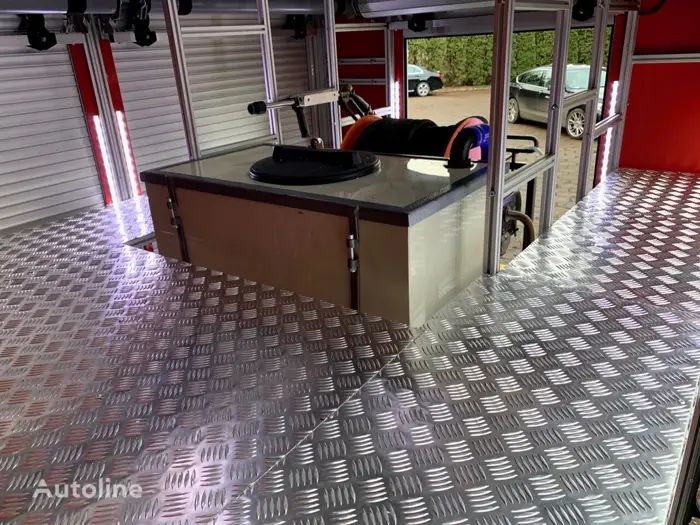
The seller describes a Polish-produced extinguishing system. A gallery view shows a tank module with a filler opening and a hose reel behind it. However, a pump manufacturer, model, flow rate and pressure rating were not confirmed for this specific vehicle.
StrażakSAM publishes general extinguishing-system specifications on its website. Those catalogue details are not sufficient evidence that the same pump or hose specification is installed in this 400-litre build. Request a system data sheet and a demonstration recording the pressure, flow and operating arrangement of the equipment actually supplied.
No verified foam-tank capacity, foam proportioner, monitor specification or suction and discharge schedule was available. Likewise, breathing apparatus visible in a gallery compartment does not establish that those sets are included in the sale. Agree quantities, service condition and certification for every supplied accessory.
DISCOVER THE EMERGENCY EQUIPMENT
Emergency Warning Lights and Communication Equipment
The inspected gallery shows a blue roof warning bar, auxiliary warning lamps and compartment lighting in some views. These observations explain the conversion’s emergency-service presentation, but they do not establish the make, approval status or exact lighting package of the supplied vehicle.
A siren model, radio system and incident communications package were not individually confirmed. Fleet buyers should specify how warning controls, radio equipment and body electrics will be integrated, including power protection and instructions. This is particularly useful when a department needs compatibility with an existing communications network.
Emergency-light use and vehicle registration must be assessed for the intended operating jurisdiction. A Polish fire-service description is useful identification, but it is not a substitute for the destination authority’s acceptance.
Crew Cabin and Operator Environment
Six seats are listed, and the gallery shows a double crew cab. That makes personnel accommodation a central part of this Transit’s appeal. It can allow a team to travel with its equipment, provided the seating and fully loaded configuration meet the buyer’s requirements.
The advertisement does not define the division between front and rear seats, seat specifications, air conditioning, infotainment or driver-assistance equipment. These details should be checked on the exact vehicle rather than borrowed from a higher-trim Transit brochure.
A practical inspection should include access while wearing normal response clothing, restraint availability, visibility from the driving position and the location of additional controls. Confirm where personal protective equipment is carried and secured. These checks help the organization understand the working layout without assuming a particular cab feature is installed.
Equipment Storage and Interior Configuration
Gallery photographs show roller-shutter access, metal-lined compartments, shelves and dividers. Several storage areas can be reached from outside the body. Other views show breathing-apparatus holders, illustrating the type of mounting arrangement the converter presents.
The important procurement distinction is between a mounting system and the equipment attached to it. An attractive compartment photograph does not define a complete delivered inventory. A signed schedule should list each tool, bracket, hose and portable item, with its location and any accompanying service documentation.
For fleet integration, walk through a normal deployment sequence: which locker opens first, who retrieves each item and how equipment is returned and secured. Compartment usefulness is best judged against the brigade’s own inventory and staffing pattern. Storage volume alone does not establish safe carrying capacity.
Vehicle Dimensions, Payload and Capacity
The seller lists overall dimensions of 6 m long, 1.9 m wide and 2.25 m high. The measurement basis is not stated, so confirm whether mirrors, roof fittings and other projections are included before arranging station clearance or transport.
Net weight is advertised as 2,350 kg against a 3,500 kg gross weight. Subtracting these figures gives 1,150 kg, but that arithmetic must not be represented as certified usable payload. It is unclear which fluids, body equipment and accessories are included in the advertised net figure.
The completed vehicle should be weighed in its intended response configuration, including crew, fuel, water and tools. Check individual axle loads as well as total mass. A full 400-litre water supply is a substantial part of the load plan; the crew and equipment allowance must be established from the completed vehicle’s documents and actual measurements.
Fire and Rescue Applications
For municipal or rural brigades, the six-seat configuration and listed water storage warrant consideration where the organization’s response plan calls for a light crew-carrying appliance. Any direct firefighting assignment must be matched to verified pump performance, the supplied equipment and the organization’s procedures.
Industrial fire brigades and infrastructure operators may also find the combination relevant when reviewing site access, personnel movement and equipment carriage. The review does not establish suitability for a particular industrial hazard. That assessment needs the hazard profile, extinguishing media and complete conversion specification.
There is no verified basis here for airport rescue and firefighting certification, hazardous-materials capability or specialist rescue functions. Buyers evaluating a support role should still define the required inventory and communications systems. A clear intended duty is more useful than a broad emergency-vehicle label.
Safety and Operational Considerations
Commissioning should connect driver familiarization, equipment operation and load management. Operators need instructions for the actual pump, electrical controls and installed accessories, together with the Ford base-vehicle guidance. Emergency driving authorization and procedures should follow the organization’s requirements and applicable local rules.
Inspect equipment retention, locker closures, access steps and the securing of portable items. Establish routine checks for the water system and body electrics alongside chassis maintenance. These are normal fleet acceptance tasks, not indications of an identified defect.
The seller mentions special fire-vehicle documentation. Request the exact documents, their scope and their applicability to the destination country. A registration description does not by itself demonstrate compliance with every apparatus standard or permission to operate warning equipment abroad.
Technical Specifications
Ford Transit Base Vehicle Specifications
| Item | Advertised value |
|---|---|
| Manufacturer / model | Ford Transit; full derivative not specified |
| Production / first registration | January 2025 / January 2025 |
| Condition / mileage | New, as described by seller / 1 km |
| Engine | Four-cylinder diesel; 2,000 cm³ |
| Power | 140 hp / 103 kW |
| Emissions equipment | Euro 6; particulate filter listed |
| Seats / axles | 6 / 2 |
| Advertised net / gross weight | 2,350 kg / 3,500 kg |
| Advertised dimensions | 6 × 1.9 × 2.25 m; measurement basis to confirm |
Firefighting Conversion and Emergency Equipment Specifications
| Item | Evidence reviewed |
|---|---|
| Seller / converter identity | IPS StrażakSAM; seller describes its own Polish-produced fire vehicles and extinguishing system |
| Water tank | 400 litres, explicitly advertised |
| Body arrangement | Crew cab and separate shuttered equipment body shown in gallery |
| Gallery equipment observations | Hose reel, tank module, warning bar, locker lighting and mounting arrangements; exact supplied inventory to agree |
| Registration description | Seller states special fire-vehicle documentation |
Transmission, driven axles, torque, wheelbase, certified payload and specific pump or foam-system ratings were not confirmed. They are intentionally excluded from the specification values.
VIEW CURRENT PRICE & AVAILABILITY
Current Seller Offer — Verified 24 October 2026
Product Location: Ciechanów, Poland. This is the vehicle location stated in the advertisement.
- Offer reference: GV39122.
- Asking price: PLN 229,000 net. The international display showed approximately €52,320 net when checked; conversion values can change. Confirm currency, VAT and the written total quotation.
- Year and registration: January 2025 manufacture and first registration.
- Condition and mileage: seller lists new and 1 km, and describes the vehicle as without mileage. “New” here reflects the advertiser’s classification; it does not establish an unregistered vehicle.
- Configuration: Ford Transit, six seats, 140 hp diesel, listed 400-litre water tank.
- Availability: seller states the presented vehicle is available immediately. Confirm current stock and the exact supplied build before committing.
- Warranty: a specific coverage period and terms were not stated for this offer.
A vehicle-delivery service is indicated, but no confirmed destination list, transport price or detailed export terms were found. Delivery destinations, shipping arrangements, and applicable transport terms were not specified in the information reviewed. Prospective buyers should confirm these details directly with the seller.
Buyer Considerations Before Contacting the Seller
Start with the full Ford derivative, VIN, engine code, gearbox and drive arrangement. Ask how the January 2025 registration and seller’s new condition are documented, and request a current walk-around showing the vehicle offered.
Then obtain the converter’s equipment schedule: tank details, pump identity, duty ratings, hose length and outlets, foam equipment if supplied, warning systems and portable accessories. Ask for operating manuals, commissioning results, relevant test records and maintenance requirements.
Complete the enquiry with seating approval, completed-vehicle weights, axle allowances, destination registration requirements, inspection arrangements, spare-parts support and written warranty terms. Agree delivery destinations, transport and customs responsibilities, collection arrangements, payment milestones and the final tax treatment in the quotation.
For a different configuration, compare our Ford Transit 4x4 review. Our Ford Ranger fire truck review and Mercedes-Benz Vito fire-service review offer further configuration comparisons. Each concerns a separate advertisement and equipment specification.
Buyer FAQs
What is the Ford Transit Fire Truck?
It is a Transit-based fire-service conversion advertised by IPS StrażakSAM with six seats, a separate equipment body and a 400-litre water tank.
Is the advertised vehicle new or used?
The seller classifies it as new. The listing also records January 2025 first registration and 1 km. Buyers should verify those documents and the exact condition before purchase.
What emergency equipment is installed?
The seller lists an extinguishing system and 400-litre tank. Gallery images show warning lights and equipment-storage arrangements; agree a written inventory for the supplied vehicle.
Does it have a fire pump or water tank?
A 400-litre water tank is explicitly listed. Pump manufacturer, model, flow and pressure were not confirmed for this build. Request the exact system specification.
How many crew members can it accommodate?
Six seats are advertised. Confirm the approved seating layout, restraints and fully loaded weight allowance.
Where is the advertised vehicle located?
The advertisement states Ciechanów, Poland as the vehicle location.
Does the supplier offer international delivery?
A delivery service is indicated, but international destinations, prices and detailed transport terms were not specified. Confirm these for your location.
How can buyers contact the seller?
Use the seller-offer buttons in this review to follow the tracked offer and make an enquiry about the exact vehicle and equipment.
Final Verdict
This Ford Transit presents a clearly identifiable combination: six advertised seats, a 400-litre water tank, a dedicated equipment body and a seller-described Polish firefighting conversion. Those are useful foundations for a fleet buyer seeking a light crew-carrying fire vehicle.
The strongest purchasing approach is to turn that outline into a documented specification. Confirm the pump, drivetrain, delivered inventory and completed-vehicle load limits, then assess them against the intended response role. With those details agreed, the offer can be evaluated on the requirements that matter to the organization.
Sources and Media Notes
Research checked 24 October 2026: advertiser offer GV39122, official Ford Transit chassis-cab information, and IPS StrażakSAM’s published bodywork and extinguishing-system material. Ford range information and converter catalogue options are not presented as equipment confirmed on this vehicle.
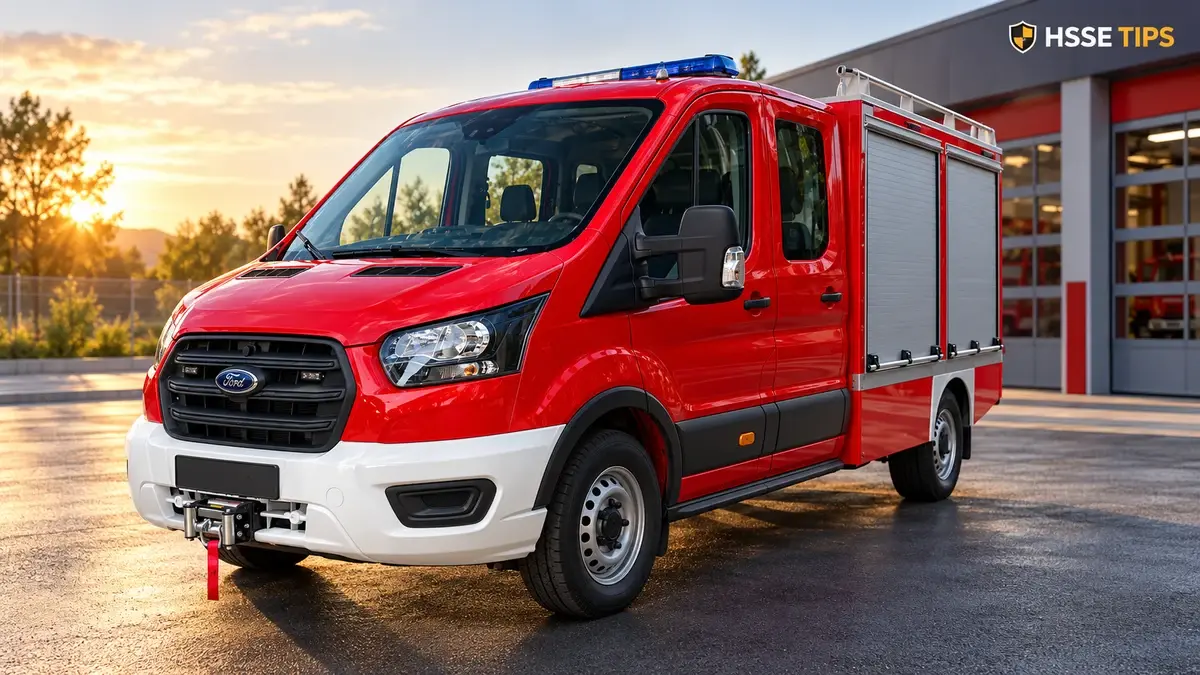
Original advertiser gallery photographs are reproduced above with their watermarks retained. The gallery includes different finishes, so buyers should confirm the actual supplied vehicle. View the full gallery through the offer buttons. No advertiser-supplied video or sufficiently specific official demonstration was verified for this build. The featured visual is generated promotional artwork based on a gallery reference, not an authentic photograph of the vehicle’s condition or location.
Join the Conversation
When choosing a Ford Transit-based emergency vehicle, what matters most—crew accommodation, firefighting equipment, configuration or operational flexibility? Share your thoughts in the comments below.
Your experience matters
Share your thoughts on this page
Have a question, a useful experience or a suggestion? Add your input below.
Comments are public. Keep them respectful and relevant. Do not share contact details, confidential information or emergency reports.
Comments on this page
Loading comments…