HSSE TIPS · Product Comparison · Mobile Healthcare Infrastructure
Mobile General OPD Clinic vs Mobile Field Hospital: Which Healthcare Facility Fits Your Project?
Affiliate Disclosure: Worksite Safety Hub may earn a commission if you make a qualifying purchase through links in this article. This does not change the price you pay.
Introduction: Two Valuable Approaches to Mobile Healthcare
Does your project need a consultation setting that travels between communities, or a connected medical facility assembled at a deployment site? The decision begins with the care you intend to deliver: consultations, examinations, referral support or a defined combination of clinical departments.
The Mobile General OPD Clinic and Mobile Field Hospital Container illustrate two distinct approaches. Autozone UAE’s example is an Isuzu-based medical truck with photographed examination and utility fittings. AmbulanceMed’s example is a thirteen-container hospital design with seven expandable modules. Both deserve evaluation against the same service brief, staffing plan and acceptance criteria.
This comparison separates advertiser statements, visible fittings and proposed design functions. It offers a procurement framework rather than a clinical inspection or a universal winner. Equipment quantities, patient capacity and readiness to operate must follow the specific purchase specification.
Understanding Mobile General OPD Clinics
OPD means outpatient department. It supports consultation and examination without those encounters themselves requiring inpatient admission. A mobile OPD project brings that service environment to planned locations, supported by suitable professionals, medical supplies and referral arrangements.
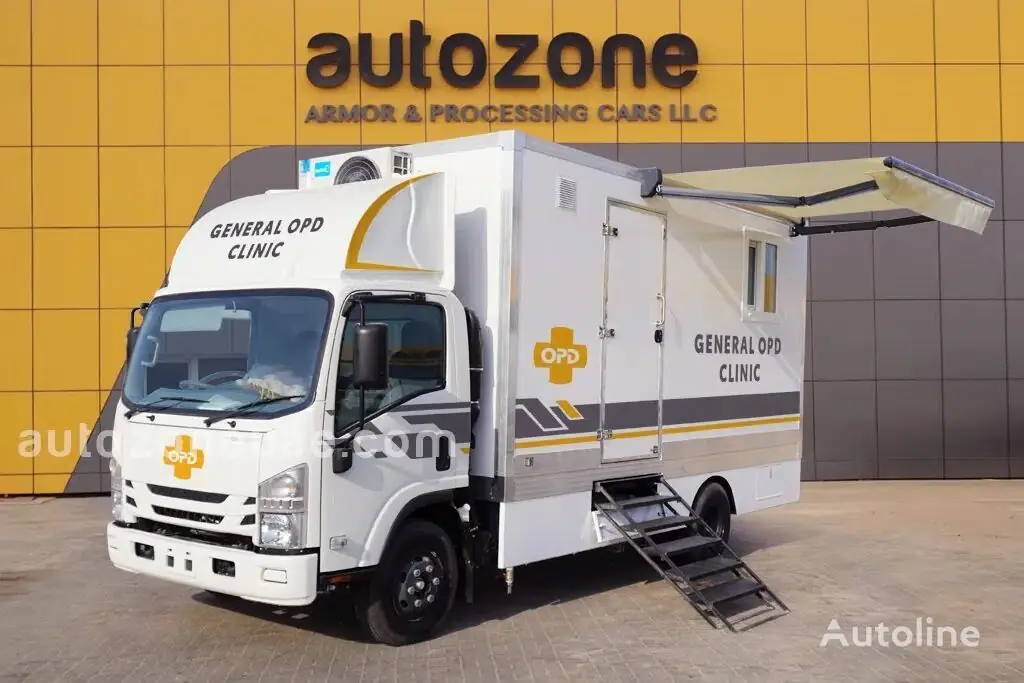
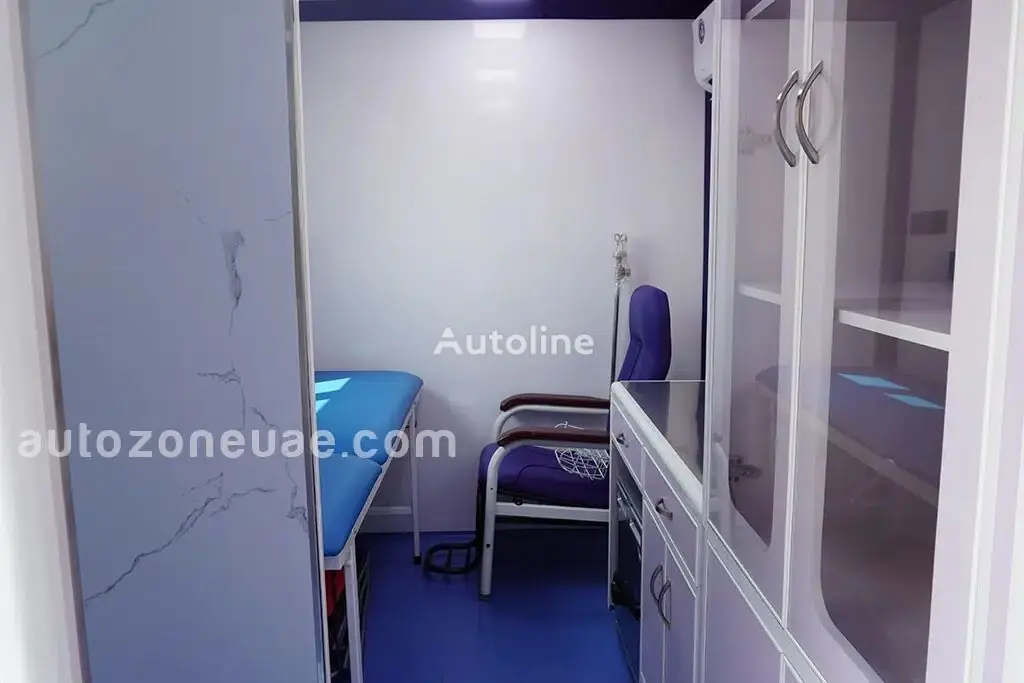
The featured Autozone clinic uses a raised medical box on an Isuzu NPR 75 truck. Its matched converter page identifies diesel fuel, manual transmission, two-wheel drive and left-hand drive. Reception and clinic areas are listed; original photographs show a blue examination couch, seating, cabinets, a sink and toilet facilities. They do not establish a room count or daily patient capacity.
For procurement, map the consultation from arrival to onward referral. Confirm where records are taken, how examinations remain private and how supplies are replenished between visits. Road access and a reliable parked deployment site form part of this clinical service plan.
Understanding Mobile Field Hospital Facilities
A mobile field hospital brings transportable clinical and support spaces together at a selected site. Its service scope comes from the approved layout, installed devices, professional team and supporting infrastructure. The term describes a facility concept; it does not by itself establish surgical, intensive-care or inpatient capability.
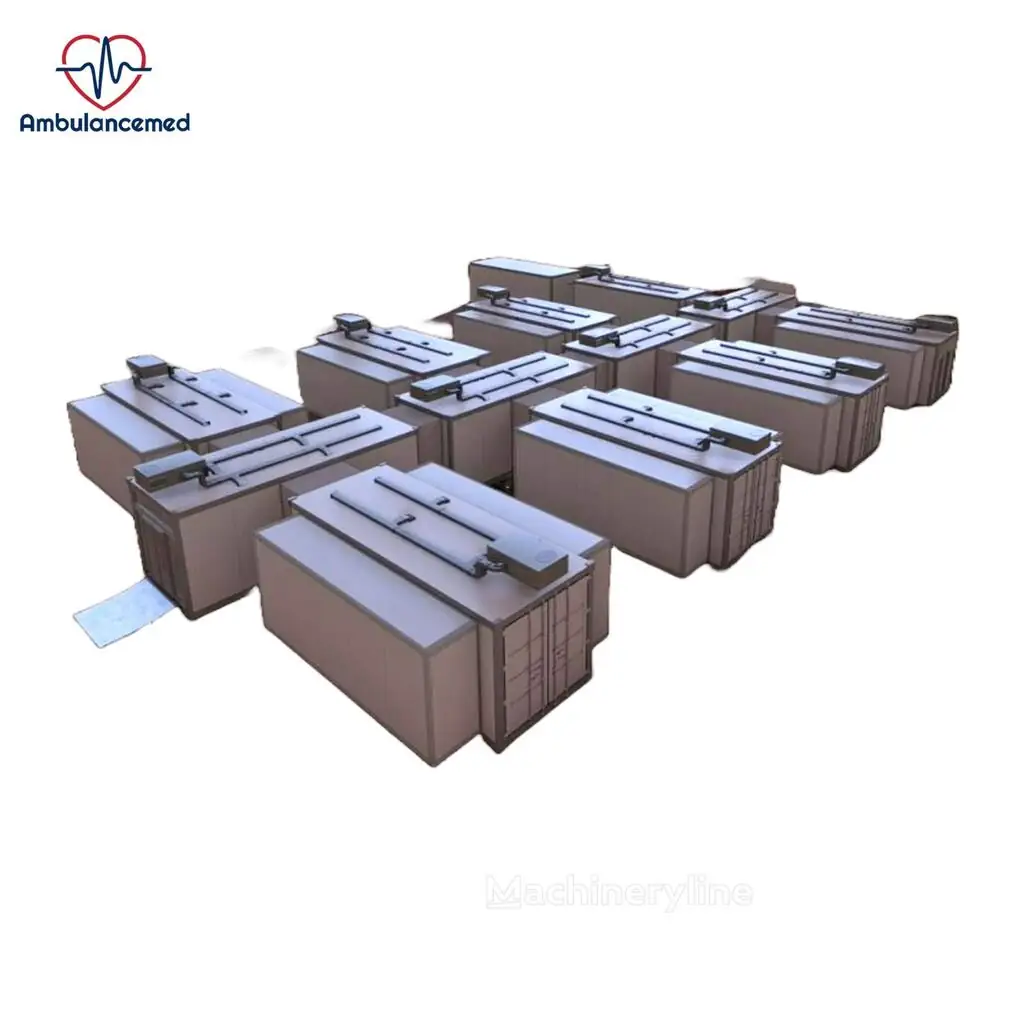
AmbulanceMed’s advertised design comprises thirteen supplier-described ISO 20-foot containers, including seven expandable units, with an approximate deployed footprint of 28.5 × 17 metres. It is a connected modular system, rather than a single medical container or a self-propelled vehicle. The figure is configuration-dependent and does not establish usable interior floor area.
Published departments include emergency/operating space, two ICU modules, patient modules for men and women, laboratory/pharmacy, imaging and blood collection, alongside utility and sanitation functions. These are manufacturer-described design areas. No itemised supplied-device schedule or contracted bed capacity was verified. A project team should translate every department into a room specification, equipment inventory and operating requirement.
Mobile General OPD Clinic vs Mobile Field Hospital: At-a-Glance Comparison
Healthcare Configuration Comparison
| Healthcare consideration | Mobile general OPD clinic | Mobile field hospital |
|---|---|---|
| Healthcare focus | Outpatient consultations and examinations | Clinical services defined by the installed configuration |
| Facility approach | Mobile outpatient workspace | Transportable, connected clinical and support spaces |
| Consultation and examination | According to approved layout | According to approved departmental layout |
| Treatment and patient accommodation | According to equipped and authorised service | According to equipped and authorised departments |
| Diagnostics | Devices specified for the service | Devices specified for each department |
| Power, water and HVAC | Match installed systems to deployment site | Coordinate systems across modules and support areas |
| Staffing and patient flow | Based on intended services and clearances | Based on departments, interfaces and operating hours |
| Transportation | Based on actual vehicle or facility format | Based on actual transport modules and handling plans |
| Deployment | Site access, safe parking and service connections | Site preparation, positioning, interconnection and commissioning |
The category comparison above is a planning framework. The next table reports the two specific offers; “not specified” means evidence was unavailable, rather than that a feature is absent. Published design scope is distinguished from a signed sale inventory.
Featured Products: Verified Advertiser Details
| Specification | Autozone Mobile General OPD Clinic | AmbulanceMed Mobile Field Hospital |
|---|---|---|
| Manufacturer / model | Autozone UAE conversion; Isuzu NPR 75 base identified by converter | AmbulanceMed; Mobile Field Hospital; no unique model code verified |
| Product type / condition | Truck-mounted box-body clinic; advertised new | Connected container hospital design; advertised new |
| Year / internal dimensions | Not specified | Not specified |
| Structure / external dimensions | Thermal insulation listed; material grades and overall dimensions not specified | 13 nominal 20-foot containers, 7 expandable; approx. 28.5 × 17 m deployed; material grades not specified |
| Transport configuration | Diesel, manual, 2WD, LHD truck; two axles listed | Transportable modules; included chassis, trailers and handling equipment not specified |
| Clinical facilities | Reception, clinic, examination bed and privacy curtain listed; couch and cabinets pictured | Named operating, ICU, patient, diagnostic and support departments; equipped capacity not verified |
| Medical equipment evidence | BP/stethoscope, pulse oximeter, diagnostic set, scales, thermometer and other devices listed; final inventory to agree | Device makes, quantities and priced inclusion schedule not specified |
| Electrical / water | Gasoline auxiliary generator, control panel, lighting, tanks, basin and toilet listed; ratings/capacities not specified | Power/water network and sanitation design functions; generator rating and storage capacities not specified |
| HVAC / access | AC and insulation listed; entrance steps pictured; ramp/lift not specified | Climate provision described; performance and final accessible routes not specified |
| Physical location / price | Ajman, United Arab Emirates; price on request | Türkiye, country-level listing only; price on request |
| Availability / delivery terms | Listing accessible; stock, dispatch date, destinations and agreed terms not specified | Listing accessible; stock, dispatch date, destinations and agreed terms not specified |
Clinical Facilities, Patient Flow and Healthcare Workflow
For an OPD programme, define a practical sequence: arrival, registration, consultation, examination, advice and referral. Ask the supplier to demonstrate this sequence on the proposed layout, including the positions of patients, accompanying people and staff. Listed reception space does not establish a separate waiting room or an electronic registration system.
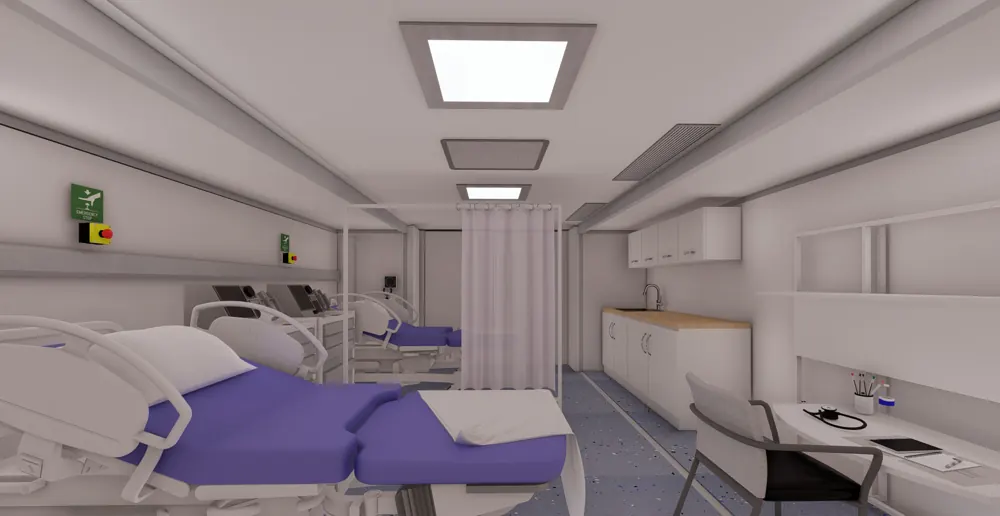
For the field-hospital project, review how departments connect. Plan assessment and onward movement alongside staff access, clean supplies, equipment servicing and waste collection. Rendered corridors illustrate relationships between rooms; final widths, stretcher turning, privacy and emergency exits require dimensioned drawings.
Both projects benefit from a walk-through using the intended workflow. Check whether a clinician can access the patient and equipment while preserving privacy, and whether cleaning can be completed before the next encounter. Define treatment positions and staffing from usable space and service tasks, rather than counting furniture in an image.
Medical Equipment and Clinical Service Planning
Seller-listed OPD equipment
The OPD proposal names an examination bed, blood-pressure equipment with stethoscope, pulse oximeter, diagnostic set, physician scale, digital thermometer, glucometer and hemoglobinometer. It also lists oxygen equipment, a laryngoscope kit, bag-mask device and foldable stretcher. Confirm models, accessories, calibration, consumables and quantities in the quotation. These entries do not alone establish an emergency department or licensed laboratory.
Field-hospital design and equipment scope
The hospital’s clinical department labels provide a starting point for a multidisciplinary specification. They do not confirm a supplied ventilator, ECG machine, ultrasound unit, CT scanner, laboratory analyser, suction system or medical refrigerator. Equipment shown in renderings remains illustrated unless expressly included. Separate fixed installations, supplied devices, selected options and buyer-provided items in the contract.
The useful comparison is the complete service package: an examination bed needs suitable access and cleaning arrangements; any proposed imaging, surgery or critical care requires its own equipment, engineering, staffing and approval pathway. Avoid treating an equipment catalogue linked from a manufacturer page as an inclusion list for this purchase.
Electrical Power, Water and Sanitation
The OPD listing expressly describes a gasoline-engine auxiliary generator, distinct from the diesel truck engine. Its output, voltage, frequency, connection method and electrical protection are not specified. A shore-power inlet, batteries and inverter were not verified. Agree the load schedule, starting demand, operating duration and safe supply arrangements for each deployment.
The field hospital includes a power/water network in its design scope; that does not establish a rated generator, backup battery or UPS package. Specify distribution between modules, earthing, essential loads, changeover arrangements and testing. Any selected medical equipment should be checked against the actual supply, rather than a generic description of independent operation.
Water tanks, washing basin and a toilet with basin are listed for the OPD, with sink and toilet photographed. Hospital sanitation and water services are described, but neither offer publishes verified freshwater or wastewater capacities. Define potable supply, handwashing, drainage, servicing and waste collection against the proposed workload. Include replenishment and disposal responsibilities in the operating plan.
HVAC, Hygiene and Medical Facility Safety
Autozone lists air conditioning and thermal insulation; a split AC unit is visible in its photographs. Field-hospital information describes climate provision and utility interfaces. Cooling capacity, ambient operating range, humidity control and ventilation performance need project-specific confirmation. Comfort air conditioning does not establish validated isolation ventilation, HEPA filtration or negative pressure.
CDC’s core infection-prevention guidance applies across healthcare settings. Use that framework to plan staff training, hand hygiene, environmental cleaning, appropriate protective equipment and safe reprocessing. The guidance is a clinical planning reference, not evidence that either advertised facility is certified.
Assign responsibility for sharps, clinical waste, cleaning supplies and maintenance. Review secure equipment mounting, oxygen-cylinder restraint where applicable, electrical inspection, fire protection and emergency access. Obtain documented surface materials and cleaning compatibility. A smooth appearance in a photograph or rendering does not establish a tested healthcare finish.
Patient Accessibility and Facility Planning
The OPD exterior shows an elevated doorway reached by metal steps. A wheelchair ramp or lift was not verified. Ask for the proposed accessible arrival route, doorway clearances, assisted access and safe evacuation arrangements, matched to the intended population and applicable requirements.
For the modular hospital, examine approaches to each required service, levels between connected modules, turning areas and emergency exits. Confirm ramps, landings and clearances on the final site plan. Patient dignity also requires private consultation, appropriate signage and a practical way for carers to accompany patients where suitable.
Mobility, Transportation and Deployment Considerations
The OPD integrates its medical body and road platform, making route and parked-site assessment central to planning. Confirm completed dimensions, axle weights, permissible gross weight, road legality and turning access. The advertised 4,255 kg load entry is not proof of remaining payload after conversion, water, equipment and people are aboard.
The hospital requires a module transport and positioning plan. Thirteen containers do not automatically mean thirteen identical freight movements. Obtain finished transport envelopes, masses, centres of gravity, lifting points and packing lists. Nominal ISO size does not by itself establish current transport approval for modified units or carrier acceptance. The IMO container-safety framework provides relevant context; it is not proof of this product’s certification.
Both formats need a site survey. For the hospital, add ground-bearing assessment, drainage, support points, expansion clearances and interconnections. Agree stages for delivery, positioning, utility connection, testing and clinical handover. The supplier’s rapid-setup description is not a verified duration. No deployment time or fuel-cost comparison is established for these offers.
Which Healthcare Facility Fits Different Medical Projects?
Community Primary Healthcare
An OPD clinic may be worth considering where its verified examination facilities support planned consultations and follow-up. Establish appointment arrangements, records, medicines and referral access. A modular facility may also support community services when its agreed departments and operating support match the programme.
Rural Healthcare Outreach
For repeated community visits, evaluate the OPD truck against actual routes, parking and patient access. For a selected rural base, evaluate the hospital against transport, installation, staffing and utility provision. Neither two-wheel drive nor container construction establishes suitability for a particular remote route.
Humanitarian Medical Programmes
Begin with the population’s assessed healthcare needs and coordination with existing providers. The OPD may support an appropriate consultation service; the hospital may support an agreed departmental programme. Include professional staffing, supplies, maintenance, translation and continuity of care in either proposal.
Disaster Response and Emergency Preparedness
Select infrastructure against the response plan, receiving-site readiness and verified clinical capability. A container hospital design can inform planning for coordinated departments; an OPD can inform assessment and follow-up planning. Neither product name establishes an operational emergency medical team or a WHO classification.
Hospital Outreach Programmes
An established hospital may use an OPD unit for suitable outreach consultations with clear referral arrangements. A modular project may provide agreed additional clinical space at an approved site. Align records, clinical governance, maintenance and resupply with the supporting hospital.
Corporate Occupational Healthcare
Define the workforce services, confidentiality requirements and clinical authorisations first. An OPD may suit scheduled consultations where its facilities meet the brief. A departmental modular proposal may be considered when the employer’s healthcare plan calls for those specified services and supporting professionals.
Remote Industrial Healthcare
Match the proposed facility to the workforce, site access, communications and referral chain. Reliable power, water, consumables and qualified cover belong in both options. Emergency response and patient transport require their own verified resources; they should not be inferred from the clinic or hospital label.
Temporary Healthcare Facility Expansion
Compare usable, commissioned space against the service being added. The OPD may provide appropriate examination capacity; the hospital may provide agreed linked departments. Confirm integration with utilities, patient pathways, operating hours and the eventual relocation or decommissioning plan.
Procurement, Maintenance and Project Planning
Write one service brief before requesting two quotations. State the intended consultations or departments, treatment positions, patient-access needs, operating hours, staffing and site conditions. This allows suppliers to describe a deliverable configuration and makes the proposals meaningfully comparable.
Separate the purchase into facility, medical equipment, transport, site works, installation, commissioning and operational support. Both offers use price on request, so no verified purchase-price ranking or operating-cost saving can be calculated. Budget using scoped quotations, including taxes, insurance, training, spares and recurring consumables.
The OPD needs both vehicle and clinical-equipment maintenance plans. The hospital needs module, connection, utility and clinical-equipment plans, plus transport support for relocation. Confirm local service availability, warranties, documentation, inspection intervals and access to replacement parts. Define factory and site acceptance tests before committing payment milestones.
Current Seller Offers — Verified 26 October 2026
These independently editable snapshots record the information accessible on the check date. An accessible advertisement does not establish allocated stock, a production slot or immediate dispatch. Ask for a dated offer tied to a specific vehicle or revision-controlled hospital specification.
Current Seller Offer: Mobile General OPD Clinic — Verified 26 October 2026
Manufacturer / model: Autozone UAE conversion; Isuzu NPR 75 base. Product type: truck-mounted OPD clinic. Condition: advertised new. Year: not specified. Price: on request; amount and currency not specified. Product Location: Ajman, United Arab Emirates, from the vehicle-location field; exact collection premises not verified.
Equipment: examination, basic assessment and oxygen/emergency items listed above; signed inclusion schedule to agree. Availability: listing accessible; allocated unit and dispatch date unconfirmed. Delivery / export: destinations, charges, Incoterms and documentation responsibilities not specified for this offer.
Current Seller Offer: Mobile Field Hospital Container — Verified 26 October 2026
Manufacturer: AmbulanceMed; seller AMBULANCEMED LTD.ŞTİ. Model: Mobile Field Hospital, Machineryline UN46997. Product type: connected container hospital design. Condition: advertised new. Year: not specified. Price: on request; amount and currency not specified. Product Location: Türkiye, country-level only; physical dispatch city and premises not specified. The supplier’s office address is not substituted.
Equipment: clinical and support departments described; supplied device quantities and bed capacity not verified. Availability: listing accessible; built stock, manufacturing slot and dispatch date unconfirmed. Delivery / export: product-specific destinations, shipping charges, Incoterms and installation or commissioning scope not specified.
Delivery, Export and International Purchasing Considerations
For each offer: Delivery destinations, shipping arrangements, and applicable transport terms were not specified in the information reviewed. Prospective buyers should confirm these details directly with the seller.
Request a proposal naming the collection point, destination, shipment method, insurance, customs responsibilities and delivery milestones. For the truck, verify import eligibility, registration, emissions and completed-vehicle documents. For the hospital, verify module handling, carrier acceptance, site approvals and installation responsibilities. Medical devices, oxygen systems and any selected imaging equipment require destination-specific review.
Define who supplies export documents, unloading equipment, local works, utility connections and commissioning personnel. An exporter’s general experience or international project gallery does not establish worldwide delivery, included installation or eligibility in a particular country.
Questions to Ask Before Buying Either Facility
- Which services, patient positions and staffing does the signed specification support?
- Which drawings establish usable dimensions, patient access, privacy and emergency exits?
- Which devices are included, optional, pictured only or buyer-supplied?
- What electrical loads, backup arrangements, water demand and wastewater provision apply?
- What dimensions, weights, transport approvals and handling instructions govern delivery?
- Who completes site works, installation, testing, training and operational acceptance?
- Which local clinical, structural, vehicle, environmental and equipment approvals are required?
- What are the full quoted price, exclusions, warranty, maintenance support and delivery terms?
Frequently Asked Questions
What is the main difference between a mobile OPD clinic and a field hospital?
The OPD centres on outpatient consultation and examination. A field hospital brings together clinical and support functions according to its actual specification. Neither name alone establishes a particular treatment capacity.
Is the featured OPD clinic a bus or a container?
The matched Autozone offer is an Isuzu NPR 75-based medical truck with an enclosed box body. It is distinct from the connected ground-deployed hospital modules.
Is the featured field hospital one container?
The advertised design describes thirteen nominal 20-foot containers, seven expandable. Confirm the supplied module schedule and final arrangement in the purchase documents.
Does the field hospital include surgery and intensive care?
Operating and ICU areas are named in its departmental design. Supplied devices, bed numbers, staffing, engineering performance and authorisations must establish which services can operate.
How many patients can either facility accommodate?
A verified contracted capacity is not specified. Define examination positions, beds where required, operating hours and workflow with the supplier and clinical team.
Are generators supplied with both products?
A gasoline auxiliary generator is listed for the OPD, without published ratings. The hospital describes a power network; an included rated generator package was not verified.
Are both facilities wheelchair accessible?
An OPD stair entrance is pictured; a ramp or lift was not verified. Hospital access and circulation need final dimensioned drawings. Agree an accessible service route for each project.
Can either facility provide advanced diagnostics?
Only the specifically equipped and authorised services should be planned. An imaging or laboratory department label does not confirm installed equipment or an operational diagnostic service.
Which option fits regular outreach visits?
Consider the OPD where its verified road access, dimensions and clinical facilities match the visit programme. Consider a modular proposal where the selected site and agreed departmental services suit the project.
Are shipping and installation included?
Product-specific destinations, shipping terms and included installation or commissioning were not established. Obtain a written delivered-and-commissioned scope for the destination.
Do these products have WHO emergency-medical-team approval?
No such approval was verified. WHO classification addresses the functioning team and its capabilities; it is not automatically a certification of a purchased truck or container facility.
Can the two configurations complement each other?
Yes, a healthcare organisation can plan outreach consultation and referral around an appropriately commissioned base facility. The interfaces, staffing, records and patient transport must be agreed for the actual service.
Final Verdict: Choosing a Configuration for Your Healthcare Project
The OPD offer provides a concrete truck-based consultation example, supported by original photographs and a listed assessment-equipment proposal. The field-hospital offer provides a connected multi-module design with named clinical and support departments. Those are distinct starting points for healthcare planning.
Choose the OPD where its completed specification supports the intended outpatient programme and deployment route. Consider the hospital where its agreed departmental configuration, utilities, staffing and site plan support the required services. Evaluate both through the same clinical brief and commissioning standard, and use written inclusions to turn an enquiry into a reviewable procurement proposal.
Join the Conversation
Which requirement shapes your project most: consultation workflow, clinical departments, patient access, utilities or deployment logistics? Share your planning priorities. Every Task. Every Person. Home Safe.
Sources, Media and Editorial Method
Checked 26 October 2026 using the original Autoline NT41519 and Machineryline UN46997 advertisements, the matched Autozone OPD specification, AmbulanceMed field-hospital documentation and related EOW project information. The WHO emergency-medical-team standards inform the distinction between a facility purchase and an operating clinical service. Planning recommendations are editorial analysis; no on-site test is claimed.
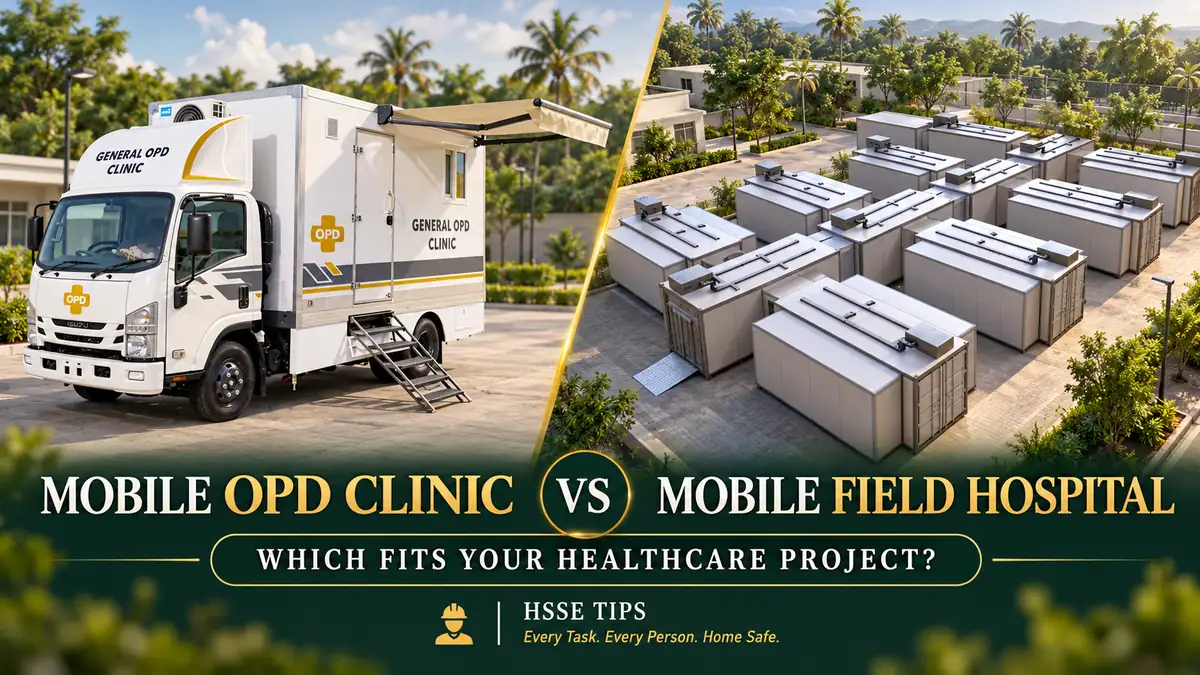
Read the individual Mobile General OPD Clinic review and Mobile Field Hospital Container review for additional product context. Original OPD photographs and hospital advertiser renderings are locally hosted under the confirmed review-use permission, with watermarks preserved. The featured image is illustrative. No unit-specific video was verified in either listing; no video is embedded here.
Your experience matters
Share your thoughts on this page
Have a question, a useful experience or a suggestion? Add your input below.
Comments are public. Keep them respectful and relevant. Do not share contact details, confidential information or emergency reports.
Comments on this page
Loading comments…