HSSE TIPS · Product Reviews · Mobile Dental Healthcare
Mobile Dental Clinic Medical Bus Review: Equipment, Specs & Buying Guide
Affiliate Disclosure: Worksite Safety Hub may earn a commission if you make a qualifying purchase through links in this article. This does not change the price you pay.
Introduction — Bringing Professional Dental Care Closer to Communities
A community dental programme begins with people: patients who need a convenient appointment, clinicians who need an organized workspace, and a team responsible for bringing both together. A carefully specified mobile clinic can make the treatment setting part of that outreach plan.
Autozone UAE’s Mobile Dental Clinic Medical Bus is advertised around two dental rooms and a central reception area. Its written specification also describes onboard generation, external power, climate control and a wheelchair lift. Those provisions make it an interesting institutional procurement candidate, subject to confirming the final build and equipment inventory.
This is a listing-based review, not a road test or clinical acceptance inspection. We distinguish the seller’s written configuration, its design renderings and the records a buyer should obtain. The objective is a practical oral-healthcare facility that fits your service, route and professional approvals.
EXPLORE THE MOBILE DENTAL CLINIC MEDICAL BUS
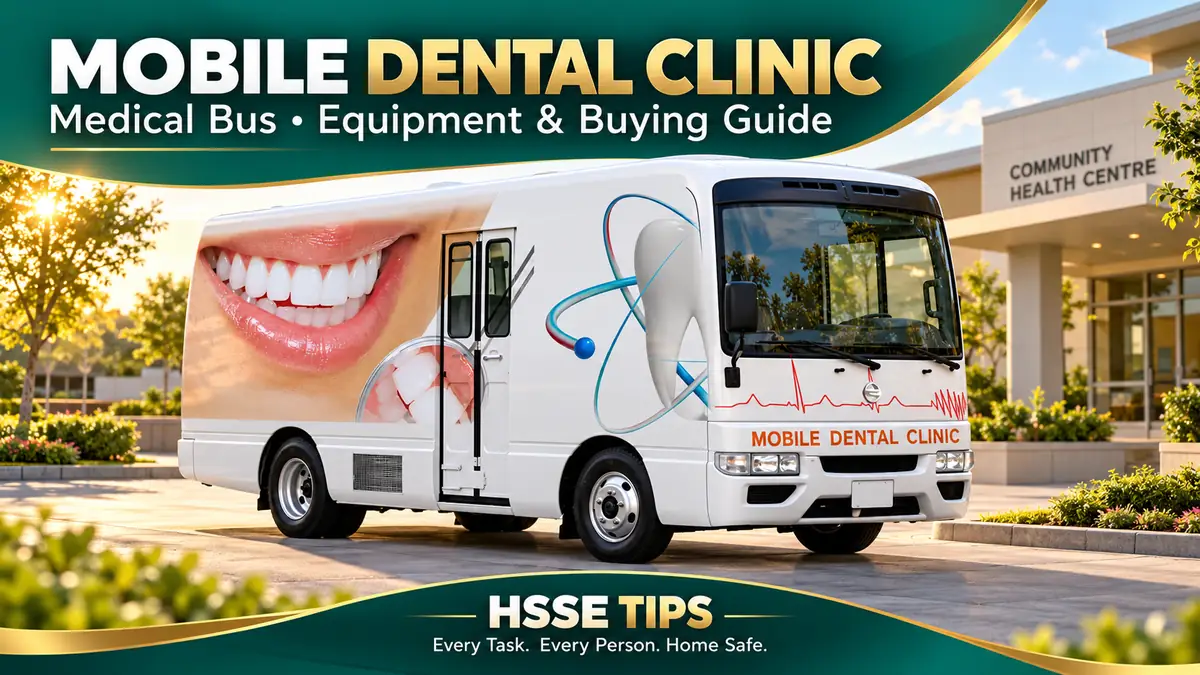
Mobile Dental Clinic Medical Bus Overview
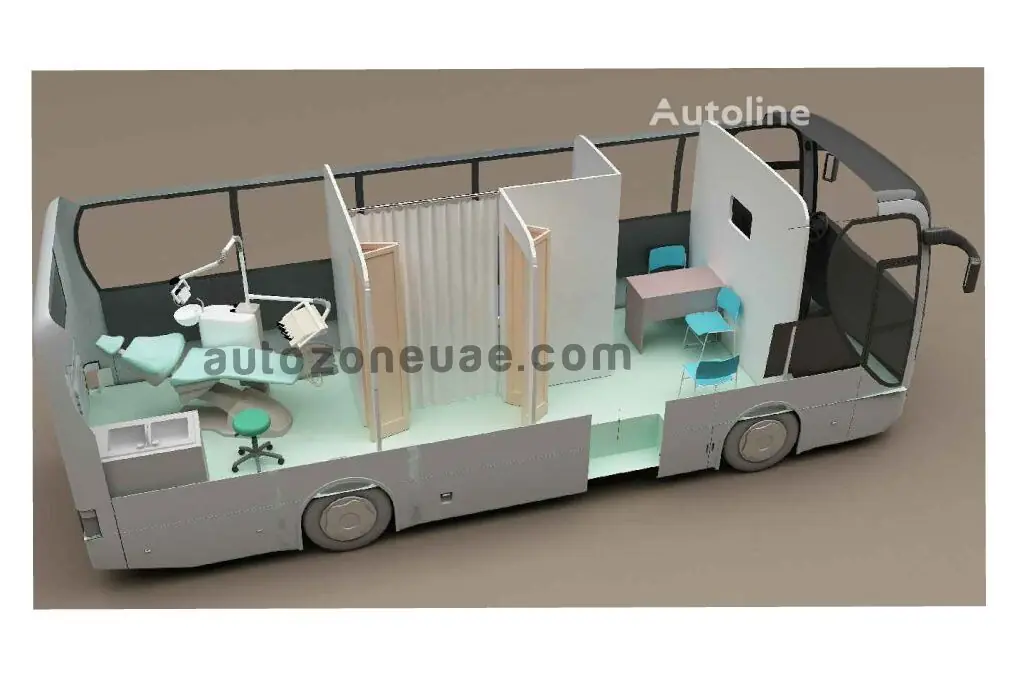
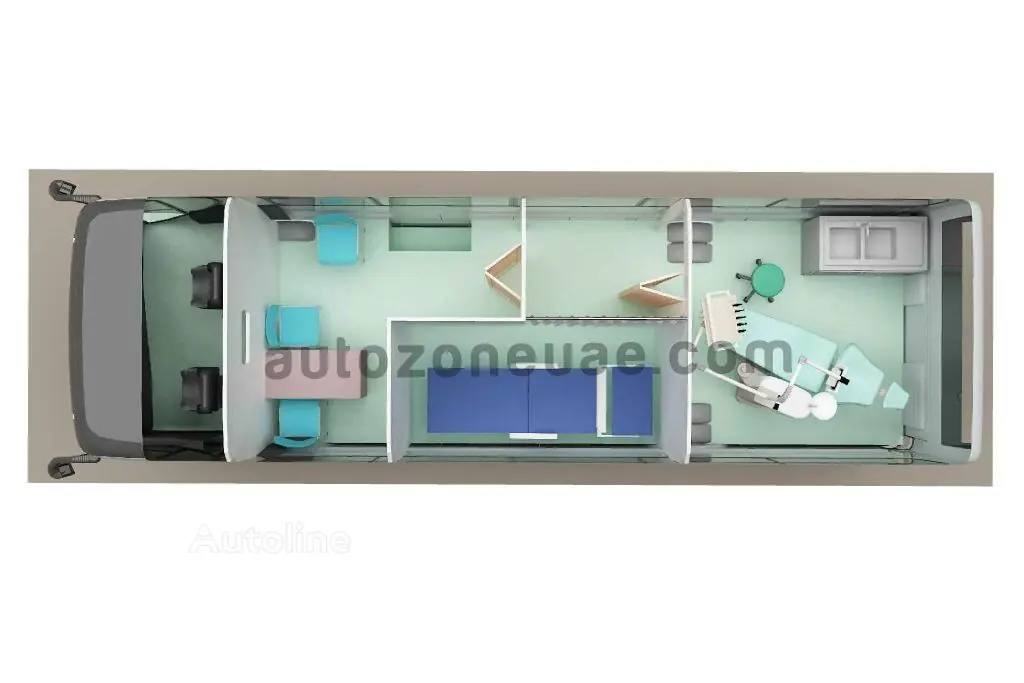
The offer is a bus-based dental conversion concept, rather than a conventional emergency ambulance. Its proposed clinical arrangement places one treatment room near the driver and another at the rear, with reception between them. Sliding-door partitions are specified for the clinical rooms.
The advertiser also offers customization. Treat the description as the starting specification for a quotation, then agree which elements will be delivered. A signed drawing and equipment schedule should connect every advertised feature to the exact vehicle being purchased.
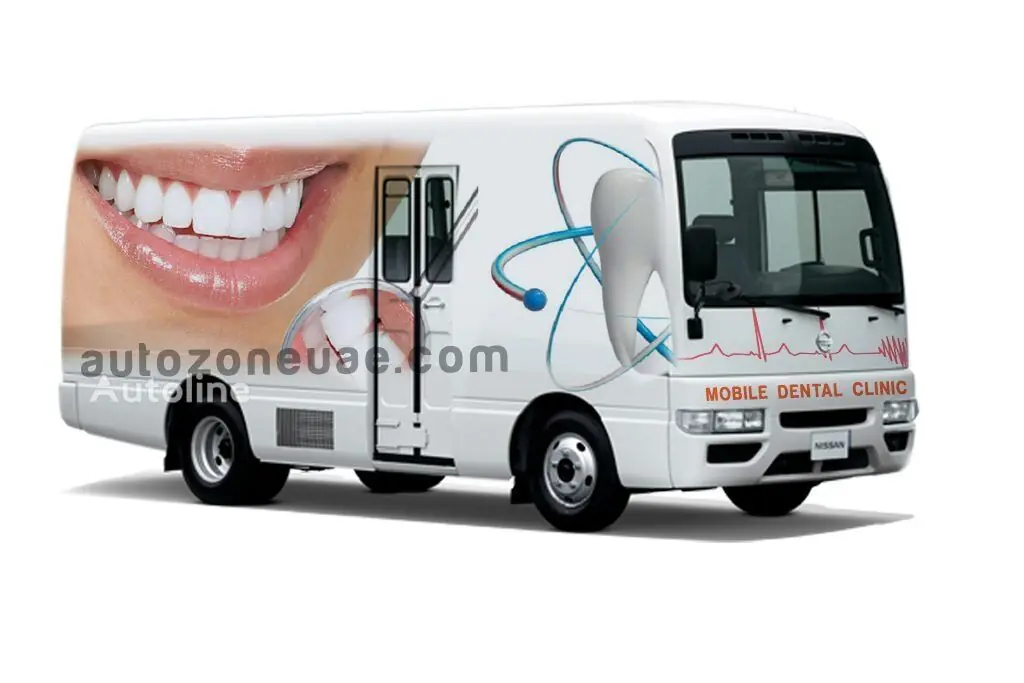
Understanding the Bus Platform
The listing identifies a medical bus and two axles, but does not name a chassis manufacturer or model. The exterior concept carries Nissan branding; the wider gallery includes van and truck examples too. That mixed presentation describes conversion possibilities rather than establishing one final base vehicle.
Accordingly, this review does not assign a Civilian, Coaster or other model designation. Request the VIN, chassis plate, original specification and conversion drawing. Once these identify the vehicle, the relevant manufacturer’s documentation can support maintenance planning, parts ordering and fleet compatibility.
Engine, Transmission and Drivetrain
Engine model, displacement, rated power, torque, fuel type, transmission and driven axles are not specified for the bus chassis. The diesel generator described later is a separate utility system; its fuel does not establish the propulsion engine’s specification.
Ask for the complete powertrain schedule and destination-market emissions documents. Match them to the planned route, driver qualifications and local workshop support. A supplier demonstration should include the actual vehicle’s controls and service information, rather than figures from a visually similar bus.
Chassis, Dimensions and Gross Vehicle Weight
Overall length, width, height, wheelbase, gross vehicle weight and available payload are not published in the reviewed offer. The renderings cannot provide reliable measurements or establish ground clearance, turning performance, suspension or braking equipment.
Obtain transport dimensions including rooftop fittings and a certified weight schedule for the completed conversion. Review axle loads with fuel, water, instruments, consumables and authorized occupants aboard. This gives fleet planners a sound basis for route surveys, parking arrangements and registration discussions.
Dental Clinic Conversion and Exterior Design
The written conversion specification describes an 18 mm marine-plywood floor beneath heavy-duty vinyl, PVC-based partitions and cabinets, and privacy treatment for applicable windows. These are advertiser-described materials and finish characteristics, not independently tested performance claims.
The seller also describes lead lining in selected partitions and the forward room. Request an as-built shielding plan if imaging is proposed. Shield thickness alone does not confirm an installed X-ray system, a radiation survey, or permission to perform radiography.
Exterior lighting and a siren are listed. Their operation and installation need destination-specific approval; they do not turn the dental facility into an authorized emergency-response vehicle.
Dental Treatment Area and Interior Layout
Two specified treatment rooms create a useful planning framework: patients can check in centrally before moving to an assigned room. The reception schedule includes a desk, flip-up seating and pantry fittings. The clinical rooms are described with sinks, cabinets, lighting and reinforced chair mounting.
Use a scaled layout to test the full appointment journey: entry, registration, consent, treatment, payment or programme recording, and exit. Check privacy, staff movement and access to supplies with the proposed equipment in place. Two rooms describe physical accommodation; they do not establish daily patient throughput or a staffing number.
Dental Chairs, Delivery Units and Instruments
The offer describes chair units, operating lights, a saliva ejector/suction arrangement and a three-way syringe. The written room schedule places a chair on a reinforced floor in each treatment room. Chair brand, model, adjustment range and load rating are not identified.
Prepare an inclusion schedule separating fixed installations, removable devices, optional additions and items your clinical team will procure. Ask for delivery-unit connections, compatible handpieces and servicing instructions. Scalers, curing lights, cameras, imaging systems and specialist instrument sets should be named individually in the contract.
A photograph or rendering can help explain placement, but does not establish the delivery inventory, device approval or clinical performance. Confirm the devices, accessories and consumables required by your intended dental services.
DISCOVER THE DENTAL EQUIPMENT & FACILITIES
Compressor, Suction and Dental Utility Systems
A central compressor is described in the luggage compartment, supplying the dental chair installation. The published material also mentions saliva removal and suction. Compressor capacity, filtration, moisture management, suction-pump specification and waste-separation arrangements are not stated.
Have the dental-equipment supplier define air quality, flow, pressure and suction requirements for the selected chairs. Request testing with the intended equipment operating together. Agree access for servicing, drainage and replacement components, and ensure the utility schematic identifies the connections assigned to each room.
Sterilization and Infection Prevention Facilities
An autoclave, instrument washer and dedicated reprocessing room are not confirmed inclusions. The clinical lead should define a suitable instrument-processing pathway, either within the agreed conversion or through an organized supporting facility. Specify clean storage and the handling of used instruments before commissioning.
CDC dental reprocessing guidance emphasizes trained personnel, correct processing sequences and manufacturer instructions. It also distinguishes instrument cleaning, disinfection and sterilization. This is general professional guidance, not certification of this bus.
Agree responsibility for records, maintenance, monitoring and staff training. A room fitted with a sink and cabinets becomes clinically useful through its approved operating procedures as well as its installed equipment.
Electrical Power and Backup Systems
The seller specifies a 10 kVA diesel generator, a 220 V/32 A shore connection with a 20 m extension, distribution protection and clinical-area sockets. Lighting is described on 220 V and 24 V circuits. An inverter or backup-battery capacity is not identified.
Use an electrical load schedule to check simultaneous demand and equipment starting loads. Generator apparent power in kVA is not a confirmed continuous kW output. Obtain frequency, phase, earthing arrangements, changeover design and test certificates for the delivered installation.
The supplier states the generator can run the clinical equipment and air conditioning. Make this a witnessed acceptance test under the agreed load. Plan safe cable routing, exhaust management, refuelling and the response to power interruption with qualified personnel.
Water Supply, Sanitation and Waste Management
The specification describes an underbody water-supply installation and sinks with pressure-fed water in both treatment rooms. Freshwater capacity, wastewater capacity, treatment equipment and a toilet are not specified. Pantry water provisions should be distinguished from dental treatment-water requirements.
CDC water-quality guidance calls for maintaining and monitoring dental water systems according to equipment instructions. A storage tank alone does not establish suitable treatment-water quality.
Build replenishment, waterline maintenance and lawful wastewater disposal into the deployment plan. Identify secure locations for sharps and clinical waste, the collection partner and the records required locally. These arrangements should follow the actual clinical service and equipment selected.
Heating, Ventilation and Air Conditioning
Two Dometic 220 V rooftop air conditioners and a rear roof exhaust fan are described. Cooling output, heating provision, air-change performance, filtration and humidity control are not documented. These comfort and ventilation provisions should not be described as validated infection-control containment.
Ask for model numbers and an environmental design brief covering the expected climate, occupancy and equipment heat load. During commissioning, check temperature performance, service access and condensate management in the intended operating mode. Coordinate ventilation planning with your clinical infection-prevention adviser.
Transportation and Deployment Requirements
The listing names a hydraulic Braun L929 wheelchair lift with a 24 V supply. Confirm its exact identification, rated capacity, platform dimensions, installation records and working condition. The manufacturer’s manual resources reinforce the importance of matching operation and maintenance to the installed lift.
Accessibility planning should cover the route from ground level to reception and the treatment position, including doors, clearances, transfer arrangements and staff assistance. A lift specification alone does not demonstrate the complete access pathway.
For each destination, survey approach roads, overhead clearance, turning space, parking surface and utility points. Agree wheel securing, levelling requirements, equipment stowage and a deployment checklist. Stabilizers, awnings and automatic levelling are not confirmed equipment.
Mobile Dental Healthcare Applications
Community, rural, school and workplace programmes can consider this configuration when its final equipment and approvals match the proposed care. Screening, consultation and preventive oral-health services should be defined by qualified professionals, with consent, records and onward-care arrangements established before appointments begin.
Hospital outreach, humanitarian programmes and private mobile operators can use the same planning approach. Set out referral pathways, consumable replenishment, follow-up and professional support. Temporary dental capacity needs a commissioning plan just as an established facility does.
The published material does not establish authorization for advanced surgery, radiography or specialist procedures. Each proposed service needs an appropriate clinical configuration, professional team and applicable approvals.
Bus-Based Mobile Dental Clinic vs Van-Based Dental Clinic
A bus project can organize its specification around separate rooms and reception; a van project can organize its service around the layout of the chosen van conversion. Both can support professional outreach when the actual facilities, utilities and patient access meet the programme’s needs.
Compare measured drawings, equipment schedules, deployment routines and ownership quotations rather than assigning a universal winner. Our van-type dental vehicle review and Sprinter dental clinic review provide separate examples; their specifications and images are not transferred to this bus.
Safety, Hygiene and Regulatory Considerations
Appoint qualified dental professionals and assign responsibility for infection prevention, equipment maintenance and patient safety. Specify equipment anchoring, cabinet restraints, safe electrical installation, fire protection and vehicle weight compliance. Confirm exits and evacuation arrangements on the as-built drawing.
Professional, vehicle, healthcare and any radiation-related approvals depend on the operating jurisdiction. Obtain advice for the actual destination, including emergency warning equipment and patient seating. Waiting seats with belts are described, but authorized travel positions and occupancy still require documentation.
An acceptance inspection should connect every installed item to its manual, test record and service plan. This gives the organization a reviewable basis for staff training, ongoing care and operational handover.
Technical Specifications
The following tables summarize source-confirmed listing statements. They are not an independent inspection report; the delivered specification should be agreed in writing.
| Specification | Source-attributed detail |
|---|---|
| Advertised category | Medical bus / mobile dental clinic |
| Axles | Two, listed by advertiser |
| Chassis identity | Not specified; exterior concept has Nissan branding, without a verified model |
| Specification | Source-attributed detail |
|---|---|
| Written room layout | Two dental rooms with central reception; sliding-door partitions |
| Floor | 18 mm marine plywood with heavy-duty vinyl, seller-described |
| Cabinets / partitions | PVC-based panels and cabinetry; selected lead-lined areas described |
| Treatment fittings | Chair mounting reinforcement, sinks, lighting and cabinets described |
| Reception | Desk, flip-up seating and pantry with fridge/water dispenser described |
| Access equipment | Braun L929 hydraulic lift, 24 V, advertiser-stated |
| Specification | Source-attributed detail |
|---|---|
| Dental equipment | Chair units, dental light, saliva ejector/suction and three-way syringe described |
| Air supply | Central compressor in luggage compartment; performance not stated |
| Generation | 10 kVA diesel generator, seller-described |
| External electricity | 220 V, 32 A shore connection; 20 m extension |
| Distribution | MCB, ELCB, fuses and relays described |
| Climate provision | Two Dometic 220 V rooftop AC units; rear exhaust fan |
| Water | Underbody supply system and pressure-fed sinks; capacities not stated |
VIEW CURRENT PRICE & AVAILABILITY
Current Seller Offer — Verified 26 October 2026
Product: Mobile Dental Clinic Medical Bus. Product Location: Ajman, United Arab Emirates, from the vehicle-location field; exact collection premises require confirmation. Advertiser/converter: Autozone UAE / Autozone Assembling LLC. Listing reference: YT41519.
Manufacturer and exact chassis model: not specified. Production year, first registration, mileage, engine, transmission and gross vehicle weight: not specified in the information reviewed. Condition: new, advertiser-stated. Asking price: on request; amount and currency not quoted.
Dental facilities and equipment: the seller describes two rooms, reception, chair equipment, lighting, sinks and storage. Compressor/suction: described without performance data. Sterilization equipment: not confirmed. Power: generator and shore supply as summarized above. Confirm the signed inventory and whether the quote covers a completed vehicle or a customized build.
Availability: advertisement accessible when checked; allocated stock, production status and dispatch date unconfirmed. Delivery destinations, shipping arrangements and export terms: no order-specific terms verified. Autozone describes company-wide international export activity, which is separate from a destination-specific commitment.
Delivery destinations, shipping arrangements, and applicable transport terms were not specified in the information reviewed. Prospective buyers should confirm these details directly with the seller.
CHECK DELIVERY & EXPORT OPTIONS
What Buyers Should Confirm Before Purchasing
Begin with a clinical brief identifying services, patient groups, accessibility needs and intended deployment locations. Request a VIN-linked base-vehicle schedule, measured layout, completed-vehicle weights and a line-by-line equipment quotation. Identify which features are fixed, optional, removable or supplied by the purchaser.
Next, agree utility ratings, installation drawings, water and waste arrangements, device manuals and acceptance tests. Include training, warranty responsibilities, service contacts, spare parts and records for the lift, generator, dental units and clinical electrical systems.
For international purchasing, define destination compliance, export documents, customs responsibilities, freight dimensions, transport insurance and the chosen Incoterm. Agree inspection milestones, commissioning and handover before dispatch. Evaluate the full project quotation without assuming savings, clinical throughput or an investment return.
Frequently Asked Questions
What chassis is the advertised bus based on?
The listing does not identify a verified manufacturer or model. A Nissan-branded exterior concept is shown, but the final chassis needs VIN-linked documentation.
Does it have two dental rooms?
The written specification describes two dental rooms with central reception. Gallery concepts show different arrangements, so request the final signed layout.
Are two chairs included?
A chair installation is described in each room. Confirm the brand, model, accessories and contractual inclusions for both positions.
Is a generator specified?
Yes. The seller describes a 10 kVA diesel generator. Obtain its nameplate ratings and test it against the agreed equipment load.
Can the bus use external power?
The description specifies a 220 V/32 A shore connection and 20 m extension. Frequency and the final electrical design require confirmation.
Is wheelchair access described?
A hydraulic Braun L929 lift with 24 V supply is listed. Verify the installed unit and the complete patient route to treatment.
Does lead lining mean X-ray equipment is included?
No imaging equipment or radiation authorization is confirmed by the lead-lining description. Obtain a separate device inventory and any required shielding assessment.
Is an autoclave included?
An autoclave is not confirmed in the reviewed specification. Agree the instrument-processing equipment and operating arrangements with the clinical team.
What do the original images show?
They are advertiser-supplied renderings of bus and other conversion concepts, not verified photographs of one completed bus. The bus-related examples are credited and hosted locally here.
Where is the product and what does it cost?
The listing places it in Ajman, United Arab Emirates, with price on request. Confirm the allocated vehicle, collection site, quotation and delivery terms.
Final Verdict
The strongest documented features are the proposed two-room layout, central reception, onboard generation, shore power, climate provision and specified access lift. Together, they provide a useful framework for a bus-based oral-healthcare project.
The next step is a project-specific specification: identify the chassis, reconcile the drawings, confirm every device and utility rating, and plan commissioning with your dental team. That process turns an appealing conversion concept into a clear, reviewable procurement proposal.
Planning a wider oral-healthcare project? Read our mobile dental bus vs mobile dental van comparison for a configuration-based buying guide.
Join the Conversation
Which services would your mobile dental programme prioritize, and what access or deployment arrangements would your community need? Share your planning questions or experience. Every Task. Every Person. Home Safe.
Sources, Images and Editorial Method
Reviewed 26 October 2026: advertiser listing YT41519, Autozone’s mobile-dental conversion specification, CDC dental reprocessing and water-quality guidance, and BraunAbility manual resources. Seller statements are attributed; deployment and procurement recommendations are editorial analysis. No road test, delivered-unit inspection or clinical certification is claimed.
Original advertiser renderings are reproduced under the review-use permission confirmed by HSSE TIPS, with watermarks and attribution retained. Only bus-related concepts are selected for this review. The featured and portrait promotional artwork are separately labelled illustrations. No unit-specific advertiser video was verified in the reviewed listing or converter page; no video URL or equipment demonstration is invented.
Your experience matters
Share your thoughts on this page
Have a question, a useful experience or a suggestion? Add your input below.
Comments are public. Keep them respectful and relevant. Do not share contact details, confidential information or emergency reports.
Comments on this page
Loading comments…