HSSE TIPS · Product Reviews · Institutional Buyer’s Guide
Ford Transit Mobile Maternity Clinic vs Isuzu 20FT Mobile Maternity Clinic: Which Configuration Fits Your Healthcare Project?
Affiliate Disclosure: Worksite Safety Hub may earn a commission if you make a qualifying purchase through links in this article. This does not change the price you pay.
Introduction: Two Approaches to Mobile Maternal Healthcare
When your healthcare project needs to bring maternity services closer to patients, should you choose a clinic built into a Ford Transit van or a medical module carried on an Isuzu truck? The useful answer starts with the appointment you intend to provide, the sites you must reach and the support available when you arrive.
A good choice connects clinical services, equipment, patient access, workspace, staffing, roads, utilities and maintenance. This comparison examines two specific AmbulanceMed offers: a Ford Transit examination-clinic van and an Isuzu truck-mounted 20FT maternity facility. Original photographs establish different layouts; they do not establish an overall winner, a patient-throughput figure or readiness for childbirth.
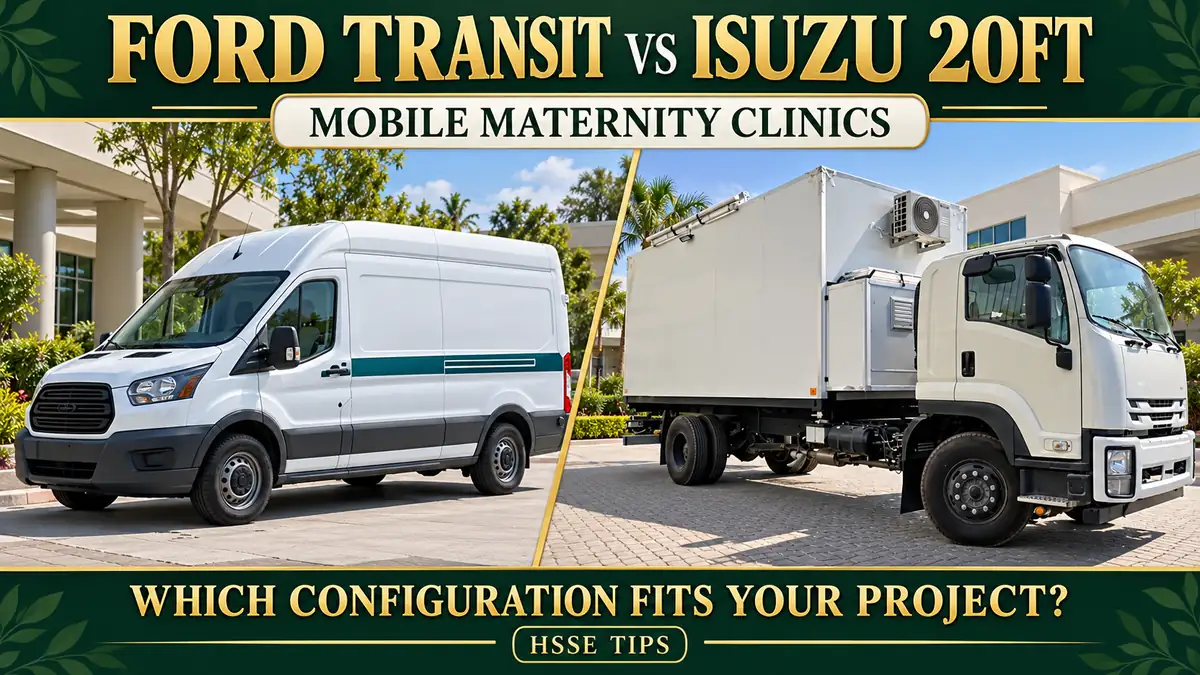
Ford Transit Mobile Maternity Clinic: Configuration Overview
The Ford offer presents an examination workspace within a high-roof van. The gallery shows a burgundy chair, fitted cabinets, worktops, sink and compact refrigerator, with rear and side access. That arrangement gives buyers a concrete starting point for planning a consultation-focused service.
The exact Transit derivative is not identified. Treat the illustrated build and the supplier’s customizable offer separately: the signed specification must identify the actual chassis, furniture and devices. Our Ford Transit maternity clinic review examines the individual offer in more detail.
Isuzu 20FT Mobile Maternity Clinic: Configuration Overview
The Isuzu offer combines a truck chassis with a separate medical body. Its photographs show a teal examination chair, another examination surface, counter storage, sink and privacy curtain. The rear entrance and an external stairway create a different access arrangement from the Ford’s side doorway.
“20FT” is the advertised module designation, not a verified overall truck length. A dimensioned drawing and mounting documentation are needed before defining shipping or site requirements. Our Isuzu 20FT maternity clinic review covers this configuration independently.


Ford Transit vs Isuzu 20FT: At-a-Glance Comparison
“Not specified” means the reviewed evidence does not establish the feature; it does not mean the feature is absent. Photographed fittings require confirmation in the final sale inventory. Prices and location entries below reflect the dated offers checked on 26 October 2026.
| Comparison factor | Ford Transit Mobile Maternity Clinic | Isuzu 20FT Mobile Maternity Clinic |
|---|---|---|
| Manufacturer / exact model | Ford Transit Maternity Clinic; derivative not specified. | Isuzu; NPR named in seller description, exact variant not specified. |
| Vehicle configuration | Van-based examination clinic pictured. | Truck-mounted 20FT medical module pictured. |
| Engine / transmission / drivetrain | Diesel described; engine identity/output, gearbox and drivetrain not specified. | Offered chassis specification not established; related manufacturer data are not VIN-linked. |
| Gross vehicle weight / payload / wheelbase | Not specified. | Not specified for the offered chassis. |
| Overall dimensions | Not specified. | 6 × 2.4 × 2.4 m entered as overall dimensions; measurement scope unresolved. |
| Medical facility dimensions | Not specified. | 20FT designation; measured external/internal dimensions of offered build not confirmed. |
| Examination facilities | Chair, cabinets, sink and worktops pictured. | Chair, separate examination surface, sink, storage and curtain pictured. |
| Included medical equipment | Model-specific contractual inventory not specified; ultrasound/fetal monitor not verified. | Model-specific contractual inventory not specified; ultrasound integration described as optional. |
| Electrical power | Emergency supply and 110 V/220 V outlets advertised; package/rating not specified. | External 220 V supply described; generator inclusion and package require reconciliation. |
| Water and sanitation | Sink pictured; hot/cold supply described; capacities not specified. | Sink pictured; water/waste systems described; capacities not specified. |
| HVAC | Air conditioning/ventilation described; ratings not specified. | Split AC pictured; heating/ventilation performance not specified. |
| Patient accessibility | Side entry and internal steps pictured; ramp/lift not verified. | Rear access and stairway pictured; ramp/lift not verified. |
| Physical product location | Not specified beyond Türkiye listing country. | Ankara, Türkiye in vehicle-location field; exact dispatch site unverified. |
| Current asking price | €85,000; tax, equipment and freight basis to confirm. | On request; amount and currency not quoted. |
| Delivery destinations / export terms | Not specified. | Not specified. |
Vehicle Engineering and Technical Specifications
Neither vehicle can be selected responsibly by badge alone. Obtain VIN-linked records for engine, fuel specification, transmission, driven wheels, axle ratings, gross weight and wheelbase. Two listed axles do not establish traction, road clearance or licensing requirements. Neither listing supplies a complete basis for comparing power, payload or fuel consumption.
Ford Pro provides conversion and integration resources; Isuzu publishes bodybuilder guidance. Ask for the instructions applicable to the actual market and chassis year, then the converter’s completed installation records. These resources guide an engineering review but do not assign another regional model’s specifications to either advertised clinic.
For the Isuzu, inspect the body/subframe mounting and load distribution; for the Ford, inspect the conversion’s anchorage and body modifications. Require completed-vehicle and axle weights in the intended operating condition, including people, fluids and equipment. The relevant limit is the documented finished installation, rather than a generic chassis payload figure.
Size, Interior Layout and Medical Workspace
The photographs establish different body forms, not a reliable dimensional ranking. The Isuzu advertisement’s 6 × 2.4 × 2.4 m entry needs clarification because it does not clearly distinguish module dimensions from the complete truck. Related container specifications must not silently replace measurements of the offered build.
Request both external transport dimensions and internal usable dimensions. Then draw the examination chair in its working positions, circulation routes, door openings, cabinets and the selected equipment. Allow for the patient getting onto the chair, a clinician working alongside and the movement of supplies without obstructing exits.
The Isuzu gallery visibly includes a separate examination surface and curtain; the Ford presents its chair within a van workspace. Whether either layout accommodates your required activities depends on measured clearances and an operational walkthrough. No standing-height, floor-area or simultaneous staffing advantage is established by the images alone.


Maternity Examination Facilities and Equipment
Compare a service specification rather than the length of a marketing equipment list. Divide each quotation into fixed installations, expressly included devices, loose photographed items, options and buyer-supplied equipment. Record manufacturer, model, quantity, accessories, maintenance support and acceptance requirements for each item.
Neither reviewed offer establishes a model-specific blood-pressure, ultrasound, fetal-monitoring, oxygen or suction package ready for clinical acceptance. The Isuzu presentation describes ultrasound integration as optional. The Ford description also offers configurable interior equipment. Selection and installation should follow the healthcare team’s approved service brief.
The Ford’s photographed compact refrigerator and the separately advertised medical-fridge option need particular care: appearance does not establish temperature qualification or intended medical use. For either clinic, specify storage requirements, monitoring and power continuity for the actual supplies. A chair or refrigerator photograph is not an equipment performance certificate.
Patient Accessibility and Clinical Workflow
The Ford’s side entrance shows blue internal steps. The Isuzu’s gallery includes rear access and a stairway with handrails. Neither establishes an approved wheelchair route. Ask each supplier to demonstrate the entire journey from arrival to examination, including doorway clearance, support points, landings and exit arrangements.
Build a simple appointment walkthrough: confidential registration, discussion, examination, dressing and referral. In the Isuzu, the curtain is evidence of a privacy provision; in the Ford, effective screening remains to be demonstrated. In both, test acoustic privacy and sightlines with doors and windows in their normal operating positions.
Allocate staff positions by task rather than assuming a crew capacity. Confirm approved travel seats separately from clinical furniture. A patient examination chair does not establish a restraint system for travelling occupants. External waiting arrangements, weather protection and access for a support person belong in the site plan.
Electrical Power, Water and Sanitation
Treat utility design as a comparison of complete systems. Ford describes emergency power and 110 V/220 V outlets, without establishing the supply architecture. Isuzu material describes external 220 V supply and generator provisions, but general and optional-generator descriptions require one agreed specification. Neither offer supports a verified independent operating duration.
Ask both suppliers for voltage, frequency, continuous load, protective devices, earthing, changeover and backup arrangements. Build a simultaneous-load schedule for the selected clinical devices, lighting, heating/cooling and water equipment. Agree what happens during a power interruption and demonstrate the specified response at acceptance.
Both galleries show a sink. Tank capacity, water servicing intervals and wastewater arrangements need drawings and inspection. Include hand-hygiene supplies, cleaning access and waste collection in the service plan. Do not infer an installed toilet, unlimited water autonomy or onsite clinical-waste treatment from either medical-body description.
HVAC, Hygiene and Medical Facility Safety
The Ford describes air conditioning and ventilation; the Isuzu photographs show split AC equipment. Neither provides a commissioned comparison of cooling, heating, fresh-air delivery or humidity control. Ask for equipment identity and performance under the expected climate, occupancy and device heat load. Cooling and fresh-air ventilation are different requirements.
Inspect interior finishes, joints, high-touch surfaces and access for cleaning. Obtain material-compatible cleaning instructions and maintenance schedules. No specialized filtration or negative-pressure capability is established. Sharps, clinical waste, electrical protection, fire precautions and exits require documented arrangements for the chosen service.
WHO’s antenatal-care guidance emphasizes person-centred care and well-being. Applied to procurement, the clinical visit should support respectful communication, privacy and continuity of care. Neither vehicle is thereby certified for childbirth, emergency obstetric surgery, caesarean section, neonatal intensive care or emergency patient transportation. Those services require their own verified facility, equipment, staffing and approvals.
Mobility, Transportation and Deployment
A van body and a truck-mounted module create different deployment questions, but route suitability needs actual measurements. Survey road widths, bends, gradients, surface condition, overhead obstructions and parking space. Request turning information, clearance and operating-weight limits before claiming either vehicle is easier to manoeuvre or suited to remote roads.
For frequent moves, compare the tasks at every stop: securing equipment, connecting utilities, preparing entry, arranging privacy and completing functional checks. For longer stays, assess replenishment, waste collection, maintenance access and protection of the occupied site. No setup-time or relocation-cost difference is established.
The Isuzu module must not be booked for standard container handling without documentation. Its detachability, ISO compatibility and lifting arrangements are unverified. Obtain complete transport drawings and handling instructions before planning road haulage, port loading or sea freight. The Ford likewise needs measured transport dimensions and agreed equipment-securing arrangements.
Which Configuration Fits Different Healthcare Projects?
Frequent Community Outreach
Consider the Ford when a van-based clinic fits your route, appointment format and daily relocation plan. Confirm its actual size and setup sequence first. The Isuzu remains a candidate if its route and access arrangements meet the same brief; body style alone does not establish a speed or cost advantage.
Rural Maternal Healthcare
Start with an actual route survey and reliable utility arrangements. Neither offer establishes all-wheel drive or off-road performance. Select the configuration whose documented chassis, access solution and service support match the roads and sites, while maintaining an appropriate referral pathway.
Hospital Outreach Programs
Use the hospital’s intended appointment as the acceptance scenario. The Ford’s photographed chair-and-counter arrangement may match a focused examination service. The Isuzu’s separate examination surface and curtain may merit consideration where the measured layout supports the planned workflow. Specify identical clinical equipment before comparing quotations.
Temporary Maternal Healthcare Facilities
For an extended deployment, evaluate usable space, privacy, weather protection, servicing and replenishment. The Isuzu may be worth considering where its measured module layout supports additional required activities. The Ford can also be evaluated for a defined examination service; neither should be selected by assumed patient capacity.
Humanitarian Healthcare Programs
Make transportability, local maintenance, utilities, trained staff and consumable supply part of the procurement. Compare a complete deployment package, including access and referral support. Project logos in photographs are not evidence of current endorsement or delivery arrangements for your programme.
Government Maternal Health Initiatives
Use one outcome-based specification for both bids, with consistent device requirements, accessibility criteria, documentation, training and acceptance. Assess support over the intended service life. A framework purchase should identify the exact chassis and conversion supplied rather than accepting an undefined vehicle-family substitution.
Private Mobile Healthcare Services
Define the authorized services, expected appointment pattern and operating sites before evaluating investment. Compare itemized purchase and support proposals, insurance, maintenance, consumables and commissioning. No verified cost-per-visit, fuel saving or payback advantage can be calculated from these listings.
Procurement, Maintenance and Operating Considerations
An equitable comparison requires both suppliers’ offers on the same basis: chassis, conversion, devices, access equipment, utilities, training, warranty, freight and commissioning. The Ford asking price cannot be compared with an unquoted Isuzu amount or an unequipped alternative. Confirm taxes, currency and the conditions under which the price applies.
Plan two maintenance streams: the road vehicle and the healthcare installation. Identify service providers for the engine and brakes, chair, doors, refrigeration, water and electrical systems. Specify replacement-parts access, technical documentation and staff handover. Request actual fuel and utility information where available; do not build operating budgets from assumed consumption.
Current Seller Offers — Verified 26 October 2026
Current Seller Offer: Ford Transit Mobile Maternity Clinic — Verified 26 October 2026
Model: Transit Maternity Clinic; exact derivative not specified. Condition: new. Price: €85,000. Production year, first registration and mileage: Not specified in the information reviewed. A 12-month warranty entry needs written scope and territory confirmation.
Product Location: Not specified in the advertiser’s listing. The listing identifies Türkiye as the country, without an exact physical dispatch site. Equipment: photographed examination fittings; final itemized inventory required. Availability: advertisement accessible; allocated stock and dispatch date unconfirmed. Delivery destinations, shipping terms and export arrangements are not specified.
Current Seller Offer: Isuzu 20FT Mobile Maternity Clinic — Verified 26 October 2026
Model: NPR named in description; exact variant not specified. Production year: 2025, advertiser-stated. Condition: new. Price: on request; currency not quoted. Mileage and first registration: Not specified in the information reviewed.
Product Location: Ankara, Türkiye, as entered in the vehicle-location field; exact dispatch premises unverified. Equipment: photographed examination fittings, with final included devices to be confirmed. Availability: advertisement accessible; ready-stock allocation and lead time unconfirmed. Delivery destinations, shipping terms and export arrangements are not specified.
Delivery, Export and International Purchasing Considerations
The Ford listing displays a vehicle-delivery service, but does not establish a destination-specific arrangement. The Isuzu offer likewise does not establish countries served, freight charges, Incoterms or a commissioning package. General supplier logistics statements should not be converted into promises for either order.
Delivery destinations, shipping arrangements, and applicable transport terms were not specified in the information reviewed. Prospective buyers should confirm these details directly with the seller.
For each clinic, obtain a quotation naming collection point, transport method, insurance, loading responsibilities, export documents, customs responsibilities and lead time. Destination specialists should confirm vehicle age/emissions rules, registration, equipment compliance and clinical authorization. Neither a marketplace category nor a country named in project graphics establishes import eligibility.
Questions to Ask Before Buying Either Mobile Maternity Clinic
Ask for the VIN and build records; dimensioned external and internal plans; finished weights; medical-body mounting details; and an itemized equipment schedule. Require written inclusion status for every device and option. Ask who provides vehicle servicing, device maintenance, training and warranty support at the deployment destination.
Agree acceptance demonstrations covering patient entry, privacy, examination-chair use, equipment securing, utilities under load, water servicing, HVAC and emergency exit. Have the maternal-health team sign off the intended service and referral arrangements. Compare the two completed proposals against those same criteria before committing to a configuration.
Frequently Asked Questions
Which is the better mobile maternity clinic?
The configuration that meets your measured clinical, access, route and support requirements. Neither offer establishes a universal winner.
Is the Ford definitely smaller than the Isuzu?
The body forms differ, but comparable complete-vehicle and internal measurements are not established. Request dimensioned plans.
What does 20FT mean here?
It is the Isuzu medical-module designation. It does not establish overall truck length or ISO-container handling compatibility.
Can the Isuzu module be detached?
Rated removal and lifting arrangements were not verified. Obtain the mounting and handling documentation.
Do both include ultrasound and fetal monitoring?
No model-specific included package is verified. The Isuzu presentation describes ultrasound integration as optional.
Can either clinic support childbirth?
Seller maternity descriptions do not establish readiness. Confirm equipment, facility configuration, staffing, procedures and authorization for the intended service.
Are they approved patient-transport ambulances?
The reviewed evidence supports parked clinical workspaces. Transport-approved patient restraints and the relevant approvals are not established.
Which offers better wheelchair access?
Neither has a verified complete wheelchair-access solution. Evaluate the actual doorway, steps and proposed ramp or lift.
Does either include a generator?
The Ford emergency supply is not fully specified; Isuzu generator descriptions differ in scope. Confirm one included, rated system in each quotation.
Which is cheaper to own?
Comparable equipment and operating-cost data are unavailable. Obtain complete purchase, freight, maintenance and utility proposals.
Where are the clinics advertised?
Ford identifies Türkiye only. Isuzu lists Ankara, Türkiye in its vehicle-location field. Confirm the actual collection premises.
Is international delivery included?
No destination-specific included shipment or export package is established. Request written terms for each vehicle.
Final Verdict: Which Configuration Should You Choose?
Shortlist the Ford when its measured van layout and access arrangements support your consultation service and relocation plan. Shortlist the Isuzu when its documented module layout, separate examination surface and privacy provisions fit your required clinical workflow and sites. Both recommendations depend on confirmed equipment, utilities and approval.
The decisive comparison is the finished, supported clinic against your service brief. Require the same acceptance evidence from both offers, then choose the configuration that can demonstrate the required patient experience and operational fit. That approach keeps procurement useful beyond the life of either advertisement.
Join the Conversation
What would decide your mobile maternity clinic purchase: examination layout, accessible entry, privacy, utilities or deployment logistics? Share your project requirements and procurement experience. Every Task. Every Person. Home Safe.
Research and Editorial Method
Both exact affiliate redirects and advertiser listings, NV47052 and NJ35912, were checked on 26 October 2026. Four original gallery photographs are shown here, with attribution and watermarks. No unit-specific video was verified. This is a desk-based comparison; no VIN inspection, road test or clinical commissioning was performed.
Contextual sources: Ford Pro conversion resources, Isuzu bodybuilder resources, AmbulanceMed maternity configuration documentation and WHO antenatal-care guidance. Related specifications are not assigned to an offered chassis without build-linked confirmation. Commercial enquiries use the two distinct tracked buttons.
Your experience matters
Share your thoughts on this page
Have a question, a useful experience or a suggestion? Add your input below.
Comments are public. Keep them respectful and relevant. Do not share contact details, confidential information or emergency reports.
Comments on this page
Loading comments…