Process Safety · Lesson 42 · 8 min read
Insulation Can Hide a Growing Loss-of-Containment Threat
Insulation protects temperature and people, but it also hides the steel beneath it. If water enters damaged cladding and remains against an inadequately protected surface, external corrosion can progress out of sight. A line may look serviceable from the walkway while its remaining wall is falling toward loss of containment.

Why corrosion under insulation is a major-hazard issue
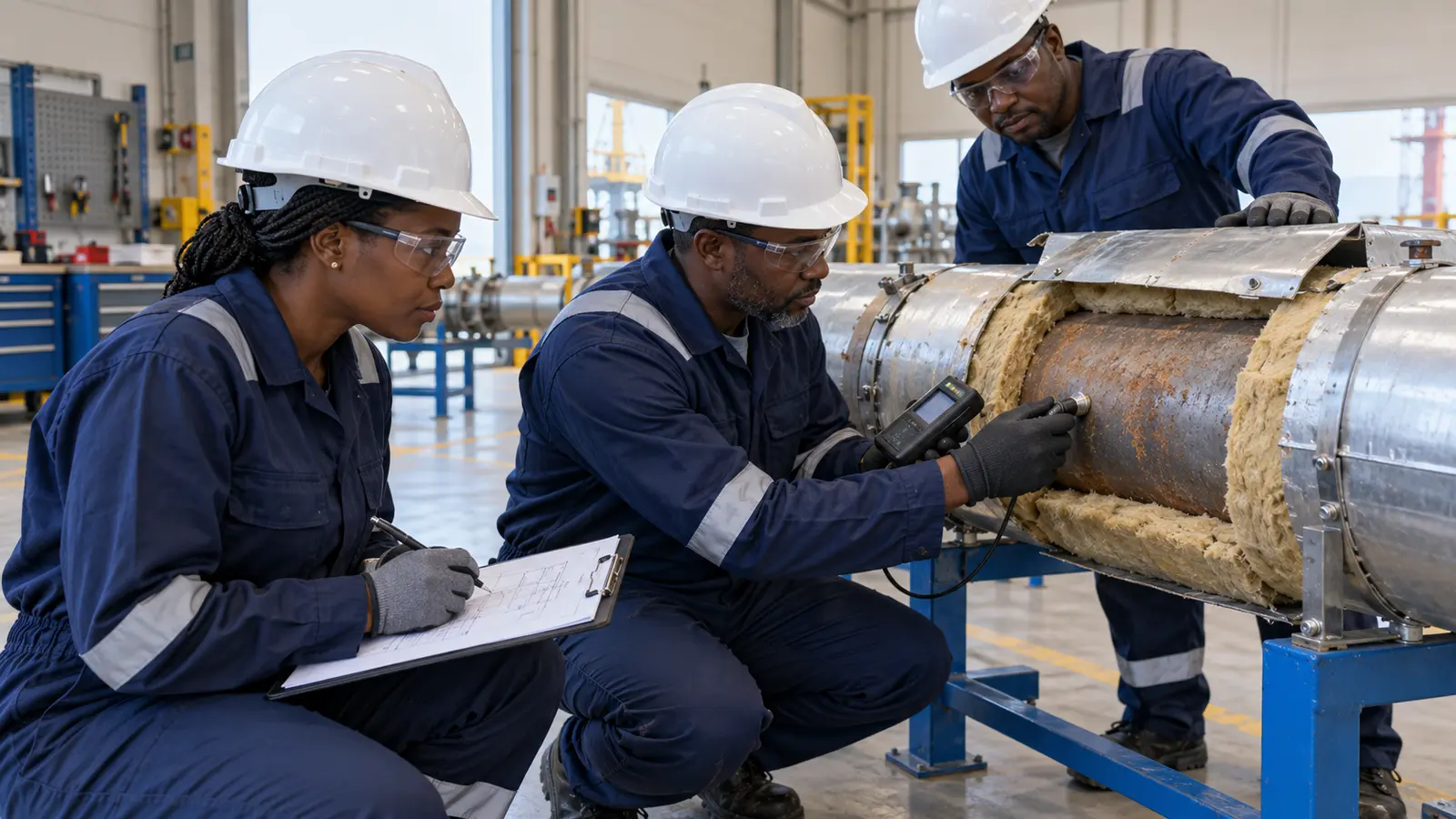
Corrosion under insulation, commonly shortened to CUI, is external metal loss hidden beneath insulation, weatherproof cladding or similar coverings. Water can enter through damaged seams, penetrations, poorly sealed terminations or degraded jacketing. The insulation can retain moisture at the metal surface. Coating breakdown and wet-dry cycles then create conditions for localised attack.
The hazard is not the rust itself; it is the reduction of pressure-boundary strength. Local thinning can form a pinhole or contribute to a larger rupture. If the line contains flammable, toxic or high-energy material, the result can be a serious release even though the process was operating normally. HSE notes that external atmospheric corrosion causes many losses of containment and that improperly installed insulation can create ideal corrosion conditions. It calls for inspection and maintenance programmes that include lagged systems. [1]
Official learning from Fife and the US offshore sector
On 26 August 2026, HSE reported the outcome of its investigation at the Fife Ethylene Plant in Scotland. HSE said five known leaks of extremely flammable hydrocarbons occurred between February 2018 and September 2019 and attributed all five to CUI. It found that the arrangements for inspecting insulated pipework were inadequate. Some visual scoping checks were made from ground level with limited visibility, and insulation was not always removed to examine beneath it. [2]
One line leaked for about four and a half months after the operator first detected it. In another case, HSE reported an estimated 82 tonnes of hydrocarbons escaped over roughly six weeks. These figures belong to that investigation; they are not inspection thresholds or leak estimates for another facility. The transferable warning is that repeated events do not automatically correct a weak inspection system. The organisation must challenge whether its method can actually find the damage it claims to manage.
BSEE's 2018 offshore Safety Bulletin 013 described severe corrosion discovered beneath insulation blankets on generator exhaust piping after a platform fire investigation. Similar corrosion was then found on an identical generator. BSEE also warned that CUI issues can exist on insulated process piping, valves and vessels, and recommended expanding inspection programmes to include covered components where corrosion could lead to process leaks. [3]
Hypothetical FPSO example: a damaged seam is only the first clue
Hypothetical example—not a documented incident: During an FPSO walkdown, an operator finds a split in the metal cladding around an insulated produced-water line near a support. There is staining at the low point but no visible leak. The team does not tape over the split and close the observation as a housekeeping defect.
The condition enters the installation's integrity process. Operations and inspection specialists review the service, temperature history, coating system, water-entry paths, access and nearby susceptible locations. Any insulation removal and examination are planned under the approved isolation, permit and inspection arrangements. The team then records the measured condition, defines repair or monitoring requirements, checks whether the finding changes the wider CUI population, and reinstates the insulation and weather barrier to the specified standard.
This example provides no universal inspection interval, temperature band, remaining-wall limit or acceptance criterion. Those decisions must come from the actual material, service, design data, damage-mechanism review and competent engineering assessment.
Critical controls
Build a credible CUI inventory. Know which pressure-containing items are insulated or otherwise covered. Rank them using the installation's approved method and real evidence: consequence of release, material and coating, operating and shutdown history, age, water exposure, jacketing condition, geometry, supports, penetrations and previous findings. A database score is useful only if field assumptions are valid.
Inspect the hidden surface effectively. Match the technique and extent to the damage mechanism and uncertainty. External cladding inspection can guide priorities, but it does not by itself measure the covered pressure boundary. Where insulation removal or another examination method is required, provide safe access and a work plan that accounts for the possibility of finding severe thinning or an active leak. Do not disturb suspect insulation on live hazardous service without an authorised, technically assessed plan.
Close the loop. Record locations, findings, measurements and confidence. Repair or replace equipment using approved engineering controls; restore coatings, insulation and weather seals correctly; and verify completion. Feed significant findings back into similar-service inspection scopes instead of treating each defect as isolated.
Leadership actions
Leaders should ask whether the inspection programme is capable of revealing CUI before containment is lost—not merely whether planned tasks are marked complete. Track overdue inspections, inaccessible areas, temporary cladding repairs, damaged jacketing and insulation reinstatement quality. Give integrity teams the outage access and production windows needed to expose representative high-risk locations.
Three practical actions
- Find the water paths: during the next walkdown, identify damaged seams, penetrations, low points, supports and terminations where moisture can enter or collect.
- Test the inspection claim: choose one high-consequence insulated line and verify that the current method can reveal the predicted damage, not just inspect the cladding.
- Use every finding: when CUI is found, review similar materials, duties and geometries and update the wider inspection plan.
Official video check
No directly relevant official incident or technical video dedicated to CUI was identified during source verification for this lesson. An unrelated corrosion video has not been embedded. The official HSE and BSEE written sources below provide the relevant evidence.
Takeaway and team discussion
Key takeaway: the outside of the insulation is not the condition of the pressure boundary beneath it.
Discussion question: which insulated hydrocarbon line on our installation carries the highest consequence but has the weakest recent evidence about the condition of the hidden steel?
Continue in the Process Safety hub, and connect this lesson with mechanical integrity, temporary-repair governance and damage-mechanism-focused inspection.
Verified primary references
- UK HSE Technical Measures Document: Corrosion and selection of materials—external corrosion, insulation weatherproofing and inspection of lagged systems.
- UK HSE: Five hydrocarbon leaks at Fife Ethylene Plant attributed to corrosion under insulation, 26 August 2026—official investigation and enforcement summary.
- US BSEE Safety Bulletin 013: Severe Corrosion Found Under Insulation, 3 December 2018—offshore findings and inspection recommendations.
Published and sources checked 24 October 2026. Educational discussion only: apply the installation's approved integrity-management, isolation, permit-to-work, inspection and engineering procedures. No universal CUI inspection interval, temperature band, remaining-wall limit or permission to work on live equipment is supplied.
Your experience matters
Share your thoughts on this page
Have a question, a useful experience or a suggestion? Add your input below.
Comments are public. Keep them respectful and relevant. Do not share contact details, confidential information or emergency reports.
Comments on this page
Loading comments…