Process Safety · Lesson 32 · 7 min read
Condensate Can Turn Steam Admission Into a Pressure Shock

Steam is often treated as a dependable utility rather than a major-accident challenge. Yet a steam line containing accumulated condensate can suffer a violent internal impact when steam is admitted or operating conditions change. Condensate-induced water hammer is not simply an irritating noise: it can threaten the pressure boundary and release hot water or live steam near people and process equipment.
The hazard mechanism: a liquid pocket changes the load
Steam gives up heat as it travels through pipework, producing condensate. Where that liquid is not effectively removed, it can gather in low points. One water-hammer mechanism involves moving liquid striking a bend, valve or other obstruction. Another involves steam rapidly condensing when it contacts cooler condensate: the steam volume collapses, surrounding liquid moves into the resulting space and a damaging pressure transient can follow.
These mechanisms are related but not identical. TLV's technical guidance explains that slow valve operation may help with condensate propelled by steam flow, but it does not reliably prevent hammer driven by sudden steam condensation. A controlled warm-up therefore needs an effective drainage arrangement as well as an approved operating sequence. Turning a valve more gently is not a substitute for establishing the required condition.
The relevant safety question is not just whether the indicated pressure is within its normal range. It is whether the system can handle the actual combination of liquid accumulation, steam admission and changing temperatures. Treating every bang as ordinary thermal expansion can conceal a recurring integrity threat.
What the primary guidance says
HSE issued safety notice STSU2–2019 on 7 August 2019 following a steam release in which three people were injured. The notice described water hammer as a potential cause while the investigation was ongoing; it did not establish that cause as a completed finding. It specifically includes offshore operators among its audience and warns that condensate-induced water hammer can occur even with relatively steady steam flow.
HSE highlights operator training, pipework slope and drainage, places where condensate collects, steam-trap operation and isolation valves. The message is practical: the steam system's operating and maintenance arrangements must work together. An intact-looking line and a signed restart instruction do not, by themselves, demonstrate that condensate is being removed.
Hypothetical offshore example
Hypothetical example—not a documented incident: A steam branch serving a process heater on an FPSO has been idle during maintenance. Before restart, the team finds an unresolved steam-trap defect and cannot confirm the approved low-point drainage route. The heater is needed, and the branch appears quiet and mechanically intact. Restarting on those observations would leave a critical uncertainty: liquid may remain where incoming steam can contact or accelerate it.
The appropriate decision is to hold the restart at the required procedural boundary, notify the responsible supervisor and obtain competent confirmation of drainage and readiness. Nobody should improvise by opening a hot drain, loosening a flange or standing close to listen for hammering. Any necessary intervention requires the installation's isolation, permit and pressure-system precautions.
Critical controls before steam admission
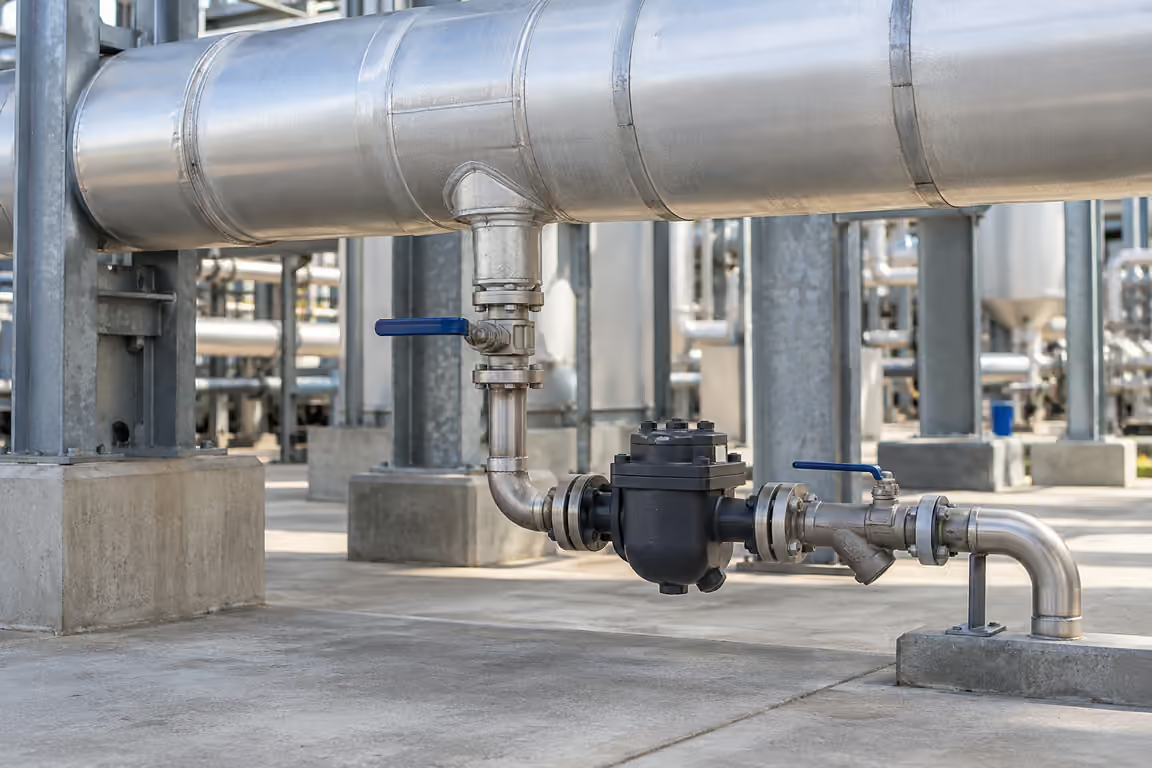
Verify the complete drainage path. Trace the approved route from each relevant collection point through its trap arrangement to the intended condensate destination. Review available drawings against the field condition, including valve line-up, supports and recent modifications. A drain connection's presence does not prove that the path is available or effective.
Maintain traps as functional equipment. Inspection should establish condition and performance using competent methods suitable for the trap and service. An overdue defect needs an explicit operating decision, owner and corrective plan; an informal assumption that the remaining traps will compensate is not assurance. Access difficulties must not silently remove an asset from the maintenance programme.
Check restart against the actual condition. Confirm that the procedure addresses the shutdown duration, equipment changes and relevant drainage requirements. Spirax Sarco's guidance distinguishes warm-up condensate loading from running loading. Readiness must therefore be assessed for the transition being attempted, rather than inferred from previous steady operation. Use installation-specific limits and hold points, not universal valve-opening rates taken from an article.
Respond to abnormal behaviour without exposure. Unexpected banging, pipe movement or loss of drainage should trigger the approved response and escalation. Do not repeatedly cycle valves to investigate or continue until the sound disappears. If hammer has occurred, competent assessment should determine whether pressure-boundary components and supports need inspection before further use.
Leadership: make the utility boundary visible
A useful management review connects steam-trap defects, restart problems and repeat hammer reports. Ask whether the same branch is repeatedly restored through operator experience instead of a durable correction. The accountable owner should be clear across operations, maintenance and integrity teams, particularly where the steam supply and process consumer have different custodians.
After a modification, consider whether the drainage arrangement still matches the changed system. Review consequences for neighbouring equipment and people, not only the affected heater's availability. Provide time for field verification and record what demonstrates readiness. These are suggested learning actions, not a claim that one legal standard applies to every offshore installation.
Three practical actions for today
- Select one intermittently used steam branch and confirm its collection points and approved condensate destination.
- Review its trap defects, maintenance evidence and restart hold points with the responsible operations and integrity personnel.
- Report recurring hammer or uncertain drainage as a pressure-boundary concern, and resolve it before the next authorised restart.
Directly relevant technical video
TLV's official technical webinar explains steam-system water-hammer mechanisms and mitigation. This is technical training, not footage of the hypothetical offshore example. View the webinar on TLV's official website. If embedded playback is unavailable, use that source link.
Team discussion question
Which steam branch on our installation has the least reliable evidence of effective drainage—and what must be verified before its next restart?
Continue the learning
Compare this rapid-condensation mechanism with trapped-liquid thermal expansion, and review why startup is a controlled operation. For intervention on pressure equipment, revisit verified isolation.
Verified primary and technical sources
Sources checked on 14 October 2026. General learning does not replace approved site procedures, competent engineering advice or applicable local requirements.
Your experience matters
Share your thoughts on this page
Have a question, a useful experience or a suggestion? Add your input below.
Comments are public. Keep them respectful and relevant. Do not share contact details, confidential information or emergency reports.
Comments on this page
Loading comments…