Process Safety · Lesson 38 · 8 min read
A Small-Bore Branch Can Fail Under Repeated Vibration
A short branch carrying a gauge, drain valve or level instrument is part of the pressure boundary. Its small diameter does not limit the consequences of a release. Repeated vibration can damage a connection while the main equipment continues operating, so a familiar installation still needs an appropriate integrity assessment.

The hazard mechanism: repeated loading, not only pressure
Pipework vibration produces changing stresses. Fatigue cracks can initiate or grow under repeated loading until they penetrate the wall and release the contents. The UK Onshore Pipeline Operators’ Association identifies vulnerable arrangements such as long unsupported branches and a relatively large mass carried at the end of a small connection. Its guide also distinguishes fatigue from fretting, where repeated relative movement between contacting surfaces removes material. [1]
This is why a static pressure rating is not a complete answer to vibration risk. The operating assembly includes the connection, attached equipment, supports and excitation from the surrounding system. The same pressure-rated component can behave differently after its arrangement changes. A practical assessment must consider the installed system, not just the fitting’s catalogue description.
Official offshore learning: a small nipple, a platform response
BSEE Safety Alert 502, issued on 10 June 2025, describes an offshore gas release following failure of a threaded three-quarter-inch nipple connected to a compressor suction scrubber. The platform was shut in and personnel mustered. No injuries or significant equipment damage were reported. [2]
BSEE identified fatigue cracking consistent with mechanical stress and cyclic loading in a high-vibration environment. Its discussion included possible installation over-tightening, vibration, unsupported bridle weight and loosening. These were qualified contributing factors, not proof that every similar connection will fail in the same way. The alert recommends suitable support, correct tightening, inspection, vibration monitoring and maintained dampers. The wider lesson is to protect small pressure-containing connections as deliberately as the machinery beside them.
Look beyond a normal machinery vibration reading
Wood’s original small-bore assessment guidance explains that local branch resonance can amplify the response even when vibration on the main pipe appears acceptable. It also distinguishes a branch-integrity engineering assessment from routine machinery condition monitoring aimed at bearings. A satisfactory machinery route reading therefore cannot automatically close a piping-fatigue concern. [3]
Ask what was measured, where, under which operating condition and for what purpose. Evidence suited to one question may not answer another. Avoid applying an unverified universal vibration limit: acceptance depends on a suitable method, the installation and competent interpretation. A safe-looking photograph or a single overall reading does not establish remaining fatigue life.
Include changing operating conditions
BETA Machinery Analysis, now part of Wood’s vibration business, published field learning on transient conditions in small-bore piping. It identifies startup, shutdown and temporary control-valve conditions as situations that steady-state checks can miss. Its example showed a different response during transients than during stable operation. Do not transfer that example’s plotted screening value to another installation. [4]
For an offshore team, this means defining an assessment scope that represents the credible operating envelope. Record the relevant equipment state, operating mode and process conditions when reporting a concern. Do not deliberately reproduce a potentially damaging condition merely to obtain a measurement. Operations and the responsible specialists should agree any testing and its safeguards.
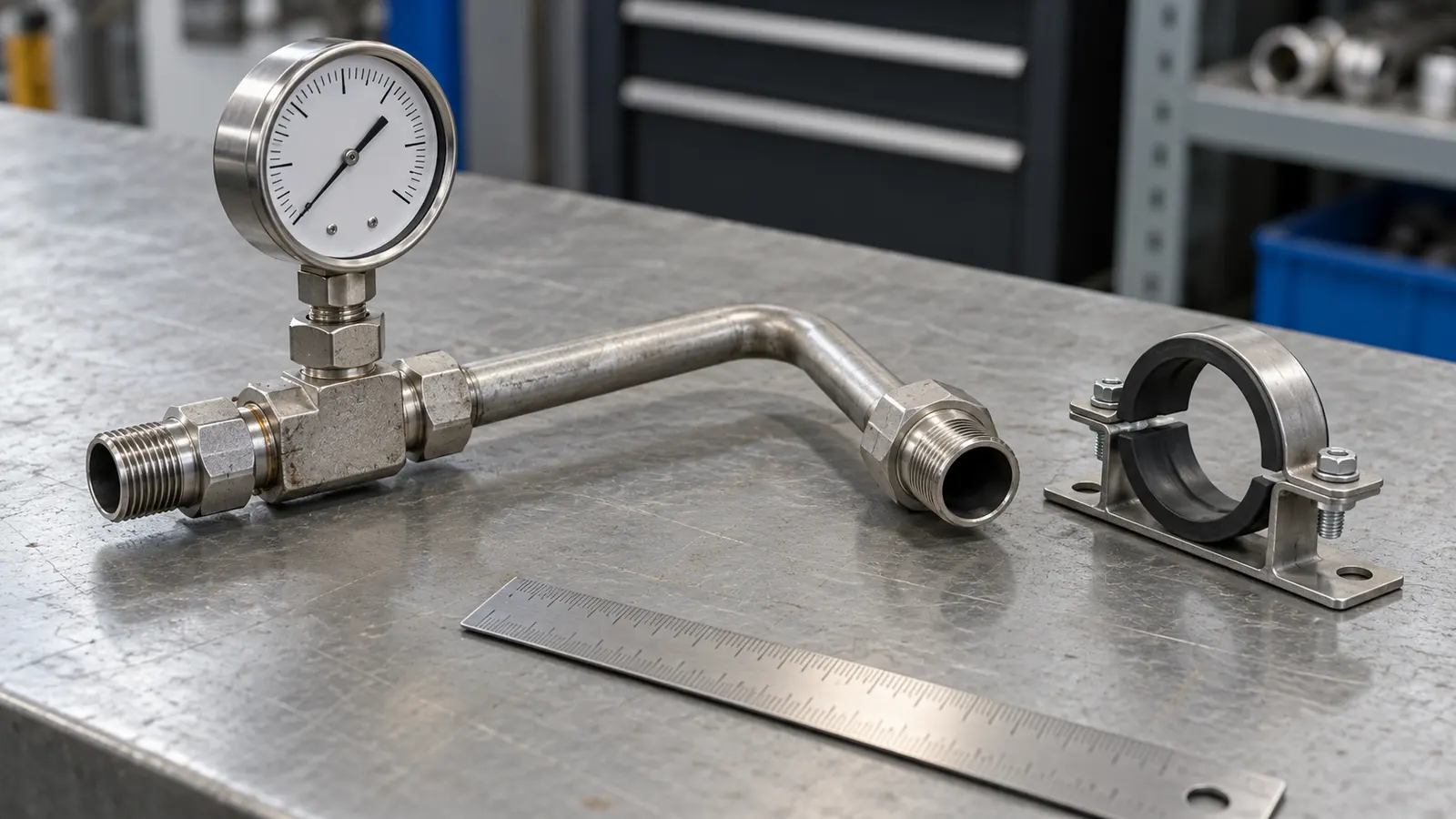
Hypothetical FPSO example: a replacement changes the assembly
Hypothetical example—not a documented incident: During a walkdown, an operator notices a small instrument branch moving differently when a compressor changes operating mode. A recently fitted instrument is heavier than the previous unit. The work record confirms its pressure suitability, but does not show whether the changed mass and installed support arrangement were assessed.
The operator reports the location and operating condition from a safe position, without touching or restraining the moving branch. The supervisor follows the installation’s approved response and obtains integrity advice. The team reviews the modification, checks the as-installed arrangement and agrees the necessary assessment before treating the issue as closed.
The example does not prescribe a shutdown threshold or a particular brace. Its decision point is the missing dynamic assessment. A cable tie that makes movement less visible would not provide evidence that fatigue risk had been resolved.
Critical controls and leadership actions
The Energy Institute’s original guidance summary describes a staged approach: identify potential excitation mechanisms, prioritise systems, assess higher-risk locations and refine the assessment with inspection and measurement. It applies the approach to new designs, existing plant, changes and identified operating problems. That is a useful management framework, not a substitute for the complete guidance or specialist judgement. [5]
Leaders should make responsibility clear between machinery, piping, instrumentation and operations teams. A small branch can sit between those disciplines and escape ownership. Include changes in instrument weight, geometry and support arrangements in the appropriate technical review. Close actions on accepted evidence and as-built condition, rather than on the fact that a replacement has been installed.
UKOPA warns that an absence of obvious vibration does not necessarily demonstrate low fatigue risk. It also identifies inappropriate temporary bracing and damaged or missing supports as concerns. Do not improvise a support on live equipment: the intended load path and movement need engineering consideration. [1]
Three practical actions
- Identify: select vulnerable pressure-containing branches and record changed instruments, support defects or unexpected movement from a safe position.
- Assess: obtain the right piping-integrity review, including relevant operating modes; do not rely only on machinery bearing-monitoring results.
- Verify: confirm authorised corrective work, inspection acceptance and updated records before closing the concern.
Technical video
Wood’s first-party technical resource links to Small Bore Piping Examples, published by its Vibration, dynamics and noise channel. These are technical examples, not footage of the BSEE incident. Use them to discuss branch response—not to select a support design or operating limit. View the publisher’s source page.
Takeaway and team discussion
Key takeaway: a small-bore branch remains a major-hazard pressure boundary; verify its response to repeated loading, not only its pressure rating.
Discussion question: which small connection has changed in weight, geometry or support without clear evidence that vibration-fatigue risk was reviewed?
Continue in the Process Safety hub, and connect this lesson with mechanical integrity and management of change.
Verified primary references
- UKOPA: Management of Pipework Vibration, GPG/030, edition 1—fatigue, vulnerable connections, assessment and supports.
- BSEE Safety Alert 502, 10 June 2025—official alert and linked investigation-learning PDF.
- Wood: Small-Bore Connections Assessment—local response and assessment scope; first-party technical guidance.
- BETA Machinery Analysis/Wood: Transient Conditions on Small Bore Piping—original field-learning note.
- Energy Institute: Guidelines for the avoidance of vibration induced fatigue failure in process pipework, second-edition introductory extract and summary, January 2008.
Published and sources checked 20 October 2026. Educational discussion only: apply approved installation procedures, appropriate engineering assessment and applicable requirements. No universal vibration acceptance limit or permission to modify live equipment is supplied.
Your experience matters
Share your thoughts on this page
Have a question, a useful experience or a suggestion? Add your input below.
Comments are public. Keep them respectful and relevant. Do not share contact details, confidential information or emergency reports.
Comments on this page
Loading comments…