Safety · Excavation and Contractor Coordination
One Excavation, Several Employers: Engineering and Inspections Need Clear Ownership
Published
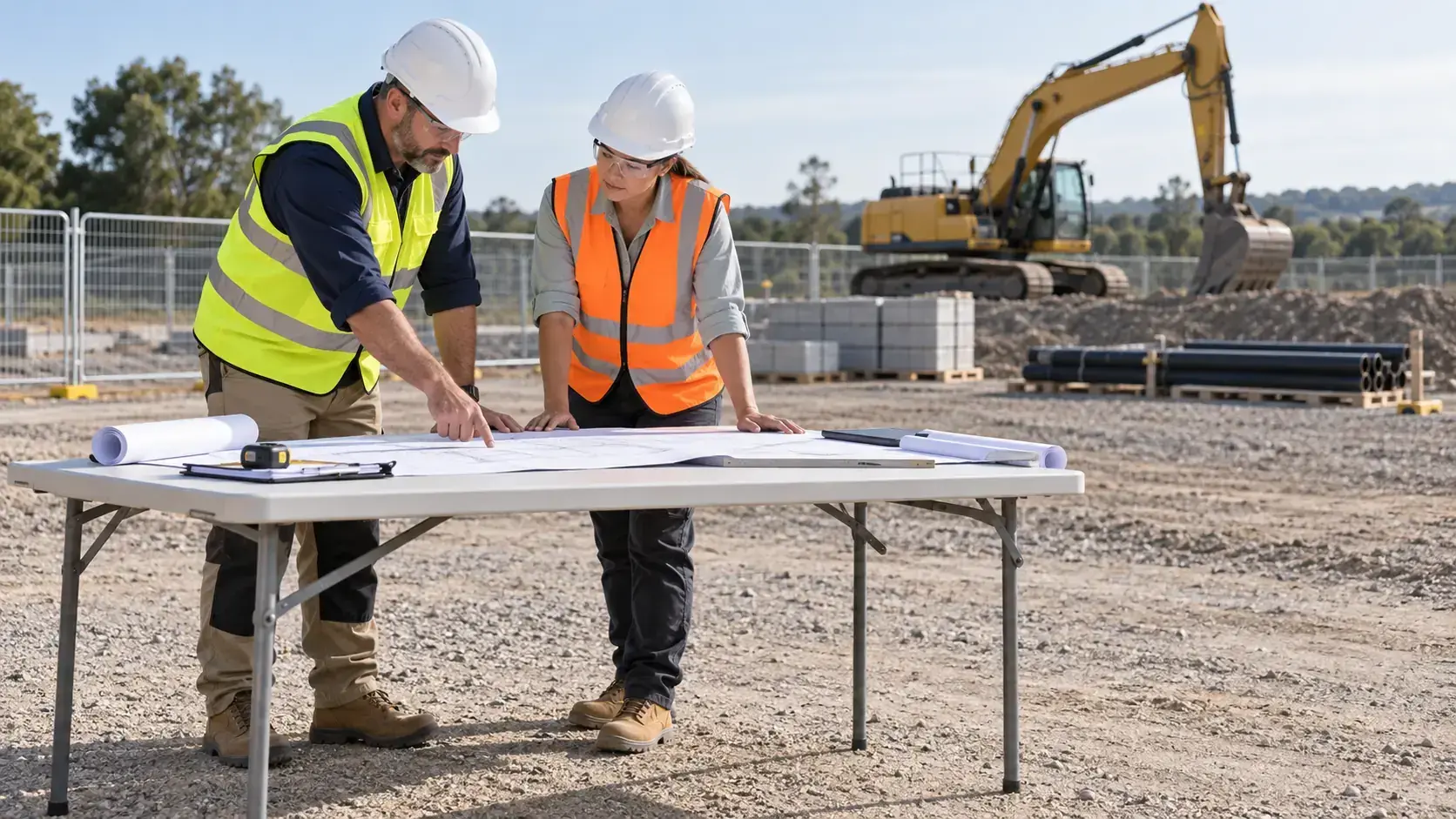
At a shared excavation, every employer needs to know what protects its people. An engineering drawing, an inspection and a contractor briefing perform different jobs. None should disappear into an assumption that another company has dealt with the risk.
What OSHA reported—and what remains proposed
OSHA reported citations involving six construction employers at Monroe Commons, also called Magna Square, in Monroe, New York. The agency described an unstable embankment nearly 75 feet high, inadequate protection, missing competent-person inspections and engineering failures. It proposed combined penalties of $648,094.
Date and status matter: the release body says 13 October 2026, while OSHA’s news index places it under 16 October. It does not give an exact field-inspection date. This is an enforcement report, not a claim that a collapse occurred today. The citations and penalties are proposed, not a final adjudicated outcome; employers may contest them. Read the primary OSHA account.
Why a shared site needs explicit responsibilities
OSHA’s existing Multi-Employer Citation Policy distinguishes creating, exposing, correcting and controlling employers. More than one employer can be cited, depending on the facts and applicable duties. Those roles do not create identical obligations for every contractor, and a contract label alone does not settle the analysis.
The practical application is to replace “the groundworks team handles that” with a named, evidenced arrangement. Before a new trade enters the work area, ask its supervisor to explain the protection, its limitations and the escalation route. If that explanation conflicts with the project team’s account, resolve the difference before exposure.
Separate engineering assurance from the daily inspection
The existing US protective-systems standard provides design and selection routes, including written engineered designs and the limits of approved data. It also requires systems to withstand reasonably expected loads. A generic trench-safety checklist is not a substitute for establishing the correct design basis.
For a project review, request the current authorised design information, identify who controls revisions and check how the actual work is compared with it. Ask the responsible engineering team which changes require referral. Do not derive a slope, support spacing or allowable loading from this article or its illustrative image.
A competent-person inspection asks a different question: are conditions safe for the work now? It does not make an unsuitable design acceptable. Equally, an approved design does not guarantee that the installed arrangement or changing ground conditions remain within its assumptions.
Make inspection findings change the work
Under 1926.651(k), inspections are required before work, as needed during the shift and after rainstorms or other hazard-increasing events when employee exposure can reasonably be anticipated. If hazardous conditions are identified, exposed employees must be removed until necessary precautions have been taken.
The assurance question is therefore not just “Is the form signed?” Ask what was observed, what changed and how the decision reached each affected crew. A defect that sits in one employer’s notebook while another employer continues working is a coordination failure waiting to happen.
Build a short responsibility handover
The following is an original planning framework, not a legal allocation of duties or an excavation method:
- Design: name the person who confirms that the proposed stage is covered by the authorised information.
- Inspection: identify the competent person, availability and arrangements when conditions change.
- Interfaces: agree how plant movement, deliveries, adjacent work and access changes reach the responsible team.
- Stop and restart: explain who excludes people, who resolves the issue and what evidence permits a restart.
- Incoming trades: brief each employer before its people enter—not after a problem is noticed.
Keep this handover connected to the real location and stage of work. Use a drawing reference and a clear description of the authorised activity rather than a broad statement that “excavations are covered.” Where the team cannot answer a question, record the gap and obtain competent resolution.
Questions for leaders and toolbox talks
- Can each contractor explain the protection without relying on an unnamed person?
- Which current design or approved data covers this stage and its actual conditions?
- How does an inspection finding reach every affected employer?
- What change would stop today’s work and trigger engineering review?
- Can workers report uncertainty without being asked to enter and investigate?
Official video: Trench Safety Can Save Lives
Publisher: USDepartmentofLabor. This general trench-safety video is linked by OSHA and provides a short briefing aid. It is not footage of this case, a deep-excavation design or a replacement for site-specific instruction.
Watch the verified official video directly. US requirements have their own scope; apply the law and competent engineering advice relevant to your project. The review prompts above are learning applications, not additional findings about the employers.
Primary sources and dates
- OSHA — Six construction employers cited at Monroe excavation ↗Release body dated 13 October 2026; news index lists it under 16 October. Proposed citations and penalties; exact inspection date not stated in the release.
- OSHA — News release index ↗Checked 17 October 2026 to distinguish the index date from the date printed in the release.
- OSHA — Multi-Employer Citation Policy, CPL 02-00-124 ↗Existing enforcement policy, effective 10 December 1999; not a new regulation.
- OSHA — 1926.651, Specific excavation requirements ↗Existing US construction standard; see inspection and removal-from-danger requirements in paragraph (k).
- OSHA — 1926.652, Protective systems ↗Existing US construction standard; selection, design and use of protective systems.
- OSHA — Trenching and excavation safety ↗Supporting guidance and link to the official Department of Labor video.
- USDepartmentofLabor — Trench Safety Can Save Lives ↗Official publisher, exact title and embedding availability checked through YouTube oEmbed on 17 October 2026.
Sources checked 17 October 2026. Supporting guidance is distinguished from the new development.
Share the lesson
Open the separate 9:16 Pinterest poster
The poster is a fictional AI-generated planning illustration, not an actual incident, approved design or verified product formulation. HSSE TIPS branding appears only in the designed footer.
Your experience matters
Share your thoughts on this page
Have a question, a useful experience or a suggestion? Add your input below.
Comments are public. Keep them respectful and relevant. Do not share contact details, confidential information or emergency reports.
Comments on this page
Loading comments…